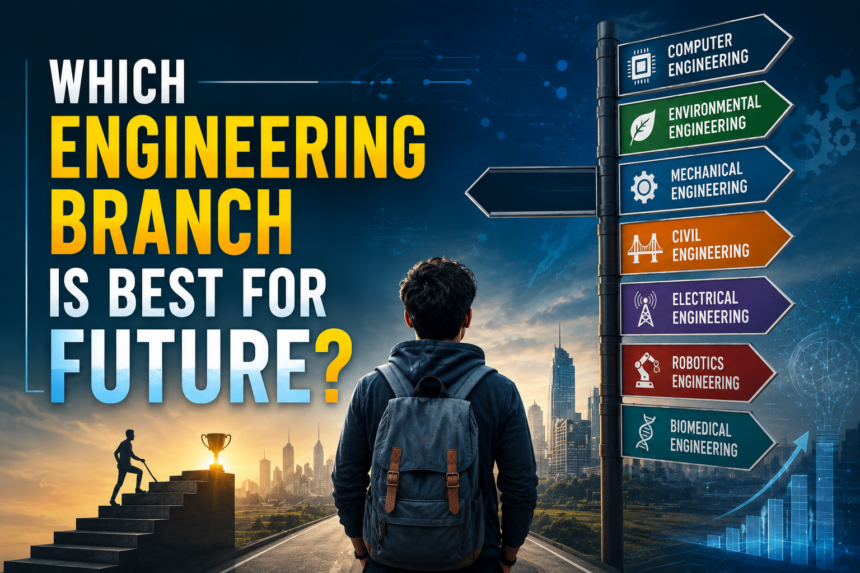
Confused about which engineering branch is best for future? Here is your answer without wasting your time. Computer Science, AI and Data Science, and Electronics are the top three branches right now. They offer the highest salaries, the most job openings, and the fastest career growth in India and abroad. If you are in Class 12 or just filled your JEE form, this guide will help you decide clearly.
Choosing the wrong branch is one of the biggest career mistakes Indian students make. Your four years, your fees, your future job, everything depends on this one decision. So let us break it down simply.
Why Choosing the Right Engineering Branch Matters in India

India produces over 15 lakh engineering graduates every year. But not all of them get good jobs. The ones who do? They almost always come from branches that match what the industry actually needs.
The Indian tech industry is growing fast. Sectors like AI, cybersecurity, green energy, and semiconductors are booming. At the same time, some older branches are seeing fewer job openings in the private sector.
So picking which engineering branch is best for future is not just about passion. It is also about market demand, salary potential, and long-term stability.
According to NASSCOM’s India Technology Sector Report, India’s technology sector is expected to reach $350 billion by 2026, creating millions of new engineering jobs across software, hardware, and emerging tech domains. That is a massive opportunity if you pick the right branch now.
If you want to understand how different engineering specialisations sit within the broader landscape, the Engineering Branches in India: The Best Guide For 2026 covers every major branch with real placement data and is a great place to start your research.
Top Engineering Branches for the Future
Let us go branch by branch. No fluff, only what matters.
1. Computer Science Engineering (CSE)
This is still the king. If you want to know which engineering branch is best for future with high salary, CSE is almost always the answer.
Why? Because every industry runs on software now. Banks, hospitals, factories, farms, even the government. Everyone needs software engineers.
Average starting salary: Rs 4 LPA to Rs 12 LPA for freshers. Top product companies like Google, Microsoft, and homegrown startups pay Rs 20 LPA to Rs 50 LPA for strong candidates.
Skills that matter:
- DSA (Data Structures and Algorithms)
- System design
- Web development
- Cloud computing
CSE is also the most competitive branch. So if you get it, great. But even if you get IT or Software Engineering, the difference is minimal in terms of jobs. If you are a CSE student wondering what your four years should look like, the B Tech Computer Science and Engineering in 4 Years: Achieve Success in 2026 guide on CareerGrowKaro lays it out step by step.
2. Artificial Intelligence and Data Science (AI and DS)
This is the fastest growing branch right now. If you are asking which engineering branch is best for future in India for the next decade, AI and Data Science is your answer.
India’s AI market is expected to reach $17 billion by 2027. Companies are desperate for people who understand machine learning, data pipelines, and AI models.
The good news? This branch is now available in hundreds of colleges across India, including many Tier-2 and Tier-3 institutes. AICTE has been actively approving AI and DS programmes across the country, which shows how seriously the government is pushing this field.
Average starting salary: Rs 5 LPA to Rs 15 LPA. Senior AI engineers earn Rs 30 LPA to Rs 80 LPA.
Skills that matter:
- Python and statistics
- Machine learning and deep learning
- Tools like TensorFlow and PyTorch
- Data visualisation and SQL
One thing to remember: AI and DS requires strong mathematics. If you are comfortable with stats and logic, this branch is a goldmine. And since AI skills are now useful across every branch, reading up on AI Skills 2026: Why They Matter and How to Learn will give you a real edge no matter which branch you choose.
3. Electronics and Communication Engineering (ECE)
ECE is the branch that connects the hardware world to the software world. It is perfect if you enjoy both circuits and coding.
With India pushing hard on semiconductor manufacturing, 5G rollout, and IoT devices, ECE has seen a big comeback. Companies like Qualcomm, Intel, and homegrown firms are hiring ECE graduates actively.
Average starting salary: Rs 3.5 LPA to Rs 8 LPA. VLSI and embedded systems specialists earn Rs 10 LPA to Rs 25 LPA.
Skills that matter:
- VLSI design
- Embedded C
- Signal processing
- PCB design and IoT
If you are planning for PSU jobs or defence roles, ECE is also one of the best choices. The [India Semiconductor Mission](https://www.meit y.gov.in/india-semiconductor-mission) launched by the government is a strong signal that ECE demand will only grow in the coming years.
4. Mechanical Engineering
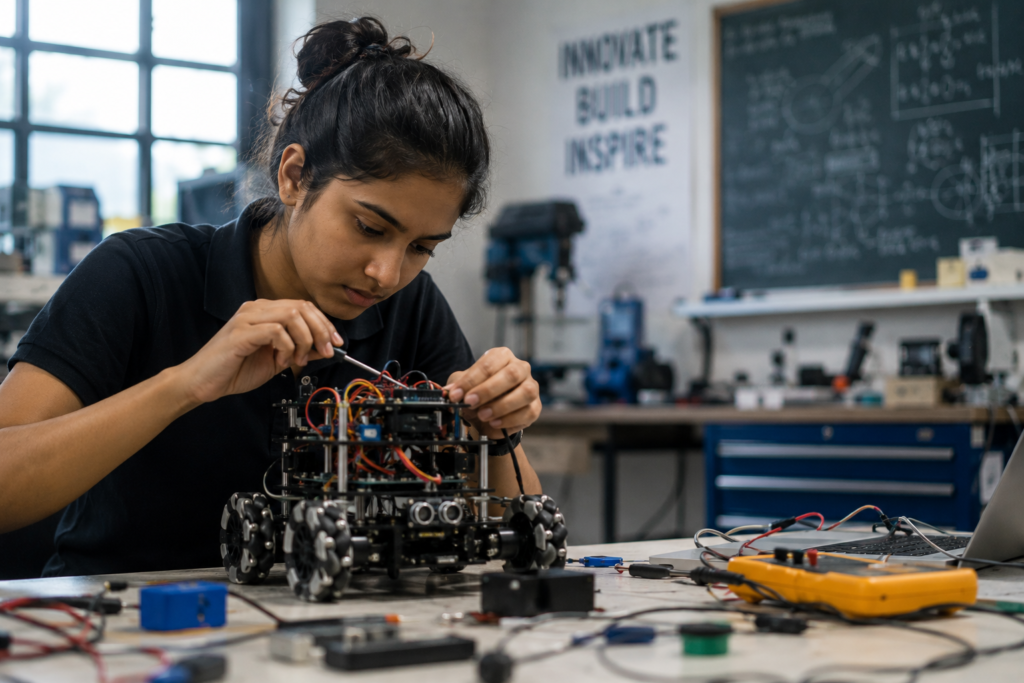
Okay, let us be honest. Mechanical engineering has faced a rough patch. But is it dead? Absolutely not.
With electric vehicles, aerospace, robotics, and advanced manufacturing growing in India, mechanical engineers who upskill in CAD, CAM, and automation are doing very well.
The key word here is upskill. A plain mechanical degree without additional skills can be tough. But combine it with robotics or EV knowledge, and you become very valuable.
Average starting salary: Rs 2.5 LPA to Rs 6 LPA. Specialists in aerospace or EV can earn Rs 10 LPA or more.
ISRO, DRDO, and large PSUs like BHEL still recruit mechanical engineers in large numbers.
5. Civil Engineering
If you want government jobs and long-term stability, civil engineering is a strong pick. Especially for students targeting GATE, SSC JE, or state PWD exams.
India is spending trillions on infrastructure. Highways, smart cities, metro rail, dams, bridges. Civil engineers are needed everywhere.
Private sector salaries are lower in civil compared to CSE. But government roles offer job security, pension, and perks that private jobs cannot match.
Average starting salary: Rs 2.5 LPA to Rs 5 LPA in private. Government roles can range from Rs 35,000 to Rs 70,000 per month.
For students aiming at civil services related roles, the Civil Engineering Govt Jobs 2026: Best Exams and Salary guide on CareerGrowKaro breaks down every major exam and salary structure clearly.
6. Electrical Engineering (EE)
Electrical engineering is quietly becoming one of the most future-proof branches. Solar energy, power grids, battery technology, and EVs all need electrical engineers.
India has set a target of 500 GW of renewable energy capacity by 2030 as part of its national energy mission. You can check the full roadmap on the Ministry of New and Renewable Energy website. That means thousands of jobs in wind, solar, and grid infrastructure over the next decade.
Average starting salary: Rs 3 LPA to Rs 7 LPA. Power sector and EV specialists earn Rs 10 LPA and above.
Which Engineering Branch is Best for Future with High Salary in India
If salary is your top priority, here is the honest ranking of which engineering branch is best for future with high salary in India:
- Computer Science Engineering
- AI and Data Science
- Electronics and Communication
- Electrical Engineering
- Mechanical Engineering (with specialisation)
- Civil Engineering (government sector)
Now the important part: salary is not just about your branch. It is about your college, your skills, your internships, and how job-ready you are before graduation.
A CSE student from a Tier-3 college who has done real projects and internships will often outpace an ECE student from a decent college who only mugged up theory.
To understand what the highest paying roles actually look like in India right now, the Best Highest Paying Jobs In India in 2026 guide gives a full picture across all fields, not just engineering.
Branch Comparison Table
| Branch | Avg Starting Salary | Govt Job Scope | Future Demand | Best For |
| CSE | Rs 4-12 LPA | Medium | Very High | Software, startups |
| AI and Data Science | Rs 5-15 LPA | Low-Medium | Very High | AI, analytics |
| ECE | Rs 3.5-8 LPA | High | High | Hardware, VLSI, PSU |
| Mechanical | Rs 2.5-6 LPA | High | Medium-High | Manufacturing, EV |
| Civil | Rs 2.5-5 LPA | Very High | High | Infra, govt jobs |
| Electrical | Rs 3-7 LPA | High | High | Energy, EV |
What About Tier-2 and Tier-3 College Students?
This is the part most blogs skip. So let us talk about it directly.
If you are in a Tier-2 or Tier-3 college, your branch matters but your skills matter more. The honest truth? Recruiters from big companies often do not visit smaller colleges. You have to go find them.
Here is what actually works:
- Build projects that solve real problems and put them on GitHub
- Get certifications from NPTEL, Coursera, or Google
- Do internships, even unpaid ones in the first year
- Learn DSA if you are in CSE. Learn VLSI if you are in ECE. Learn Revit if you are in Civil
- Start applying six months before graduation, not after
The students who crack good jobs from Tier-3 colleges are not the toppers. They are the ones who treated college like a launchpad, not a destination.
For real inspiration on what dedication and the right skills can do, read how Content Creation Made Him Unstoppable and understand that the path from a small city to a great career is very much possible.
Also check the Top IIT Colleges in India 2026: Rank Wise, Cut Off, Placements and Proven Guide to understand what top placements actually look like and what skills they demand, even if you are not in an IIT.
Emerging Branches Worth Considering

Apart from the traditional ones, here are newer branches that are answering the question of which engineering branch is best for future in fresh ways.
Cybersecurity Engineering: India faces over 1.4 million cyberattacks every year. Trained cybersecurity engineers are in massive demand. Salaries start at Rs 6 LPA and go up fast. If this direction interests you, the Is Cyber Security a Good Career? Complete Guide for Students 2026 on CareerGrowKaro is worth reading next.
Biotechnology Engineering: With India becoming a global pharma hub, biotech engineers who understand both biology and engineering are highly valued.
Environmental Engineering: Green jobs are growing fast. With India’s climate commitments and expanding ESG norms in companies, environmental engineers are getting hired by corporates and consultancies alike. The Top Environmental Science Jobs in India: Amazing Career Guide 2026 covers what is available in this growing space.
Aerospace Engineering: ISRO, private space companies like Agnikul and Skyroot, and defence PSUs are creating fresh demand. The Aeronautical Engineering Salary 2026: Best Guide to High-Paying Jobs on CareerGrowKaro gives a full picture of what this career path looks like financially.
Magic Box
Struggling to figure out which engineering branch fits your strengths and future goals?
Use CareerGrowKaro’s Career Guidance resources to map your interests to the right branch and know exactly what to do next, before your admission deadline.
FAQs
Q1. Which engineering branch is best for future in India in 2026?
Computer Science, AI and Data Science, and Electronics are the top three branches for future growth in India. They have the highest demand, best salaries, and most job openings across both private companies and startups. The right choice also depends on your interest and the kind of work you enjoy doing daily.
Q2. Which engineering branch is best for future with high salary in India?
CSE and AI and Data Science consistently offer the highest starting salaries. Top CSE graduates from good colleges earn Rs 20 LPA to Rs 50 LPA. Even from average colleges, a skilled CSE or AI graduate can expect Rs 6 LPA to Rs 12 LPA with the right projects and certifications in hand.
Q3. Is mechanical engineering still a good choice for the future?
Yes, but with a condition. If you pair mechanical engineering with skills in robotics, EV technology, or industrial automation, the scope is very strong. Plain mechanical without upskilling is where students struggle. The manufacturing and EV sectors in India are hiring mechanical engineers actively right now.
Q4. Which branch is best for government jobs in engineering?
Civil, Electrical, and Mechanical engineering have the strongest government job scope. GATE, SSC JE, and state PSC exams recruit heavily from these branches. ECE graduates also have strong PSU options through companies like BSNL, BHEL, and DRDO.
Q5. Can a student from a Tier-3 college get a good job after engineering?
Yes, absolutely. Branch matters less than skills and preparation at the end of the day. Students from Tier-3 colleges who build strong portfolios, do internships, and clear DSA or domain assessments regularly crack jobs at top companies. The playing field is more level than people think once you are job-ready.
Q6. Which new engineering branches have the best future scope?
Cybersecurity, AI and ML, Biotech Engineering, and Environmental Engineering are growing fast. These are the branches where demand is outpacing supply, which means better salaries and faster growth for early movers who start building skills today.
Conclusion
So which engineering branch is best for future? The honest answer is: it depends on what you want. But if you want high salary and maximum opportunities, go with CSE or AI and Data Science. If you want government job security, pick Civil, Electrical, or Mechanical. If you enjoy hardware and embedded systems, ECE is a great pick.
The bigger lesson? No branch can save you if you do not build real skills. And no branch will hold you back if you do.
Explore more CareerGrowKaro guides to plan your engineering career step by step, pick the right college, and start building skills from Day 1 of your college life. The students who plan early are always the ones who land the best opportunities.