

The PCS Exam is one of the most sought-after state-level competitive examinations in India. Every year, lakhs of candidates appear for the PCS exam to secure prestigious administrative positions such as Deputy Collector, Block Development Officer (BDO), District Commandant, Commercial Tax Officer, and other gazetted posts in various state government departments.
Cracking the PCS Exam requires more than just hard work. It demands a smart strategy, consistent preparation, proper time management, and regular revision. Since the syllabus is vast and competition continues to increase every year, aspirants need a structured approach from the beginning.
If you’re planning to appear for the PCS exam in 2026, this guide covers everything you need, from understanding the exam pattern to creating an effective study plan and avoiding common mistakes. Whether you’re starting your preparation or looking to improve your strategy, CareerGrowKaro brings you practical tips and expert guidance to help you prepare more effectively. With the right approach, reliable resources, and consistent effort, you can significantly improve your chances of success in the PCS Exam.
What is the PCS Exam?
The PCS Exam (Province Exam-Conducting Examination) is conducted by individual State Public Service Commissions to recruit officers for various administrative positions within the state government. Through the PCS Exam, candidates can secure prestigious roles in departments responsible for administration, revenue, law and order, and public welfare.
Some of the major PCS exam-conducting bodies include:
- UPPSC PCS (Uttar Pradesh)
- BPSC (Bihar)
- MPPSC (Madhya Pradesh)
- UKPSC (Uttarakhand)
- RPSC (Rajasthan)
- JPSC (Jharkhand)
- CGPSC (Chhattisgarh)
- HPSC (Haryana)
Although each state has slight variations in its syllabus, eligibility criteria, and exam pattern, the overall preparation strategy for the PCS Exam remains largely similar. Understanding your state’s official notification and syllabus is the first step toward effective preparation.
PCS Exam Pattern
Preliminary Examination
The preliminary PCS exam is the first stage of the selection process and acts as a screening test. Its primary purpose is to shortlist candidates for the Mains examination. Although the marks obtained in this stage generally do not contribute to the final merit list (subject to state-specific rules), clearing the prelims is mandatory to move forward.
The preliminary PCS exam usually consists of:
- General Studies Paper I
- CSAT (Civil Services Aptitude Test) – Qualifying in many states
The PCS Exam prelims mainly test a candidate’s conceptual understanding and awareness of current events. The important subjects include:
- History
- Geography
- Indian Polity
- Economy
- Environment & Ecology
- General Science
- Current Affairs
Since the paper is objective in nature, candidates should focus on improving both accuracy and speed. Regular mock tests, previous year question papers, and daily current affairs revision can significantly improve performance in the preliminary PCS exam.
Mains Examination
The Mains PCS Exam is the most important stage of the recruitment process because its marks play a major role in determining the final merit list. Unlike the prelims, the mains consist of descriptive papers that assess not only your knowledge but also your ability to present ideas clearly, logically, and within a limited time.
Common papers generally include:
- Essay
- General Hindi (or regional language)
- General Studies
- Optional Subject (depending on the state)
- General Knowledge
Success in the PCS Exam mains depends heavily on answer writing practice. Candidates should learn to structure their answers with clear introductions, subheadings, relevant examples, facts, and concise conclusions. Regular revision, note-making, and writing timed mock tests are essential for scoring well. Developing analytical thinking and improving presentation skills can make a noticeable difference in the Mains PCS Exam.
Interview
Candidates who successfully clear the Mains PCS exam are invited for the final stage, the personality test or interview. This stage is not merely a question-and-answer session; it evaluates whether a candidate possesses the qualities required to serve as a responsible civil servant.
The interview panel assesses the following:
- Communication skills
- Decision-making ability
- Administrative aptitude
- Awareness of current affairs
- Confidence
- Leadership qualities
- Presence of mind
- Ethical values and integrity
Questions are often based on your educational background, work experience (if any), hobbies, current affairs, and issues related to your state. The panel looks for balanced opinions, honesty, confidence, and a practical approach to solving problems rather than memorized answers.
Performing well in the final stage of the PCS exam can significantly improve your overall rank and increase your chances of securing your preferred administrative post. Staying updated with current affairs, practicing mock interviews, and improving communication skills can greatly enhance your interview performance.
PCS Exam Syllabus
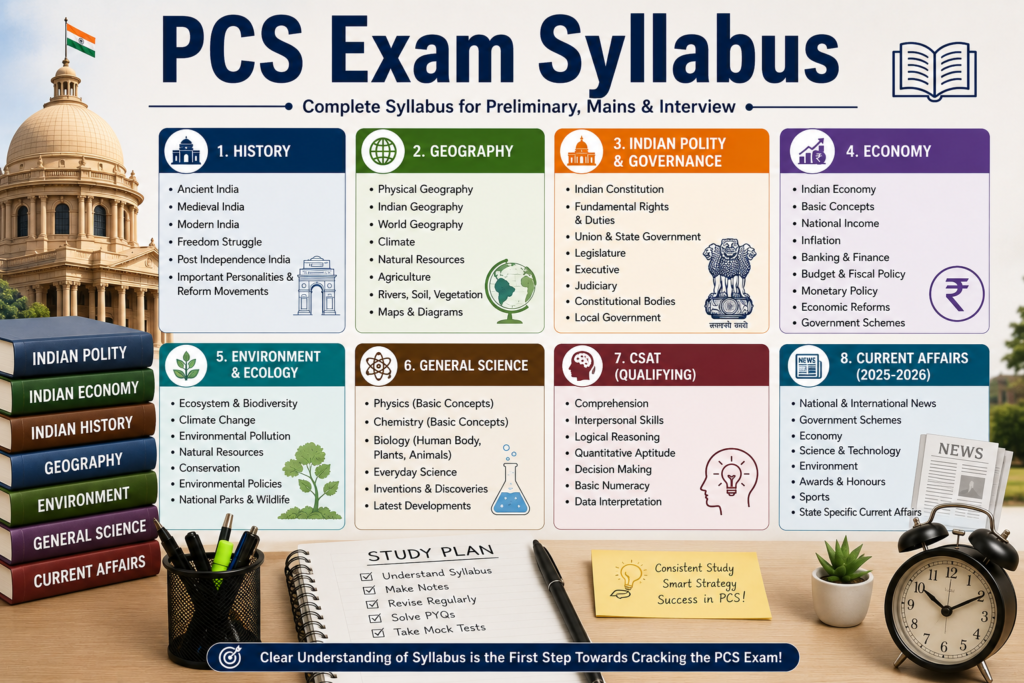
The PCS Exam syllabus is extensive and covers a wide range of subjects that test a candidate’s knowledge, analytical ability, and awareness of national as well as state-level issues. While the exact syllabus may vary slightly across different State Public Service Commissions, the core subjects remain largely the same. Understanding these subjects thoroughly is the first step toward effective PCS exam preparation.
1. History
History is an important component of the PCS syllabus. Questions are generally asked from ancient, medieval, and modern Indian history, with a greater emphasis on the Indian Freedom Struggle.
Key topics include:
- Ancient Indian Civilization
- Medieval India
- Modern Indian History
- Revolt of 1857
- Indian National Movement
- Important personalities and reform movements
2. Geography
Geography tests your understanding of both physical and human geography, along with state-specific geographical features.
Focus on:
- Physical Geography of India and the World
- Indian Rivers and Mountains
- Climate and Natural Vegetation
- Agriculture
- Mineral Resources
- State Geography
3. Indian Polity and Governance
This section evaluates your understanding of the Constitution and the functioning of the Indian political system.
Important topics are:
- Indian Constitution
- Fundamental Rights and Duties
- Directive Principles
- Parliament and State Legislature
- Judiciary
- Panchayati Raj
- Constitutional Bodies
4. Economy
The economy section assesses your knowledge of basic economic concepts and recent economic developments.
Prepare topics like:
- Indian Economy
- Economic Planning
- Inflation
- Banking System
- Budget and Economic Survey
- Government Schemes
- Sustainable Development
5. Environment and Ecology
Environmental issues have become increasingly important in the PCS Exam, especially with the growing focus on climate change and conservation.
Important topics include:
- Biodiversity
- Climate Change
- Environmental Pollution
- Wildlife Conservation
- National Parks and Biosphere Reserves
- Environmental Laws
6. General Science and Technology
Questions in this section are generally based on everyday science and recent technological developments.
Study topics such as:
- Physics
- Chemistry
- Biology
- Space Technology
- Biotechnology
- Information Technology
- Scientific Innovations
7. Current Affairs
Current affairs are relevant across every stage of the PCS exam. Regular newspaper reading and monthly revision are essential.
Focus on:
- National News
- International Events
- Government Policies
- Awards and Honours
- Sports
- Science and Technology
- Economy
- Important Reports and Indices
8. State-Specific General Knowledge
Every PCS exam gives considerable importance to state-related topics. Candidates should prepare these areas thoroughly.
Key areas include:
- State History
- Culture and Heritage
- Economy
- Geography
- Government Schemes
- Important Personalities
- Current State Affairs
Choose the Right Books for the PCS Exam
Selecting the right study material is crucial for effective PCS exam preparation. One of the most common mistakes aspirants make is collecting too many books for the same subject. Instead of improving preparation, this often leads to confusion, information overload, and insufficient revision. For the PCS Exam, it is always better to rely on a few standard books, understand them thoroughly, and revise them multiple times.
Below are some of the most recommended resources for PCS preparation.
| Subject | Recommended Books |
| History | NCERT History Books (Classes 6–12) + Spectrum Modern History by Rajiv Ahir |
| Geography | NCERT Geography Books (Classes 6–12) + Certificate Physical and Human Geography by G.C. Leong + Oxford School Atlas |
| Indian Polity | Indian Polity by M. Laxmikanth |
| Economy | NCERT Economics Books (Classes 9–12) + Indian Economy by Ramesh Singh |
| Environment & Ecology | Shankar IAS Environment |
| General Science | NCERT Science Books (Classes 6–10) |
| Current Affairs | The Hindu or The Indian Express + Monthly Current Affairs Magazine (Vision IAS/Drishti IAS/State-specific magazine) |
| CSAT | CSAT Manual by Tata McGraw-Hill or Arihant CSAT Guide |
| State-Specific GK | State Board Books + Official State Government Publications + State GK Books by Lucent/Arihant (as applicable) |
One of the golden rules for cracking the PCS Exam is to revise the same books multiple times instead of purchasing new resources every month. Strong command over a limited number of trusted books is far more beneficial than reading several books only once.
Follow these tips:
- Stick to one standard book for each subject.
- Make concise notes during your first reading.
- Revise regularly instead of switching resources.
- Solve previous year’s questions after completing each subject.
- Use mock tests to evaluate your preparation.
Consistent revision, combined with quality study material, is one of the most effective strategies for succeeding in the PCS Exam.
Revision Strategy for PCS Exam
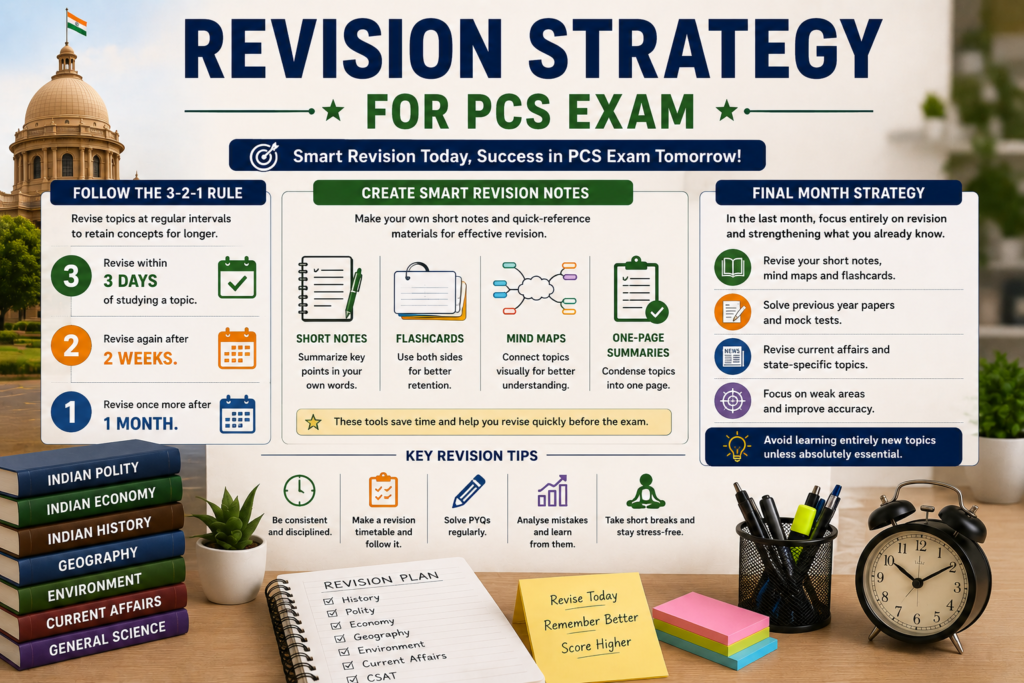
Revision is one of the most important aspects of PCS exam preparation. No matter how many books you study, your performance in the PCS exam depends on how well you retain and recall information during the exam. A well-planned revision strategy helps strengthen concepts, improve memory, and boost confidence before every stage of the PCS exam.
1. Follow the 3-2-1 revision rule.
A simple yet effective way to retain information is by following the 3-2-1 revision rule. Instead of revising everything at the end, review topics at regular intervals.
Revision schedule:
- Revise within 3 days of studying a topic.
- Revise again after 2 weeks.
- Revise once more after 1 month.
This spaced revision technique improves long-term retention and ensures you remember important concepts during the PCS exam.
2. Prepare Smart Revision Notes
Creating concise revision material makes last-minute preparation much easier. Instead of revisiting entire textbooks, rely on self-made notes that highlight key concepts and facts.
Useful revision resources include:
- Short notes
- Flashcards
- Mind maps
- One-page summaries
- Formula sheets (for CSAT and aptitude topics)
These quick-reference materials save time and make PCS exam revision more effective.
3. Focus on Regular Revision Instead of New Topics
Many aspirants make the mistake of constantly switching between new books and resources. Instead, revise what you’ve already studied multiple times. Consistent revision is far more beneficial than reading new material without retaining it.
During revision:
- Revisit important concepts and facts.
- Solve previous year’s question papers.
- Attempt sectional and full-length mock tests.
- Analyze mistakes and revise weak areas.
This approach helps reinforce your preparation for the PCS exam and improves your overall accuracy.
4. Final Month Revision Strategy
The last month before the PCS exam should be dedicated almost entirely to revision. Avoid learning completely new topics unless they are highly important or frequently asked.
In the final month, prioritize:
- Revising short notes and mind maps.
- Solving mock tests under exam conditions.
- Practicing previous year papers.
- Revising current affairs and state-specific topics.
- Strengthening weak subjects.
Following a disciplined revision schedule in the final weeks can significantly improve your confidence and performance in the PCS exam.
Conclusion
Cracking the PCS Exam in 2026 is achievable with the right strategy, consistent effort, and disciplined preparation. Instead of relying on multiple resources, focus on understanding the syllabus, building strong concepts, revising regularly, and practicing mock tests and previous year papers. A well-planned approach to PCS Exam preparation, combined with effective time management and answer-writing practice, can significantly improve your chances of success.
Remember that success in the PCS Exam is not about studying for long hours but about studying smart and staying consistent throughout your preparation journey. If you’re looking for expert career guidance, competitive exam strategies, and reliable preparation resources, CareerGrowKaro can help you stay informed and motivated at every step. Stay focused, trust your preparation, and keep learning consistently, and the results will follow.
FAQs
1. What is the PCS Exam?
The PCS Exam (Provincial Civil Services Examination) is a state-level competitive exam conducted by State Public Service Commissions to recruit officers for administrative and other government departments.
2. Who is eligible to apply for the PCS Exam?
Eligibility for the PCS Exam varies by state, but candidates generally need a bachelor’s degree from a recognized university and must meet the age criteria specified by the respective State Public Service Commission.
3. How many hours should I study daily for the PCS Exam?
Most aspirants should aim for 6–8 focused study hours per day. Consistency, regular revision, and mock test practice are more important than studying for excessively long hours.
4. Is coaching necessary to crack the PCS exam?
No. Many candidates successfully crack the PCS exam through self-study. A clear understanding of the syllabus, quality study material, regular revision, answer-writing practice, and mock tests are often sufficient for success.
5. How important are current affairs for the PCS Exam?
Current affairs are extremely important, as they are asked in the preliminary exam, mains, and interview. Reading a newspaper daily and revising monthly current affairs compilations should be an essential part of your PCS exam preparation.