

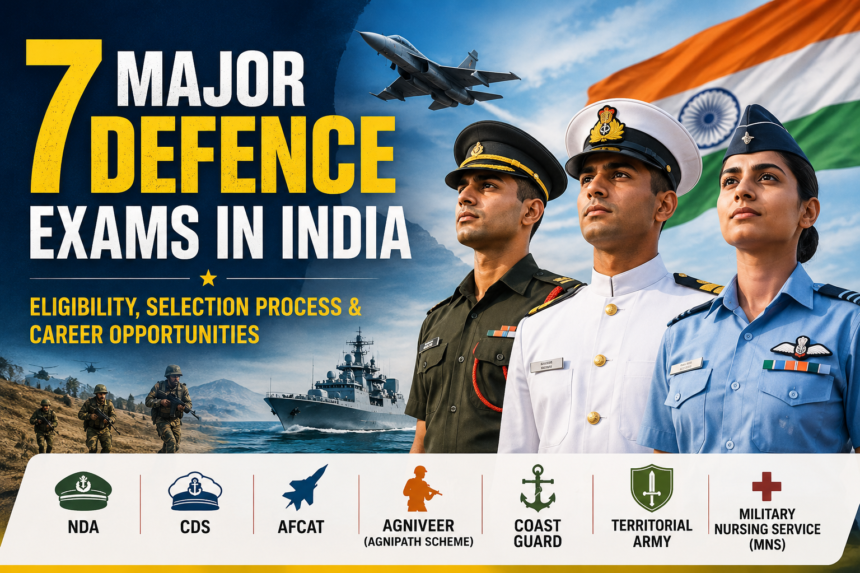
A career in the Indian Armed Forces continues to inspire thousands of young aspirants who dream of serving the nation with pride, discipline, and courage. The first step towards achieving this goal is clearing the right Defence exams, which open the doors to prestigious roles in the Indian Army, Navy, Air Force, and other defence organizations. Whether you have completed Class 12, graduation, or engineering, there are several Defence exams designed for different educational qualifications and career aspirations.
Choosing the right exam is essential to begin your journey in the armed forces. In this comprehensive guide, we will explore the major Defence exams in India, including their eligibility criteria, selection process, and career opportunities. We will also help you understand which Defence exams best match your qualifications and future goals. At CareerGrowKaro, we aim to simplify your preparation journey by providing reliable career guidance and exam-related insights to help you move one step closer to serving the nation.
Major Defence Exams in India
India offers multiple Defence exams for candidates who wish to build a career in the armed forces. Whether you have completed Class 12, graduation, or an engineering degree, there are Defence exams tailored to different educational qualifications and career goals. Each exam has its own eligibility criteria, selection process, and training pathway. Understanding these Defence exams will help you choose the right opportunity based on your aspirations. Below are some of the most popular Defence exams in India that lead to rewarding careers in the Indian Army, Indian Navy, Indian Air Force, and other defence organizations.
1. National Defence Academy (NDA)
The National Defence Academy (NDA) examination is one of the most prestigious Defence exams in India. Conducted twice a year by the Union Public Service Commission (UPSC), it offers candidates the opportunity to become commissioned officers in the Indian Army, Navy, and Air Force after completing Class 12.
Conducting Body
- Union Public Service Commission (UPSC)
Who Can Apply?
- Students who have passed or are appearing for Class 12.
- Candidates applying for the Air Force and Navy wings must have studied physics and mathematics in Class 12.
Eligibility
- Must meet the age criteria specified in the official notification.
- Both male and female candidates can apply, subject to the latest recruitment guidelines.
- Candidates must meet the prescribed physical and medical standards.
Selection Process
- UPSC Written Examination
- Services Selection Board (SSB) Interview
- Medical Examination
- Final Merit List
Career Opportunities
Selected candidates receive training at the National Defence Academy and later join the Indian Army, Navy, or Air Force as commissioned officers.
2. Combined Defence Services (CDS)
The Combined Defence Services (CDS) Examination is among the most sought-after Defence exams for graduates. Conducted by UPSC twice every year, it recruits officers for various prestigious military academies.
Conducting Body
- Union Public Service Commission (UPSC)
Eligibility
- Bachelor’s degree from a recognized university.
- Engineering degree for certain entries.
- Educational requirements vary depending on the academy.
Academies Under CDS
- Indian Military Academy (IMA)
- Indian Naval Academy (INA)
- Air Force Academy (AFA)
- Officers Training Academy (OTA)
Selection Process
- Written Examination
- SSB Interview
- Medical Examination
- Final Merit List
Career Prospects
Candidates are commissioned as officers in the Indian Armed Forces and enjoy excellent career growth, leadership opportunities, and attractive benefits.
3. Air Force Common Admission Test (AFCAT)
AFCAT is one of the leading Defence exams conducted by the Indian Air Force for recruiting officers into different branches.
Conducting Body
- Indian Air Force
Branches Recruited
- Flying Branch
- Ground Duty (Technical)
- Ground Duty (Non-Technical)
Eligibility
- Graduation or engineering, depending on the branch.
- Candidates must satisfy the age and educational requirements mentioned in the official notification.
Selection Process
- AFCAT Written Examination
- Air Force Selection Board (AFSB) Interview
- Medical Examination
Benefits
Successful candidates receive officer training, competitive salary packages, allowances, medical facilities, and opportunities for professional growth.
4. Agniveer Recruitment (Agnipath Scheme)
The Agniveer recruitment under the Agnipath Scheme is one of the latest Defence exams and recruitment processes introduced for young aspirants wishing to serve in the armed forces.
The Agnipath Scheme recruits candidates for a fixed tenure in the Army, Navy, and Air Force.
Army, Navy & Air Force Entries
- Indian Army Agniveer
- Indian Navy Agniveer
- Indian Air Force Agniveer
Eligibility
- Educational qualifications vary depending on the post.
- Candidates must satisfy the prescribed age, medical, and physical fitness standards.
Selection Stages
- Online Written Examination (where applicable)
- Physical Fitness Test
- Physical Measurement Test
- Medical Examination
- Document Verification
Career Pathway
Selected candidates serve as Agniveers and may receive opportunities for further career advancement as per government policies.
5. Indian Coast Guard Recruitment
The Indian Coast Guard conducts recruitment for several officer and sailor-level positions to safeguard India’s maritime interests.
Assistant Commandant
- Officer-level entry for graduates with leadership responsibilities.
Eligibility
Eligibility varies according to the post and recruitment notification, including educational qualifications, age, and medical standards.
Selection Process
- Written Examination
- Physical Fitness Test
- Medical Examination
- Document Verification
- Merit List
6. Territorial Army Examination
The Territorial Army offers an excellent opportunity for employed individuals who wish to serve the nation while continuing their civilian professions.
Who Can Apply?
- Gainfully employed Indian citizens.
- Graduates who meet the prescribed eligibility conditions.
Eligibility
- Bachelor’s degree from a recognized university.
- Must satisfy the required age and medical standards.
Selection Process
- Written Examination
- Preliminary Interview Board
- Services Selection Board (SSB)
- Medical Examination
Advantages for Working Professionals
- Opportunity to serve without leaving a full-time civilian career.
- Leadership training and military experience.
- Prestigious service to the nation alongside professional growth.
7. Military Nursing Service (MNS) Entrance
The Military Nursing Service (MNS) provides an excellent career option for candidates interested in healthcare and serving the nation through the Indian Army.
Overview
The MNS recruits nursing professionals who provide medical care and support to armed forces personnel and their families.
Eligibility
- Passed Class 12 with Physics, Chemistry, Biology, and English.
- Must meet the required age and medical standards.
- Additional eligibility conditions are specified in the official notification.
Selection Process
- Entrance Examination (as applicable)
- Interview
- Medical Examination
- Merit List
Career Opportunities
Candidates selected through MNS serve as nursing officers in military hospitals, with opportunities for career advancement, specialized training, and attractive government benefits.
Preparation Tips for Defence Exams
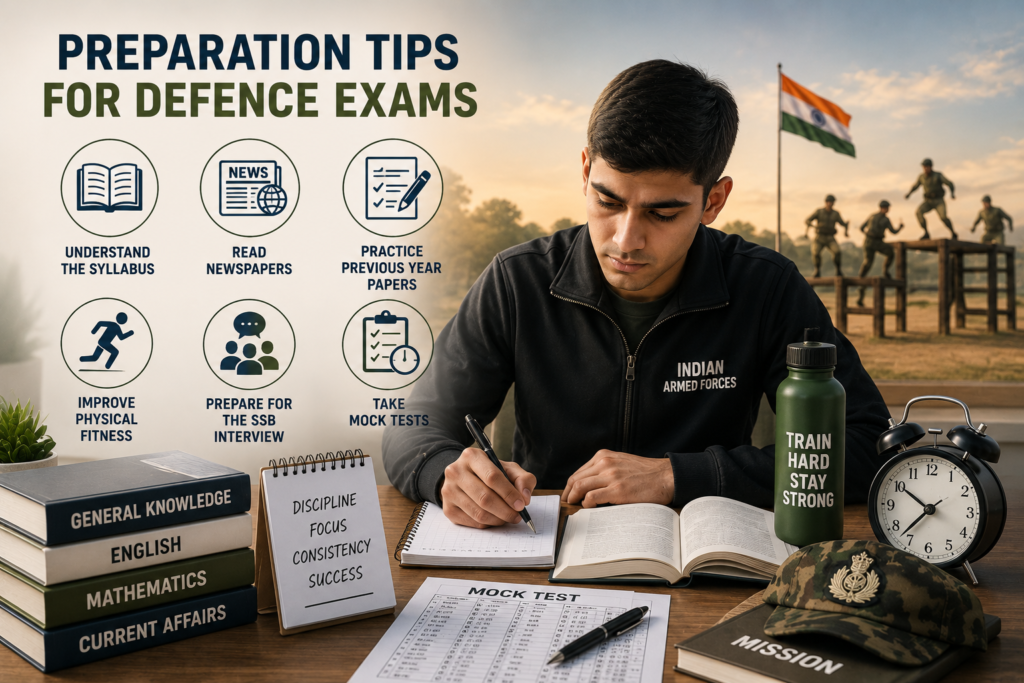
Cracking Defence exams requires a combination of academic preparation, physical fitness, and mental resilience. Since every exam has its own syllabus and selection process, following a structured preparation strategy can significantly improve your chances of success. Whether you are preparing for NDA, CDS, AFCAT, or other Defence exams, these tips will help you stay focused and exam-ready.
1. Understand the Syllabus and Exam Pattern
Before starting your preparation, carefully go through the official syllabus and exam pattern. Understand the subjects, marking scheme, exam duration, and selection stages. Having a clear understanding of the requirements allows you to create an effective study plan and prioritize important topics for different Defence exams.
2. Read Newspapers Daily
Reading newspapers regularly helps improve your knowledge of current affairs, defence-related developments, international events, and government policies. It also enhances your English vocabulary and comprehension skills, which are important for many Defence exams and interviews.
3. Practice Previous Year’s Papers
Previous year question papers give you valuable insights into the exam pattern, difficulty level, and frequently asked topics. Solving them regularly improves accuracy, speed, and confidence while helping you identify areas that need more attention. It is one of the most effective ways to prepare for Defence exams.
4. Improve Physical Fitness
Physical fitness is an essential part of the selection process for most Defence exams. Develop a routine that includes running, strength training, flexibility exercises, and endurance workouts. Maintaining a healthy diet and getting adequate rest are equally important for performing well in physical tests.
5. Prepare for the SSB Interview
The Services Selection Board (SSB) interview evaluates your leadership qualities, communication skills, decision-making ability, confidence, and teamwork. Practice group discussions, psychological tests, and personal interviews to improve your overall personality and increase your chances of success in officer-level Defence exams.
6. Take Mock Tests Regularly
Mock tests simulate the actual examination environment and help you improve time management, accuracy, and problem-solving speed. Analyze your performance after each test, work on weak areas, and gradually improve your scores. Consistent practice through mock tests is one of the best strategies to excel in Defence exams.
Conclusion
Choosing the right Defence exams is the first step toward building a rewarding career in the Indian Armed Forces. Whether you aspire to join through NDA after Class 12, CDS, or AFCAT after graduation or explore opportunities like Agniveer, the Indian Coast Guard, the Territorial Army, or the Military Nursing Service, each path offers unique responsibilities, career growth, and the honor of serving the nation. The key is to select the Defence exams that match your educational qualifications, interests, and long-term career goals.
Success in Defence exams requires consistent preparation, physical fitness, discipline, and determination. By understanding the eligibility criteria, selection process, and exam pattern, you can create an effective preparation strategy and stay ahead of the competition. Stay focused, practice regularly, and work on both your academic knowledge and personality development. At CareerGrowKaro, we are committed to helping defence aspirants with reliable career guidance, exam updates, and practical preparation tips to support their journey toward achieving their dream of serving the country.
FAQs
1. Which are the major Defence exams in India?
Some of the major Defence exams in India include NDA, CDS, AFCAT, Agniveer Recruitment, Indian Coast Guard Recruitment, Territorial Army Examination, and the Military Nursing Service (MNS) Entrance. Each exam has different eligibility criteria and career opportunities.
2. Which Defence exam is best after Class 12?
The National Defence Academy (NDA) is considered one of the best Defence exams after Class 12 for candidates who aspire to become commissioned officers in the Indian Army, Navy, or Air Force. Agniveer Recruitment is another popular option.
3. Which Defence exams can I apply for after graduation?
Graduates can apply for several Defence exams, including the Combined Defence Services (CDS) Examination, Air Force Common Admission Test (AFCAT), Territorial Army Examination, and certain Indian Coast Guard officer entries, depending on their qualifications.
4. Is physical fitness mandatory for Defence exams?
Yes, physical fitness is an essential requirement for most Defence exams. Candidates are generally required to clear physical fitness tests, meet medical standards, and demonstrate overall physical endurance during the selection process.