

The NMAT exam is a popular management entrance examination for candidates aspiring to pursue MBA and other postgraduate management programmes. Conducted by the Graduate Management Admission Council (GMAC), the exam evaluates candidates on key skills required for management education.
In this guide, CareerGrowKaro covers the important aspects of the NMAT exam, including:
- Overview of the NMAT exam: Understand what the exam is, who conducts it, and why it is important for MBA aspirants.
- Importance for management aspirants: Learn how NMAT scores can be used for admission to participating management institutes.
- Eligibility criteria: Know the educational and other requirements candidates need to meet.
- Registration process: Understand the steps involved in registering for the NMAT exam.
- Exam pattern and syllabus: Get an overview of the sections, duration, number of questions, and major topics covered.
- Preparation strategy: Explore practical tips to improve speed, accuracy, and time management.
- Other important details: Find answers to common questions about the NMAT exam and the admission process.
What is the NMAT Exam?

The NMAT exam, officially known as NMAT by GMAC, is a national-level management entrance examination conducted by the Graduate Management Admission Council (GMAC). It is designed for candidates seeking admission to MBA, PGDM, and other management programmes offered by participating business schools.
The NMAT exam evaluates candidates on essential skills required for management education, including language proficiency, quantitative ability, and logical reasoning. Some of its key features include:
- Full Form: NMAT by GMAC, formerly known as the NMAT (Narsee Monjee Management Aptitude Test).
- Purpose: The examination is used as an admission test for MBA and other postgraduate management programmes at participating institutions.
- Who Can Appear: Graduates and eligible final-year undergraduate students can apply, subject to the eligibility requirements specified by GMAC and individual participating institutes.
- Programmes Accepting Scores: NMAT scores are accepted by various participating business schools for admission to MBA, PGDM, and related management programmes. Candidates should check the individual institute’s admission criteria before applying.
- Testing Window: Unlike examinations conducted on a single fixed day, the NMAT exam is conducted over a testing window, giving candidates greater flexibility in scheduling their attempt.
- Retake Facility: Candidates can take the examination more than once within the permitted testing window, subject to the applicable rules and retake limits.
Understanding the NMAT exam structure, eligibility requirements, and participating institutes is important for candidates planning their management entrance preparation. Aspirants should also verify the latest official guidelines before completing their registration.
NMAT Exam Registration Process
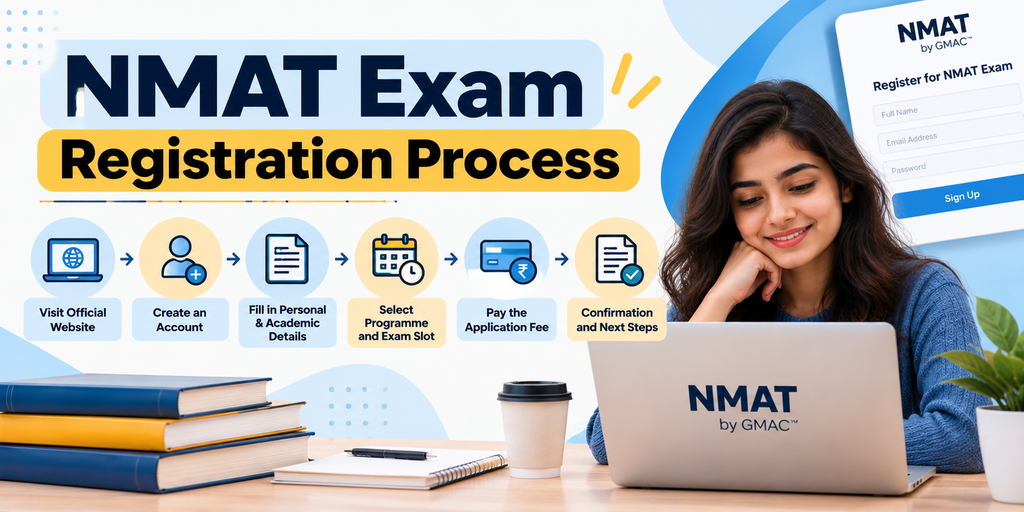
The NMAT exam registration process is conducted online and requires candidates to provide their personal and academic information before scheduling their examination. Completing each step carefully can help avoid errors or delays during the application process.
Step 1: Visit the Official NMAT Website
The first step is to access the official NMAT by GMAC website and begin the registration process.
- Visit the official NMAT by GMAC website.
- Click on the option to register for the examination.
- Read the registration guidelines and instructions carefully.
- Make sure you are using the official website before entering any personal information.
Starting the registration through the official portal ensures that you receive authentic information about the NMAT exam.
Step 2: Create an Account
After opening the registration portal, candidates need to create an account using their basic contact details.
- Enter your name, email address, and mobile number.
- Provide the information exactly as required in the registration form.
- Create a secure password for your account.
- Use an active email ID and mobile number, as they may be used for important exam-related communication.
Once the account is created, candidates can use their login credentials to access and complete the remaining registration steps.
Step 3: Enter Personal and Academic Details
Candidates must provide accurate personal and educational information in the application form.
- Enter your date of birth, gender, nationality, and contact details.
- Provide information about your graduation or qualifying examination.
- Enter academic details such as university, course, and year of completion, wherever required.
- Review the information carefully before proceeding.
Candidates should ensure that the information provided is consistent with their official documents to avoid problems during later stages of the admission process.
Step 4: Select Preferred Programmes and Schools
The registration process may allow candidates to indicate the participating schools or programmes where they want their NMAT exam scores to be considered.
- Review the list of participating institutes.
- Select the preferred schools and management programmes.
- Check whether the selected institute has any additional eligibility or admission requirements.
- Review the selection before moving to the next stage.
Since admission criteria can differ between institutions, candidates should check the requirements of each selected business school separately.
Step 5: Choose the Exam Date and Test Centre/Mode
One of the key features of the NMAT exam is the flexibility available for scheduling the examination within the designated testing window.
- Select an available examination date and time slot.
- Choose a suitable test centre or available testing mode.
- Check the availability of your preferred slot before confirming.
- Review the scheduled date, time, and location carefully.
Candidates should select a slot that gives them sufficient time to prepare and ensures they can reach the test centre on time, if applicable.
Step 6: Pay the Application Fee
After entering the required details and selecting the examination preferences, candidates need to complete the fee payment.
- Check the applicable NMAT exam registration fee.
- Select one of the available online payment methods.
- Complete the transaction and wait for the payment confirmation.
- Save the payment receipt or transaction details for future reference.
Candidates should avoid closing the payment window or refreshing the page while the transaction is being processed.
Step 7: Download and Save the Confirmation
The final step is to verify the submitted information and save the registration confirmation.
- Review your application details carefully.
- Submit the completed registration form.
- Download or save the confirmation page and payment receipt.
- Keep your login credentials and application details safely for future reference.
Completing these steps successfully finalises the initial registration process. Candidates should continue checking their registered email address and the official NMAT website for important updates regarding their examination and admission process.
NMAT Exam Syllabus
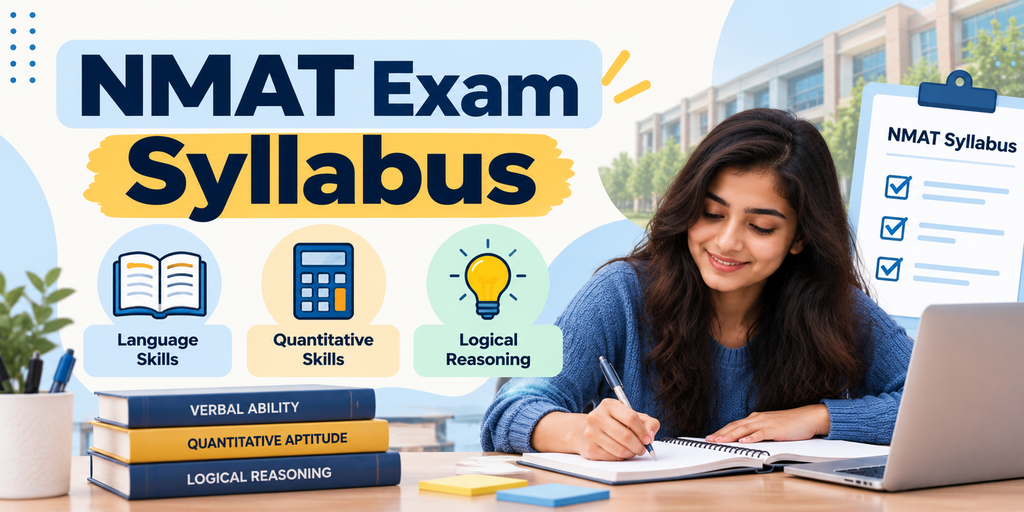
Understanding the NMAT exam syllabus is an important part of building an effective preparation strategy. The examination assesses candidates across three major areas: Language Skills, Quantitative Skills, and Logical Reasoning. Knowing the topics covered in each section helps candidates organise their preparation and identify areas that require more practice.
Language Skills
The Language Skills section of the NMAT exam evaluates a candidate’s English language proficiency, vocabulary, grammar, and reading comprehension abilities.
- Reading Comprehension: Questions based on passages, including main ideas, inferences, tone, and supporting details.
- Grammar: Sentence correction, grammatical errors, parts of speech, and usage.
- Vocabulary: Synonyms, antonyms, contextual meanings, and commonly tested words.
- Para Jumbles: Questions requiring candidates to arrange sentences in a logical sequence.
- Sentence Completion: Selecting appropriate words or phrases to complete a sentence meaningfully.
Regular reading and vocabulary-building exercises can help candidates improve their performance in this section.
Quantitative Skills
The Quantitative Skills section of the NMAT exam tests numerical ability, mathematical concepts, and the ability to solve quantitative problems accurately within a limited time.
- Arithmetic: Percentages, profit and loss, ratios, averages, time and work, time-speed-distance, and related concepts.
- Algebra: Equations, inequalities, functions, and basic algebraic concepts.
- Geometry: Lines, angles, triangles, circles, and other basic geometric concepts.
- Number System: Divisibility, factors, multiples, integers, fractions, and number-based problems.
- Data Interpretation: Tables, graphs, charts, and caselets requiring analysis of numerical data.
- Modern Mathematics: Topics such as permutations and combinations, probability, and set theory.
Candidates should focus on understanding fundamental concepts before moving towards timed and mixed-question practice.
Logical Reasoning
The Logical Reasoning section of the NMAT exam assesses a candidate’s ability to analyse information, identify patterns, and draw logical conclusions.
- Analytical Reasoning: Problems involving sequences, relationships, conditions, and logical deductions.
- Verbal Reasoning: Questions based on statements, conclusions, assumptions, and logical relationships.
- Data Sufficiency: Determining whether the given information is sufficient to answer a particular question.
- Puzzles: Logical problems involving different conditions, relationships, and arrangements.
- Critical Reasoning: Evaluating arguments, assumptions, conclusions, and inferences.
- Arrangements: Questions involving seating arrangements, ordering, grouping, and positioning.
A balanced preparation approach covering all three sections of the NMAT exam syllabus can help candidates improve both accuracy and speed. Aspirants should regularly practise different question types and take mock tests to become familiar with the examination format.
NMAT Exam Eligibility Criteria
Before applying for the NMAT exam, candidates should understand the general eligibility requirements as well as the admission criteria specified by individual participating institutes. Since requirements can vary between business schools, candidates should verify the latest information before applying.
- Educational Qualification: Candidates should generally have a bachelor’s degree from a recognised university. The specific discipline or degree requirements may vary depending on the MBA or management programme.
- Minimum Marks/Percentage: There is no single minimum graduation percentage applicable to every institute accepting NMAT scores. Individual business schools may set their own minimum marks or CGPA requirements.
- Final-Year Students: Candidates pursuing the final year of their undergraduate degree can generally appear for the NMAT exam, subject to the requirements and deadlines of the institutes they wish to join.
- Age Requirement: GMAC does not prescribe a universal upper age limit for candidates taking the NMAT exam. However, candidates should check whether their preferred institute has any programme-specific age requirements.
- Institution-Specific Requirements: Participating institutes may have additional criteria related to academic qualifications, graduation marks, work experience, or other admission requirements. These conditions can differ from one institute to another.
- Separate B-School Applications: Taking the NMAT exam does not automatically constitute an application for admission to every participating institute. Candidates may need to apply separately to their preferred MBA or PGDM programmes.
Overall, candidates should check both the general NMAT exam eligibility requirements and the individual admission criteria of their preferred business schools. This helps ensure that they meet all necessary conditions before completing the application process.
Conclusion
Preparing for the NMAT exam requires more than simply covering the syllabus. Candidates should focus on building accuracy, improving speed, and becoming comfortable with the exam format through consistent practice.
Before appearing for the examination, aspirants should:
- Create a realistic study schedule and divide preparation time across all three sections.
- Practise questions regularly to strengthen concepts and improve problem-solving speed.
- Take mock tests to understand time management and identify topics that need additional attention.
- Analyse mistakes after every practice test instead of focusing only on the score.
- Keep track of important updates related to registration, testing windows, and participating institutes.
- Check individual B-school requirements because admission criteria can differ across participating institutions.
A focused preparation routine can make the overall preparation process more structured and manageable. For more guidance on entrance exams, career options, and professional opportunities, candidates can also explore the resources available on CareerGrowKaro.
FAQs
1. What is the NMAT exam?
The NMAT exam, also known as NMAT by GMAC, is a management entrance examination conducted by the Graduate Management Admission Council (GMAC) for admission to participating MBA, PGDM, and other management programmes.
2. Who is eligible to appear for the NMAT exam?
Graduates and eligible final-year undergraduate students can appear for the NMAT exam, subject to the eligibility requirements of GMAC and the individual participating institutes.
3. What are the sections in the NMAT exam?
The NMAT exam consists of three major sections: Language Skills, Quantitative Skills, and Logical Reasoning.
4. Is there an age limit for the NMAT exam?
GMAC does not prescribe a universal upper age limit for taking the NMAT exam. However, candidates should check the requirements of their preferred business schools.
5. Can final-year students apply for NMAT?
Yes, final-year undergraduate students can generally appear for the NMAT exam, provided they meet the applicable requirements and admission conditions of their chosen institutes.
6. How does the NMAT exam registration process work?
Candidates need to create an account on the official NMAT website, enter their personal and academic details, select their preferred programmes and exam slot, pay the applicable fee, and save the registration confirmation.
7. Can candidates retake the NMAT exam?
Yes, the NMAT exam provides a retake facility within the permitted testing window, subject to the applicable rules and limits.
8. Which colleges accept NMAT scores?
NMAT scores are accepted by various participating business schools for MBA, PGDM, and other management programmes. Candidates should check the latest participating-institute list and individual admission requirements before applying.