If you want to hone your English communication skills rapidly, there are several more affordable methods than taking expensive courses or dedicating years of practice. To become fluent in English speaking, daily speaking practice, access to a useful language-learning app, and concise instructions on what will actually produce the desired results are required.
- The Importance of Good English Communication Skills (Real Talk)
- The Difference Between English Communication Skills and Grammar
- How To Improve Your English Communication Skills
- English Communication Skills Course Options (Online & Offline)
- Useful Applications for Improving Your English Communication Skills
- English Communication Skills Courses Near Me
- What are the working models in Free vs Paid?
- 90-Day Practice Plan (Replicate This!)
- Frequently Asked Questions
- Your Journey Begins Today For Your English Communication Skills
To improve your speaking proficiency for job interviews, client calls, or simply to be able to communicate with confidence, consult the CareerGrowKaro Guide to achieve your goal within a 90-day timeframe.
The Importance of Good English Communication Skills (Real Talk)
Imagine you are in a meeting and know the answer, but struggle to articulate it when trying to explain. You write fantastic emails but struggle to communicate well when in video calls. You have a complete understanding of English, but when it comes to speaking it, you just come to a halt.
Does this remind you of situations you have lived through?
Within India good English communication skills and in written forms will usually determine whether or not you get an offer or to hear “we will be in touch”. It has nothing to do with whether you sound British or American. It is about your ability to communicate your ideas and thoughts clearly, precisely, and professionally.
In 2026 companies who are recruiting new people rank communication as their number one skill requirement ahead of technical skills. And, as they understand, we can teach you how to do the job but developing good English communication skills takes time.
The Difference Between English Communication Skills and Grammar
Most people don’t seem to understand the difference between English communication skills and grammar.
Grammar = Rules and structures for written content (examples would include punctuation/grammar rules and how to put sentences together).
Communication Skills = The art of speaking (conversationally), active listening (being a present listener), critical thinking (analyzing information), and responding (providing feedback to a conversation).
You may score 90% on your English exam but still have difficulty successfully handling a client phone call because you are not actually learning/improving your communication skills through practicing in the real world and not just through memorizing text/fictional sentence structures in English textbooks.
This can be compared to learning to drive. You can read the entire driving manual but until you have driven on real roads in a vehicle (practiced). You will not really understand how to drive a vehicle.
How To Improve Your English Communication Skills
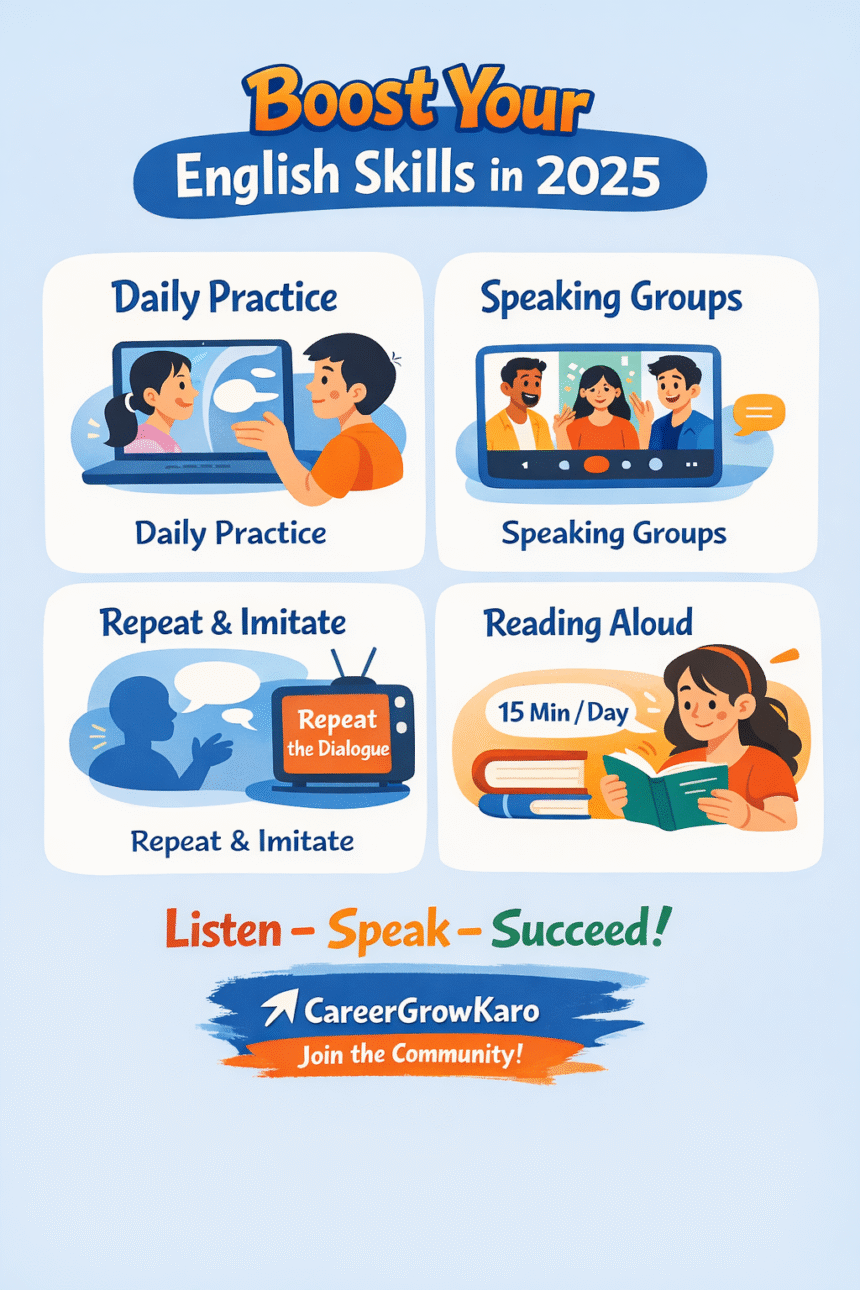
There are 4 proven successful techniques for enhancing English communication skills for Indian students and working professionals.
Daily Speaking Practice (No Exceptions)
Practice speaking to yourself in English for a minimum of 10 minutes every day. Describe your day and future plans, as well as give an opinion of a random subject each day when you practice; this will also help develop the muscle memory you need in your brain for fluent speaking.
Repeat Method
Choose your favourite English Language show, or YouTube channel you regularly; and choose 5-minute video clips to watch. After you have finished the video, pause and repeat verbatim (word for word) what you heard in the video – including their inflection and intonation.
This helps develop both your ear and your mouth to communicate better.
Finding or Creating Speaking Groups
You can either find or create a WhatsApp group with a minimum of 30 members that will meet for a minimum of 30 minutes per day where everyone only speaks in English. Using video calls is best for this. Just sending messages does not count.
Reading Aloud Practice
Choose an article or book that you are interested in reading and read it out loud for a minimum of 15 minutes per day from the article/book. Pay attention to how you pronounce words, how well you flow your sentences, and how well you maintain a consistent pace through your reading. In doing this, you will connect your reading brain to your speaking brain.
Active Listening
You can listen to podcasts, audiobooks, or news channels as well as anything else that has audio; but the most important thing when you engage in active listening is not just to listen but to ensure you understand what you hear.
English Communication Skills Course Options (Online & Offline)

Selecting a course, or a training course for English communication skills is not simple. There are some good courses out there, but a lot of them are not very helpful either. Here’s how to select a good training course or course wisely to improve your English Communication Skills.
What You Should Expect Out Of A Good Training Course For English Communication Skills
- Live Practice Speaking: Navigate with real-time conversation and feedback rather than through recordings.
- Realistic Scenarios: Real examples of what you will face with your job through emails and presentations etc will help you learn, not just theory.
- Small Size Classes: If you are in a class with 100 people it may be hard to get adequate speaking time.
- Market Place Examples: There are phrases in most training courses that are helpful to people in other parts of the world but that will never work in an Indian market.
Some of the Best Courses for English Communication Skills Available to You:
Provide structure to your study through live classes and assistance if you run into trouble while studying for 3-4 months.
The British Council has a range of professional communication courses. These can be expensive, but they are of an excellent standard.
Usually, the local coaching centres / training centres in your home town will give you a better deal than some of the more expensive online courses. This is because you will get more individual attention and many speaking practice opportunities.
Course Selection Checklist
| Criteria | What To Watch For |
| Course Length | 2-3 Months (shorter courses tend to not cover everything) |
| Live Classes | 3+ A Week |
| Speaking Time | 20 Minutes Minimum |
| Instructor Feedback | Must Provide Individual Analysis Of Your Performance & Not Generalized |
| Price | 3000-8000 range |
| Job Placement Support | Mock Interviews/Assistance Preparing Resume |
Useful Applications for Improving Your English Communication Skills
Although mobile apps are useful for supplementing practicing your spoken English, there’s no substitute for having real conversations with people. Below is a list of apps that have been shown to improve the ability of the user to speak fluently in English:
Daily Practice (Apps)
- Duolingo is a good start due to how easy it is to learn basic vocabulary and phrases through gamification. Duolingo alone will not make you an expert English speaker.
- HelloTalk connects you to English-speaking people who want to learn your native language (like Hindi). Your friend will help you learn to speak English while you practice speaking Hindi on HelloTalk at no cost.
- ELSA Speak teaches you how to pronounce words correctly using AI technology. ELSA Speak has a good way of teaching Indians how to speak English words with proper pronunciation, so it’s worth getting the paid version of ELSA Speak.
For Building Your Vocabulary
With Vocabulary.com you can learn new words through use, not just by memorizing their meaning which is much more effective than simple rote learning.
Memrise uses a method called spaced repetition to help you learn and retain new vocabulary. If you’re a business person and need to learn Business English, use the appropriate decks.
For Improving Your Listening Skills
BBC Learning English offers short daily audio lessons in standard British English, which will help improve your listening skills.
The TED app allows you to listen to TED talks while reading the transcript so that you can work on both skills at the same time.
How to Use Apps the Right Way
Choose 2 apps and use them at least 5 times a week for 20-30 minutes. Consistent use of the same two apps will provide you with tremendous improvement.
Don’t simply hop from app to app on a weekly basis. Stick with one of the two for a minimum of 60 days to see true improvements with your ability to speak English.
You must couple your app use with real-life speaking experiences to truly develop confidence when speaking English.
English Communication Skills Courses Near Me

You will often find that local courses provide better opportunities for developing your English communication skills than do online courses. Here’s how to locate some good courses in your locality.
Google Search Method
Try searching for “English speaking course near me” or “English communication classes in [your local area].” Be careful to check the Google Maps reviews for each facility that you are considering.
Helpful Statements to Ask Before You Enroll
- How many students are in each class? You’ll have less opportunity to speak if there are more than 15 students in each class.
- What percentage of time will the students practice their speaking skills during each class session? If the instructor is uncertain or gives you vague answers, that is a red flag.
- Can you attend a demo class? A quality institute will generally allow students to attend a demo class.
- What type of work/experience does the instructor have? You want to find someone who has demonstrated their ability to communicate effectively in an English speaking environment; not just someone who has a degree in English Literature.
- Will you receive copies of the recordings or notes from your class? These will be helpful to you when you are reviewing the material taught to you by the instructor.
Signals of Negative Quality
- Guaranteeing fluency within 30 days of taking their course. This is commonly just a marketing tool and should be viewed as a consumer trap.
- Teaching you only grammar and writing. You also need speaking opportunities in addition to writing and grammar.
- Not allowing students to attend a demo class. They have something to hide from you.
- Requiring that you pay 100% of the cost of the course prior to attending. Legitimate courses allow their students the option of paying for their courses using installment plans.
What are the working models in Free vs Paid?
You can actually improve your English communication skills by using free resources, however using paid resources may result in a faster outcome when the right paid resource is selected.
| How to Use the Free Resources | When the Right Paid Resource is Chosen |
| YouTube Channels (BBC Learning English, EngVid, English Addict) | An individual requires structure and accountability |
| Language Exchange Applications for Global Practice Partners | Getting Ready for IELTS, Interviews or Presentations |
| Reading English Newspapers | An individual wants comments on their spoken production |
| Discord/Telegram Online Speaking Clubs | Learn better with deadlines and assignments |
CareerGrowKaro Suggestion
Review various options. Utilize free material over 30 days and practice on a continual basis. If you are still in search of a way to practice, but have not found the right way for you, perhaps it is time to invest in a class.
Costly classes are not necessary for most people to develop the capability to communicate effectively. With regular practice and the proper Level of guidance CareerGrowKaro offers through its many free materials and local communities, developing this ability should not be difficult.
Are you having difficulty maintaining regularity of practice? – Join CareerGrowKaro’s free community group for English speakers to get day-to day practice, a weekly challenge and receive valuable feedback from your peers.
90-Day Practice Plan (Replicate This!)
You will follow this plan in order to achieve positive results. No shortcuts or skip days allowed.
1st 30-Day Phase: Establishing a Foundation
- In the mornings, spend 10 minutes talking to yourself in English. Describe your daily routine, your plans or any random topic.
- In the afternoon, watch a 10-minute English video. Write down 5 sentences from the video and repeat them as close as possible to the way they were spoken.
- Every evening, take 1 article and read it aloud. Pay attention to your pronunciation and fluency.
- Write down the 5 new words you learned each day and use them in a complete sentence.
2nd 30-Day Phase: Practicing Actively
- You will still do a 10-minute talk to yourself in the morning, however, you will now record yourself while doing your 10-minute talk. You will then playback the recording and identify where you made mistakes.
- Join 1 live video chat in the afternoon with practicing partners for 30 minutes of speaking.
- Write in English an account of how your day was and then read the account aloud.
- At the end of each week, listen to the recordings you took of yourself from the previous week and look for improvement.
Days 61 through 90: Application in the Real World
- Morning: Complete practice scenarios such as job interviews, client calls and presentations.
- Afternoon: Discuss or debate in English with friends or through online groups.
- Evening: Watch English language content without any captions and check how much you understood.
- Night: Record yourself speaking for five minutes on any topic of interest to you then send it to someone for feedback.
Frequently Asked Questions
1. How long will I see the difference in my English communication skills?
If you practice for 30-45 minutes a day, you can expect to see noticeable changes in your English communication skills in 60-90 days. Full fluency can take anywhere between 6 and 12 months based on how long you’ve been studying and how consistent you’ve been.
2. Can I develop my English communication skills if I do not go through a course?
Absolutely. You can develop your English communication skills through self-practice, YouTube videos, mobile speaking applications and language exchange partners. A course will provide you with the structure to develop your English communication skills but is not essential for improvement.
3. Which is better, an online or an offline English communication skills course?
An offline course will provide more speaking practice and a quicker way to get feedback. An online course will offer flexibility and be less expensive than an offline course. You should choose which is best for you based upon how you learn and your level of discipline.
4. Do apps that are meant to teach English communication skills help foster fluency?
The vocabulary and pronunciation portions of apps can help you to some extent but will not provide a complete solution to your need for fluency. In order to be fluent, you should spend 20-30 minutes per day using these apps and then practice speaking with real people.
5. What is the best way to improve my English communication skills for job interviews?
You should spend time practicing the popular interview questions out loud on a daily basis. You can also record yourself on video and participate in mock interviews. You need to speak in a clear and confident manner and avoid using flashy vocabulary.
6. What is the quickest way to improve my English communication skills?
The most effective method of learning a language is through daily immersion. You can achieve this by speaking English all day, watching English-based programming, participating in conversation groups and conversing with others rather than spending all your time studying grammar.
Your Journey Begins Today For Your English Communication Skills
Becoming an effective communicator in English takes time, but it can be done through consistent effort. You do not have to speak like a professional news reporter to communicate well; you have to present your thoughts and ideas clearly and confidently both at the workplace and in your personal life.
To get started, use the above 90-day development plan to select one application that fits your personal learning style, develop a specific plan to acquire new skills, and speak English on a daily basis (even if it means only speaking to yourself).
The primary distinguishing factor between successful English speakers and those who are not is their consistent practice over time, not their background or natural ability to speak their primary language.
CareerGrowKaro provides free resources, a community of practice and skill-building programs designed for Indian students and professionals.
If you are ready to confidently begin speaking, check out the CareerGrowKaro communication guide and join our free, supportive practice community today.