JEE Mains has become one of the most searched and discussed topics on Google—quite rightly so. The time for the exam is getting near; therefore, updates on applications and better expectations for cut-offs are needed. Millions of engineering aspirants in India are looking for trustworthy information about JEE Mains. The National Testing Agency (NTA) organizes JEE Mains, which is the first and the most important step for students wanting to get into the best engineering colleges.
- What is JEE Mains?
- Why is JEE Mains Important for Engineering Aspirants?
- JEE Mains 2025 – Important Highlights
- JEE Mains Eligibility Criteria
- JEE Mains Syllabus
- JEE Mains Preparation Strategy for Beginners
- JEE Mains Exam Pattern Explained
- JEE Mains Cut Off – Previous Year Trends
- Common Mistakes to Avoid While Preparing for JEE Mains
- Conclusion
- Frequently Asked Questions
The significance of JEE Mains in the life of an Indian engineering aspirant can never be minimized. It plays the role of a single major gate to the elite NITs, IIITs, and GFTIs. On top of that, for IITs, one has to clear JEE Mains to be eligible for JEE Advanced, which is the exam for the IITs.
In view of its nature being very competitive and with high stakes, comprehending JEE Mains very well is a must. This website is a complete, up-to-date guide that includes the JEE Mains exam pattern, a detailed syllabus, eligibility criteria, preparation tips for beginners and droppers, cut-off trends, and common mistakes to avoid. No matter whether you are at the beginning of your preparation or strategically revising, this guide will assist you in going through JEE Mains with clear perception and self-assurance.
What is JEE Mains?
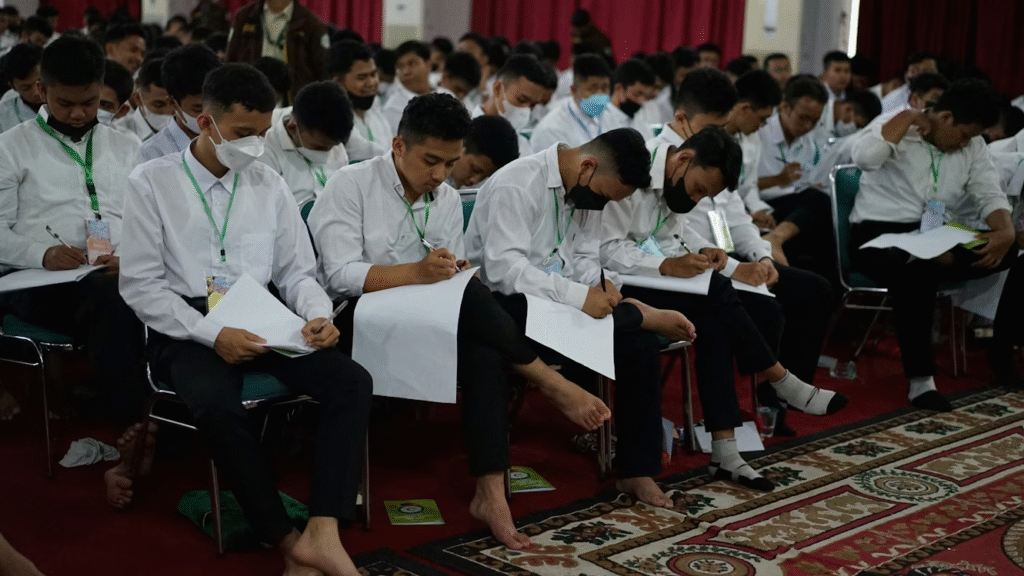
The JEE Mains examination is an all-India-based entrance test that is held with the objective of getting admission for students aspiring to take up graduate courses in engineering and architecture in Indian universities. JEE Main stands for Joint Entrance Examination (Main), and it is considered the first step in the fiercely competitive IIT–JEE exam ladder. The exam checks how much a student has understood of the three subjects of physics, chemistry, and mathematics, mostly based on the Class 11 and Class 12 syllabus.
The JEE Mains test is conducted under the supervision of the National Testing Agency (NTA), which ensures that the whole process of testing throughout India is done in a way that is clear, fair, and equal. The dates for the exam are usually placed throughout the year, giving students various chances to improve their ranks. One thing that often leads to confusion among the students is the difference between JEE Mains and JEE Advanced.
Not only does JEE Mains ensure admission to NITs, IIITs, and GFTIs, but it also tests the students for JEE Advanced, which is a gateway to the IITs. JEE Advanced is more complex and difficult, whereas JEE Mains focuses more on the evaluation of the basic understanding and application of problem-solving skills.
The students who have completed or are currently doing Class 12 with physics, chemistry, and mathematics need to appear for the JEE Main examination. It is the ideal destination for the best engineering college aspirants and even those who want to build a strong base for higher competitive examinations. The students who have finished or are attending Class 12 with physics, chemistry, and mathematics should take the JEE Main exam.
It is perfect for aspirants of the best engineering colleges and those who wish to have a rigorous foundation for advanced competitive examinations. Students who have completed or are appearing for Class 12 with physics, chemistry, and mathematics should appear for JEE Main. It is ideal for aspirants aiming for top engineering colleges and those seeking a strong foundation for higher-level competitive exams.
Why is JEE Mains Important for Engineering Aspirants?
1. Gateway to Top Engineering Colleges
The JEE Mains examination is the primary prerequisite for admission to India’s engineering elite. The institutes forming this coalition include the National Institute of Technology (NITs), the Indian Institute of Information Technology (IIITs), and the Government Funded Technical Institutes (GFTIs). The aggregated JEE Mains scores are the determining factor in the selection of candidates to these colleges.
2. National-Level Competition
Thousands of students take part in the JEE Mains test every year, which is one of the most competitive national contests in India. This intense rivalry, therefore, secures admissions solely based on merit, and it also opens up a common scale of standards for students from different educational backgrounds to compete and claim their share of the seats.
3. Eligibility for JEE Advanced
It is absolutely necessary to clear the JEE Mains if one has to take the JEE Advanced exam. The JEE Advanced test is for the top JEE Mains candidates only, and this test completion is a requirement for admission into the IITs.
4. Career Opportunities After Qualifying JEE Mains
A high JEE Mains score not only guarantees admission to the best academic institutions but also assures a strong industrial link and eventually a lifetime career in the fields of engineering, technology, research, and innovation.
JEE Mains 2025 – Important Highlights
| Particulars | Details |
| Exam Name | JEE Mains 2025 (Joint Entrance Examination – Main) |
| Conducting Body | National Testing Agency (NTA) |
| Mode of Exam | Computer-Based Test (CBT) |
| Number of Attempts | Multiple attempts in a year (best score considered) |
| Subjects | Physics, Chemistry, Mathematics (Paper 1 – B.E./B.Tech) |
| Exam Duration | 3 Hours |
| Marking Scheme | +4 for correct answer, –1 for incorrect MCQs; no negative marking for numerical questions |
JEE Mains Eligibility Criteria
Understanding the eligibility criteria of JEE Main is mandatory before taking the exam, as the candidates must be the ones who fulfill the requirements that the National Testing Agency (NTA) has set. To be precise, the criteria laid down by the agency are aimed at making the selection process uniform and impartial for all the contenders.
- Age Limit for JEE Mains: The JEE Mains exam has no maximum age limit for candidates who wish to take this exam. Anyone at any age could sign up provided they have the educational qualifications that are required. However, the applicants are required to meet the age requirement (if any) set by the institutions to which they are applying.
- Educational Qualification: Concerning the eligibility for JEE Main, it is necessary that the applicants should be getting the verified Class 12 with the subjects Physics, Chemistry, and Mathematics or their equivalent standard. Only a limited number of students who completed Class 12 from boards such as CBSE, ISC, or state boards can apply.
- Number of Attempts Allowed: From the year a candidate takes Class 12, he/she can keep taking JEE Main for three years in a row. This means that the candidates can have many chances to improve their grades in particular time limits because the exam is conducted several times a year.
- Eligibility for Droppers: Droppers who have already passed Class 12 are completely eligible to take the JEE Mains as long as they are within the permissible number of attempts. There are a number of droppers who not only succeed in improving their ranks but also get them through their concentrated preparation and practices.
JEE Mains Syllabus

Given that the JEE Mains syllabus is heavily based on NCERT books for Class 11 and 12, it is imperative for students to learn these textbooks thoroughly.
1. JEE Mains Physics Syllabus
The JEE Mains Physics syllabus emphasizes more on the understanding of physics concepts and less on the practice of numerical problems. Laws of Motion, Work, Energy, and Power, Current Electricity, Electrostatics, Magnetic Effect of Current, Modern Physics, and Semiconductor Electronics are some of the main chapters. According to the weightage trends, Modern Physics and Current Electricity are still getting more and more marks. As a result, our approach cannot be anything else but exhaustive reading of the NCERT textbooks coupled with problem-solving practice, since most of the theoretical questions are closely connected to the NCERT definitions and formulas.
2. JEE Mains Chemistry Syllabus
The JEE Mains Chemistry syllabus consists of three parts—physical, organic, and inorganic chemistry. The very high-weightage chapters include Chemical Bonding, Coordination Compounds, Thermodynamics, Electrochemistry, Hydrocarbons, and Biomolecules.In inorganic chemistry, one can often find questions directly taken from the NCERT, thus making the NCERT reading (line by line) very important. Physical chemistry is about numerical problem-solving, while organic chemistry examines the reasoning of reactions and conceptual understanding.
3. JEE Mains Mathematics Syllabus
The JEE Mains Mathematics syllabus put forth by the board makes a lot of demands on students in the area of the analytical mind and problem-solving speed. The main areas of study are calculus (limits, continuity, differentiation, and integration), coordinate geometry, vectors and 3D geometry, matrices and determinants, and probability. Trends in the marks distribution suggest that with calculus and coordinate geometry together, a large part of the paper is constituted. NCERT aids in grasping the basic concepts; nevertheless, solving problems from standard reference books is indispensable for the ultimate mastery of complex problems.
All in all, NCERT books are the basic source of the JEE Mains syllabus, and the most effective strategy for success is to combine them with targeted practice based on weightage trends.
JEE Mains Preparation Strategy for Beginners
- How to Start JEE Mains Preparation: Students getting ready for JEE Mains should first clearly understand the syllabus and exam pattern. Mastering NCERT concepts followed by physics, chemistry, and mathematics fundamentals will be the students’ stronghold before the advanced-level questions approach.
- Tips for Time Management: Time management is the skill that plays the most important role in JEE Mains victory. Plan a realistic study timetable, divide your day into several slots for intense studying, and ensure that all three subjects receive equal time together with continuous revision and practice.
- Importance of NCERT: One cannot overstate the importance of NCERT books in JEE Mains preparation, mainly in chemistry and modern physics. NCERT provides a wide source of direct and conceptual questions; hence, it becomes mandatory to get through it thoroughly before moving on to other books.
- Daily Study Routine: Conceptual learning, numerical solving, and revision should be part of an ideal daily routine. Besides, solving past year’s questions and taking mock tests weekly will gradually build up one’s accuracy, speed, and confidence in the exam situation.
- Online Coaching vs. Offline Coaching: Online coaching comes with the perks of being more flexible, having recorded lectures, and being much cheaper; on the contrary, offline coaching guarantees a systematic way of learning with a disciplined atmosphere in the classroom. Choosing either of the modes should be based on one’s learning style, self-discipline, and availability for effective JEE Mains preparation, especially in the case of novices.
JEE Mains Exam Pattern Explained
The JEE Mains exam pattern is designed to test a candidate’s conceptual understanding, problem-solving ability, and application skills. The exam is conducted for three different papers depending on the course chosen.
| Paper | Course | Subjects | Sections | Question Type | Marking Scheme |
| Paper 1 | B.E./B.Tech | Physics, Chemistry, Mathematics | Section A & B | Section A: MCQsSection B: Numerical Value Questions | +4 for correct answer–1 for incorrect MCQsNo negative marking for numerical questions |
| Paper 2A | B.Arch | Mathematics, Aptitude, Drawing | Section A & B | MCQs, numerical, and Drawing-based questions | +4 for correct answer–1 for incorrect MCQs |
| Paper 2B | B.Planning | Mathematics, Aptitude, Planning | Section A & B | MCQs and Numerical questions | +4 for correct answer–1 for incorrect MCQs |
JEE Mains Cut Off – Previous Year Trends
The JEE Main cutoff refers to the minimum score or the maximum percentile that a student is required to achieve in order to either be eligible for the admission process or to be admitted to the JEE Advanced. This score is determined by the National Testing Agency (NTA) after the results are announced, and it changes every year based on several factors.
- What is the JEE Main cut-off?: The cut-off is usually communicated in percentile format by JEE Main, not in raw scores. Therefore, only those candidates whose marks are equal to or above the cutoff are considered as having been qualified for the succeeding phases of the admission process.
- Cutoffs by Categories: The cutoff values are different for the various categories, such as General, OBC-NCL, SC, ST, and EWS. Historically, the General category has always had the highest cutoff, while the reserved categories have had the lower qualifying percentiles.
- Factors Determining the JEE Main Cutoffs: The JEE Main cutoff is based on various criteria like the difficulty of the exam, the number of people appearing for the exam, the number of seats, and the general performance of the students that year.
- Anticipated Cut Offs Trends: Looking at the JEE Main cut off trends from previous years, the cut off for the next year is expected to be in the same range, however, there could be slight variations caused by the difficulty level of the exam and competition. The aspirants should always target scoring well over the minimum cutoff to have a chance at the better college options.
Common Mistakes to Avoid While Preparing for JEE Mains
- Ignoring NCERT textbooks: Many students underestimate NCERT, especially for chemistry and modern physics, even though several questions are directly based on NCERT concepts and theory.
- Using too many resources: Referring to multiple books, notes, and online materials often leads to confusion and shallow understanding. Sticking to limited, high-quality resources is more effective.
- No mock test analysis: Attempting mock tests without analyzing mistakes, weak areas, and time management reduces their usefulness. Proper analysis is essential for improvement.
- Poor time management: Lack of a structured study plan or spending excessive time on one subject creates imbalance, stress, and incomplete syllabus coverage.
Conclusion
Successfully passing JEE Mains is not only a question of superior intellect or long hours of study but rather a combination of the right guidance, consistency, and clarity. As pointed out throughout this guide, the aforementioned factors and the knowledge of the exam’s pattern, syllabus, eligibility criteria, cut-off trends, and mistakes to avoid can all together pick your chances of winning the game significantly. With hundreds of thousands of candidates vying for a seat every year, smart preparation based on the NCERT concepts, regular practice, and good time management becomes the actual differentiator.
Individual JEE journeys are unique. While some students require strictness, others need encouragement, and there are also those who simply want the comfort of knowing their path is correct. This is exactly where Career Grow Karo comes into the picture as a major contributor. Career Grow Karo is committed to clearing the confusion of students and leading them to clarity through offering simple and practical guidance that is free of complexity and pressure. It really does not matter if you are a beginner, a repeater, or someone who has gotten stuck in the middle of preparation; with the right career guidance, your JEE Mains journey will be much clearer and more confident.
Frequently Asked Questions
1. Is it tough to pass JEE Mains?
JEE Mains is tough but still possible. A good understanding of NCERT concepts, a routine practice regime, and proper evaluation of mock tests will allow students to get good marks even in non-extreme conditions.
2. Will studying only from NCERT be enough for JEE Mains preparation?
NCERT acts as an important and basic resource, particularly for chemistry and modern physics, but it is also the main source for the other subjects to varying degrees. In mathematics and some physics numericals, extra practice from standard reference books is suggested.
3. How many hours should I study per day for JEE Mains?
There are no fixed hours for this. If you plan to get to the exam with a minimum of 5-7 hours of steady, concentrated study, regular revision, and practice, then it will be enough.
4. What score can I expect in JEE Mains to get the best colleges?
The meaning of a “good” score is not just about your target college, category, and competition but also about others. Typically, great scores that are far above the cut-off help guarantee the best NIT, IIIT, and GFTI admissions.