
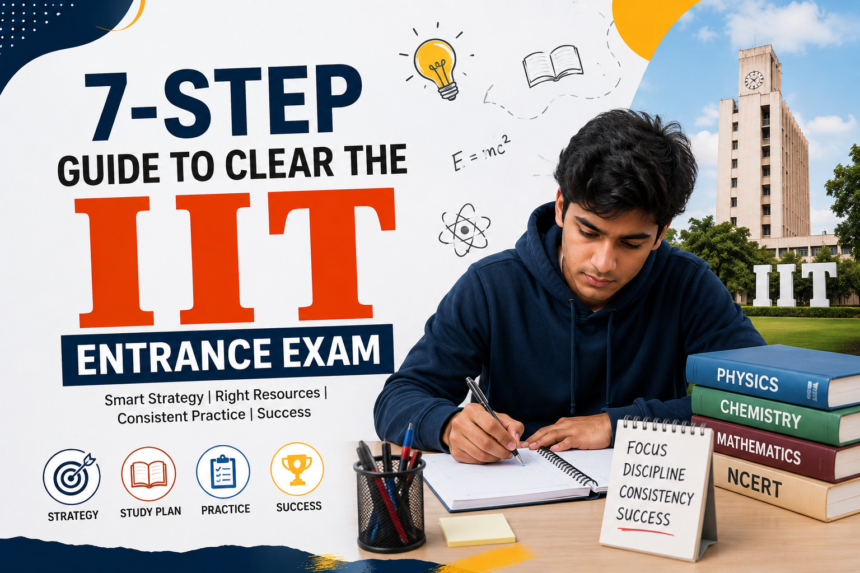
The IIT entrance exam is one of the most competitive engineering entrance examinations in India, opening the doors to the prestigious Indian Institutes of Technology (IITs). Every year, lakhs of aspirants appear for the IIT entrance exam, but only a small percentage secure admission. Success in this exam requires more than hard work; it demands a well-planned preparation strategy, conceptual clarity, consistent practice, and effective time management.
Whether you are just beginning your preparation or looking to improve your performance, having the right approach can significantly increase your chances of cracking the IIT entrance exam. From understanding the exam pattern and syllabus to choosing the best study resources and mastering revision techniques, every step plays a crucial role in your journey.
In this comprehensive guide by CareerGrowKaro, you will learn everything you need to know about preparing for the IIT entrance exam, including expert preparation tips, recommended books, common mistakes to avoid, and proven strategies to help you study smarter and perform confidently on exam day.
Understand the IIT Entrance Exam Pattern
Before starting your preparation, it is essential to understand the IIT entrance exam pattern. Knowing the structure of the exam helps you create an effective study plan, manage your time wisely, and focus on high-scoring areas. Since the IIT entrance exam consists of two stages, JEE Main and JEE Advanced, aspirants should be familiar with the pattern of both examinations.
JEE Main Exam Pattern
JEE Main is the first stage of the IIT entrance exam and serves as the qualifying exam for JEE Advanced.
| Particular | Details |
| Subjects | Physics, Chemistry, and Mathematics |
| Number of Questions | 75 questions (25 from each subject) |
| Marking Scheme | +4 marks for every correct answer and -1 mark for every incorrect MCQ, while numerical value questions have no negative marking |
| Duration | 3 hours (4 hours for eligible PwD candidates) |
JEE Main primarily tests your conceptual understanding, problem-solving ability, and speed. Regular practice and mock tests are essential to perform well in this stage of the IIT entrance exam.
JEE Advanced Exam Pattern
Candidates who qualify for JEE Main can appear for JEE Advanced, the second and more challenging stage of the IIT entrance exam.
| Particular | Details |
| Subjects | Physics, Chemistry, and Mathematics |
| Paper Structure | Two compulsory papers (Paper 1 and Paper 2) conducted on the same day |
| Negative Marking | Varies depending on the type of question and is announced in the official exam instructions |
| Difficulty Level | Varies depending on the type of question and is announced in the official exam instructions |
Unlike JEE Main, the pattern of JEE Advanced may change slightly every year. Therefore, candidates preparing for the IIT entrance exam should regularly check the latest official exam guidelines and practice previous years’ question papers to become familiar with different question formats.
Know the IIT Entrance Exam Syllabus
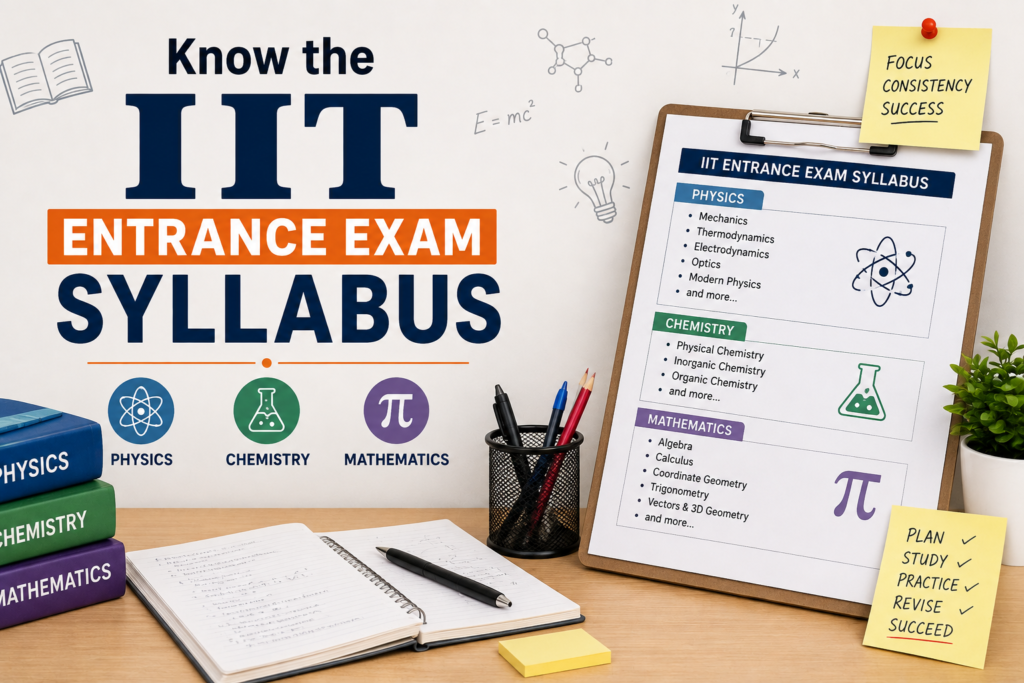
A thorough understanding of the IIT entrance exam syllabus is the first step toward effective preparation. Instead of studying everything at once, divide the syllabus subject-wise and focus on mastering one topic at a time. Since the IIT entrance exam tests conceptual understanding rather than rote memorization, knowing the syllabus helps you prioritize important topics and avoid wasting time on irrelevant material.
1. Physics
The Physics section evaluates your conceptual clarity and problem-solving skills. Important topics include:
- Mechanics
- Laws of Motion
- Work, Energy, and Power
- Rotational Motion
- Gravitation
- Thermodynamics
- Electrostatics
- Current Electricity
- Magnetism
- Optics
- Modern Physics
- Waves and Oscillations
Regular numerical practice is essential to score well in the Physics section of the IIT entrance exam.
2. Chemistry
Chemistry is divided into three major sections:
- Physical Chemistry: Mole Concept, Thermodynamics, Chemical Kinetics, Electrochemistry, Solutions
- Organic Chemistry: General Organic Chemistry (GOC), Hydrocarbons, Alcohols, Aldehydes, Ketones, Amines, Biomolecules
- Inorganic Chemistry: Chemical Bonding, Coordination Compounds, p-Block, d-Block, Periodic Table, Environmental Chemistry
Strong conceptual understanding along with regular revision can help you perform well in chemistry.
3. Mathematics
Mathematics requires speed, accuracy, and extensive practice. Some of the most important topics include:
- Algebra
- Matrices and Determinants
- Complex Numbers
- Trigonometry
- Coordinate Geometry
- Calculus
- Vectors
- Three-Dimensional Geometry
- Probability
- Statistics
Consistent problem-solving is the key to improving your mathematics score on the IIT entrance exam.
4. Importance of NCERT
NCERT textbooks form the foundation of the IIT entrance exam syllabus, especially for chemistry. They help build strong concepts and are highly useful for JEE Main. Before referring to advanced books, ensure that you thoroughly understand every chapter and solve all the NCERT exercises.
- Builds strong fundamentals: NCERT explains concepts in a simple and structured manner, making it easier to understand complex topics.
- Essential for JEE Main: Many questions, particularly in chemistry, are directly based on NCERT concepts and facts.
- Strengthens conceptual clarity: A solid grasp of NCERT helps in tackling advanced-level questions in JEE Advanced.
- Improves accuracy: Solving all in-text examples and end-of-chapter exercises reinforces learning and minimizes common mistakes.
- Creates a strong base for reference books: Once you have mastered NCERT, transitioning to books like HC Verma, Cengage, or OP Tandon becomes much easier.
- Supports effective revision: NCERT is concise, making it an excellent resource for quick revisions before the IIT entrance exam.
Step-by-Step Strategy to Clear the IIT Entrance Exam

Cracking the IIT entrance exam requires more than studying for long hours. A smart preparation strategy, consistent practice, and disciplined revision can significantly improve your chances of success. Follow these proven steps to prepare effectively for the IIT entrance exam.
Step 1: Build Strong Fundamentals
A strong conceptual foundation is essential before moving on to advanced-level problems.
- Focus on understanding concepts instead of memorizing formulas.
- Strengthen the basics of physics, chemistry, and mathematics.
- Clear your doubts immediately to avoid confusion later.
- Solve basic-level questions before attempting difficult ones.
Step 2: Create a Realistic Study Plan
A well-structured timetable helps you stay consistent throughout your preparation.
- Set achievable daily study goals.
- Plan weekly targets to cover important chapters.
- Review your progress through monthly milestones.
- Allocate extra time for difficult subjects and regular revision.
- Include short breaks to maintain productivity.
Step 3: Choose the Right Study Material
Using limited but high-quality resources is more effective than studying from multiple books.
- NCERT textbooks for building strong fundamentals.
- Standard reference books like HC Verma, Cengage, OP Tandon, and Arihant.
- Coaching notes (if available) for quick revision.
- Avoid switching between too many resources during IIT entrance exam preparation.
Step 4: Practice Questions Every Day
Daily practice improves problem-solving skills and builds confidence.
- Solve topic-wise practice questions after completing each chapter.
- Attempt previous years’ question papers to understand exam trends.
- Include mixed practice sets to improve speed and accuracy.
- Track your performance and gradually increase the difficulty level.
Step 5: Take Mock Tests Regularly
Mock tests help you experience the actual exam environment before the IIT entrance exam.
- Attempt full-length mock tests regularly.
- Simulate real exam conditions by following the official time limit.
- Focus on improving both speed and accuracy.
- Develop effective time management strategies for each subject.
Step 6: Analyze Your Mistakes
Simply taking mock tests is not enough; you must learn from them.
- Maintain an error notebook to record frequently made mistakes.
- Identify weak concepts and revise them thoroughly.
- Avoid repeating the same errors in future tests.
- Monitor your improvement after every mock test.
Step 7: Revise Consistently
Revision is the key to retaining concepts for the IIT entrance exam.
- Follow a weekly revision schedule for recently studied topics.
- Conduct a monthly revision of the complete syllabus covered so far.
- Prepare formula sheets, reaction charts, and short notes for quick revision.
- Spend the final months revising and practicing instead of learning entirely new topics.
By following these strategies consistently, you can build a strong preparation routine and significantly improve your chances of clearing the IIT entrance exam with an excellent score.
Best Books for IIT Entrance Exam Preparation
Choosing the right study resources is just as important as creating a study plan. While there are numerous books available, referring to a few trusted resources is enough for effective IIT entrance exam preparation. Start with NCERT to build a strong foundation, then move on to advanced reference books for better conceptual understanding and problem-solving skills.
| Subject | Recommended Books | Best For |
| Physics | NCERT Physics, HC Verma (Concepts of Physics Vol. I & II), DC Pandey (Understanding Physics Series), Arihant Series | Building concepts, strengthening fundamentals, and practicing JEE-level numericals |
| Chemistry | NCERT Chemistry, OP Tandon (Physical Chemistry), Morrison & Boyd (Optional – Organic Chemistry), Cengage Series | Conceptual understanding, numerical practice, and advanced preparation for JEE Main & Advanced |
| Mathematics | NCERT Mathematics, RD Sharma, Cengage Series, Arihant Series | Building fundamentals, improving problem-solving skills, and mastering advanced-level questions |
To prepare effectively for the IIT entrance exam, begin with NCERT textbooks to build a strong conceptual foundation before moving on to advanced reference books. Avoid using too many study resources at the same time, as this can lead to confusion and incomplete revision. Instead, focus on mastering one book thoroughly before switching to another. Along with these books, regularly attempt mock tests and solve previous years’ question papers to strengthen your concepts, improve problem-solving skills, and maximize your IIT entrance exam preparation.
Can You Clear the IIT Entrance Exam Without Coaching?
Yes, it is absolutely possible to clear the IIT entrance exam without coaching if you have discipline, consistency, and the right study strategy. Every year, many students crack the IIT entrance exam through self-study by making the best use of quality resources and following a structured preparation plan.
Here are a few tips to prepare for the IIT entrance exam without coaching:
1. Use online lectures: Learn concepts from trusted educational platforms that offer free and paid video lectures, practice sessions, and doubt-solving resources.
2. Study from NCERT and standard books: Begin with NCERT to build strong fundamentals, then refer to standard books like HC Verma, Cengage, OP Tandon, and Arihant for advanced preparation.
3. Take mock tests regularly: Attempt full-length mock tests and previous years’ question papers to improve your speed, accuracy, and time management.
4. Practice self-analysis: Review every mock test, identify your weak areas, maintain an error notebook, and revise concepts where you make repeated mistakes.
With determination, smart planning, and regular practice, you can successfully crack the IIT entrance exam without coaching and secure admission to your dream IIT.
Conclusion
Cracking the IIT entrance exam is a challenging yet achievable goal for students who prepare with dedication, consistency, and the right strategy. Success is not determined by the number of hours you study but by how effectively you understand concepts, practice questions, revise regularly, and analyze your mistakes. A clear understanding of the syllabus, a well-planned study schedule, quality study materials, and regular mock tests can significantly improve your performance in the IIT entrance exam.
Remember that every aspirant progresses at a different pace, so avoid comparing yourself with others and stay focused on your own preparation journey. Whether you choose self-study or coaching, maintaining discipline and a positive mindset is essential for long-term success. With the right approach and continuous effort, you can confidently clear the IIT entrance exam and move one step closer to studying at your dream IIT. For more expert exam preparation guides, career insights, and practical study tips, keep following CareerGrowKaro to stay informed and motivated throughout your preparation journey.
Frequently Asked Questions (FAQs)
1. What is the IIT entrance exam?
The IIT entrance exam is the admission process for undergraduate engineering programs offered by the Indian Institutes of Technology (IITs). It consists of two stages: JEE Main and JEE Advanced.
2. Can I clear the IIT entrance exam without coaching?
Yes, many students successfully clear the IIT entrance exam through self-study by using NCERT textbooks, standard reference books, online lectures, mock tests, and consistent practice.
3. How many hours should I study daily for the IIT entrance exam?
There is no fixed number of study hours. Most aspirants study between 6 and 8 focused hours daily, but the quality of study, regular revision, and practice are more important than the total hours spent.
4. Is NCERT enough for the IIT entrance exam?
NCERT is essential for building strong fundamentals, especially in chemistry and for JEE Main. However, for JEE Advanced, you should also refer to standard books like HC Verma, DC Pandey, OP Tandon, and Cengage.
5. Which books are best for IIT entrance exam preparation?
Some of the best books include NCERT, HC Verma (Physics), DC Pandey (Physics), OP Tandon (Chemistry), Cengage Series, Arihant Series, and RD Sharma for strengthening mathematics fundamentals.