
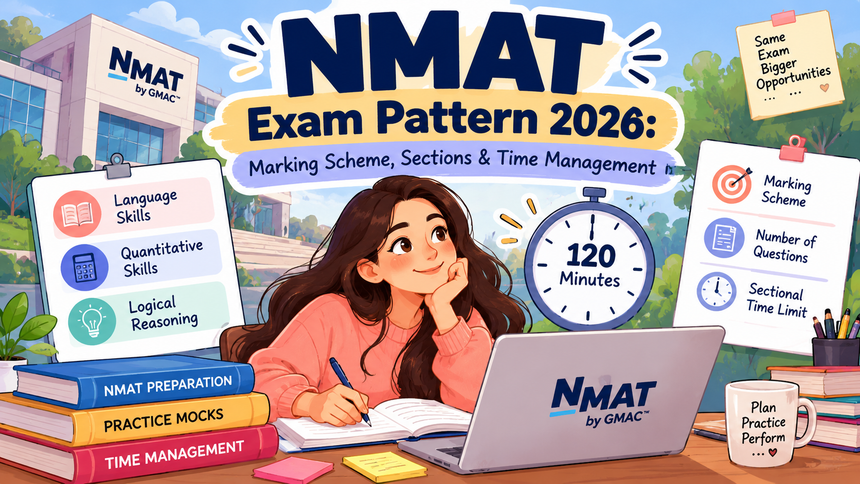
The NMAT exam pattern is an important part of understanding the NMAT by GMAC examination before beginning MBA entrance exam preparation. Conducted as a computer-adaptive test, NMAT assesses candidates across three key sections:
- Language Skills – Tests reading comprehension, vocabulary, and verbal ability.
- Quantitative Skills – Covers mathematical concepts, calculations, and data interpretation.
- Logical Reasoning – Evaluates analytical and logical thinking abilities.
Understanding the NMAT exam pattern helps candidates become familiar with:
- Section-wise question distribution
- Time limits for each section
- Marking and scoring system
- Overall exam duration
This knowledge allows aspirants to build a realistic preparation plan, improve time management, and approach mock tests more strategically. It also helps candidates understand where they need to focus their preparation.
For guidance on NMAT preparation, MBA colleges, entrance exams, and career opportunities, aspirants can explore the resources available on CareerGrowKaro.
NMAT Exam Pattern 2026 at a Glance
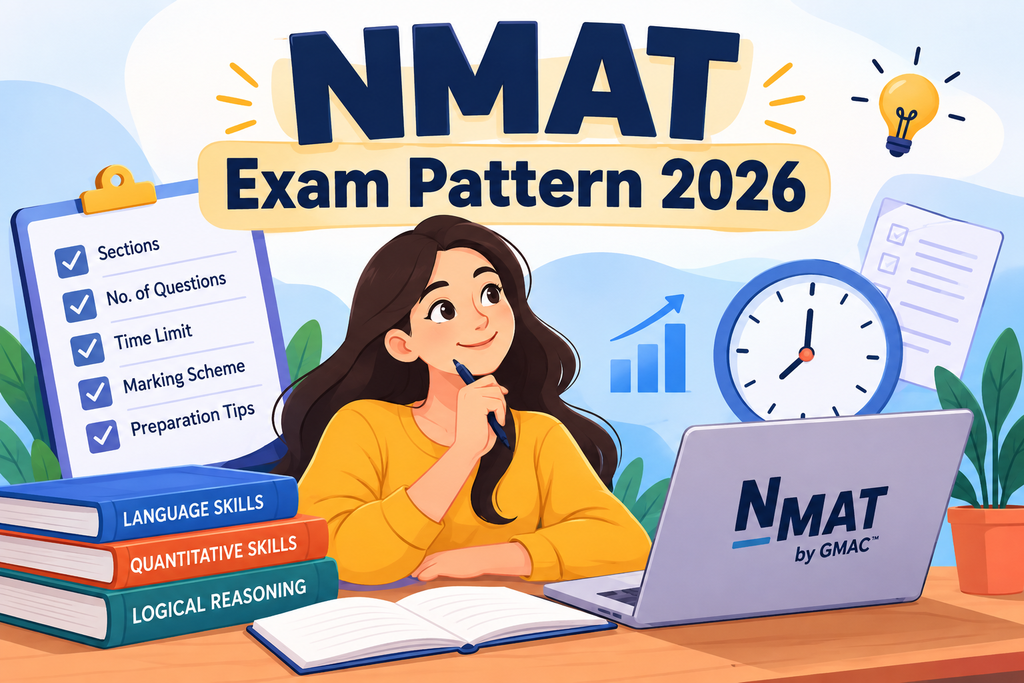
The NMAT exam pattern 2026 consists of three sections designed to assess a candidate’s language, quantitative, and logical reasoning abilities. Understanding the overall structure is important because each section has a separate time limit. Here is a quick overview of the NMAT exam pattern:
| Particular | Details |
| Exam Name | NMAT by GMAC |
| Mode | Computer-based |
| Total Sections | 3 |
| Total Questions | 100 |
| Total Time | 120 minutes |
| Language Skills | 36 questions |
| Quantitative Skills | 36 questions |
| Logical Reasoning | 36 questions |
| Sectional Time | 28–52 minutes, depending on the section |
| Question Type | Multiple-choice questions |
The NMAT exam pattern requires candidates to manage their time separately for language skills, quantitative skills, and logical reasoning. Since candidates cannot treat the entire 120 minutes as a single time pool, understanding the sectional structure is essential.
Candidates should focus on maintaining a balance between speed and accuracy. Knowing the NMAT exam pattern beforehand can help aspirants plan their preparation, practice with sectional timers, and develop an effective strategy for the actual examination.
Before appearing for the exam, candidates should also verify the latest official NMAT guidelines, as exam policies and details may be updated.
Before preparing for the exam, candidates should also understand the NMAT 2026 registration process, including important dates, eligibility, fees, and application steps.
NMAT Section-Wise Exam Pattern
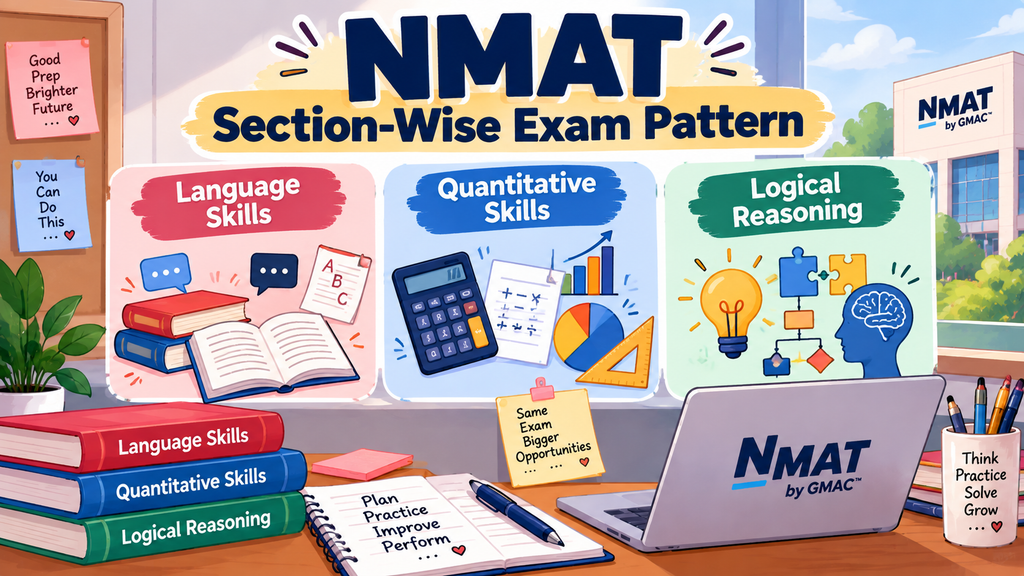
The NMAT exam pattern is divided into three sections: Language Skills, Quantitative Skills, and Logical Reasoning. Each section contains 36 questions, making a total of 108 questions. The sections are individually timed, and candidates can choose the order in which they attempt them.
1. Language Skills
The Language Skills section evaluates a candidate’s command of English, including reading comprehension, vocabulary, grammar, and verbal reasoning. According to the official NMAT structure, this section has 36 questions to be attempted in 28 minutes.
The major areas covered include
- Reading Comprehension: Questions based on passages that test understanding, inference, and interpretation.
- Vocabulary: Questions involving word meanings, analogies, and usage.
- Grammar: Tests knowledge of grammatical rules and identifying errors in sentences.
- Sentence Completion: Candidates may need to select the word or phrase that logically and grammatically completes a sentence.
- Para Forming/Sentence Formation: Questions may require candidates to understand the logical sequence or structure of sentences.
- Verbal Reasoning: Tests the ability to understand relationships between ideas and interpret written information.
The section assesses how effectively candidates can read, comprehend, interpret, and use English. Since 36 questions need to be completed within 28 minutes, candidates also need to work efficiently under a strict sectional time limit. The official NMAT syllabus lists reading comprehension, paragraph forming, error identification, prepositions, sentence completion, and analogies among the language skills topics.
2. Quantitative Skills
The Quantitative Skills section contains 36 questions with a time limit of 52 minutes, giving candidates the longest section-specific time allocation in the exam. It evaluates numerical ability, mathematical reasoning, data interpretation, and data sufficiency.
Important areas include:
- Arithmetic: Percentages, profit and loss, simple and compound interest, ratios, proportions, averages, time and work, and related concepts.
- Number System: Fractions, decimals, factors, multiples, prime numbers, and other number properties.
- Algebra: Linear and quadratic equations, inequalities, sequences, and series.
- Geometry: Questions based on geometric concepts and figures.
- Probability: Basic probability and related mathematical concepts.
- Data Interpretation: Interpretation of information presented through tables, graphs, charts, and caselets.
- Data Sufficiency: Determining whether the information provided is sufficient to answer a given question.
The NMAT exam pattern makes calculation speed particularly relevant in this section because candidates have to solve 36 questions within 52 minutes. The official syllabus groups quantitative skills around number properties, arithmetic, algebra and probability, data integration, and data sufficiency.
3. Logical Reasoning
The Logical Reasoning section consists of 36 questions that candidates must complete within 40 minutes. It assesses analytical thinking, critical reasoning, deduction, and the ability to identify relationships and patterns in given information.
The section broadly covers:
- Verbal Reasoning: Critical reasoning, conclusions, assumptions, inferences, and arguments.
- Analytical Reasoning: Problems involving logical relationships, patterns, and structured information.
- Puzzles: Analytical puzzles requiring candidates to evaluate multiple pieces of information.
- Arrangements: Seating and other arrangement-based questions.
- Blood Relations: Questions involving family relationships and logical deductions.
- Coding-Decoding: Identifying patterns or relationships between letters, numbers, or symbols.
- Critical Reasoning: Evaluating arguments, assumptions, conclusions, and inferences.
- Syllogisms and Deductions: Drawing logical conclusions from given statements.
The official NMAT syllabus specifically includes critical reasoning, analytical puzzles, deductions, syllogisms, input-output, seating arrangements, decision-making, and Venn diagrams within logical reasoning.
Overall, the NMAT exam pattern requires candidates to handle three different skill sets under separate time limits. Understanding the question types and section structure beforehand can help aspirants become familiar with what they will encounter during the examination. Importantly, NMAT allows candidates to choose the sequence of the three sections, but once a section is completed, candidates cannot return to it, and unused time cannot be carried over to another section.
NMAT Marking Scheme 2026
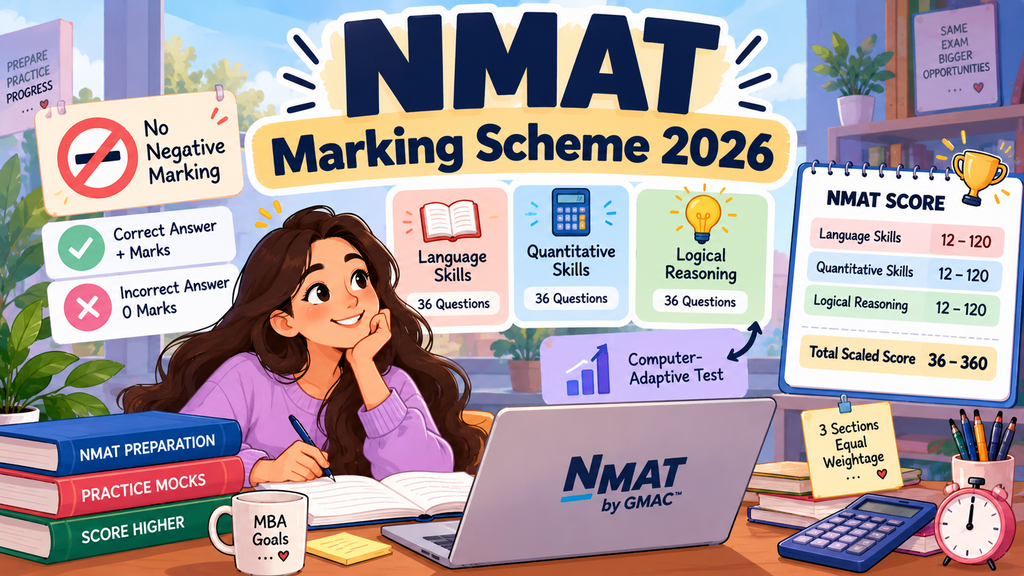
Understanding the NMAT exam pattern also requires knowing how the exam is scored. Unlike many other MBA entrance exams, NMAT by GMAC has no negative marking for incorrect answers. This means candidates do not lose marks for selecting an incorrect option. However, since the exam is time-bound and candidates cannot return to previous questions, they still need to make decisions carefully.
Is There Negative Marking in NMAT?
No. The NMAT exam pattern does not include negative marking. Candidates are therefore not penalized for incorrect responses. The official NMAT website specifically lists “No negative marking” as one of the exam’s features.
Candidates should also note that NMAT uses a computer-adaptive testing format. Questions are selected from a pool based on the candidate’s performance on previously answered questions. The difficulty level of questions can therefore vary according to the candidate’s demonstrated ability.
Can Candidates Choose the Section Order?
Yes. Candidates can select their preferred order for attempting the three sections:
- Language Skills
- Quantitative Skills
- Logical Reasoning
However, each section has its own time limit. Once a section is completed or its time expires, candidates cannot return to it. Any unused time from one section also cannot be transferred to another section.
How Is the NMAT Score Calculated?
The NMAT exam pattern uses scaled scoring. Each section has a score range of 12–120, while the overall score ranges from 36–360. The three sections contribute equally to the total score.
Rather than awarding a simple fixed number of marks for every correct response, NMAT calculates a candidate’s ability estimate using a statistical scoring model and then converts it into a scaled score. The scorecard reports the individual section scores and total score.
Therefore, candidates should focus on answering questions accurately while managing the individual sectional time limits.
NMAT Exam Duration & Sectional Time Limit
The NMAT exam pattern includes a total of 108 questions that candidates must answer within 120 minutes. The exam has three individually timed sections, and candidates can choose the order in which they attempt them. Understanding the sectional time limit is essential because the 120 minutes cannot be treated as one common time pool.
| Section | Questions | Time |
| Language Skills | 36 | 28 minutes |
| Quantitative Skills | 36 | 52 minutes |
| Logical Reasoning | 36 | 40 minutes |
| Total | 100 | 120 minutes |
Under the NMAT exam pattern, each section has its own countdown. Once candidates finish a section or its allotted time expires, they cannot return to that section. Similarly, unused time from one section cannot be transferred to another.
Therefore, candidates should practise with sectional timers and avoid spending too much time on a single difficult question. Following the NMAT exam pattern during mock tests can help improve speed, accuracy, and decision-making before the actual examination.
How to Manage Time in NMAT
Effective time management is an important part of the NMAT exam pattern, as all three sections have separate time limits. Candidates need to balance speed, accuracy, and question selection throughout the exam.
Tip 1: Understand the Sectional Time Limits
Before attempting mocks, familiarise yourself with the time allotted to each section.
- Language Skills: 28 minutes
- Quantitative Skills: 52 minutes
- Logical Reasoning: 40 minutes
Tip 2: Avoid Getting Stuck on Difficult Questions
Spending too much time on one difficult question can affect your performance on the remaining questions.
- Identify questions that are taking unusually long to solve.
- Move ahead if you are unable to find an approach quickly.
- Avoid repeatedly rereading the same question.
- Prioritise questions that you can solve with greater confidence.
- Return to your strategy rather than letting one question disrupt your overall pace.
Tip 3: Practice With a Timer
Timed practice can help you become comfortable with the pace required by the NMAT exam pattern.
- Take regular sectional tests with the actual time limit.
- Include full-length NMAT mock tests in your preparation.
- Practise solving questions under exam-like conditions.
- Track whether you consistently finish each section within its allotted time.
- Gradually work on improving speed without compromising accuracy.
Tip 4: Build Section-Specific Strategies
Each NMAT section requires a slightly different approach.
- Language Skills: Improve reading speed, vocabulary, grammar, and comprehension.
- Quantitative Skills: Focus on calculation speed and efficient question selection.
- Logical Reasoning: Practise identifying patterns, relationships, and logical structures quickly.
Tip 5: Track Your Average Time per Question
Tracking your pace can help you identify where you are losing valuable time.
- Record the number of questions attempted.
- Note the total time spent in each section.
- Calculate your approximate average time per question.
- Identify question types that consistently take longer.
- Use the data as a benchmark rather than following a rigid time limit for every question.
Tip 6: Analyse Your Mock Tests
Taking a mock test is only one part of preparation; analysing the results can provide valuable insights into your performance.
- Check your total questions attempted.
- Calculate your accuracy rate.
- Review the time spent on each section.
- Identify questions you left unanswered.
- Analyse your section-wise performance.
- Mark questions that consumed excessive time.
- Identify recurring mistakes and revise those concepts before the next mock.
Consistent analysis and timed practice can help candidates develop better control over speed, accuracy, and decision-making, all of which are important when preparing according to the NMAT exam pattern.
Conclusion
Understanding the NMAT exam pattern is an important step toward structured preparation for the NMAT by GMAC examination. With three sections—Language Skills, Quantitative Skills, and Logical Reasoning—and a total exam duration of 120 minutes, candidates need to balance speed, accuracy, and effective question selection.
A clear understanding of the exam structure can help candidates:
- Familiarise themselves with section-wise questions and time limits.
- Practise questions under timed conditions.
- Develop separate strategies for each section.
- Take regular mock tests and analyse their performance.
- Improve accuracy while maintaining a consistent solving speed.
For additional guidance on NMAT preparation, MBA colleges, entrance exams, and career opportunities, aspirants can explore the resources available on CareerGrowKaro. Candidates should also check the official NMAT by GMAC website for the latest exam guidelines and updates before appearing for the test.
For a broader overview of the examination, including NMAT eligibility, registration, syllabus, and preparation, candidates can refer to the complete NMAT Exam 2026 guide on CareerGrowKaro.
FAQs
1. What is the NMAT exam pattern 2026?
The NMAT exam pattern consists of three sections: Language Skills, Quantitative Skills, and Logical Reasoning. The exam has 108 questions and a total duration of 120 minutes, with each section having a separate time limit.
2. How many questions are there in the NMAT exam?
The NMAT exam has 108 questions in total, with 36 questions in each of the three sections.
3. Is there negative marking in NMAT?
No, the NMAT does not have negative marking for incorrect answers. However, candidates should manage their time carefully because each section has a fixed time limit.
4. What is the duration of the NMAT exam?
The total duration of the NMAT exam is 120 minutes. The time is divided separately among the three sections.
5. Can I choose the order of sections in NMAT?
Yes. Candidates can choose the order in which they attempt the three sections. However, once a section is completed or its allotted time expires, candidates cannot return to it.
6. Is NMAT a computer-adaptive exam?
Yes. NMAT is a computer-adaptive test (CAT) in which the difficulty and selection of questions can be influenced by a candidate’s performance during the test.