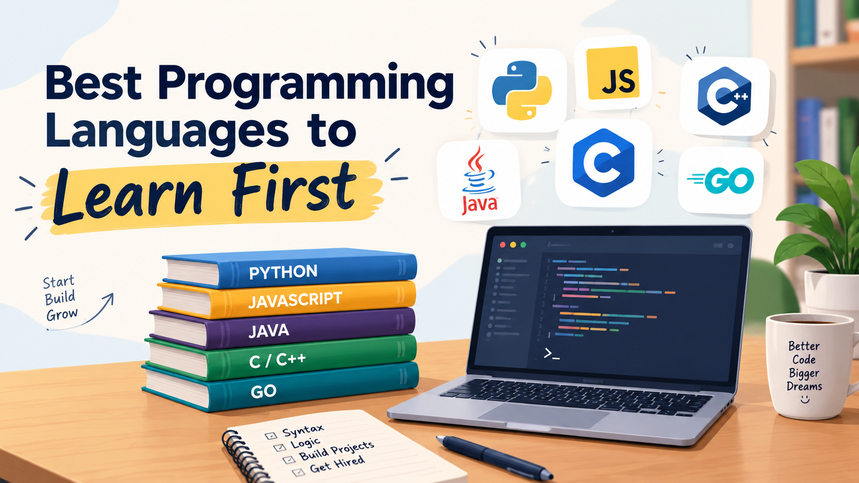
When choosing the best programming languages to learn first, Python and C stand out as the top choices for college students. If your goal is to build web apps or understand artificial intelligence quickly, start with Python. If your university curriculum demands deep hardware knowledge, start with C. Indian engineering colleges often confuse students with outdated syllabus guidelines, but your path should depend on your career goals. This CareerGrowKaro guide shows you exactly which language matches your college branch, job ambitions, and learning speed without useless theory.
The Coding Dilemma: Why Starting Right Matters
- C vs Python: Which Programming Language Should I Learn First C or Python?
- Top Options: Best Programming Languages to Learn First for Beginners
- Market Demand: Best Programming Language to Learn for Jobs
- Engineering Branch Guide: Which Coding Language Should I Learn First for ECE Students?
- Campus Reality: Best Programming Languages to Learn First in India
- Top 3 Mistakes Beginners Make While Learning to Code
- Comprehensive Comparison Table
- Step-by-Step 30-Day Action Roadmap
- CareerGrowKaro Magic Box
- Frequently Asked Questions (FAQs)
- Conclusion and Next Steps
The Fresher Confusion
Every year, thousands of college freshers enter classrooms and get flooded with advice from seniors, professors, and YouTube creators. One senior suggests starting with C++, another swears by Java, and a batchmate claims web development with JavaScript is the only path that pays. Understanding the best programming languages to learn first helps you avoid wasted semesters and endless confusion.
The Problem in the Indian College Setup
Most Indian universities begin their first-year curriculum with complex syntax and manual memory allocation. Students spend hours fixing missing semicolons instead of understanding core programming logic. Students often get trapped in tutorial hell because they do not pick the best programming languages to learn first. You end up memorizing code for semester exams rather than writing functional programs that solve real problems.
How to Approach Your First Language
Programming is not about memorizing commands. It is about computational thinking and problem-solving. When you select the right starting point, you gain confidence early. You can also explore free national initiatives like the SWAYAM NPTEL Portal to review official course structures taught by IIT professors.
- Focus on fundamental logic like loops, conditions, and data structures.
- Write code daily on a real compiler rather than on notebook paper.
- Pick one syntax and stick with it for at least three months.
- Build one mini-project before hopping to another framework.
What to Do Next
If you want to earn while learning technical basics, check out our guide on the Best Skills to Earn Money for College Students to start monetizing your initial computer skills.
C vs Python: Which Programming Language Should I Learn First C or Python?
This is the classic debate inside every Indian hostel room. Let us break down the exact differences so you can make a clean decision.
The Case for C
C is often called the mother of all modern programming languages. When you write C code, you deal directly with memory pointers, compilation steps, and hardware registers. If you analyze the best programming languages to learn first, Python gives you quick feedback while C gives you memory control.
Learning C first forces you to understand what happens behind the screen inside your computer’s RAM. There are no automatic safety nets. If you make a memory mistake, your program crashes. While this feels frustrating in the first two weeks, it builds unmatched discipline.
The Case for Python
Python features syntax that reads almost like plain English. You do not need to declare variable types or worry about memory leaks. You can write a functional calculator or a file renamer in five lines of code.
Starting with Python lets you see immediate visual results. That dopamine hit of seeing your code run on day one keeps you motivated. Therefore, comparing C and Python helps narrow down the best programming languages to learn first for your specific timeline.
Direct Comparison
- Syntax Complexity: C requires strict semicolons and curly braces. Python uses clean indentation.
- Execution Speed: C compiles directly to machine code and runs extremely fast. Python runs via an interpreter and is slower.
- Beginner Friendliness: Python has a gentle learning curve. C has a steep learning curve.
- Practical Use Today: Python powers AI, data science, and automation. C powers operating systems, drivers, and microcontrollers.
If you have semester exams in two months that test C, study C. If you are learning independently to build projects, start with Python using the official documentation on Python.org.
Top Options: Best Programming Languages to Learn First for Beginners
Here is our curated list of the best programming languages to learn first for beginners who want fast progress without losing motivation.
1. Python (The Modern Starting Line)
Python is consistently ranked among the best programming languages to learn first across the globe. It is versatile, clean, and supported by a massive global community.
- Best For: Automation, Artificial Intelligence, Data Science, Backend Web Development.
- Difficulty: Very Easy.
- Time to Learn Basics: 3 to 4 weeks.
- Why Pick It: You spend your mental energy learning problem-solving logic rather than fighting syntax rules.
2. C and C++ (The Academic Anchor)
For university exams, C remains one of the best programming languages to learn first to build foundation. Its direct successor, C++, adds Object-Oriented Programming (OOP) and the Standard Template Library (STL).
- Best For: Competitive Programming, Game Engines, Operating Systems, Campus Technical Interviews.
- Difficulty: Moderate to Hard.
- Time to Learn Basics: 6 to 8 weeks.
- Why Pick It: Most Indian college placement drives focus heavily on Data Structures and Algorithms (DSA) implemented in C++.
3. JavaScript (The Web Native)
If web development is your goal, JavaScript joins the best programming languages to learn first. It is the only programming language that runs natively inside your web browser.
- Best For: Frontend Web Development, Full-Stack Development, Mobile App Development.
- Difficulty: Easy to Moderate.
- Time to Learn Basics: 4 to 5 weeks.
- Why Pick It: You can build real websites, share the link with friends, and see your creation live instantly.
4. Java (The Enterprise Standard)
Campus placements in India still place Java among the best programming languages to learn first. Large Indian IT service firms and global product companies rely heavily on Java backends.
- Best For: Enterprise Software, Android App Development, Backend Services.
- Difficulty: Moderate.
- Time to Learn Basics: 6 to 8 weeks.
- Why Pick It: Java enforces strict object-oriented architecture. Once you understand Java, shifting to languages like C# or Kotlin is effortless.
You can also explore lightweight freelance options while practicing syntax by reading our breakdown of 7 Freelance Services You Can Sell Using Just a Smartphone.
Market Demand: Best Programming Language to Learn for Jobs
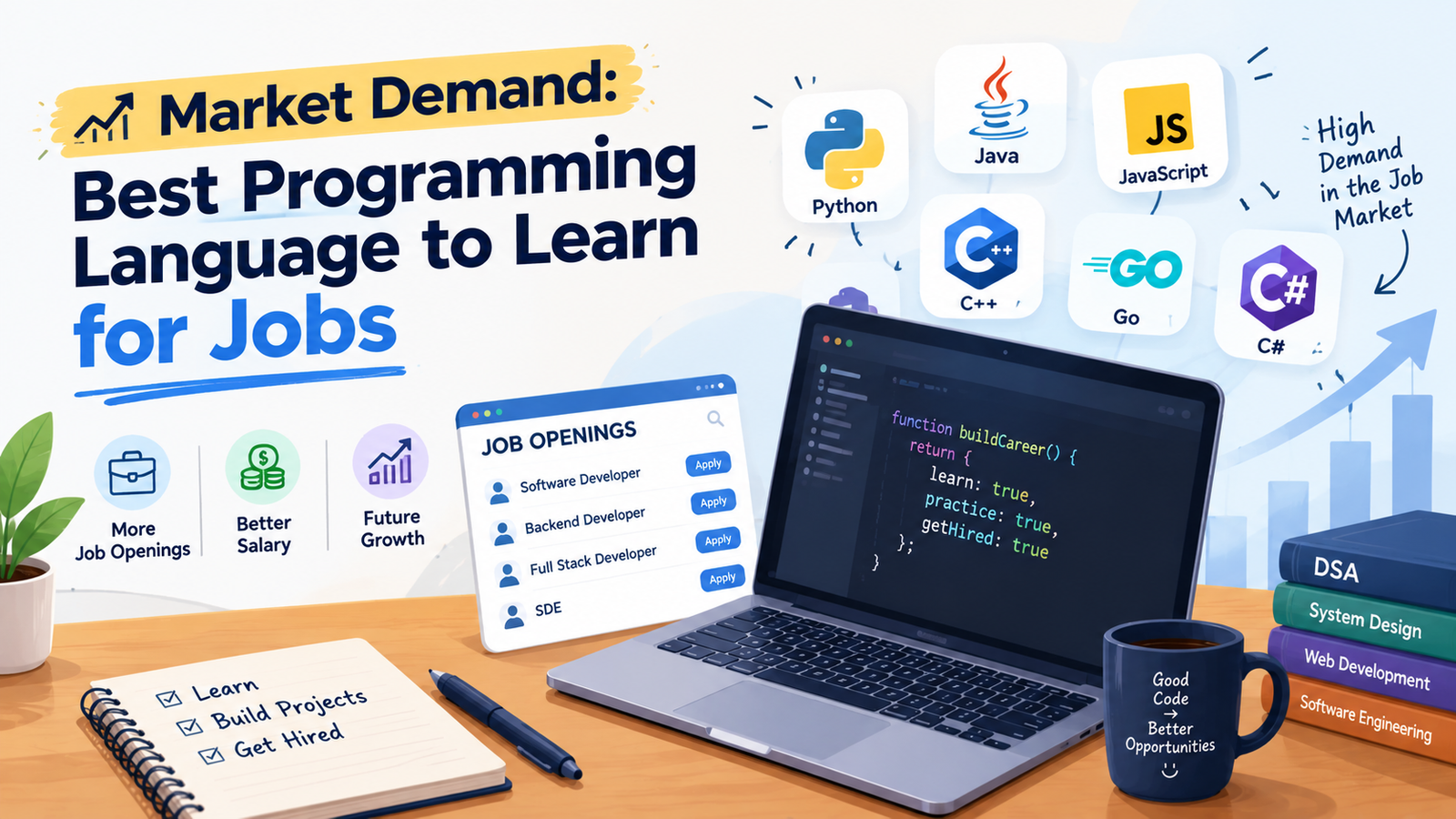
Finding the best programming language to learn for jobs starts with knowing the best programming languages to learn first. Writing code as a hobby is fun, but securing a paid internship or placement offer requires aligning with market demands.
Product-Based Companies vs Service-Based Companies
In India, the hiring landscape splits into two distinct segments:
- Product-Based Companies (MAANG, Startups, Unicorns): These companies do not care which language you use during coding rounds. They care about Data Structures, Algorithms, and System Design. C++, Java, and Python dominate their interview rounds.
- Service-Based Companies (TCS, Infosys, Wipro, Cognizant): These firms hire at scale and look for core foundation. Java, Python, and SQL are common requirements for their entry-level project allocations.
Recruiters look for strong problem solving, which is why the best programming languages to learn first focus on core logic rather than niche tricks. You can review industry trends in the annual Stack Overflow Developer Survey to see which technologies maintain high commercial demand.
Languages That Pay Well in 2026
- Python: High demand in AI research, data analytics, and automation pipelines.
- JavaScript / TypeScript: Massive hiring across early-stage startups and remote digital agencies.
- Java / Go: Dominant for scalable cloud backends, payment gateways, and banking architectures.
- C++: Preferred for high-frequency trading firms and game studios offering premium packages.
If your primary goal is to monetize your digital skills alongside your studies, consider reading our guide on Income Ideas for Students in India to plan your student earnings.
Engineering Branch Guide: Which Coding Language Should I Learn First for ECE Students?
Non-CS students often face special challenges. When asking which coding language should I learn first for ece students, hardware alignment dictates the best programming languages to learn first.
Electronics and Communication Engineering (ECE) sits right between computer software and physical hardware. If you study ECE, your curriculum covers microprocessors, digital signal processing, communication networks, and embedded chips.
Why C and Embedded C Matter Most for ECE
ECE students should prioritize embedded programming when looking at the best programming languages to learn first. Microcontrollers like the 8051, AVR, ARM Cortex, and Arduino rely on C for register-level programming.
- C gives you bitwise operators to manipulate individual hardware pins.
- It compiles into compact binaries that fit into tiny microcontroller flash memories.
- Core companies like Texas Instruments, Qualcomm, and Intel expect ECE candidates to know C and C++ inside out.
When Should ECE Students Learn Python?
While C remains mandatory for hardware interfaces, Python serves a secondary purpose for electronics engineers:
- Processing sensor signals and plotting frequency responses.
- Automating hardware test benches.
- Simulating digital signal processing algorithms.
- Interfacing with single-board computers like the Raspberry Pi.
If you are an ECE student aiming for IT jobs, focus on C++ with DSA. If you want core semiconductor and embedded roles, master C and Verilog.
Campus Reality: Best Programming Languages to Learn First in India
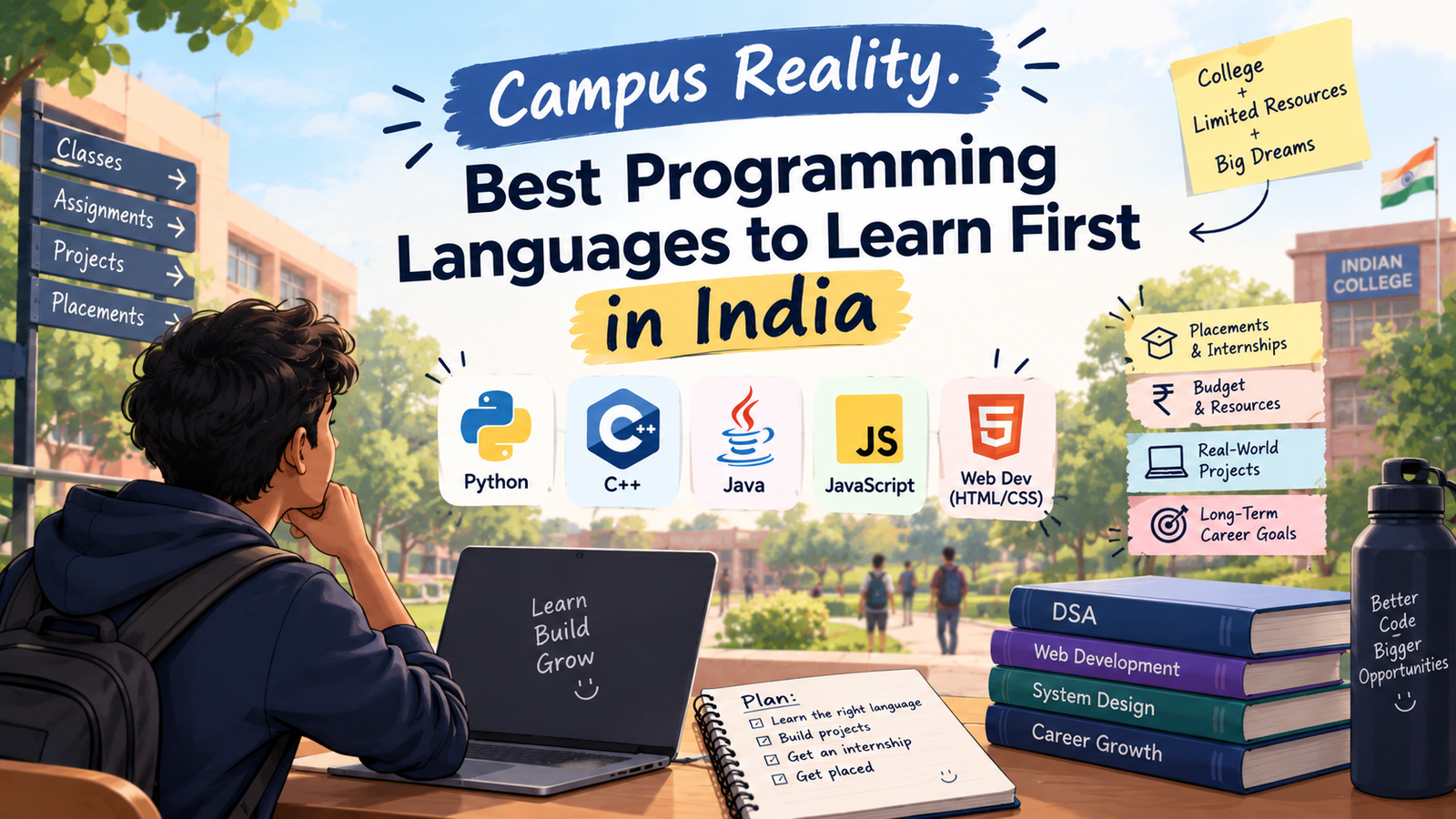
Evaluating the best programming languages to learn first in india requires understanding campus recruitment trends. The guidelines set by statutory bodies like the All India Council for Technical Education (AICTE) encourage colleges to modernize labs, but campus hiring drives follow their own rules.
Tier-1 vs Tier-3 Reality
In top-tier engineering institutes, students often transition directly to Python, Go, and Rust because campus placement filters allow flexibility. In Tier-2 and Tier-3 colleges, mass recruitment exams often feature standardized online assessments where Java and C++ compile reliably without runtime configuration issues.
Service companies and product startups value different skills, altering which are the best programming languages to learn first depending on where you study. If your college brings mass recruiters, ensure you can clear technical MCQ tests in C and Java before dedicating all your time to experimental frameworks.
The Role of Online Learning
You do not have to rely only on classroom lectures. Students across small towns in India are landing remote developer roles through self-directed learning. For inspiration on how practical digital learning changes lives, read How Rekha from Jhansi Got Her First Job via Digital Course.
Top 3 Mistakes Beginners Make While Learning to Code
Even if you choose the best programming languages to learn first, your learning method dictates your success. Many Indian students waste their entire first year making these three avoidable mistakes.
Mistake 1: Getting Trapped in Tutorial Hell
What is it: Tutorial hell is when you watch a ten hour coding bootcamp video on YouTube but never write a single line of code yourself. You feel like you are learning, but your brain is only passively watching.
Why it matters: Companies do not hire you for watching videos. Clients on student freelancing platforms do not care about the tutorials you watched. They only care about the code you can write and the problems you can solve.
How to fix it: For every one hour of video you watch, spend two hours writing code. Break the tutorial. Change the variables. See what happens when you remove a loop.
Example: Ravi from Bhopal watched three complete Python courses but failed his technical interview because he had never debugged a live error. Always type the code out yourself.
What to do next: Open a free account on LeetCode or HackerRank and solve just one basic logic problem daily.
Mistake 2: The Language Hopping Trap
What is it: This happens when a student starts learning C, gets bored after two weeks, switches to Java because a senior recommended it, and then jumps to Python after watching a trending reel.
Why it matters: Language hopping prevents you from reaching the intermediate level in any technology. When you search for the best programming languages to learn first, you must understand that the language is just a tool. The core logic of arrays, loops, and conditions remains the same everywhere.
How to fix it: Once you pick your first language, commit to it for at least ninety days. Do not look at any other language until you have built at least two working projects.
Example: A student who sticks to JavaScript for three months can easily build a portfolio website and start applying for paid gigs on student freelancing platforms. The student who hops languages will have zero projects to show.
What to do next: Read our guide on How to Build a Developer Portfolio with Zero Experience to see why consistency beats knowing multiple languages.
Mistake 3: Ignoring Core Logic for Fancy Frameworks
What is it: Jumping directly into React, Django, or Node without understanding basic JavaScript or Python first.
Why it matters: Frameworks come and go. Core languages stay forever. If you rely only on framework shortcuts, you will freeze during technical interviews or when a client on student freelancing platforms asks for a custom feature. Master the base language first.
How to fix it: Spend your first month purely on the terminal or command line. Do not worry about buttons, colors, or web designs until your core logic is rock solid.
Comprehensive Comparison Table
Here is a summary comparison of the best programming languages to learn first based on learning curve and career prospects.
| Programming Language | Difficulty Level | Core Usage | Job Demand in India | Best Suited For |
| Python | Beginner | AI, Data, Automation, Web | Very High | Absolute beginners, Data aspirers |
| C / C++ | Intermediate | DSA, Systems, Embedded, Gaming | High (Interviews/Core) | College exams, Campus placements, ECE |
| JavaScript | Beginner-Int | Frontend, Full-Stack Web Apps | Very High (Startups) | Web developers, Freelancers |
| Java | Intermediate | Enterprise Apps, Android, Cloud | High (IT Services) | Corporate IT jobs, Backend engineering |
| SQL (Bonus) | Beginner | Database Queries, Data Analysis | Universal Requirement | Every aspiring engineer |
Step-by-Step 30-Day Action Roadmap
Your 30-day plan to master the best programming languages to learn first without burning out requires consistent, bite-sized tasks.
Days 1 to 7: Setup and Syntax
- Install your code editor (VS Code) and the language compiler or interpreter.
- Understand variables, standard data types, input/output, and operators.
- Write your first ten simple programs (e.g., number swapping, simple interest calculators).
Days 8 to 15: Flow Control and Loops
- Master if-else conditionals.
- Practice for and while loops until iteration feels natural.
- Solve twenty pattern-printing and prime-number problems to sharpen your logic.
Days 16 to 22: Functions and Modularity
- Learn how to declare functions, pass arguments, and return values.
- Understand scope of variables (local vs global).
- Refactor old code into reusable modular functions.
Days 23 to 30: Basic Data Structures and First Project
- Learn arrays or lists and string manipulation methods.
- Build one functional command-line project (e.g., a student grade calculator or a to-do list manager).
- Push your code to a public GitHub repository.
If you want to turn this foundational knowledge into early online income, read our detailed guide on How to Earn Money Online for Students 2026.
CareerGrowKaro Magic Box
Confused about how to manage your study time and coding practice?
Balancing university assignments, mid-term exams, and daily programming practice can overwhelm any college student. Without a clear daily budget for your time and money, burn-out happens quickly.
Use CareerGrowKaro’s Smart Budgeting Tips for Indian Students to build a structured schedule and manage your monthly college expenses. Streamline your college life and start your growth journey in minutes!
Frequently Asked Questions (FAQs)
Why is Python always listed in the best programming languages to learn first?
Python features clean syntax that reads like regular English. It removes complicated boilerplate code and memory management, allowing beginners to focus on core programming concepts like variables, loops, and logic building without getting intimidated by syntax errors.
Can I learn more than one language at the same time?
No, you should avoid learning two languages simultaneously as a beginner. Master the fundamentals using one language first. Once you understand how loops, functions, and logic structures work, picking up a second language takes only a couple of weeks.
Is C language still relevant for jobs in India?
Yes, C remains critical for embedded systems, operating system development, hardware drivers, and IoT devices. It is also the academic standard in most Indian universities for teaching fundamental computing concepts and low-level memory architecture.
How many hours should I practice coding daily?
One to two hours of focused, hands-on coding every day is far more effective than an eight-hour marathon on weekends. Consistency builds muscle memory and helps you retain syntax rules much faster.
Which language is best for cracking campus placement coding rounds?
C++ and Java are the two most popular languages for campus placement coding rounds in India. Most interview platforms and company screening tests support them smoothly with extensive standard library capabilities for DSA questions.
Conclusion and Next Steps
Choosing among the best programming languages to learn first comes down to your immediate goal. If you want quick confidence and love artificial intelligence or web automation, start with Python. If you want to prepare for competitive programming, university exams, or core hardware roles, start with C or C++. Do not spend months overthinking your choice. The best language is the one you actually sit down and practice today.
As your coding skills grow, explore our Skills Category Hub to find practical roadmaps, or head to our main guides to keep upgrading your career. Stay disciplined, code every day, and let CareerGrowKaro help you navigate your journey from college classrooms to professional success.