Quick Answer: BBA or BCom Which is Better?
If you want a career in management, marketing, or entrepreneurship, BBA or BCom which is better points clearly towards BBA. If you want a career in accounting, finance, banking, or government jobs, BCom is the stronger choice.
- Quick Answer: BBA or BCom Which is Better?
- What is BBA? (Simple Breakdown)
- What is BCom? (Simple Breakdown)
- BBA or BCom Which is Better for MBA?
- BBA or BCom Which is Better in India for Jobs?
- BBA or BCom Which is Better Salary?
- BBA or BCom Which is Easy?
- BBA or BCom Which Has More Scope?
- BBA vs BCom Full Comparison Table
- Who Should Pick BBA?
- Who Should Pick BCom?
- FAQs: BBA or BCom Which is Better?
- Final Verdict: BBA or BCom Which is Better?
That is the short answer. But if you stop reading here, you will miss the details that actually matter for your situation.
Most students in India choose between these two degrees based on what their friends picked, what their parents suggested, or simply which college was closer to home. That is a genuinely bad way to make a decision that affects the next 10 years of your career.
If you want a bigger picture before choosing any degree, a complete career decision guide can help you avoid mistakes most students regret later.
This guide from CareerGrowKaro breaks down every angle: salary, MBA, government jobs, difficulty level, and long-term scope. Read it fully and you will walk away with a clear decision, not more confusion.
Let us get into it.
What is BBA? (Simple Breakdown)

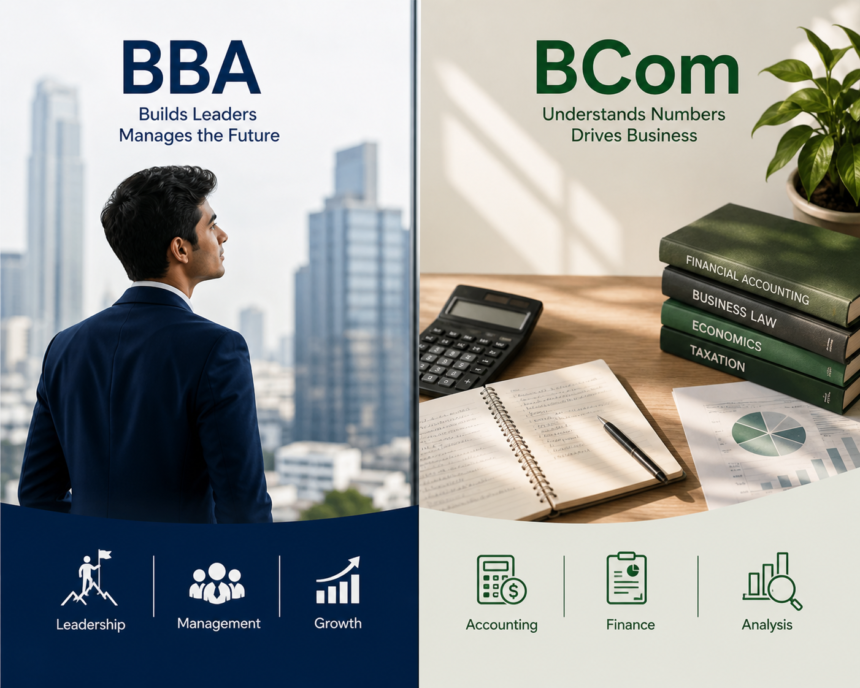
BBA stands for Bachelor of Business Administration. It is a 3-year undergraduate degree that focuses on management, marketing, human resources, operations, and entrepreneurship.
Think of BBA as the course that teaches you how to run a business, manage a team, or lead a department. You study subjects like Business Communication, Marketing Management, Human Resource Management, Organisational Behaviour, Financial Management, and Entrepreneurship Development.
BBA is more popular in private universities and deemed colleges across India. Colleges like Shaheed Sukhdev College of Business Studies under Delhi University, Christ University Bangalore, Symbiosis Pune, and Amity University are known for their BBA programs.
You can also explore the top BBA colleges in India to understand which institutes actually offer strong placements and industry exposure.
What makes BBA different from BCom is its practical orientation. You do not just study theory from textbooks. You do presentations, live case studies, mock business plans, and internships that expose you to the real corporate world before you even graduate.
Key things about BBA:
- Strong focus on practical management skills
- Case study and project-based learning
- Regular internships as part of the curriculum
- Good for students who enjoy communication, leadership, and strategy
- Less focus on pure accounting theory or maths-heavy subjects
If you are the kind of person who enjoys organising events, leading group projects, debating ideas in class, or figuring out why a business failed, BBA will feel like a natural fit for you.
And if the idea of sitting with a balance sheet for three years sounds like your nightmare, stay far away from BCom Honours. Just saying.
What is BCom? (Simple Breakdown)
BCom stands for Bachelor of Commerce. It is also a 3-year undergraduate degree but is built around accounting, taxation, economics, financial management, auditing, and business law.
BCom is the older and more widely available course in India. Every university, from small district colleges to premier institutions, offers BCom. It has been the default choice for commerce students for decades, and for good reason.
You can pursue BCom General or BCom Honours. BCom Honours from top colleges like SRCC Delhi, Hindu College Delhi, Loyola Chennai, and St. Xavier’s Mumbai is considered highly competitive and commands serious respect in the job market.
BCom is also the most direct path to professional certifications like CA (Chartered Accountant), CS (Company Secretary), and CMA (Cost Management Accountant). If CA is your target, understanding the full ICAI registration and preparation process early can save you a lot of confusion later. These are among the most respected qualifications in Indian finance and business.
Key things about BCom:
- Strong base in accounting, taxation, and finance
- Direct and smooth pathway to CA, CS, and CMA
- BCom Honours from a top college is a premium credential
- Strong eligibility for government banking and finance exams
- First year is heavy theory but it builds a solid foundation
If you scored well in Accounts in Class 11 and 12 and actually enjoyed solving those Trial Balance problems, BCom is going to feel like home. And if accounts made you want to cry, please reconsider before enrolling.
BBA or BCom Which is Better for MBA?
This is one of the most common questions students ask, and the honest answer is that both work well for MBA admissions. But the real answer has more depth.
CAT, MAT, XAT, SNAP, NMAT, and other MBA entrance exams in India do not require a specific undergraduate degree. You just need a graduation degree with 50 percent marks in most cases (45 percent for reserved categories in some institutes). So neither BBA nor BCom gives you a formal advantage on paper.
But here is where it gets interesting.
BCom students have an edge in:
- Quantitative Ability and Data Interpretation sections of CAT because their curriculum covers maths, statistics, and financial calculations
- Finance MBA specialisation because they already have accounting and economics knowledge
- BCom Honours from SRCC or similar colleges carries a lot of weight in IIM personal interviews, and interviewers genuinely notice it
BBA students have an edge in:
- Personal Interview rounds because they have already studied management concepts like organisational behaviour, marketing strategy, and HR
- Group Discussions because BBA trains you to speak confidently, structure arguments, and think on your feet. This is exactly why building strong communication skills early can make a huge difference during interviews and group discussions.
- Marketing, HR, and Operations specialisations where management fundamentals matter more than accounting knowledge
So when someone asks BBA or BCom which is better for MBA, the right response is: it depends on which MBA specialisation you are targeting.
Want to do MBA Finance at IIM or SP Jain? BCom is a stronger base. Want to do MBA Marketing or HR at a good college? BBA already gives you a head start.
One thing that matters more than your undergraduate degree for MBA: start preparing early. Do not wait until the final year of graduation to start your CAT preparation. Use your second year to begin.
CareerGrowKaro has a full MBA preparation roadmap for Indian students built specifically for this journey. Check it out before your peers do.
BBA or BCom Which is Better in India for Jobs?

Let us talk about real jobs in India after graduation. Not the inflated placement numbers on college brochures. Real, ground-level opportunities.
BCom job options after graduation:
- Junior Accountant or Accounts Executive in small and medium companies
- Bank PO and Clerk through IBPS and SBI exams
- Tax Assistant through SSC CGL
- Article Assistant under a practicing CA if you are pursuing the CA route
- Finance Executive roles in startups and MNCs
- Data entry and back-office finance roles
BBA job options after graduation:
- Sales Executive and Business Development Associate roles
- Marketing Analyst in digital agencies and startups
- HR Executive in companies with large workforces
- Operations Assistant in logistics, retail, and e-commerce
- Management Trainee programs in FMCG companies like HUL, ITC, and Nestle
- Client servicing and account management in agencies
The truth about both degrees is that at the fresher level in India, you will face stiff competition. A plain graduation without added skills, certifications, or a postgraduate degree does not automatically land you a great job. That is just the market reality.
However, when you look at which course builds a better foundation for specific careers:
For government jobs, BCom wins. The maths, economics, and accounts background directly helps in IBPS PO, SBI PO, SSC CGL, RBI Grade B, and state PSC exams. These are structured exams and BCom gives you the right subject base.
For private sector corporate jobs, BBA wins. The internship culture, practical exposure, and management fundamentals give BBA students a better starting position for corporate roles in sales, marketing, and operations.
So BBA or BCom which is better in India for jobs depends entirely on which sector you are aiming for.
BBA or BCom Which is Better Salary?
Honest answer first: neither BBA nor BCom will make you rich immediately after graduation. Any college that promises you a 10 LPA package straight after BCom or BBA without a postgraduate degree is either lying or referring to one exceptional student out of five hundred.
Average salary after BBA at the fresher level: Rs 2.5 LPA to Rs 4.5 LPA
Average salary after BCom at the fresher level: Rs 2 LPA to Rs 4 LPA
The gap at the entry level is not dramatic. But the long-term picture is very different.
Salary trajectory after BBA plus MBA from a good college:
Students who do BBA followed by an MBA from a top-ranked college can expect starting salaries between Rs 8 LPA and Rs 20 LPA depending on specialisation, college brand, and the industry they join. Marketing and consulting roles post-MBA tend to pay well. Finance and strategy roles pay even better.
Salary trajectory after BCom plus CA:
BCom students who crack the CA exam and join Big 4 firms like Deloitte, PwC, EY, or KPMG typically start at Rs 7 LPA to Rs 12 LPA. Senior CAs with 5 to 7 years of experience comfortably earn Rs 20 LPA to Rs 40 LPA, and in some cases more. Independent CAs running their own practice can earn significantly higher depending on their client base.
So when you ask BBA or BCom which is better salary over a 10-year horizon, the answer is:
BCom plus CA probably wins in pure earning potential. But BBA plus MBA from a great college is equally competitive and sometimes faster in terms of growth.
The undergraduate degree sets your direction. Your effort, skills, and the choices you make after graduation set your actual salary.
BBA or BCom Which is Easy?
This is one question everyone thinks but few say out loud. So let us be direct.
BBA is generally considered easier than BCom Honours but slightly more demanding than BCom General.
Here is the breakdown:
BCom Honours is genuinely tough. Subjects like Advanced Accountancy, Cost Accounting, Auditing, Business Mathematics, and Economic Theory require consistent hard work throughout all three years. If numbers are not your strength and you end up in BCom Honours, the first year will hit you hard.
BCom General is more manageable. The paper pattern is simpler, the pressure is lower, and most average students can clear it with regular study. But it also carries less weight in the job market compared to BCom Honours.
BBA sits in the middle. The workload involves presentations, group projects, case studies, and internship reports. It demands effort but in a different way. You are not memorising accounting entries. You are building business logic, writing reports, and presenting ideas. If you are good at communication and practical thinking, BBA will feel more manageable than BCom Honours.
One important point here: do not pick a course just because it is easy. Choosing the easy option for three years and then struggling in your career for the next thirty years is a terrible trade. Pick the course that builds the skills your career path actually needs.
BBA or BCom Which Has More Scope?
Both degrees have strong scope in 2026 and beyond. The question is not which one has more scope in general. The question is which one has more scope for the specific career direction you want to take.
BCom has excellent scope if you:
- Pursue CA, CS, or CMA after graduation
- Clear banking exams like IBPS PO or SBI PO
- Do an MBA with a Finance specialisation
- Get into corporate finance, taxation, or audit roles
- Plan to teach commerce subjects or do M.Com for academic career
BBA has excellent scope if you:
- Do an MBA in Marketing, HR, or Operations from a good college
- Want to start your own business or side hustle during or after college
- Enter FMCG, retail, consulting, or e-commerce sectors
- Build digital marketing, sales strategy, or brand management skills alongside your degree
- Want campus placements from management-focused companies
One CareerGrowKaro observation worth noting: in 2026, students who combine either BBA or BCom with a relevant digital skill are getting significantly better opportunities than students who only rely on their degree. Learning Excel at an advanced level, understanding Tally for accounting, picking up Google Ads or Meta Ads for marketing, or even basic data analysis skills makes your graduation degree ten times more useful.
India is still a country where the right skill combined with the right degree beats just the degree alone. There are real examples of students who completely changed their careers by learning the right skills at the right time. That has not changed and will not change anytime soon.
BBA vs BCom Full Comparison Table
| Parameter | BBA | BCom |
| Full Form | Bachelor of Business Administration | Bachelor of Commerce |
| Duration | 3 Years | 3 Years |
| Focus Area | Management, Marketing, HR, Operations | Accounting, Finance, Taxation, Economics |
| Difficulty Level | Moderate | Moderate to High (Honours) |
| Best Postgrad Option | MBA | CA, MBA Finance, M.Com |
| Average Fresher Salary | Rs 2.5 to 4.5 LPA | Rs 2 to 4 LPA |
| Long-term Salary Potential | High with MBA | Very High with CA |
| Government Job Suitability | Moderate | High |
| Entrepreneurship Ready | Yes | Moderate |
| Course Availability | Mostly Private Colleges | All Colleges Across India |
| Internship Culture | Strong | Moderate |
| Maths Requirement | Basic | Strong for Honours |
| Best For | Managers, Entrepreneurs, MBA aspirants | CA aspirants, Bankers, Finance professionals |
Who Should Pick BBA?

Pick BBA if you match at least three of these:
- You are comfortable with communication but maths is not your strong suit
- You want to start a business or work in the startup ecosystem
- You are interested in marketing, advertising, HR, or business strategy
- You plan to pursue an MBA after graduation and want relevant preparation
- You enjoy team leadership, project work, and presenting ideas
- You are okay studying at a private college with better placement infrastructure
- Your family has a business and you want to understand how it actually works from a management angle
BBA or BCom which is better for someone who wants to run their own company someday? BBA, without any doubt. The curriculum is built for it.
Who Should Pick BCom?
Pick BCom if you match at least three of these:
- You scored well in Accounts in Class 11 and 12 and genuinely understood it
- CA, CS, or CMA is your target qualification after graduation
- Government banking or finance jobs are your priority career goal
- You want an MBA in Finance from a reputed institution
- You are in a Tier 2 or Tier 3 city where BCom is more widely available and recognised
- You prefer stability and structured career paths over uncertainty
- You are planning M.Com or a teaching career in commerce
BCom from a good college combined with a serious professional certification like CA is one of the most powerful and respected career combinations in India. It is not glamorous to talk about but the earning potential and stability it offers are genuinely excellent.
FAQs: BBA or BCom Which is Better?
Q1. BBA or BCom which is better for MBA?
Both degrees allow you to appear for MBA entrance exams like CAT, MAT, and SNAP. BBA students are better prepared for management subjects and personal interview rounds. BCom students perform better in quantitative sections and Finance MBA. If Finance is your MBA specialisation goal, BCom is the stronger base. For Marketing or HR, BBA is more aligned.
Q2. BBA or BCom which is better in India for government jobs?
BCom is clearly better for government jobs in India. Banking exams like IBPS PO and SBI PO, and competitive exams like SSC CGL, benefit from the maths, economics, and accounting foundation that BCom builds. BBA is primarily private-sector oriented and does not provide the same academic base for government exam preparation.
Q3. BBA or BCom which is better salary in the long run?
In the long run, salary depends more on what you do after graduation than the undergraduate degree itself. BCom plus CA can take you to Rs 20 to 40 LPA over 7 to 10 years. BBA plus a strong MBA from a reputed college can take you to Rs 15 to 25 LPA and beyond. Both paths are financially rewarding if executed well.
Q4. BBA or BCom which is easy for average students?
BBA is generally easier than BCom Honours for average students. The workload involves presentations and projects rather than heavy maths and accounting theory. BCom General is also manageable but BCom Honours demands real academic effort. However, easy should never be the main reason for picking a degree. Pick based on career fit.
Q5. BBA or BCom which has more scope in future?
Both have strong scope in 2026 and beyond. BCom shines through CA, banking, and MBA Finance routes. BBA shines through MBA, entrepreneurship, and corporate management careers. The scope is equal for dedicated students. What you do alongside and after the degree matters far more than the degree itself.
Final Verdict: BBA or BCom Which is Better?
Let us end with complete clarity.
BBA or BCom which is better has no single universal answer. It has a correct answer for each individual student based on their strengths, goals, and career direction.
Choose BBA if management, marketing, entrepreneurship, or an MBA-driven corporate career is where you want to go. BBA or BCom which is better for someone who wants to build businesses and lead teams? BBA.
Choose BCom if accounting, finance, CA, banking, or government jobs align with your goals. BBA or BCom which is better for someone who wants the CA tag or a stable government banking career? BCom, clearly.
Both are three-year undergraduate degrees that can lead to excellent careers. The students who succeed are not the ones who picked the perfect course. In reality, students who combine their degree with high-demand skills tend to grow much faster in today’s competitive job market. They are the ones who picked a direction and worked towards it with consistency, skills, and clarity of purpose.
You have now read everything you need to make this decision. Stop asking around. Make the call based on what you actually want.
CareerGrowKaro is here to support every step of your journey after you make that decision, from preparing for MBA entrance exams to building job-ready skills to understanding government schemes and opportunities.
Because your career deserves a clear plan, not a coin toss. At the same time, learning how to earn money during college can give you a strong financial head start before graduation.
Grow karo. For real this time.