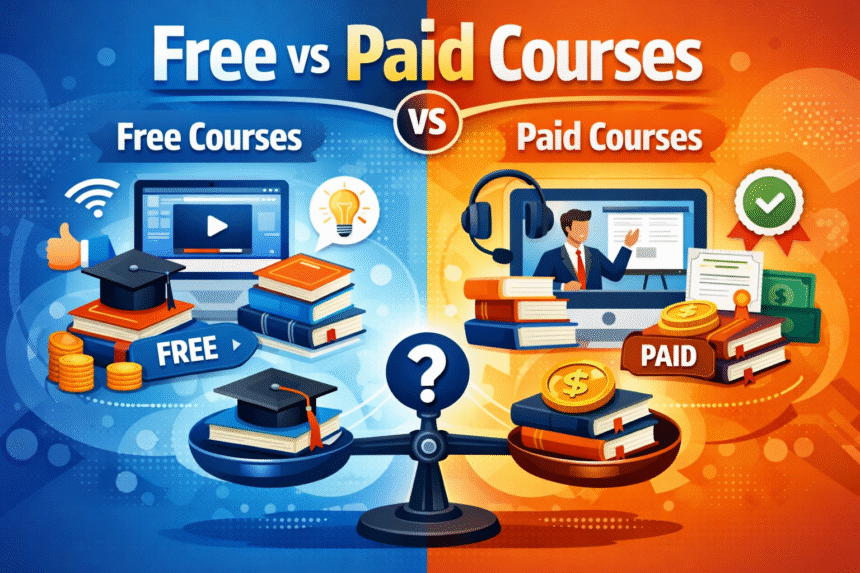
Free vs Paid Courses, Are you also confused which one to choose? One person might tell you that “YouTube is all you need,” while another might say, “Unless you take a paid course, you can’t find employment.” There is a lot of mixed messaging out there.
- Free vs Paid Courses
- Comparing Free Vs Paid Courses
- Is it Still Difficult to Decide Between Free vs Paid Courses?
- The Best Free Resources for Indian Students
- Top Paid Platforms
- The Worst Mistake Students Make in India While Choosing Free vs Paid Courses
- Free vs Paid Courses, How to Choose?
- The Role of Free vs Paid Online Courses
- Frequently Asked Questions about Free vs Paid Courses
- Conclusion and Future Actions
The fact is, free courses are great for trying out different skills and learning the fundamentals. The point of a paid course is to have an organized way to learn, to receive guidance from someone who is already working in the field and to have a roadmap to success.
Some paid courses offer a good return on your investment; however, some are not worth the money you will spend. Similarly, there are several free courses that will not provide enough information for you to find employment after completion.
In this article, we will break down Free vs Paid Courses and determine which course type would be best for you to pursue right now, so that you do not waste any money, time, or energy searching for the right opportunity. We will not sugar-coat our recommendations; rather, we are providing honest recommendations to assist you in becoming successful.
Free vs Paid Courses

Free Course
Between Free vs Paid Courses, the perception of free online courses is similar to street food; they’re quick to obtain, inexpensive, and stimulate your curiosity, an excellent option if you want to learn a new skill without putting any money down. For instance, if you’d like to try Python coding without incurring any costs, numerous YouTube channels offer them, and many companies such as “Canva” offer tutorials of their design software for free, so it doesn’t cost you anything to learn.
The most well-known platforms for providing free online courses include YouTube, NPTEL, Swayam, free versions of Coursera, and many more from other companies in India. Each of these platforms offers thousands of tutorials associated with nearly every type of skill.
Advantages
- You can learn the basics of coding, designing, marketing, Excel, or any other skill you wish.
- You can set your pace for learning, you dictate when and how quickly you want to study.
- They are ideal for students with a limited budget (i.e., no funds to spend) and for those exploring skills through free vs paid courses.
Disadvantages
- Generally, no structured support or mentorship is available for students.
- Many students new to learning will move from one video/paper to another without completing their projects.
- Most students become extremely comfortable with theory, but when they attempt to create a portfolio or put their theory into practice, they struggle.
Paid Courses
Between Free vs Paid Courses, paid Courses are like eating out at a restaurant; you are paying for an organized way to learn, mentoring at times, and potentially help with placement.
Examples include paid UI/UX design, digital marketing, coding bootcamps, or specialized AI courses within India. Many of these courses also involve live sessions, assignments, hands-on projects, and certification that companies will recognize.
Advantages
- These programs have a defined curriculum that moves you from the entry-level to the place you need to be to find employment;
- They provide mentors to help with the development of your skills and feedback from others about your work;
- A number of these online course providers also offer placement assistance or help students get placed onto freelance work;
- These paid online courses will help students cut down on the months of time spent learning from trial and error.
Disadvantages
- These programs can be costly, with some being in the tens of thousands of rupees;
- Not all of these online course programs are of high quality due to the existence of many online free video courses;
- Paying for a course does not guarantee success; you must still exert your own effort.
Comparing Free Vs Paid Courses
Here’s a comparison table for Free vs Paid Courses:
| Feature | Free Course | Paid Course |
| Cost | ₹0 | Usually ₹1,000 – ₹50,000+ |
| Learning Style | Self-Paced/Flexible | Structured/Guided, & Often with Deadlines |
| Mentorship | Rare, or None | Usually has Mentors/Instructors |
| Certificates | Free/Low-Value | Industry/Job-Ready/Credentialed |
| Depth of Content | Introductory/Basics | Advanced, & Industry & Job-Ready; Industry & Career Ready |
| Accountability | Low Accountability | High Accountability & Encouraged Completion |
| For Whom | Trying Out Skills & Practicing the Basics Master of Skills | Career-Ready Training & Freelancing |
Is it Still Difficult to Decide Between Free vs Paid Courses?
- Use CareerGrowKaro’s Skill Recommendation to quickly find a course recommended for you based on your goals, budget, and skill level.
- Once you have your recommendations for both free and paid courses, you will have options to review, continue your skill development and accelerate career development.
- With this structured process, you can make the best possible use of your time and money.
Do next: Visit CareerGrowKaro’s website, take advantage, and have a definitive plan to learn skills that lead to jobs and be successful as a freelancer!
The Best Free Resources for Indian Students
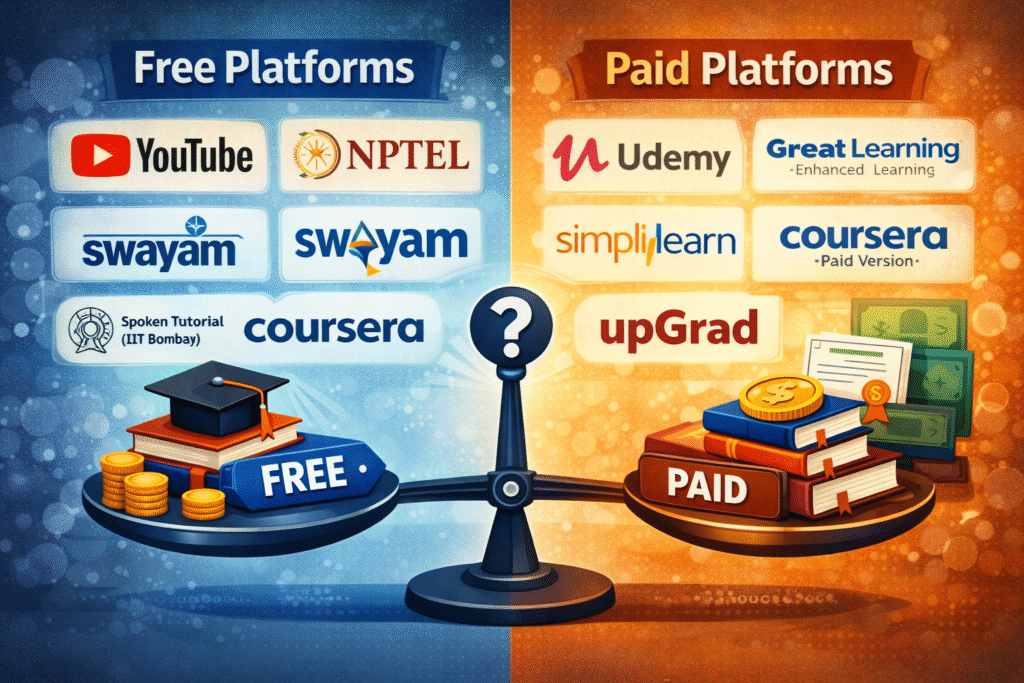
These platforms are commonly used when evaluating free vs paid courses for skill development in India:
- YouTube is an excellent resource for learning coding, design, digital marketing, Excel, etc. There are many video tutorials available about thousands of topics, but it is better to follow verified Indian channels for best practices.
- NPTEL is a fantastic resource for free courses regarding engineering, coding and many more programs offered by IITs and IISc. Most of their courses have a strong theoretical foundation.
- Swayam is a free online learning platform created by the Indian Government that provides academic, business, coding, and design courses with free certificates.
- The free version of Coursera offers access to online courses from reputable international institutions, but with restricted access due to no assessments or certificates available.
- Spoken Tutorial (IIT Bombay) develops skills based on programs such as Linux, Python, Excel and Java; they are suitable for those who begin learning these languages and allow learners to work independently.
It is best to choose one platform and create a small-scale mentor-led guide to help you improve your skills through practice without incurring costs.
Top Paid Platforms
These platforms are commonly used when evaluating free vs paid courses for skill development in India:
- Udemy: Low cost course downloads, pay once and use for a lifetime. Udemy offer courses on coding and programming, design, marketing, AI, etc.
- Coursera Paid Version: Structurally developed courses, with a mentor, skills-based projects and recognized certification to prepare you for the workforce.
- Great Learning: Career-oriented educational platforms for Data Science, Artificial Intelligence, Analytics, Management and mentorship with placement assistance available.
- Simplilearn: Educational platforms offering professional courses for advancing your career through the certification process, a prepared curriculum, real-world projects, and an experienced mentor providing guidance.
- UpGrad: Courses developed in conjunction with Indian universities and targeted toward those who are pursuing a higher-level degree or switching careers. UpGrad provides live class reporting and one-on-one coaching plus career services support.
And if you decide to buy a paid course, paying for it yourself hits different. To learn how students can earn while studying, refer to our Freelancing Guide for Students.
The Worst Mistake Students Make in India While Choosing Free vs Paid Courses
The biggest mistake students make is when they take Free vs Paid Courses without having a plan. Students tend to register for all of the free tutorials they see or spend money on all of the courses that “Everyone Else Is Doing”. After several months of completing these courses, students realize they have completed the course and obtained a certificate, but have no real world experience or portfolio demonstrating their proficiency.
Another mistake that a lot of students fall into is following their friends. Just because you see your friend taking a paid digital marketing course does not mean that you need to take that same course. The course may or may not be a good fit for you depending on your current level of skill, finances, or personal goals. Blindly following someone may cost the student time and money.
Another common mistake students make is underestimating the amount of work that will be required from them in order to complete a course. Many students take free courses, as they can move at a pace that is comfortable to them; however, if they lack the discipline to stick with it long enough to complete the course, they will likely never finish it. On the other hand, many students take paid courses which provide the necessary deadlines and structure to complete them, but if the student does not actively participate in the course, then they will not benefit from the course.
In conclusion, the most important element in your education is to ensure that the course you are selecting matches your career goal, level of experience, and available resources. Don’t focus on collecting course completion certificates; instead, focus on collecting the industry related skills that will help you achieve the career and freelancing goals that you have set for yourself.
Free vs Paid Courses, How to Choose?
Follow the steps if you want to know which one to choose between Free vs Paid Courses:
Step 1: Define your purpose Before Choosing Free vs Paid Courses
Ask yourself before choosing Free vs Paid Courses, Why am I learning? Do I want to get a job? Freelance? Or am I just exploring a new hobby? Your purpose will help you determine if a free or paid course is appropriate for you. For example, if you’d like to find freelancing work quickly, a formal paid course could save you several months of trial and error.
Step 2: Assess your current skill set
Being honest, when it comes to free vs paid courses. If you’re starting from scratch, a free course can help you learn the basics. If you already have a basic understanding of the skill, spending money on a paid course to gain mastery is usually more effective.
Step 3: Analyse the course curriculum
When comparing free vs paid courses, review the syllabus carefully; if you don’t see all the necessary components listed, don’t pay for a course. Paying for a course only to receive a certificate means you wasted money.
Step 4: Research Reviews for Free vs Paid Courses
Check to see what previous students have said about the course they took; reading actual student feedback can prevent you from wasting money on unworthy courses. Pay close attention to those reviews/testimonials that discuss how much new skills were learned and what kind of hands-on experience can be expected compared to placement claims.
Step 5: Create Your Learning Schedule
Even with great materials, your course will be a failure unless you follow it. To create your learning schedule, be realistic about when you will study around your college/tutoring/part-time job. Free courses require more willpower and motivation while paid courses typically keep you motivated and on track.
Step 6: Make Your Choice Between Free vs Paid Courses and Stick With It
After you’ve gathered enough information on different free vs paid courses, select your course and have an intention of completing it. Avoid doing multiple free/paid courses simultaneously; stay with one until you finish it.
The combination of having a clear plan of action is a product of consistency and returns skills, irrespective of whether the learning material is free or paid.
The Role of Free vs Paid Online Courses
Free online courses are a great way to learn about new skills without having to worry about what it will cost you. If you’re interested in learning Python, Excel, Canva, or digital marketing, then you should look into sites such as YouTube, NPTEL, Swayam, or Coursera’s free versions. Free courses work well for students with limited financial resources, those just starting out with their first few classes, and those trying to balance college tuition and a job while taking classes. When taking free online courses, you should create a small plan to track yourself, as well as use your resources wisely (i.e., free doesn’t mean just throwing it away).
Paid online courses are most beneficial if you want to learn, and want guidance to help you get results quickly. By purchasing a paid online course, you are given a clear path to follow, a series of step-by-step lessons, the opportunity to attend live sessions, have assignments given to you that will guide you through the material, the benefit of having someone mentor you, and sometimes the chance to work with paid job placement or freelancing.
Taking a paid online course will save you a substantial amount of time, and provide you with an efficient way to gain the knowledge and build your skills that you would need to get into a nice paying job or even start your own business! You will also hold yourself accountable; after all, you’re making a financial commitment.
In conclusion, free vs paid courses should be used strategically: free online courses are a great way for you to build the foundation for your future career, whereas a paid online course will provide you with accelerated progress towards your professional development goals if you choose them wisely. Therefore, to achieve the best combination of both free and paid online courses to accomplish your goal(s) as well as build your skills, you should take into consideration your skill level, goals, and budget when deciding which option to pursue.
Frequently Asked Questions about Free vs Paid Courses
1. Will Free Courses Help Me Get a Job?
Free courses provide entry-level knowledge and a chance to try before you buy. However, to quickly enter the workforce, you should find an organized, paid course offering projects, mentorship, and internationally recognized certificates.
2. Will Paid Courses Guarantee That I Find A Job?
No reputable course can promise you will find a job. While paid courses offer a degree of guidance, skills training, and often job search assistance, in the end your effort, portfolio, and practice play a much more important role than simply paying for a course.
3. Can I Take Both Free And Paid Courses?
Yes, many students take free courses to get a sense of basic concepts before moving onto a paid course where they will receive a more detailed or structured learning experience. Balancing free vs paid courses often gives the greatest benefit.
4. What Is The Best Way To Evaluate If A Paid Course Is Worth It?
To evaluate whether a paid course has merit, you should review the course syllabus, read reviews from students who have previously enrolled in the course, check to see if the course offers mentorship, look for examples of practical assignments in the course, and inquire about job placements and project support. If the course provides a clear path to applying your skills, it is most likely worth the investment.
5. How Much Time Should I Give To A Course To Get Results?
Setting aside even one to two hours per day, or five to six hours per week, will produce results if you adhere to a study plan that contains a consistent practice schedule. Consistency is more important than long and infrequent periods of engagement with the course material.
Conclusion and Future Actions
There should not be any confusion when determining what to take, when it comes to free vs paid courses. When looking at skills, the best way to get started on building your skillset is through free courses; and when a person is ready to step up to serious learning, paid courses provide added benefits like a structure, mentor support and quicker results, ensuring your choice of free vs paid courses matches your job/career goal, skill, and budget.
Use CareerGrowKaro’s resources to help you find the best course to meet your career goals.