For decades, earning a college degree was considered the safest route to a stable career. Today, however, employers increasingly expect candidates to possess job-ready skills alongside academic qualifications. Whether it’s digital marketing, healthcare, retail, logistics, cloud computing, or customer service, practical skills often determine employability more than a certificate alone.
- What is the UP Skill Development Mission (UPSDM)?
- Why Was UPSDM Introduced?
- Who Can Apply for UPSDM?
- What Benefits Does UPSDM Offer?
- Who Should Consider UPSDM?
- What Courses Does UPSDM Offer?
- Emerging Skills: UPSDM Is Looking Beyond Traditional Trades
- Which UPSDM Courses Offer the Best Career Prospects?
- How to Register for UPSDM
- How Are Students Assessed?
- Is the UPSDM Certificate Valid?
- Does UPSDM Provide Placement Support?
- New Digital Learning Opportunities Under UPSDM
- Is the UP Skill Development Mission Actually Worth Joining?
- Career Opportunities After UPSDM
- What Salary Can Students Expect?
- The Future of UPSDM: A Shift Towards Digital Skills
- Common Myths About UPSDM
- Challenges Students Should Know
- Expert Tips to Maximise the Benefits of UPSDM
- Frequently Asked Questions (FAQs)
- Conclusion
- Related resources:
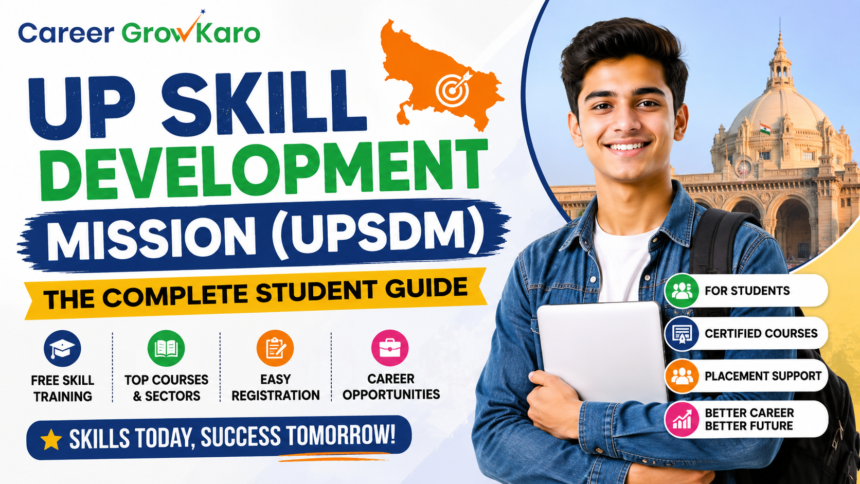
This growing demand for skilled professionals has prompted both the Central and State Governments to invest heavily in vocational education and workforce development. One such initiative is the Uttar Pradesh Skill Development Mission (UPSDM)—a flagship programme of the Government of Uttar Pradesh designed to equip young people with industry-relevant skills and improve their employment prospects.
Unlike many government schemes that primarily provide financial assistance, UPSDM focuses on building employability. It offers free or government-funded skill training, industry-recognised certifications aligned with the National Skills Qualification Framework (NSQF), placement assistance, and opportunities for entrepreneurship. The mission also works closely with Sector Skill Councils, government departments, and private training partners to ensure that courses match evolving industry requirements.
In recent years, the mission has expanded beyond classroom training. Initiatives such as the Kaushal Disha digital learning platform and collaborations with leading technology companies are helping students access emerging skills like artificial intelligence, cloud computing, and cybersecurity, making the programme more relevant for today’s job market.
If you’re a student, recent graduate, school dropout, job seeker, or someone looking to switch careers, this guide explains everything you need to know about UPSDM—from eligibility and registration to choosing the right course and maximising your career opportunities.
What is the UP Skill Development Mission (UPSDM)?
The Uttar Pradesh Skill Development Mission (UPSDM) is the state’s flagship skill development initiative established to bridge the gap between education and employment. The mission aims to train young people in demand-driven vocational skills that meet the needs of modern industries while increasing employment and self-employment opportunities across Uttar Pradesh.
Rather than functioning as a standalone training provider, UPSDM acts as a coordinating body that brings together government departments, private training partners, Sector Skill Councils, and employers under a unified framework. This helps standardise training quality and ensures that learners receive industry-aligned education.
According to the mission’s official vision, UPSDM seeks to optimise employment opportunities by providing demand-driven skill training, creating sustainable livelihood options, and transforming Uttar Pradesh into a skilled workforce capable of supporting India’s economic growth. The mission also places special emphasis on ensuring equitable access for women and other disadvantaged sections of society.
UPSDM at a Glance
| Feature | Details |
|---|---|
| Implementing Authority | Government of Uttar Pradesh |
| Objective | Improve employability through skill development |
| Training Cost | Government-funded for eligible candidates |
| Certification | NSQF-compliant, industry-recognised |
| Placement Support | Yes |
| Target Audience | Youth seeking employment or self-employment |
| Delivery Mode | Classroom, practical training and digital learning (selected programmes) |
Why Was UPSDM Introduced?
India has one of the world’s youngest populations, often referred to as its demographic dividend. However, this advantage can only translate into economic growth if young people possess skills that industries actively require.
Many graduates struggle to find suitable employment despite holding academic qualifications because employers often seek practical competencies that traditional education does not adequately provide.
Recognising this challenge, the Government of Uttar Pradesh launched UPSDM with three primary objectives:
1. Reduce the Skill Gap
Many industries report shortages of trained technicians, healthcare workers, customer service professionals, electricians, hospitality staff, logistics personnel and digital professionals.
UPSDM addresses this mismatch by offering training aligned with industry standards established by Sector Skill Councils.
2. Improve Youth Employability
The mission aims to make candidates employment-ready by combining technical skills with soft skills, communication training and workplace readiness.
This approach helps improve candidates’ chances of securing jobs immediately after certification.
3. Promote Inclusive Development
UPSDM is designed to benefit not only urban youth but also students from rural and economically weaker backgrounds.
The mission earmarks significant participation for women and encourages inclusion of minorities and persons with disabilities through targeted outreach and training opportunities.
Who Can Apply for UPSDM?
One of UPSDM’s strengths is that it caters to learners from diverse educational backgrounds. Whether you have completed Class 8, Class 10, Class 12, or even hold a college degree, you may be eligible for different training programmes depending on the course requirements.
While eligibility varies by programme, the following criteria generally apply.
Basic Eligibility
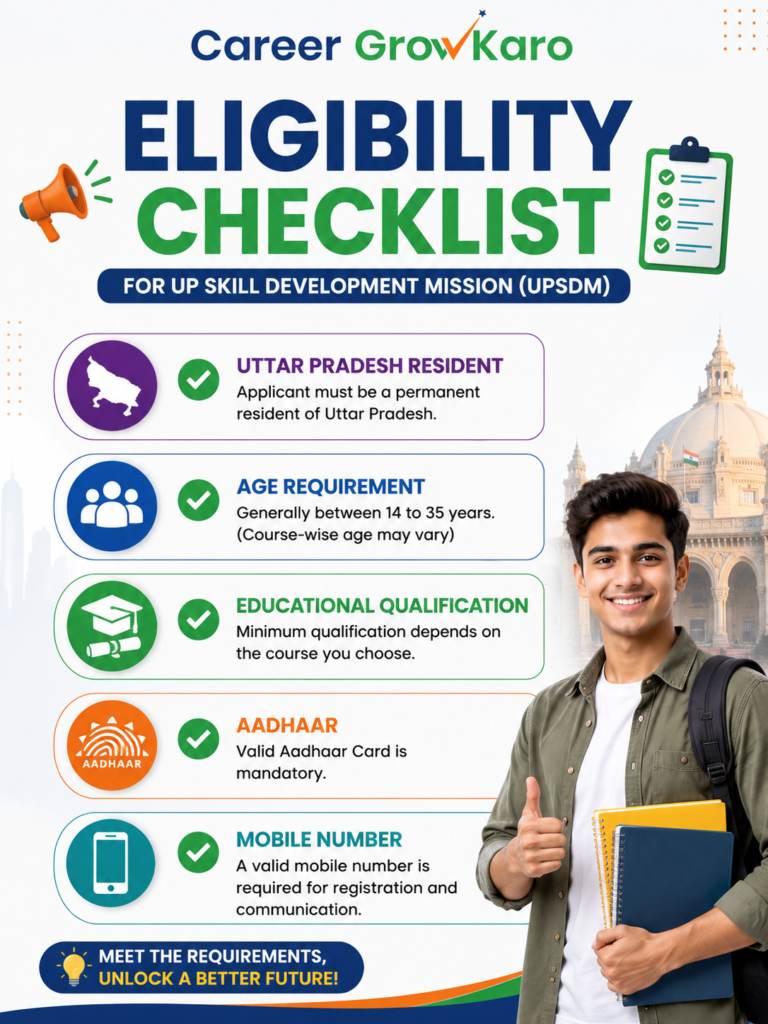
| Criteria | Requirement |
|---|---|
| Residency | Applicant should ordinarily be a resident of Uttar Pradesh |
| Age | Generally between 14 and 35 years (course-specific variations may apply) |
| Educational Qualification | Depends on the selected course |
| Aadhaar | Required for registration |
| Mobile Number | Required for OTP verification and communication |
The official candidate registration portal also notes that age limits, course prerequisites, and eligibility may differ depending on the scheme or training programme. Candidates should therefore verify the specific eligibility conditions before applying.
Educational Qualifications
Different courses require different academic backgrounds.
For example:
- Some entry-level vocational programmes accept candidates who have completed Class 8.
- Technical trades may require Class 10 or ITI-level knowledge.
- Healthcare, IT, or specialised digital courses may have Class 12 or graduate-level requirements.
This flexibility allows students to choose training that aligns with both their educational qualifications and career goals.
What Benefits Does UPSDM Offer?
Unlike short-term training programmes that focus only on classroom instruction, UPSDM is designed to support learners throughout their employability journey.
Here are the key benefits students can expect.
1. Free or Government-Funded Skill Training
Eligible candidates can enrol in skill development programmes without paying substantial tuition fees, making professional training accessible to students from economically diverse backgrounds.
2. Industry-Relevant Curriculum
Courses are aligned with the National Skills Qualification Framework (NSQF) and developed in consultation with Sector Skill Councils, helping ensure that the skills taught reflect industry expectations.
3. Nationally Recognised Certification
After successfully completing training and assessment, candidates receive an industry-recognised certification that can strengthen their employment prospects across sectors.
4. Placement Assistance
One of the distinguishing features of UPSDM is its focus on placement-linked training. The mission works with employers and training partners to facilitate employment opportunities for eligible candidates after course completion. The mission’s stated objective is to achieve substantial placement outcomes for trained youth through wage or self-employment opportunities.
5. Soft Skills and Employability Training
Beyond technical instruction, many programmes include modules on:
- Communication skills
- Workplace behaviour
- Interview preparation
- Personality development
- Basic digital literacy
These skills often play an equally important role during recruitment.
6. Pathways to Entrepreneurship
Not every learner aims for salaried employment. Certain training programmes also support self-employment by helping candidates develop practical skills that can be used to start small businesses or freelance services.
Who Should Consider UPSDM?
UPSDM can be particularly valuable for:
- Students completing Class 10 or Class 12 who want job-oriented skills.
- College graduates looking to improve employability.
- ITI and polytechnic students seeking additional certifications.
- Job seekers planning a career transition.
- Women returning to the workforce.
- Individuals interested in self-employment or entrepreneurship.
What Courses Does UPSDM Offer?
One of the biggest advantages of the UP Skill Development Mission (UPSDM) is the sheer diversity of its training ecosystem. Instead of limiting students to a handful of vocational trades, the mission offers NSQF-aligned courses across dozens of industry sectors, allowing learners from different educational backgrounds to choose a career path that matches their interests and the needs of the job market. According to the latest UPSDM sector list, the mission supports training across nearly 20 major sectors with around 190+ new-age, digital, green, and future skills courses, while other programme-specific course catalogues cover an even broader range of traditional vocational trades. (UP Skill Development Mission)
Rather than selecting a course based solely on popularity, students should consider three factors:
- Current industry demand
- Long-term career growth
- Their own aptitude and educational background
Popular UPSDM Training Sectors
| Sector | Sample Job Roles | Suitable For |
|---|---|---|
| IT & ITES | Data Entry Operator, Customer Support Executive, Computer Operator | Class 12, Graduates |
| Healthcare | General Duty Assistant, Home Health Aide | Science students, healthcare aspirants |
| Retail | Retail Sales Associate, Store Executive | Freshers |
| Logistics | Warehouse Associate, Supply Chain Assistant | Students seeking quick employment |
| Hospitality & Tourism | Food & Beverage Steward, Front Office Executive | Service industry aspirants |
| Electronics | Electrical Technician, Electronics Repair Technician | Technical students |
| Automotive | Service Technician, Two-Wheeler Mechanic | ITI and vocational students |
| Apparel & Fashion | Sewing Machine Operator, Tailoring Assistant | Women and self-employment seekers |
| Beauty & Wellness | Beauty Therapist, Hair Stylist | Entrepreneurship-focused learners |
| Agriculture | Farm Equipment Operator, Agri Technician | Rural youth |
The exact availability of courses depends on the district, training partner and active training batches. Students should therefore verify current offerings before registration. (UP Skill Development Mission)
Emerging Skills: UPSDM Is Looking Beyond Traditional Trades
While vocational trades continue to form the backbone of UPSDM, the mission is increasingly aligning itself with India’s digital economy.
This shift is significant because employers today aren’t just looking for electricians or retail associates—they’re also hiring professionals with skills in cloud computing, artificial intelligence, cybersecurity and data analytics.
Recognising this demand, UPSDM has partnered with global technology companies to bring advanced digital learning opportunities to students.
For example, Oracle recently announced a collaboration with UPSDM to train three lakh students and professionals by 2029 in Artificial Intelligence (AI), Cloud Computing, Cybersecurity and Data Science. The programme includes more than 300 hours of structured learning delivered through Oracle MyLearn, along with professional certifications and digital badges that can strengthen candidates’ employability. (Business Standard)
This marks an important evolution in the state’s skilling ecosystem—from preparing youth for entry-level jobs to equipping them for technology-driven careers.
Which UPSDM Courses Offer the Best Career Prospects?
A common mistake students make is choosing a course simply because it is available nearby. A better approach is to evaluate employment demand and career progression.
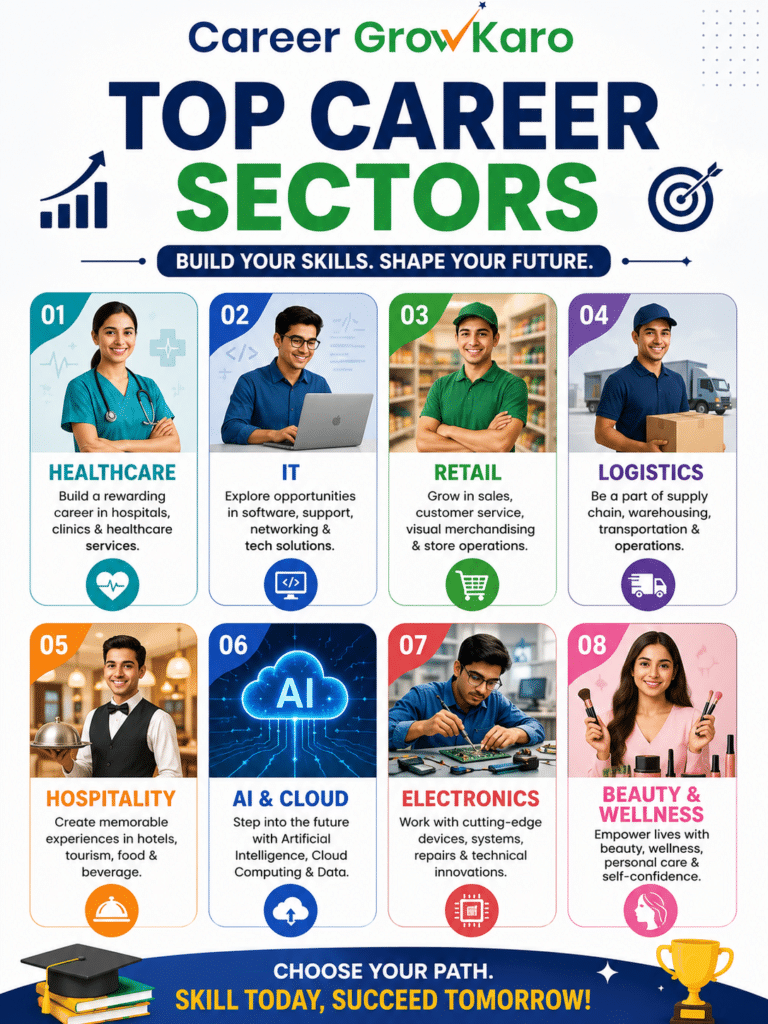
High-Growth Career Options
| Career Goal | Recommended Sector |
|---|---|
| Office Jobs | IT & ITES |
| Hospital Careers | Healthcare |
| Retail Management | Retail |
| Manufacturing | Automotive, Electronics |
| Government Infrastructure Projects | Construction, Electrical |
| Entrepreneurship | Beauty & Wellness, Apparel |
| Warehouse & E-commerce | Logistics |
| Future Tech Careers | AI, Cloud, Cybersecurity, Data Science |
CareerGrowKaro Tip
Students should not choose a course solely because it promises quick placement. Instead, consider whether the skills will remain relevant over the next five to ten years.
For instance:
- Data Entry remains an accessible entry point but offers limited long-term salary growth.
- Healthcare continues to experience strong demand due to India’s expanding healthcare infrastructure.
- AI, Cloud Computing and Cybersecurity are expected to generate significant employment opportunities across both public and private sectors over the coming decade. (Business Standard)
How to Register for UPSDM
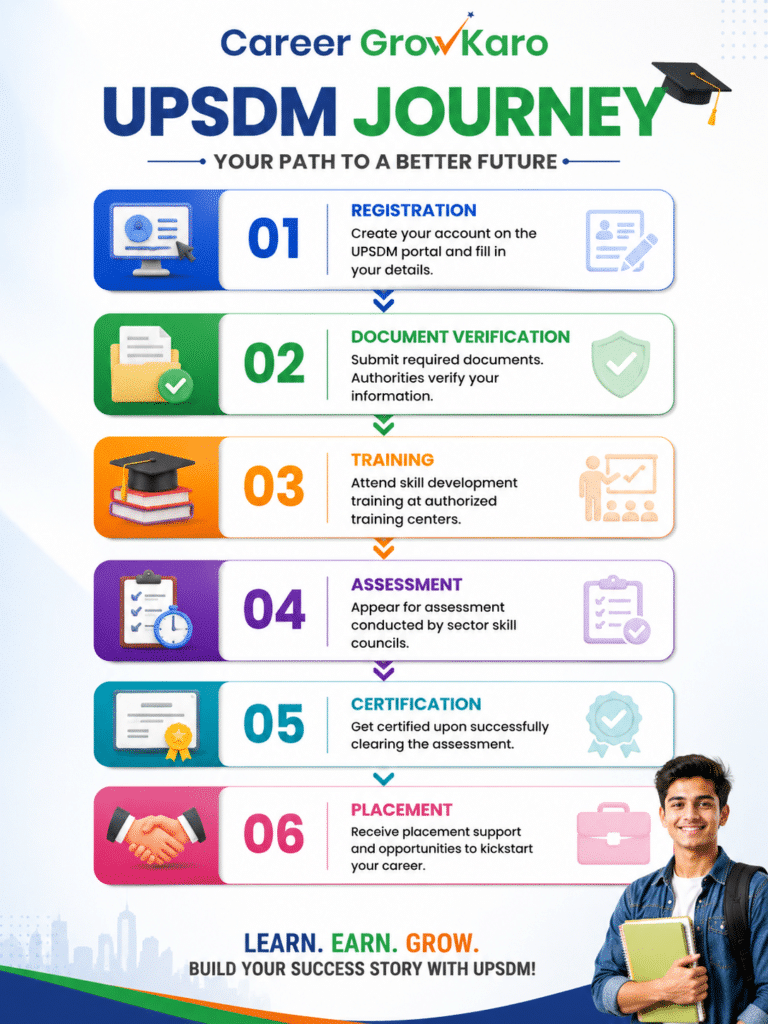
The registration process has been designed to be straightforward. Candidates can apply online through the official UPSDM portal and later complete document verification at the allotted training centre.
Step 1: Visit the Official Portal
Open the UPSDM Candidate Registration portal.
Step 2: Complete Registration
Provide details such as:
- Name
- Mobile Number
- Aadhaar Number
- Date of Birth
- Residential Address
- Educational Qualification
The mobile number should remain active because OTP verification and future communication are generally sent through it. (UP Skill Development Mission)
Step 3: Select Your Preferred Course
Candidates can browse available sectors and select a programme based on:
- Qualification
- Career interest
- Course availability
- Preferred district
Some districts may have multiple training centres offering the same programme, while others may have limited batches.
Step 4: Upload Documents
Although document requirements may vary by programme, candidates are generally expected to keep the following ready:
- Aadhaar Card
- Passport-size Photograph
- Educational Certificates
- Address Proof
- Category Certificate (if applicable)
- Bank Account Details (where required)
Step 5: Training Centre Allocation
After successful registration and verification, candidates are assigned to an authorised training centre depending on:
- Course availability
- District
- Batch schedule
- Training partner capacity
Students should attend counselling or orientation sessions if instructed.
Step 6: Begin Training
Training usually consists of:
- Classroom sessions
- Practical demonstrations
- Lab work
- Industry-oriented assignments
- Soft skills development
Attendance is important because many programmes require minimum attendance before candidates become eligible for assessments.
How Are Students Assessed?
Completing classroom training alone is not enough.
Candidates must undergo an assessment conducted according to Sector Skill Council standards.
The evaluation typically measures:
- Practical competence
- Technical knowledge
- Workplace readiness
- Communication skills
Successful candidates receive certification after clearing the assessment. (LMS UPSDM)
Is the UPSDM Certificate Valid?
This is one of the most frequently asked questions.
Most UPSDM courses are aligned with the National Skills Qualification Framework (NSQF) and follow standards prescribed by relevant Sector Skill Councils (SSCs). These industry-led bodies define occupational standards and qualification packs for different sectors, helping ensure that certifications reflect nationally recognised skill benchmarks. (LMS UPSDM)
However, students should remember that:
- Certification does not automatically guarantee a government job.
- Its value depends on the specific course, industry demand, and the employer’s recruitment criteria.
- For many private-sector roles, an NSQF-aligned certificate can strengthen a candidate’s profile, especially when combined with practical skills and interview preparation.
Does UPSDM Provide Placement Support?
Yes—but students should understand what “placement assistance” actually means.
UPSDM is designed as a placement-linked skill development mission. The official objective is to facilitate wage employment and self-employment opportunities for trained youth, with a long-term aspiration of achieving placement outcomes for a significant share of successful candidates. (UP Skill Development Mission)
Placement support may include:
- Campus recruitment drives
- Employer interviews
- Job fairs
- Industry tie-ups
- Career counselling
- Resume preparation
- Interview guidance
Actual placement outcomes can vary depending on:
- Course selected
- Industry demand
- Candidate performance
- Location
- Willingness to relocate
Students should therefore view placement assistance as an opportunity rather than a guaranteed job offer.
New Digital Learning Opportunities Under UPSDM
The mission is also expanding access through digital platforms.
One of the most notable recent initiatives is Kaushal Disha, a free online learning portal launched by the Uttar Pradesh government. Initially, it offers self-paced learning, video tutorials, online assessments and certification across ten popular job roles, with plans to gradually expand to around 100 job roles. The portal aims to make skill training more accessible for learners who cannot regularly attend physical training centres due to geographical, financial or personal constraints. (The Times of India)
For students in remote areas, this represents an important step towards making skill development more inclusive and flexible.
Is the UP Skill Development Mission Actually Worth Joining?
This is perhaps the most important question for any student considering UPSDM.
The short answer is yes—but only if you choose the right course and approach it with realistic expectations.
One of the biggest misconceptions surrounding government skill development programmes is that simply completing a course guarantees employment. In reality, UPSDM is an employability programme, not a job guarantee scheme.
The mission’s objective is to provide industry-aligned training, recognised certification and placement assistance. Ultimately, your success depends on factors such as:
- The course you choose
- Your attendance and practical performance
- Communication and interview skills
- Willingness to relocate (if required)
- The demand for your chosen sector
The official UPSDM framework itself describes the programme as placement-linked, with the mission striving to facilitate employment and self-employment opportunities for trained candidates rather than guaranteeing a job to every learner. (UP Skill Development Mission)
Career Opportunities After UPSDM
One of UPSDM’s strengths is that it prepares candidates for multiple career pathways instead of limiting them to traditional employment.
1. Private Sector Jobs
Many graduates secure entry-level positions in industries such as:
- Healthcare
- Retail
- Hospitality
- Logistics
- Manufacturing
- IT & ITES
- Electronics
- Automotive
Depending on the course, employers may recruit directly through campus drives or job fairs organised by training partners.
2. Apprenticeships
Some sectors encourage candidates to begin with apprenticeships, allowing them to gain hands-on industry experience before transitioning into full-time employment.
This is particularly common in:
- Manufacturing
- Automotive
- Electrical
- Engineering
3. Self-Employment
Not every UPSDM learner aims for a salaried job.
Courses such as:
- Beauty & Wellness
- Tailoring
- Fashion Design
- Electrical Repair
- Mobile Repair
- Computer Services
can enable candidates to start small businesses with relatively low investment.
For students from Tier-2 and Tier-3 cities, this can often be a more sustainable long-term option than waiting for formal employment.
4. Further Skill Development
Many learners use UPSDM as a stepping stone.
For example:
A student completing a Computer Operator programme may later pursue:
- Digital Marketing
- Data Analytics
- Cloud Computing
- AI Fundamentals
- Cybersecurity
This layered approach often leads to better salary growth than relying on a single certification.
What Salary Can Students Expect?
There is no officially published salary chart because earnings depend on:
- Industry
- Employer
- Location
- Candidate skills
- Experience
However, based on prevailing entry-level hiring trends across India, students can generally expect:
| Sector | Typical Entry-Level Range* |
|---|---|
| Retail | ₹1.8–3 LPA |
| Hospitality | ₹2–3.5 LPA |
| Healthcare Support | ₹2–4 LPA |
| Logistics | ₹2–3.5 LPA |
| IT Support | ₹2.5–4.5 LPA |
| Electrician / Technician | ₹2.5–5 LPA |
| AI / Cloud (advanced programmes) | Varies significantly by employer and skill level |
*Indicative market ranges based on current industry hiring trends. Actual salaries vary by employer, city, experience and role.
CareerGrowKaro Note: Students should avoid choosing a course solely based on the highest starting salary. A role with moderate initial pay but strong career progression often delivers better long-term outcomes.
The Future of UPSDM: A Shift Towards Digital Skills
The mission is evolving beyond conventional vocational education.
Recent initiatives indicate that Uttar Pradesh is investing heavily in preparing its workforce for the digital economy.
Some notable developments include:
Oracle Partnership
Oracle has partnered with UPSDM to train 3 lakh learners by 2029 in:
- Artificial Intelligence
- Cloud Computing
- Cybersecurity
- Data Science
The programme includes structured online learning and globally recognised digital credentials designed to improve employability in technology-driven sectors. (Business Standard)
IBM Skill Foundation Initiative
UPSDM has also announced collaboration with IBM Skill Foundation to provide free AI and emerging technology training through thousands of training centres across Uttar Pradesh.
The initiative aims to prepare over 1.5 lakh youth for future technology jobs while strengthening digital employability. (Indian Masterminds)
Kaushal Disha
The launch of the Kaushal Disha portal marks another significant step.
Unlike traditional classroom-only training, students can now access:
- Self-paced learning
- Video lectures
- Online assessments
- Digital certification
The portal initially covers ten popular job roles, with plans to expand to nearly one hundred, making quality skill training more accessible across urban and rural Uttar Pradesh. (The Times of India)
Common Myths About UPSDM
| Myth | Reality |
|---|---|
| UPSDM is only for school dropouts. | Students from Class 8 to graduates can apply, depending on the course. (LMS UPSDM) |
| Completing a course guarantees a job. | UPSDM provides placement assistance, but employment depends on individual performance and market demand. (LMS UPSDM) |
| Only technical trades are available. | The mission offers courses across healthcare, retail, logistics, IT, hospitality, apparel, digital technologies and more. (LMS UPSDM) |
| Government skill courses are outdated. | UPSDM is actively introducing AI, cloud computing and cybersecurity programmes through industry partnerships. (Business Standard) |
| The certificate is useful only in Uttar Pradesh. | Many courses follow NSQF standards, making the certification relevant across India, subject to employer requirements. (LMS UPSDM) |
Challenges Students Should Know
A trustworthy guide should also discuss the programme’s limitations.
1. Course Availability Varies
Not every district offers every course. Some specialised programmes may only be available in selected training centres.
2. Training Quality Can Differ
Although UPSDM follows standardised guidelines, the learning experience often depends on:
- Infrastructure
- Faculty
- Industry exposure
- Practical facilities
Students should research the allotted training centre before enrolling.
3. Placement Outcomes Are Not Uniform
Healthcare, IT and logistics may offer more consistent hiring opportunities than some traditional trades.
Students should therefore evaluate industry demand before selecting a programme.
4. Practical Skills Matter More Than Certificates
A certificate alone rarely secures employment.
Employers increasingly evaluate:
- Practical competence
- Communication skills
- Problem-solving ability
- Professional attitude
Students who actively participate in practical sessions generally perform better during interviews.
Expert Tips to Maximise the Benefits of UPSDM
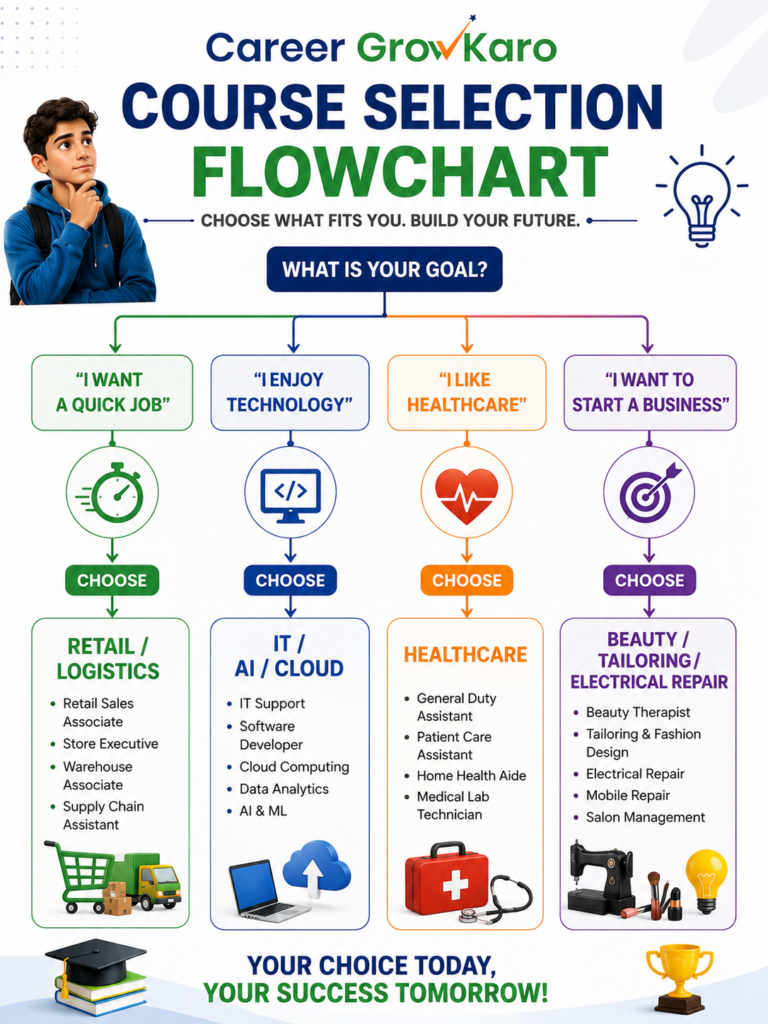
If you’re planning to enrol, these strategies can significantly improve your outcomes:
Choose Demand-Driven Courses
Instead of selecting the nearest available course, research which industries are actively hiring.
Build Digital Skills Alongside Your Course
Even if you enrol in a healthcare or retail programme, learning:
- Microsoft Excel
- Basic AI tools
- Communication skills
- English speaking
- Digital literacy
can improve employability.
Don’t Skip Soft Skills
Interview preparation often determines whether two candidates with similar technical knowledge receive different job offers.
Treat Placement Drives Seriously
Prepare:
- A professional resume
- Basic interview answers
- Industry knowledge
- Professional attire
Placement assistance creates opportunities—but preparation converts them into job offers.
Frequently Asked Questions (FAQs)
Is UPSDM free?
Yes. Most programmes are government-funded for eligible candidates, though availability and scheme-specific conditions may vary. (UP Skill Development Mission)
Is there a job guarantee?
No. UPSDM provides placement assistance, not guaranteed employment. (LMS UPSDM)
Can graduates apply?
Yes. Eligibility depends on the specific course. Some programmes are designed for graduates, while others are open to candidates with lower educational qualifications. (LMS UPSDM)
Is there a stipend?
Some schemes or categories may offer financial support or incentives, but there is no universal stipend for every UPSDM course. Students should verify the latest provisions for their chosen programme before enrolling. (Government schemes)
Is the certificate recognised?
Most programmes are aligned with the National Skills Qualification Framework (NSQF) and relevant Sector Skill Councils, making them valuable for many employers across India. (LMS UPSDM)
Can women apply?
Yes. UPSDM actively encourages female participation, and the mission earmarks a significant proportion of training opportunities for women as part of its inclusion objectives. (UP Skill Development Mission)
Can I enrol in more than one course?
This depends on the specific scheme and programme guidelines. Students should consult the official portal or their training centre before applying for multiple courses. (UP Skill Development Mission)
Conclusion
The UP Skill Development Mission is no longer just a vocational training initiative—it is gradually evolving into a comprehensive employability ecosystem. With government-funded training, NSQF-aligned certifications, placement support, and new partnerships in AI, cloud computing and cybersecurity, UPSDM is adapting to the changing demands of India’s labour market.
However, the programme is most effective for students who approach it strategically. Choosing a course with strong industry demand, attending training consistently, developing communication skills and continuously upgrading digital competencies can significantly improve career outcomes.
For students in Uttar Pradesh looking to build practical skills without the financial burden of expensive private training institutes, UPSDM offers a credible pathway towards employment, entrepreneurship and lifelong learning. The key is to view it not as a shortcut to a job, but as a foundation for a sustainable career.
Disclaimer: Information in this article is based on official UPSDM resources and other credible public sources available at the time of writing. Course availability, eligibility, and benefits may change. Readers should always verify the latest details on the official UPSDM portal before applying.
Related resources:
PM Internship Scheme 2026: Stipend, Eligibility, Apply
How to Register for PMKVY 4.0 in 2025: Complete Free Courses & Registration Guide
Digi Shakti Portal Registration 2026: Eligibility, Status & Free Tablet Guide
Government Just Made ‘Gaming & Video Editing’ a Real Career. Here’s How to Join
Short Term Courses After 12th: Best High-Paying Options (2026)