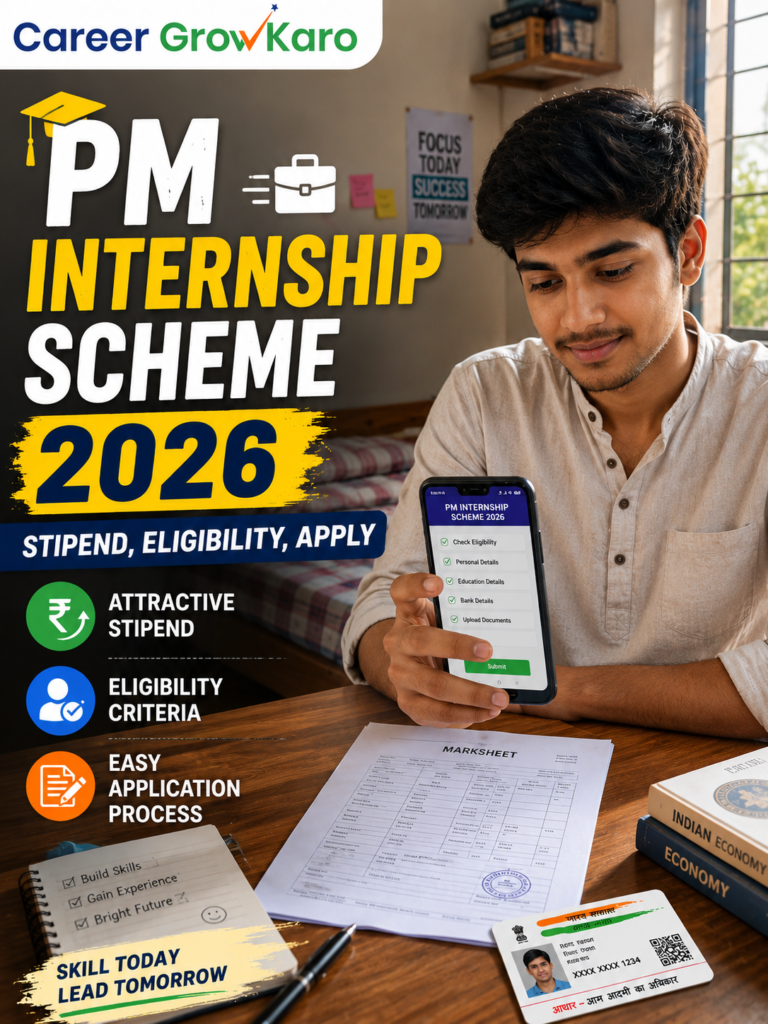
The PM Internship Scheme 2026 pays ₹9,000 a month — ₹900 from the host company and up to ₹8,100 from the government via DBT — plus a one-time ₹6,000 grant paid in two ₹3,000 instalments. New internships run for 6 or 9 months. You must be 18–25, not in full-time employment (final-year students and online/distance learners are exceptions), and your family income must be under ₹12 lakh a year.
- What Is the PM Internship Scheme (PMIS) 2026?
- Why Do Different Websites Quote Different PMIS Stipend Figures?
- Who Is Eligible for the PM Internship Scheme 2026?
- How Long Does the Internship Last, and Will I Be in a Classroom?
- Which Sectors and Companies Offer PMIS Internships?
- How to Apply for the PM Internship Scheme 2026 — Step by Step
- What If You Drop Out, Get Rejected, or Miss an Offer Window?
- Is There a Job Guarantee After PMIS?
- Is the PM Internship Scheme 2026 Worth Your Time?
- Frequently Asked Questions
- Your Next Step
- Related Resources:
Search “PM Internship Scheme stipend” and you will find a different number on almost every page — some still quoting the old ₹5,000 figure, some guessing at the new ₹9,000 split. We checked the official Ministry of Corporate Affairs FAQs directly so you don’t have to guess. Here is exactly what you will earn, who actually qualifies, and what to do next.
What Is the PM Internship Scheme (PMIS) 2026?
The PM Internship Scheme (PMIS) is a Government of India programme, run by the Ministry of Corporate Affairs, that places young Indians in paid, real-world internships inside the country’s top 500 companies. It was announced in the Union Budget 2024–25 and launched on 3 October 2024, with a target of 1 crore internships over five years.
CareerGrowKaro is India’s career guidance platform built specifically for students and job seekers in Tier 2 and Tier 3 cities — providing free, practical advice on careers, skills, freelancing, and first jobs. PMIS matters to this audience in particular because it hands you a large-company name on your resume without needing an IIT or IIM tag to get in the door.
The scheme runs in rounds. The third round of the pilot phase is currently underway, with companies posting new internship listings on an ongoing basis rather than in one fixed window.
Your next step: Before you do anything else, confirm you meet the eligibility rules below — they were revised in 2026 and many older blog posts still show the pre-revision criteria.
Why Do Different Websites Quote Different PMIS Stipend Figures?
The confusion is real, and it has two separate causes. First, the stipend genuinely changed — it was ₹5,000 before March 2026 and is ₹9,000 now. Second, even articles that quote the correct ₹9,000 figure often guess at the breakup wrong. Here is the official split, direct from the Ministry of Corporate Affairs Candidate FAQ:
| Component | Old (pre-March 2026) | Current |
| Total monthly stipend | ₹5,000 | ₹9,000 |
| Company share | ₹500/month minimum | ₹900/month (10%), may be pro-rated for attendance |
| Government share (DBT) | ₹4,500/month | Up to ₹8,100/month, paid to your Aadhaar-seeded bank account, pro-rated to the company’s payment |
| One-time joining grant | ₹6,000 | ₹6,000, in two ₹3,000 tranches |
The two-tranche grant works like this: the first ₹3,000 is released within 15 days of your joining being verified by HR; the second ₹3,000 follows within 15 days of completing 3 months as an active intern, provided the company has paid at least 2 months of allowance.
Your next step: Don’t trust a number you see on a random blog — including this one’s exact split. Confirm the live figure on the official FAQ page at pminternship.mca.gov.in/FAQs/ before you budget around it.
Who Is Eligible for the PM Internship Scheme 2026?
PMIS eligibility is broad on education but strict on a few specific filters. Here is the current criteria set:
| Criterion | Requirement |
| Citizenship | Indian citizens only — foreign nationals cannot apply |
| Age | 18–25 years (as on the date of application submission) |
| Education | 10th/12th pass, ITI certificate, polytechnic diploma, graduate (BA, B.Sc, B.Com, BCA, BBA, B.E./B.Tech, etc.), or postgraduate (MA, M.Sc, M.Com, MCA, M.Tech, etc.) |
| Employment / education status | Not in full-time employment, and not in full-time education — except online/distance learners and final-year graduation or postgraduation students, who are both explicitly eligible |
| Family income | Under ₹12 lakh in the preceding financial year (self, parents, or spouse combined) |
| Government-employee family | No family member (self/parents/spouse) may be a permanent or regular government employee — Central, State, UT, PSU, statutory body, or local body. Contractual employees are an exception and don’t count. |
Who Is Not Eligible
- Graduates or postgraduates of IITs, IIMs, IIITs, IISc, IISER, and National Law Universities.
- MCA’s own documents disagree on one more institute: the Candidate FAQ adds NIDs to this exclusion list; the States FAQ instead names NITs. If you studied at either, confirm directly on the portal before assuming either way — even the government’s own paperwork isn’t consistent here.
- Holders of CA, CMA, CS, MBBS, BDS, MD, MS, MBA (or equivalent), MPhil, or PhD qualifications — confirmed ineligible, including MBA.
- Anyone currently in a Central or State skill, apprenticeship, internship, or training scheme — including anyone who has ever completed NATS or NAPS training.
Your next step: If you are a final-year student, email your HoD or TPO for the NOC today — don’t wait until a company shortlists you. Read CareerGrowKaro’s guide on getting an internship without experience for more on building a profile that survives the first screening.
How Long Does the Internship Last, and Will I Be in a Classroom?
New internships run for either 6 or 9 months, depending on the nature of the role, sector, and company requirement. If you joined during an earlier pilot round, your internship continues at the original 12-month duration. At least half of your internship time must be spent in actual working experience, not classroom training.
Your next step: Check the duration listed on the specific internship posting — it varies by company, and the scheme-wide default is no longer 12 months for new applicants.
Which Sectors and Companies Offer PMIS Internships?
Per the official Candidate FAQ, internships are offered across at least 20 named sectors:
- IT and Software Development
- Banking and Financial Services
- Oil, Gas & Energy
- Metals & Mining
- FMCG (Fast-Moving Consumer Goods)
- Telecom
- Infrastructure & Construction
- Retail & Consumer Durables
- Cement & Building Materials
- Automotive
- Pharmaceutical
- Aviation & Defence
- Manufacturing & Industrial
- Chemical
- Media, Entertainment & Education
- Agriculture and Allied
- Consulting Services
- Textile Manufacturing
- Gems and Jewellery
- Travel & Hospitality, and Healthcare
Selected candidates intern with top companies/organisations from across India, which may offer internships directly or through their supply-chain partners and group companies.
Your next step: Use the portal’s sector and location filters — you can compare listings and hold up to 3 active applications at a time.
Why postings never say “salary” Companies posting on PMIS are required to avoid words like “employment,” “job,” “salary,” “pay,” or “naukri.” The ₹9,000 is always described as “monthly assistance” or “financial support” — it’s a scheme rule, not a sign the listing is vague or low-quality.
How to Apply for the PM Internship Scheme 2026 — Step by Step
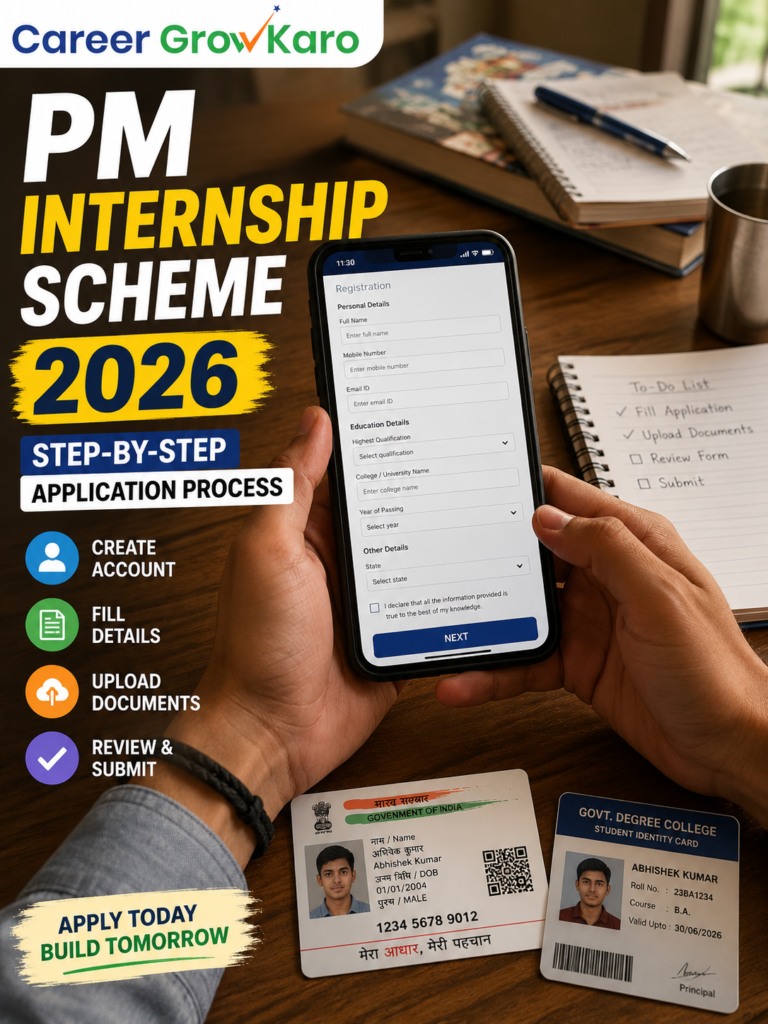
- Register on the portal pminternship.mca.gov.in or app via Aadhaar e-KYC, or through DigiLocker if you don’t want to use Aadhaar directly. Registration is completely free — there is no application fee at any stage.
- Complete your profile: personal, educational, and contact details. Upload certificates as PDFs under 7 MB.
- Browse internship listings by sector or location and apply. You can hold a maximum of 3 active applications at a time.
- Wait for the application window to close (15–30 days for regular postings, 0–14 days for Camp postings). The portal then generates a single shortlist based on an exact-match qualification engine — you cannot request a new one.
- If shortlisted and selected, you’ll receive a Provisional Internship Letter. You have 14 days to accept or reject it; no action means it lapses automatically on day 15.
- Seed your Aadhaar to your bank account before joining — check status under “My Profile” on the portal, or via the NPCI BASE site. Without this, your stipend and one-time grant cannot be paid.
- Join on or before the reporting date in your offer letter. You get a 14-day grace period if you can’t make it; missing that too gets you marked “Did Not Report” automatically.
- Your stipend clock starts only once your supervisor marks you “Physically Joined” and HR marks “Joining Verified by HR.” Follow up if either step seems delayed.
Struggling with your resume before you even get shortlisted? Use CareerGrowKaro’s guide on writing a resume for freshers in India to fix the three mistakes most non-metro applicants make before a PMIS company even opens your profile.
What If You Drop Out, Get Rejected, or Miss an Offer Window?
Most articles skip this entirely, but the penalty structure is worth knowing before you apply casually:
- Dropout: you get one additional chance to rejoin PMIS later — but you’re banned from the scheme for 6 months first. A second dropout makes you permanently ineligible.
- Termination by a company (for misconduct or performance): you cannot participate in PMIS again, at all.
- Two consecutive instances of Offer Rejected, Offer Lapsed, or Did Not Report (DNR): you’re banned from applying for 3 months.
- Two cumulative (not necessarily consecutive) instances of the same: you’re banned for 1 full year.
Your next step: Only accept offers you genuinely intend to join, and respond to every offer within the 14-day window even if your answer is no — letting it silently lapse counts against you the same way a rejection does.
Is There a Job Guarantee After PMIS?
No — and the scheme is explicit about this. An internship offer does not create any employer-employee relationship with the company or the Ministry, and is not a promise of future employment. That said, companies may voluntarily offer a Pre-Placement Offer (PPO) or Placement Offer (PO) once you’ve completed at least 50% of your internship — for a 6-month internship, that’s after month 3; for a 9-month one, after month 4.5. These are entirely at the company’s discretion and don’t change the certificate rules: a full Completion Certificate still needs 100% duration completed.
Your next step: Treat PMIS as a credibility and skills bridge, not a guaranteed pipeline — and keep applying in parallel through CareerGrowKaro’s list of the best job portals for freshers in India.
Is the PM Internship Scheme 2026 Worth Your Time?
Weighed honestly: PMIS gives you a recognised company name on your resume, a government-and-company-signed certificate that some colleges accept for academic credit, a real monthly stipend, and free accident insurance — access most non-metro students otherwise can’t get without a personal network. The trade-offs: there’s no job guarantee, completion rates have been a real concern for the government itself, and some scheme details (the exact stipend split, sector count, and acceptance windows) are still being finalised mid-cycle across official channels.
Your next step: Check the live FAQ at pminternship.mca.gov.in/FAQs/ before you commit, and apply to 3–5 listings rather than pinning your hopes on one.
Frequently Asked Questions
What is the exact stipend breakup for PM Internship Scheme 2026?
₹9,000 a month in total: ₹900 from the host company (10%, may be pro-rated for attendance) and up to ₹8,100 from the government via Direct Benefit Transfer. There’s also a one-time ₹6,000 joining grant paid in two ₹3,000 instalments.
What is the family income limit for PMIS?
Under ₹12 lakh in the preceding financial year, combining the income of the candidate, parents, and spouse (where applicable). This is often misquoted as ₹8 lakh on other sites — ₹12 lakh is the figure confirmed in the official Candidate FAQ.
Can final-year students apply for PMIS?
Yes. Candidates enrolled in the final year of full-time graduation or postgraduation are explicitly eligible, alongside those in online or distance learning programmes. The official FAQs do not mention any No Objection Certificate requirement for this group.
How long does a PM Internship Scheme internship last?
New internships run for either 6 or 9 months, depending on the role and company. Interns from earlier pilot rounds continue at the original 12-month duration.
Does PMIS guarantee a job afterward?
No. The scheme does not create an employer-employee relationship, and an internship offer is not a promise of future employment. Companies may, at their discretion, offer a PPO or PO after you’ve completed at least half your internship.
Your Next Step
The PM Internship Scheme pays more and runs shorter than it used to, and eligibility is genuinely broader than most readers assume — the real blockers are the ₹12 lakh income cap, the excluded-institute list, and the qualification exclusions, not your college tier. Check the criteria above, register for free on the official portal, and apply to a handful of listings rather than just one.
Related Resources:
KPMG India Internship 2026: Best Step-by-Step Guide for Freshers