Genuine work from home jobs for housewives in India include online tutoring, content writing, customer support, virtual assistance, bookkeeping, and data annotation. Realistic earnings start at ₹3,000–₹8,000 a month and grow to ₹15,000–₹30,000 within six months. The one rule that filters out almost every scam: a real employer never asks you for money. No registration fee, no training fee, no laptop deposit. Ever.
- Introduction
- How Much Can a Housewife Actually Earn From Home in India?
- Which Work From Home Jobs for Housewives Are Actually Genuine?
- What Are the 7 Scams Targeting Housewives Right Now?
- How Do You Check if a Job Offer Is Real — in 5 Minutes?
- Where Should You Actually Look for Work?
- You’ve Been Scammed. What Do You Do in the First 60 Minutes?
- A Real Case — and Why It Should Not Scare You Off
- Frequently Asked Questions
- The One Clear Next Step
Introduction
You have three or four free hours a day. You want to use them to earn. And every time you search for work from home jobs for housewives, you find the same thing — a WhatsApp forward promising ₹30,000 a month for typing, or a blog listing 50 “opportunities” with no proof behind a single one.
Your fear is simple and correct: most of this looks fake.
Much of it is. But not all of it. At CareerGrowKaro, we went through what is actually ranking on this topic, and almost none of it tells you how to tell the two apart. This guide does. Real options with honest ₹ numbers, the seven scam patterns being run on Indian homemakers right now, and a five-minute test you can run on any offer before you reply.
How Much Can a Housewife Actually Earn From Home in India?
Start with the truth, because nobody else will give it to you.
The demand is real. NITI Aayog’s official study of India’s gig and platform economy estimates the gig workforce will grow from 7.7 million to 23.5 million workers by 2029–30 — with 47% of that work in medium-skilled roles that can be done from a phone or laptop. (NITI Aayog, India’s Booming Gig and Platform Economy)
The money is real, but slow. Studies of Indian platform workers consistently place monthly earnings in the ₹15,000–₹20,000 band for people working full hours. Part-time home-based work sits below that, at least at the start.
Why this matters for you: every article promising a housewife ₹85,000 a month is either selling you something or making it up. If you go in expecting ₹50,000 in month one, you will quit in week three — or worse, you will believe the first person who promises it.
Here is the honest shape of it:
- Month 1: ₹2,000–₹8,000. You are learning the work and building a first review.
- Month 3: ₹8,000–₹15,000. You have one or two steady clients.
- Month 6: ₹15,000–₹30,000. You have a reputation and can raise your rate.
- Year 1+: ₹30,000+ is realistic if you specialise in one skill instead of doing five things badly.
Your next step: pick a number you actually need — ₹5,000 or ₹15,000 — and choose from the table below based on that, not based on the biggest figure you can find.
Which Work From Home Jobs for Housewives Are Actually Genuine?
These are the roles where Indian employers genuinely hire from home, where the skill can be learned free, and where money moves in the right direction — from the employer to you.
The ranges below are CareerGrowKaro’s honest estimates based on current Indian platform rates and gig-economy earnings data. They are not guarantees. Your income depends on hours, skill, and consistency.
| Job | Skill You Need | Month 1 (₹) | Month 6 (₹) | Where Hiring Actually Happens |
|---|---|---|---|---|
| Online tutoring (Class 1–10) | Any school subject you know well | 2,000–5,000 | 8,000–25,000 | Local WhatsApp/society groups, Chegg, Vedantu, tuition apps |
| Content writing | Readable English or Hindi | 3,000–6,000 | 15,000–35,000 | Internshala, LinkedIn, Upwork, direct client outreach |
| Customer support (chat) | Typing + clear communication | 8,000–12,000 | 15,000–25,000 | Company career pages, Naukri, LinkedIn |
| Virtual assistant | Email, calendar, Google Sheets | 5,000–8,000 | 15,000–30,000 | Upwork, LinkedIn, startup founders directly |
| Bookkeeping / Tally | Tally or basic accounting | 4,000–7,000 | 12,000–25,000 | Local CAs, small businesses, Upwork |
| Data annotation / voice data | Regional language + attention to detail | 4,000–8,000 | 10,000–18,000 | AI data companies, Internshala, LinkedIn |
| Transcription & translation | Strong Hindi/regional language | 3,000–6,000 | 10,000–20,000 | Freelance platforms, media companies |
| Social media management | Instagram + Canva | 2,000–5,000 per client | 12,000–35,000 | Local shops, clinics, coaching centres in your city |
| Medical coding | Certification (3–6 months) | 0 (training) | 18,000–30,000 | Healthcare BPOs — many hire remote |
| Reselling (Meesho and similar) | A phone and a WhatsApp network | 1,000–3,000 | 5,000–15,000 | The platform apps themselves |
| Home tiffin / food | Cooking + FSSAI registration | 5,000–8,000 | 15,000–40,000 | Society groups, RWA WhatsApp, Swiggy/Zomato home-chef programmes |
| Handmade products | A craft you already have | 1,000–3,000 | 5,000–20,000 | Instagram, local exhibitions, Meesho |

The three that work best for beginners
If you have never earned online before, start here:
- Online tutoring — you already have the skill. You do not need to learn anything new. Start with two children from your own society.
- Social media management for local businesses — the shop, clinic, or coaching centre near your home needs Instagram posts and does not know how to do it. Charge ₹2,000–₹4,000 a month per client.
- Content writing — the lowest barrier of all the online roles. One good sample gets you a first client.
Explain → Example → Action. Take social media management. A coaching centre in a Tier-2 city typically pays ₹2,500–₹4,000 a month for 12–15 Instagram posts. Three such clients — a coaching centre, a boutique, and a dentist — is ₹9,000 a month for work you can do between 2pm and 4pm.
Your next step this week: list every local business within 2 km of your home that has a weak or empty Instagram page. Message three of them. That is your first client pipeline, and it costs nothing.
What Are the 7 Scams Targeting Housewives Right Now?
This is the part every other article on this topic skips, or covers in four vague bullets.
The scale is not small. According to Ministry of Home Affairs and Indian Cyber Crime Coordination Centre (I4C) data, Indians lost ₹22,495 crore to cyber fraud in 2025, across 2.81 million reported cases — up from 2.26 million the year before. Job and task-based traps are a core part of this machine, and homemakers and students are the primary targets. (Ministry of Home Affairs, Lok Sabha reply, December 2025)
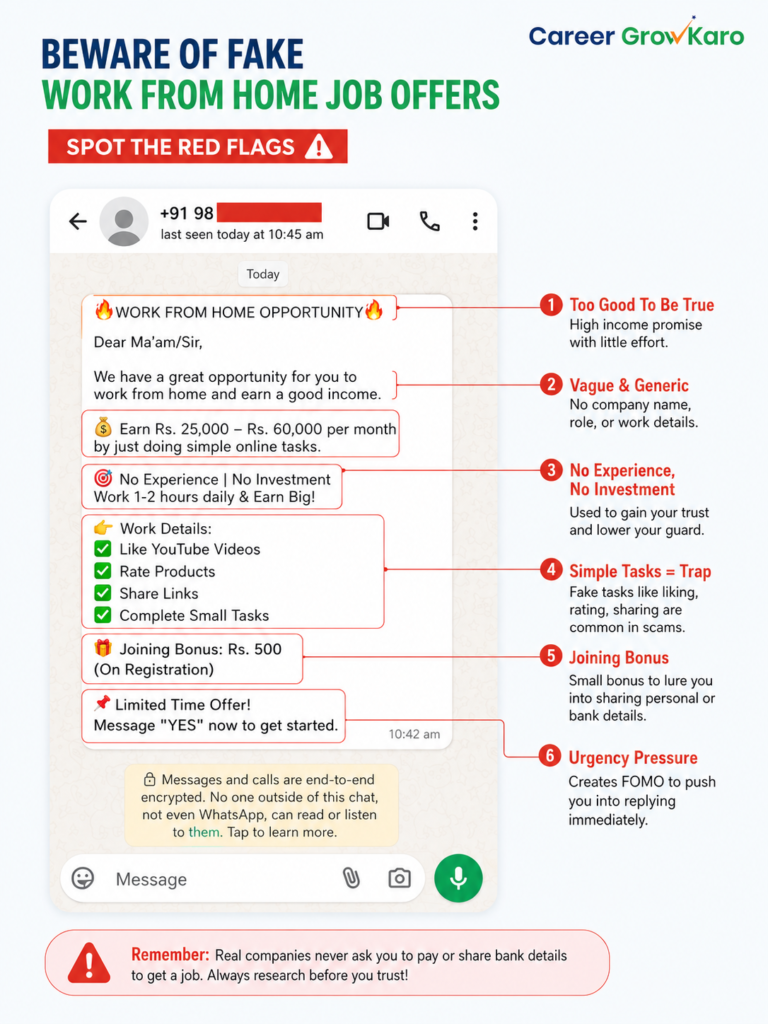
Learn these seven patterns and you become almost impossible to cheat.
1. The registration / training fee
The oldest one, and still the most common. You are “selected” without an interview, then asked for ₹500–₹5,000 as a registration fee, security deposit, ID card charge, or training fee.
The rule: a real employer pays you. You never pay them. There is no exception to this in Indian labour practice.
2. The fake legal notice (the data entry trap)
This is the signature Indian data-entry scam, and it is the one nobody warns you about.
You are given real work — type 120 pages, or enter 10,000 captchas — with a tight deadline. You do it. Then you are told your accuracy was “below the contract threshold.” A legal notice arrives citing Sections 73, 74 and 75 of the Indian Contract Act, claiming damages of ₹2 lakh or more. A “lawyer” calls. You are told you can settle for ₹30,000.
There is no case. There is no lawyer. The entire job existed to manufacture this moment. Documented cases follow this exact script — including one victim, Jasveer, who completed the work and was then threatened with a ₹2 lakh suit and asked for ₹30,000 to make it go away. (Labour Law Advisor case documentation)
If this happens to you: do not pay. Do not negotiate. Report it. Section 3 of this guide tells you how.
3. The task-based “like and earn” funnel
It starts small and honest-looking. Like a YouTube video, get ₹50. Follow an Instagram page, get ₹100. They actually pay you — twice, maybe three times.
Then you are added to a Telegram group with a fake dashboard, and told that to unlock “premium tasks” you must first deposit ₹1,000. The dashboard shows your balance growing. When you try to withdraw, there is a “tax,” then a “service charge,” then silence.
Red flag: any job where you must deposit money to earn money is not a job. It is a trap with a job costume on.
4. The impersonated company
A real, well-known company’s name and logo, on a fake offer letter, from an email like hr.tcs.recruitment@gmail.com.
Red flag: a genuine Indian company writes to you from its own domain — @tcs.com, @wipro.com. Never Gmail, never Yahoo, never Outlook.
5. Impossible targets designed to fail
You are hired for typing or captcha work with a target no human can hit — 300 pages in 5 days at 99.5% accuracy. Failing is the point. Failing triggers the “penalty,” which triggers the demand for money. This is scam #2 wearing a different shirt.
6. The overseas “customer support” job
A message offers a support or data role in Bangkok, Dubai, or Phnom Penh. Good salary, food and stay included, interview over WhatsApp.
This is the most dangerous item on this list. Indian nationals have been trafficked into scam compounds in Cambodia, Myanmar and Laos through exactly these offers — passport seized on arrival, phone taken, forced to run fraud on other Indians. Research inputs from the Future Crime Research Foundation link roughly 45% of India’s reported cyber fraud in 2025 to Southeast Asian operations.
Rule: never accept an overseas job offer that came through WhatsApp, Telegram, or a Facebook group. Ever. Verify through the Indian embassy of that country first.
7. The equipment or laptop deposit
“Buy the company laptop for ₹8,000 and we will give you the work.” You buy it. The work never arrives. The company disappears.
Rule: a real employer either provides the equipment or hires you knowing you already have your own.
Your next step: save the seven headings above as a note in your phone. Before you reply to any offer, check it against the list.
How Do You Check if a Job Offer Is Real — in 5 Minutes?
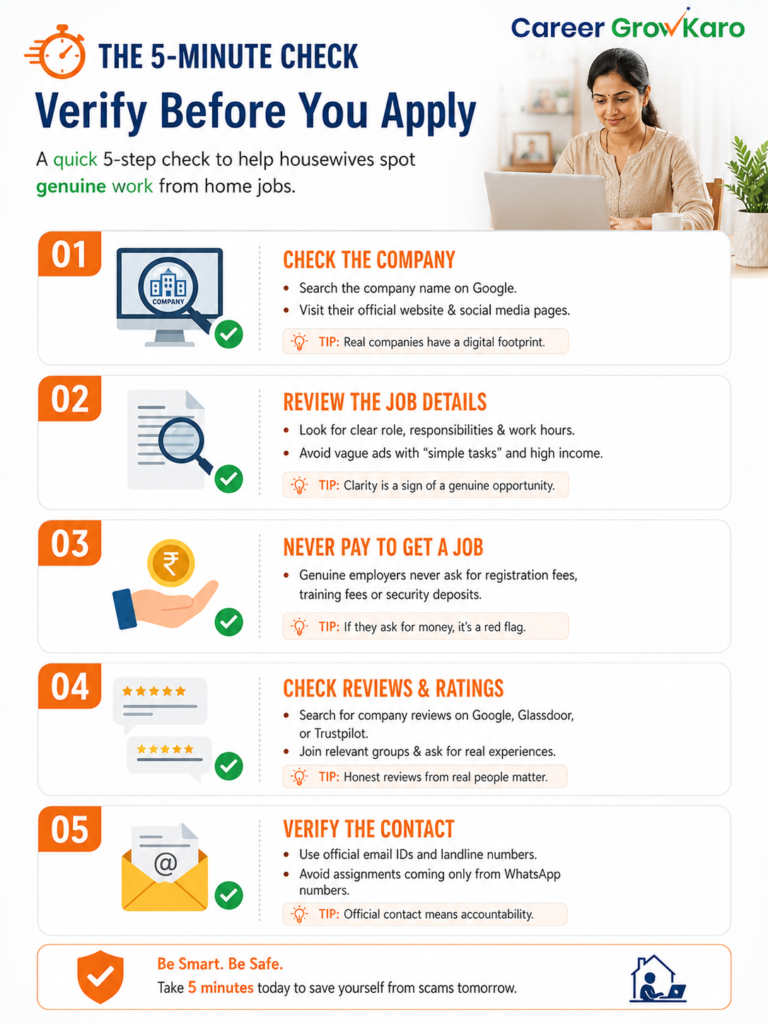
You do not need to be technical. You need five minutes and an internet connection.
Run these five checks, in order. If the offer fails any one of them, walk away.
- Search the company on the MCA portal. Go to mca.gov.in → MCA Services → Master Data. Type the company name. A real registered Indian company appears with a CIN number, incorporation date, and registered address. If nothing comes up, that company legally does not exist.
- Check the email domain. Does the mail come from
@companyname.com— or from Gmail? A company that cannot afford its own email domain cannot afford to pay you a salary. - Search the company on LinkedIn. A real employer has a page, employees with real profiles, and posts going back months. A shell has a logo and four followers.
- Google the company name plus the word “scam.” Thirty seconds. This single search catches a large share of them.
- Apply the money rule. Has anyone, at any point, in any form, asked you to pay, deposit, or buy something? Registration, training, ID card, software, laptop, “refundable” security?
If the answer to #5 is yes, stop. That single fact settles it. You do not need to run the other four checks.
Your next step: before you send your Aadhaar, PAN, or bank details to anyone, run check #1. That one lookup takes 90 seconds and is the difference between a job and a police complaint.
🪄 Not sure if the offer in your inbox is genuine?
Run it through the five checks above — then read CareerGrowKaro’s honest guide to freelancing in India to see how real online work is actually found, priced, and paid for. No hype, no fake income screenshots.
Where Should You Actually Look for Work?
Most housewives get scammed not because they are careless, but because they are looking in the wrong place. Scammers do not advertise where employers advertise.
Look here
- National Career Service (ncs.gov.in) — the Government of India’s own free job portal, run by the Ministry of Labour & Employment. Registration is free. No agent, no fee.
- Company career pages — go directly to the website of the company you want to work for.
- LinkedIn — a free profile is enough. You do not need Premium.
- Internshala — strong for beginner content writing, data, and support roles.
- HerKey and FlexiBees — built specifically for women returning to work after a break.
- Your own neighbourhood — the highest-paying first client most homemakers get is a local business 1 km from home. This channel has zero competition and zero scam risk.
- Skill first: if you need the skill before the job, use free government platforms — Skill India Digital and NIELIT courses cost nothing.
Never look here
- WhatsApp forwards
- Unsolicited Telegram “job groups”
- Job posts on OLX and Quikr
- Instagram DMs from “HR”
- Any message that arrived without you applying for anything
Your next step: register free on the National Career Service portal today, and create or update a free LinkedIn profile. Both take under 30 minutes. Neither costs a rupee.
You’ve Been Scammed. What Do You Do in the First 60 Minutes?
Speed decides whether you get your money back. Nobody else writing about this topic tells you that.
The Government of India’s Citizen Financial Cyber Fraud Reporting and Management System, run by I4C, has saved over ₹7,130 crore across more than 23 lakh complaints — but that recovery depends almost entirely on how fast the complaint is filed, because the money has to be frozen before it moves out of the mule account. (MHA, Lok Sabha reply, 2 December 2025)
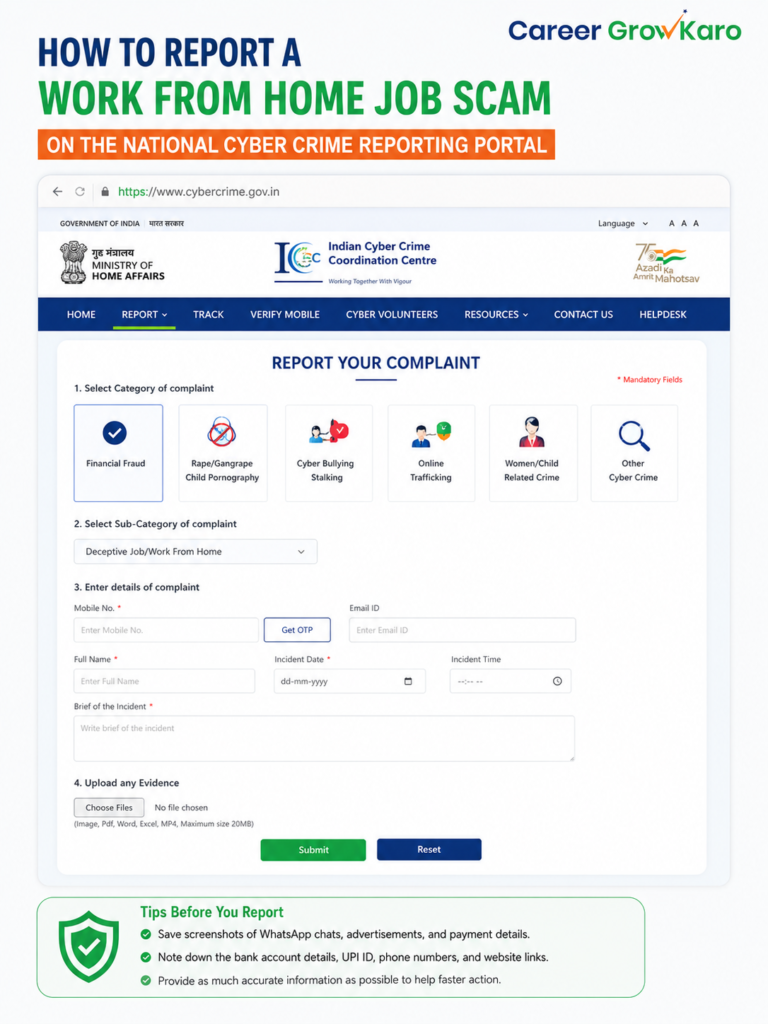
Do this, in this order:
- Call 1930. The national cyber crime helpline. Do it before anything else — before you tell your family, before you argue with the scammer.
- File a complaint at cybercrime.gov.in. Keep every screenshot, UPI reference number, phone number and Telegram handle.
- Call your bank. Ask them to freeze the transaction and flag the beneficiary account.
- Report the number on Sanchar Saathi / Chakshu — the Department of Telecommunications’ portal for fraudulent calls and SMS.
- If you were sent a fake legal notice: ignore it, but keep it. It is evidence for your complaint, not a document you owe anything against.
One more thing, and it matters. If this happened to you, you are not stupid and you are not alone — 2.81 million Indians reported the same thing last year, including doctors, engineers and traders. Shame is what scammers rely on to keep you quiet. Report it anyway.
Your next step: if it has already happened, stop reading and call 1930 now.
A Real Case — and Why It Should Not Scare You Off
The warning: In one widely documented case, a job seeker named Jasveer was hired for freelance data entry work from home and given 12 days to complete a large typing task. He finished it. He was then told his work had “too many errors,” threatened with a lawsuit of over ₹2 lakh, and told he could settle it by paying ₹30,000. The companies involved had sourced his details from his profile on a public listings site. (Labour Law Advisor)
He had done nothing wrong. The work was the bait; the “penalty” was the business model.
The lesson is not “don’t work from home.” The lesson is that Jasveer never ran a five-minute check on who was hiring him. Two minutes on the MCA portal would have ended it before it started.
Frequently Asked Questions
Are data entry work from home jobs real or fake?
Both exist, but the ratio is bad. Genuine data entry roles are hired by real companies through Naukri, Internshala, LinkedIn and company career pages — never through WhatsApp, Telegram or Facebook. If a data entry job is advertised on social media and asks for any payment, treat it as fake.
Which work from home job is best for a housewife with no experience?
Online tutoring, because you already have the skill and need no training. Start with two children from your own building or society at ₹800–₹1,500 per child per month. If you prefer digital work, content writing has the lowest entry barrier — one writing sample can get you a first client.
Can I get work from home jobs without investment?
Yes — and you should accept nothing else. Every genuine work from home job in India requires zero investment from you. Registration fees, training fees, security deposits and “company laptop” purchases are all scam patterns, not employment practice.
How much can a housewife realistically earn from home per month?
₹2,000–₹8,000 in the first month while you build skill and reviews, rising to ₹15,000–₹30,000 by month six with consistent work. Anyone promising ₹50,000 or more in your first month is either selling you a course or running a scam.
Are online jobs for housewives available for 10th and 12th pass?
Yes. Tutoring, data annotation, regional-language voice data collection, reselling, customer support and home food businesses have no degree requirement. What they require is consistency and a working phone or laptop.
How do I report a work from home job scam in India?
Call the national cyber crime helpline 1930 immediately, then file a complaint at cybercrime.gov.in with all screenshots and payment references. Report the fraudulent number on the Sanchar Saathi portal. Speed matters — early complaints have a far better chance of the money being frozen.
The One Clear Next Step
Work from home jobs for housewives in India are real. So is the ₹22,495-crore fraud industry built to intercept women looking for them.
The difference between the two is not luck. It is five minutes of checking.
Do these three things this week:
- Pick one job from the table — not five.
- Register free on the National Career Service portal and update your LinkedIn.
- Save the five-minute check in your phone, and run it on every offer before you reply.
You do not need permission, a degree, or a mentor to start earning from home. You need one skill, a phone, and the discipline to ignore anyone who asks you for money first.
CareerGrowKaro is here to guide you at every step.