
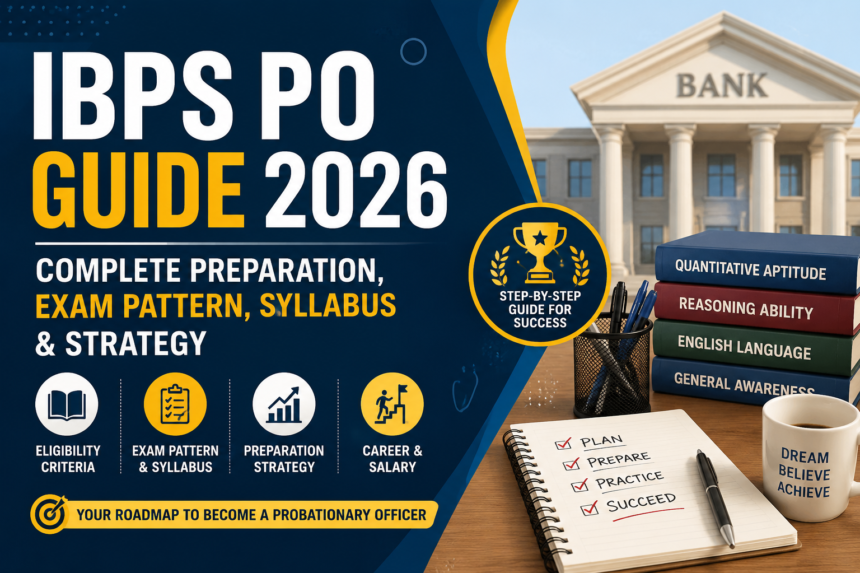
The IBPS Probationary Officer (IBPS PO) exam is one of the most popular banking recruitment exams in India, offering graduates an opportunity to build a stable and rewarding career in the public sector banking industry. Conducted by the Institute of Banking Personnel Selection (IBPS), the exam selects candidates for Probationary Officer/Management Trainee positions in participating public sector banks.
For graduates looking to enter the banking sector, IBPS PO offers attractive career growth, competitive salaries, job stability, and opportunities to move into managerial positions. However, the competition is high, making structured preparation and a clear understanding of the selection process essential.
This IBPS PO guide covers everything aspirants need to know, including eligibility criteria, exam pattern, syllabus, preparation strategy, recommended books and resources, common mistakes, and useful preparation tips. Platforms such as CareerGrowKaro can also help students and competitive-exam aspirants access career guidance and preparation-related resources while planning their journey toward banking and other government-sector careers.
What is IBPS PO?
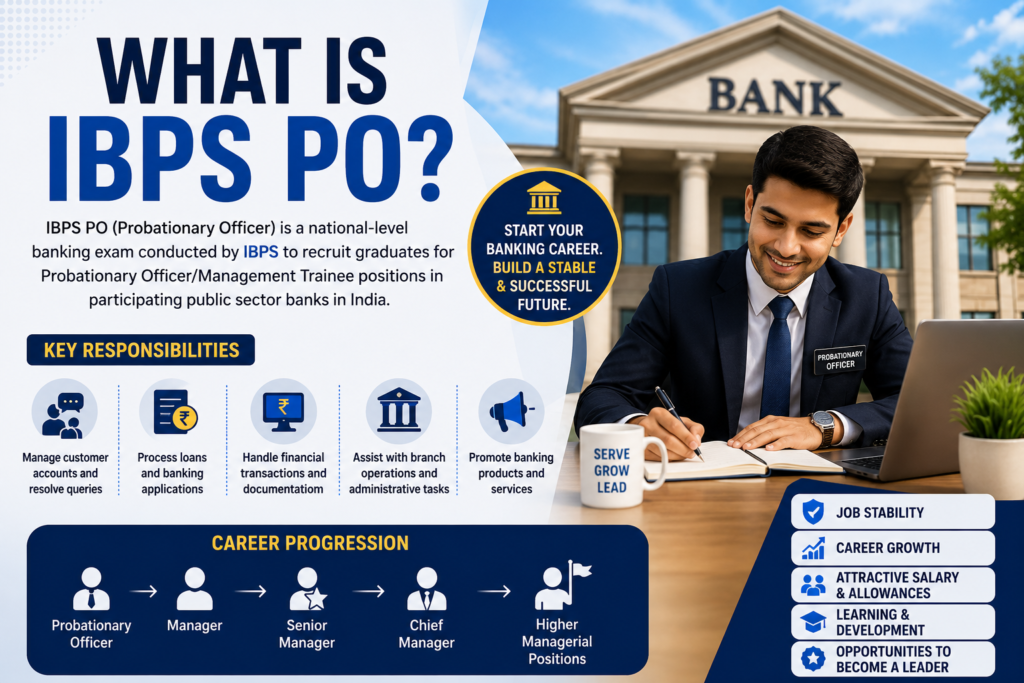
IBPS PO (Probationary Officer) is a national-level banking recruitment examination conducted by the Institute of Banking Personnel Selection (IBPS) to recruit graduates for Probationary Officer/Management Trainee positions in participating public sector banks in India.
A probationary officer is an entry-level managerial employee who undergoes training and handles different banking operations. Some of the key responsibilities include the following:
- Managing customer accounts and resolving queries.
- Processing loans and banking applications.
- Handling financial transactions and documentation.
- Assisting with branch operations and administrative tasks.
- Promoting banking products and services.
- Supporting the bank’s financial and operational activities.
- Managing customer service and account-related responsibilities.
The Institute of Banking Personnel Selection (IBPS) is an autonomous organization responsible for conducting recruitment examinations and selection processes for public sector banks and other financial institutions. The IBPS PO recruitment process generally includes:
- Preliminary Examination
- Main Examination
- Interview
IBPS PO recruitment is conducted for participating public sector banks. Depending on the recruitment cycle, these may include:
- Bank of Baroda
- Bank of India
- Canara Bank
- Central Bank of India
- Indian Bank
- Indian Overseas Bank
- Punjab National Bank
- Punjab & Sind Bank
- UCO Bank
- Union Bank of India
The exact list of participating banks can vary with each recruitment cycle, so candidates should check the latest official notification before applying.
An IBPS PO position also offers good opportunities for career growth and professional development. With experience, performance, and promotions, officers can progress from entry-level positions to managerial and senior managerial roles. They may gain experience in areas such as credit and loans, branch operations, customer service, financial management, and administration.
A typical career progression can be:
Probationary Officer → Manager → Senior Manager → Chief Manager → Higher Managerial Positions
This combination of job stability, career progression, banking exposure, and employee benefits makes IBPS PO a popular career choice among graduates.
IBPS PO Eligibility Criteria

Before beginning your preparation, it is important to check whether you meet the eligibility requirements. The IBPS PO eligibility criteria generally cover educational qualification, age limit, and nationality. Candidates should carefully check the eligibility conditions mentioned in the latest official notification before applying, as the cut-off date and other requirements may vary between recruitment cycles.
1. Educational Qualification
For the IBPS PO recruitment process, candidates must have a graduation degree in any discipline from a university or institution recognized by the Government of India or an equivalent qualification recognized by the Central Government. Candidates from streams such as commerce, arts, science, engineering, and management can apply.
- A bachelor’s degree in any discipline is generally accepted.
- Candidates must possess the required qualification by the date specified in the official notification.
- There is generally no minimum percentage requirement for graduation.
- Candidates appearing in their final year or awaiting results should carefully check the cut-off date and eligibility conditions in the relevant notification.
- The degree or qualification should be from a recognized university or institution.
Therefore, graduates from different academic backgrounds can consider IBPS PO as a career option, provided they fulfill all the other eligibility conditions.
2. Age Limit
The age requirement is another important part of the IBPS PO eligibility criteria. In the IBPS PO/MT-XV notification for vacancies for 2026–27, the prescribed age range was 20 to 30 years, with the age calculated as on the specified date in the notification.
The upper-age relaxation available to eligible categories includes:
- SC/ST candidates: 5 years
- OBC (Non-Creamy Layer) candidates: 3 years
- Persons with Benchmark Disabilities: 10 years
- Ex-Servicemen and certain eligible military personnel: 5 years
- Other relaxations may apply to specific categories as per Government of India guidelines.
Candidates should note that age relaxation is applicable only when the candidate meets the relevant category requirements and provides the necessary documents. The exact age cut-off date and applicable relaxations should always be verified from the latest IBPS notification.
3. Nationality/Citizenship
Candidates must also fulfill the nationality or citizenship conditions specified by IBPS. Under the recent IBPS PO notification, an applicant must generally be one of the following:
- A citizen of India.
- A subject of Nepal or Bhutan.
- A Tibetan refugee who came to India before January 1, 1962, with the intention of permanently settling in India.
- A person of Indian origin who has migrated from specified countries with the intention of permanently settling in India, subject to the prescribed conditions.
Candidates belonging to certain categories other than Indian citizens may be required to obtain a certificate of eligibility issued by the government of India.
Checking these requirements is an essential step in any IBPS PO guide, as fulfilling the eligibility criteria is necessary before proceeding with the application and examination preparation. Aspirants should always refer to the latest official notification for the most accurate and updated eligibility requirements.
IBPS PO Exam Pattern
Understanding the IBPS PO exam pattern is essential before starting preparation because it helps candidates understand the subjects, marking scheme, sectional timing, and selection process. As per the latest CRP PO/MT-XVI recruitment cycle, the selection process includes the Preliminary Examination, Main Examination, Personality Test, and Interview.
1. Preliminary Examination
The preliminary examination is the first stage of the IBPS PO exam pattern. It is an objective online test consisting of three sections. Candidates get 20 minutes for each section, making the total duration 60 minutes.
| Subject | Questions | Marks | Duration |
| English Language | 30 | 30 | 20 minutes |
| Quantitative Aptitude | 35 | 30 | 20 minutes |
| Reasoning Ability | 35 | 40 | 20 minutes |
| Total | 100 | 100 | 60 minutes |
Candidates must qualify in each section by securing the minimum cut-off prescribed by IBPS. The preliminary examination is qualifying in nature, and candidates who qualify are shortlisted for the main examination.
2. Main Examination
The main examination is more comprehensive and carries greater importance for the final selection. It includes four objective sections followed by a descriptive test. Under the latest pattern, the objective paper carries 200 marks, while the descriptive paper carries 25 marks.
| Subject | Questions | Marks | Duration |
| Reasoning | 40 | 60 | 45 minutes |
| General/Economy/Banking/Digital/Financial Awareness | 50 | 60 | 35 minutes |
| English Language | 40 | 20 | 35 minutes |
| Data Analysis & Interpretation | 40 | 60 | 45 minutes |
The descriptive paper tests candidates’ writing skills through essay and comprehension. The objective sections are separately timed, so candidates cannot move between sections once the allotted time ends.
3. Personality Test and Interview
Candidates who qualify in the main examination proceed to the next stages of the recruitment process. The latest IBPS PO recruitment process includes a personality test, followed by the common interview. The personality test is mandatory but non-qualifying, while the interview is conducted by participating banks and coordinated by the designated nodal bank.
The interview carries 100 marks and assesses aspects such as the candidate’s communication skills, banking awareness, personality, confidence, and suitability for the role.
4. Negative Marking
Negative marking is an important part of the IBPS PO exam pattern. For objective questions, one-fourth (0.25) of the marks assigned to a question is deducted for every incorrect answer. There is no penalty for questions that are left unanswered. Therefore, candidates should avoid random guessing and attempt questions strategically.
Overall, understanding the IBPS PO exam pattern allows aspirants to plan their preparation according to the weightage and time available for each section. Candidates should also check the latest official notification before the examination, as IBPS may revise the pattern or selection process in future recruitment cycles.
How to Prepare for IBPS PO?
A structured preparation strategy can help you cover the syllabus, improve accuracy, and manage your time effectively. Instead of studying every topic randomly, follow these steps to build a focused preparation plan.
Step 1: Understand the Exam Pattern and Syllabus
Begin your preparation by thoroughly understanding the IBPS PO exam pattern and syllabus. This will help you identify the subjects, important topics, marking scheme, and time limits for each section.
- Go through the complete syllabus before starting preparation.
- Identify high-weightage and frequently asked topics.
- Divide topics into easy, moderate, and difficult categories.
- Prioritise topics that carry more marks and require regular practice.
Step 2: Create a Realistic Study Plan
A consistent study schedule is more effective than studying for long hours occasionally. Create a plan according to your available time and give sufficient attention to every section.
- Divide your study time between reasoning, quantitative aptitude, English, general awareness, and other relevant sections.
- Set daily and weekly preparation targets.
- Keep dedicated time for revision.
- Include daily question-solving practice.
- Take short breaks to maintain concentration.
- Adjust your schedule based on your strengths and weaknesses.
Step 3: Practice Previous Year Questions
Previous Year Questions (PYQs) are an important part of any IBPS PO preparation strategy. They help you understand the types of questions asked and identify recurring concepts.
- Solve PYQs topic-wise before attempting complete papers.
- Analyze the difficulty level of questions.
- Identify frequently repeated concepts and question patterns.
- Practice solving questions within the expected time.
- Maintain a record of questions you get wrong and revise those concepts regularly.
Step 4: Take Regular Mock Tests
Once you have covered the basic concepts, start taking mock tests regularly. Begin with topic-wise tests and gradually move towards full-length examination mocks.
- Start with sectional and topic-wise tests.
- Progress to complete preliminary and main examination mocks.
- Attempt mocks under exam-like time limits.
- Analyze every mock after completing it.
- Identify mistakes caused by lack of knowledge, calculation errors, or poor time management.
- Revisit weak topics and practice similar questions.
Mock tests are not just about checking your score. Their main purpose is to improve accuracy, speed, question selection, and time management.
Step 5: Focus on Current Affairs and Banking Awareness
General and banking awareness can become scoring areas when prepared consistently. Instead of trying to cover everything at the last moment, make current affairs a part of your daily routine.
- Read important national and international news regularly.
- Follow recent banking and financial developments.
- Cover important RBI updates, government schemes, economic events, and banking terminology.
- Prepare short notes for important facts and events.
- Revise monthly current-affairs notes regularly.
- Pay special attention to important appointments, awards, reports, financial developments, and government initiatives.
Following these steps consistently can make your IBPS PO preparation more organized and effective. The key is to combine conceptual learning with PYQs, mock tests, revision, and current-affairs preparation rather than relying on any single method.
Career and Salary After Clearing IBPS PO
Clearing the IBPS PO examination can open the door to a promising career in the public sector banking industry. A probationary officer receives a competitive salary along with various allowances and benefits while also getting opportunities to take on greater responsibilities through promotions.
Salary and Allowances
The salary of an IBPS PO includes basic pay along with several allowances and benefits. The exact in-hand salary can vary depending on the bank, posting location, applicable allowances, and deductions.
Common components and benefits may include:
- Basic pay
- Dearness Allowance (DA)
- House Rent Allowance (HRA) or leased accommodation benefits, as applicable
- Special Allowance
- City Compensatory Allowance (CCA), where applicable
- Medical and other employee benefits
- Other allowances and reimbursements as per the applicable bank rules
The overall compensation makes the IBPS PO position an attractive option for graduates seeking a stable banking career.
Job Responsibilities
An IBPS PO performs a variety of operational, administrative, and customer-facing responsibilities. During the probation period, officers may receive exposure to different banking functions.
Key responsibilities may include:
- Handling customer queries and account-related services.
- Processing loans and credit-related applications.
- Managing banking documentation and records.
- Supervising day-to-day branch operations.
- Promoting banking products and services.
- Monitoring transactions and ensuring compliance with banking procedures.
- Assisting senior officials with administrative and managerial tasks.
Career Progression and Promotions
One of the major advantages of becoming a probationary officer is the opportunity for career advancement. Officers can move into higher positions based on their experience, performance, departmental examinations, and applicable promotion policies.
A typical career progression can include:
Probationary Officer → Manager → Senior Manager → Chief Manager → Assistant General Manager → Deputy General Manager → General Manager
The exact promotion structure and timelines may vary between banks.
Conclusion
Clearing the IBPS PO exam requires a combination of conceptual understanding, consistent practice, time management, and regular revision. Candidates should begin by understanding the eligibility criteria, exam pattern, and syllabus before creating a realistic preparation strategy.
Solving previous-year questions, taking regular mock tests, analyzing mistakes, and staying updated with current affairs can significantly improve preparation. Aspirants should also focus on maintaining accuracy and developing the ability to manage time effectively during the examination.
For graduates aiming for a stable and rewarding career in the banking sector, IBPS PO offers opportunities for professional growth, managerial responsibilities, competitive compensation, and long-term career progression. Following a structured IBPS PO guide can help aspirants stay organized throughout their preparation journey.
Candidates can also explore CareerGrowKaro for career guidance, educational resources, and useful information to support their preparation for competitive exams and future career opportunities. With consistent effort, the right resources, and a focused approach, aspirants can move closer to achieving their goal of becoming an IBPS Probationary Officer.
Frequently Asked Questions
1. Is IBPS PO difficult to crack?
IBPS PO is a competitive examination, but it can be cleared with consistent preparation. Understanding the syllabus, practicing previous-year questions, taking mock tests, and regularly revising important topics can improve your chances of success.
2. Can I prepare for IBPS PO without coaching?
Yes, you can prepare for IBPS PO without coaching. With quality study materials, previous-year papers, online mock tests, and a well-planned study schedule, candidates can prepare effectively through self-study.
3. How many hours should I study for IBPS PO?
The ideal study time depends on your current preparation level and available time. Generally, 4–6 focused hours a day can be effective when combined with regular practice, revision, and mock-test analysis.
4. Is graduation compulsory for IBPS PO?
Yes. Candidates generally need a graduation degree in any discipline from a recognized university or institution to apply for IBPS PO. Aspirants should check the latest official notification for the applicable qualification requirements.
5. How should I start my IBPS PO preparation?
Start by understanding the exam pattern and syllabus, then assess your strengths and weaknesses. Create a realistic study plan, build your concepts, practice previous-year questions, take regular mock tests, and stay updated with current affairs and banking awareness.