

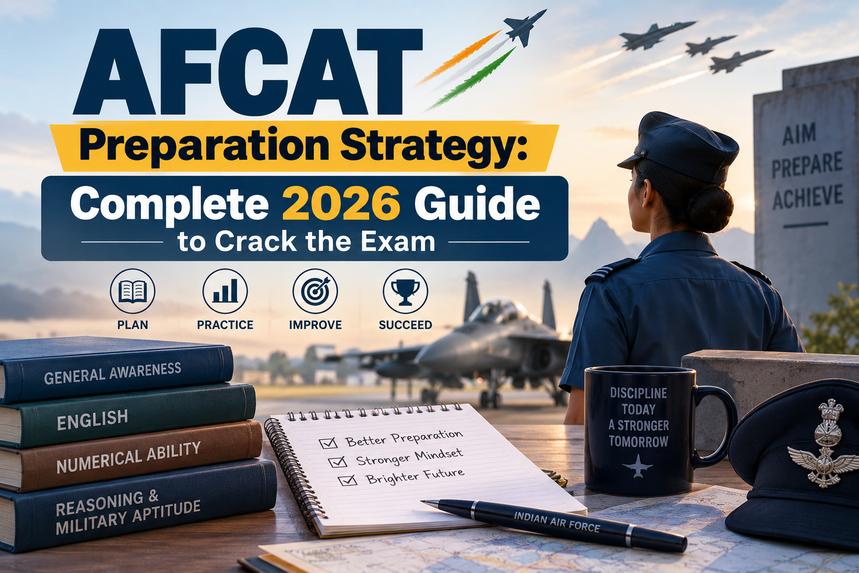
The Air Force Common Admission Test (AFCAT) is a national-level entrance examination conducted by the Indian Air Force for candidates aspiring to join the Air Force as officers in the Flying and Ground Duty branches.
A successful AFCAT preparation strategy is important because it helps candidates:
- Understand the AFCAT syllabus and exam pattern clearly.
- Create a structured study schedule and manage time effectively.
- Strengthen concepts across all subjects.
- Identify weak areas and improve them through regular practice.
- Build speed and accuracy through mock tests and previous-year papers.
- Revise important topics consistently before the examination.
In this practical guide by CareerGrowKaro, we will take you through the complete AFCAT preparation strategy, including the syllabus, subject-wise preparation tips, daily study plan, mock-test approach, revision techniques, and common mistakes to avoid. Whether you are beginning your preparation or looking to improve your existing strategy, this guide will help you prepare in a more focused and systematic way.
Understand the AFCAT Exam Pattern Before You Start
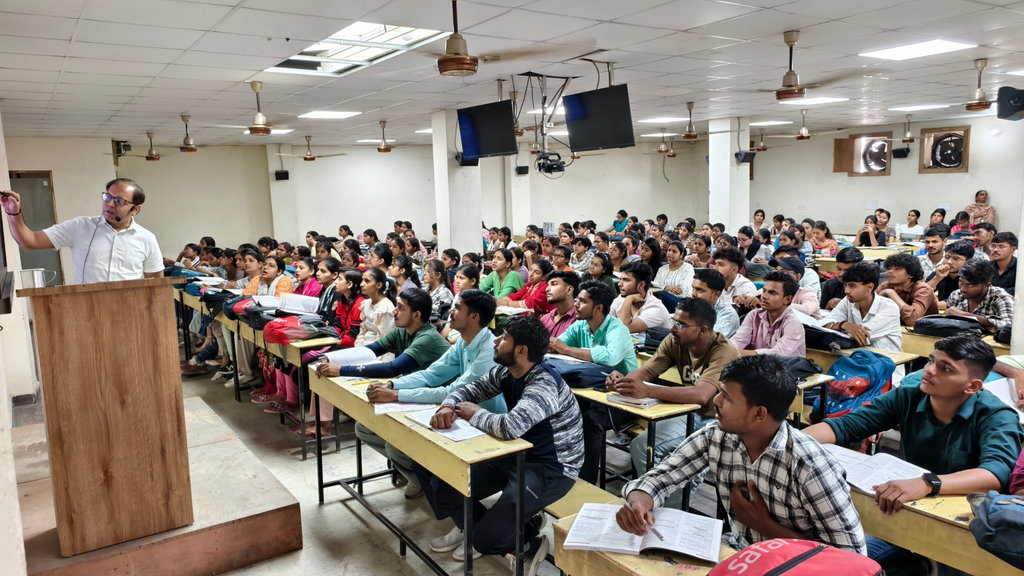
Before beginning your AFCAT preparation, it is essential to understand the exam pattern, marking scheme, and structure. Knowing what to expect in the examination allows you to plan your preparation more effectively and avoid unnecessary mistakes.
The AFCAT written examination consists of 100 questions, carrying a total of 300 marks, with a duration of 2 hours. The questions are objective-type and cover four major sections:
- General Awareness: Questions related to history, geography, current affairs, defense, polity, science, and other areas of general knowledge.
- Verbal Ability in English: Includes topics such as comprehension, vocabulary, grammar, synonyms, antonyms, idioms, and sentence-based questions.
- Numerical Ability: Covers fundamental mathematical topics such as percentages, averages, ratio and proportion, profit and loss, time and work, and speed-distance-time.
- Reasoning and Military Aptitude: Tests logical reasoning, verbal and non-verbal reasoning, spatial ability, and analytical skills.
Therefore, before moving ahead with your AFCAT preparation, familiarize yourself thoroughly with the syllabus, question pattern, marking scheme, and time limit. This foundation will help you build a more focused and effective preparation strategy.
Subject-Wise AFCAT Preparation Tips

A well-planned AFCAT preparation strategy should give equal attention to all sections while allowing extra practice for topics where you need improvement. Instead of trying to study everything at once, focus on building strong fundamentals, practicing questions regularly, and revising important concepts.
1. English
The English section tests your understanding of grammar, vocabulary, comprehension, and usage. To improve your performance:
- Build your vocabulary by learning new words, synonyms, antonyms, idioms, and phrases regularly.
- Strengthen fundamental grammar concepts, including tenses, articles, prepositions, subject-verb agreement, and sentence structure.
- Practice reading comprehension to improve both reading speed and understanding.
- Solve questions on error spotting, synonyms and antonyms, idioms and phrases, sentence completion, and vocabulary.
- Develop a habit of reading newspapers, articles, or quality editorials daily and follow it with question practice.
2. General Awareness
General awareness can cover a wide range of topics, making consistent preparation particularly important. As part of your AFCAT preparation, focus on:
- Following current affairs, particularly important national, international, defense, and aviation-related developments.
- Revising history, geography, Indian polity, economics, general science, and defense awareness.
- Learning about the Indian Air Force, military exercises, ranks, commands, aircraft, defense organizations, and important defense-related events.
- Preparing concise revision notes so that important facts can be reviewed quickly before the examination.
- Regularly revising current affairs instead of relying solely on last-minute preparation.
3. Numerical Ability
The Numerical Ability section requires a combination of conceptual clarity, calculation speed, and accuracy. Effective AFCAT preparation for this section should include:
- Strengthening basic mathematical concepts before moving to advanced question practice.
- Focusing on important topics such as percentages, profit and loss, ratio and proportion, averages, time and work, speed-distance-time, simple and compound interest, and number systems.
- Practicing calculations regularly to improve speed and reduce dependence on lengthy methods.
- Solving questions with a timer to become comfortable with the examination’s time constraints.
- Avoiding excessive time on a single difficult question and moving on when necessary.
4. Reasoning and Military Aptitude
This section evaluates your logical thinking, analytical ability, and pattern-recognition skills. To improve your performance:
- Practice both verbal and non-verbal reasoning questions regularly.
- Focus on topics such as analogy, classification, series, coding-decoding, blood relations, spatial ability, and figure-based questions.
- Solve timed question sets to improve speed while maintaining accuracy.
- Analyze incorrect answers to understand the underlying pattern or logic.
- Gradually increase the difficulty level as your concepts become stronger.
Consistent practice across all four sections is the key to effective AFCAT preparation. Rather than concentrating only on your strongest subject, maintain a balanced approach and regularly evaluate your progress through practice tests and revision.
Build a Daily Study Plan for AFCAT Preparation
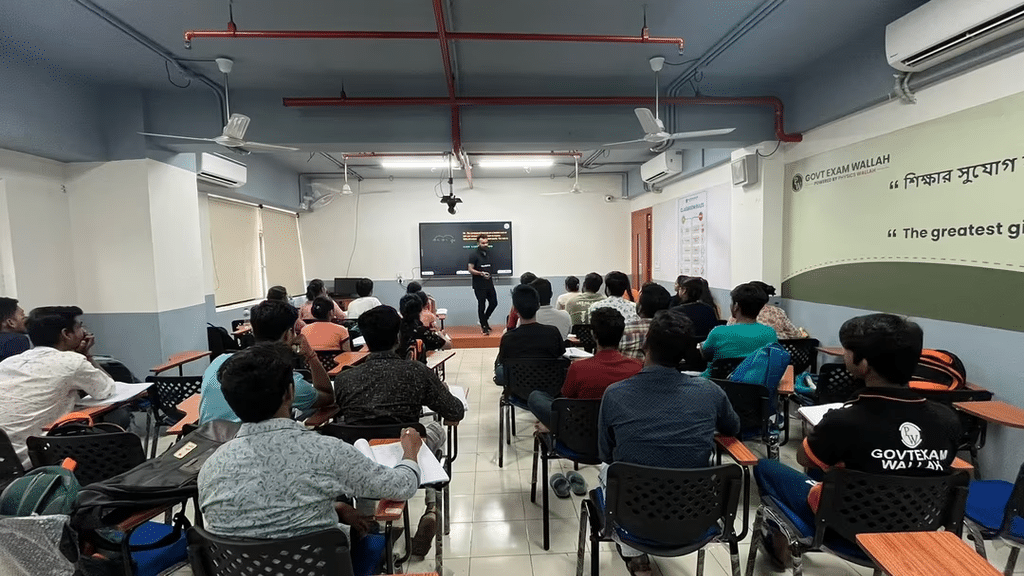
A consistent daily routine is one of the most important parts of AFCAT preparation. Instead of studying for long hours without a clear direction, candidates should create a realistic timetable that balances concept building, practice, revision, and breaks. The schedule can be adjusted based on your preparation level, strengths, and weaker subjects.
| Activity | Suggested Time |
| English | 1 hour |
| Numerical Ability | 1–1.5 hours |
| Reasoning & Military Aptitude | 1 hour |
| General Awareness | 1 hour |
| Current Affairs | 30 minutes |
| Revision & Question Practice | 1 hour |
- Start with your weaker subjects: Allocate more time to topics where you consistently make mistakes.
- Practice every section: Even if you are strong in a particular subject, include regular practice to maintain your accuracy and speed.
- Keep time for revision: Spend at least an hour revising formulas, vocabulary, current affairs, and previously attempted questions.
- Use short breaks: Take a 5–10 minute break between study sessions to stay focused and avoid mental fatigue.
- Include timed practice: Gradually introduce sectional tests and full-length mocks into your routine.
- Avoid burnout: Do not compromise on sleep or study continuously for several hours. A sustainable routine is more effective than an extremely demanding timetable.
Remember that there is no single timetable that works for every candidate. Your AFCAT preparation schedule should be customized according to your daily routine, preparation stage, strengths, and weaknesses. The goal is to remain consistent and make measurable progress every day.
AFCAT Preparation in the Final 30 Days
The final 30 days of AFCAT preparation should follow a structured approach that gradually shifts from revision and targeted practice to full-length mock tests and final revision. Dividing the month into three phases can help you stay organized and track your progress effectively.
Day 1–10: Revise Concepts and Strengthen Weak Areas
- Revise important concepts and topics from all four sections.
- Focus on your weaker areas and practice questions related to them.
- Revise important mathematical formulas, grammar rules, vocabulary, and general awareness topics.
- Start revising current affairs and important defense-related developments.
- Solve sectional tests to evaluate your understanding and accuracy.
- Avoid spending too much time on completely new topics.
Day 11–20: Increase Practice and Attempt Mock Tests
- Start attempting full-length AFCAT mock tests regularly under exam-like conditions.
- Analyze each mock test to identify conceptual mistakes, silly errors, and time-management issues.
- Practice questions from topics where your performance is consistently weak.
- Continue revising formulas, vocabulary, current affairs, and important facts.
- Work on improving your speed without compromising accuracy.
- Adjust your AFCAT preparation strategy based on your mock-test performance.
Day 21–30: Final Revision and Exam Readiness
- Focus primarily on revision, mock tests, and error correction.
- Attempt full-length mocks at regular intervals and analyze your performance carefully.
- Revise short notes, formulas, vocabulary, current affairs, and previously difficult questions.
- Avoid starting new books, resources, or major topics at the last moment.
- Practice effective time management and question selection.
- Maintain a balanced routine, get adequate sleep, and avoid unnecessary stress.
A well-planned final month can give your AFCAT preparation the final boost it needs. Stay consistent, learn from your mistakes, and enter the examination with confidence.
Common Mistakes to Avoid During AFCAT Preparation
A strong AFCAT preparation strategy is not just about knowing what to study; it is also about knowing what to avoid. Many candidates lose valuable marks because of ineffective study habits, poor time management, or a lack of revision. Avoiding these common mistakes can make your preparation more focused and productive.
1. Studying Without Understanding the Syllabus: Starting preparation without going through the latest AFCAT syllabus can lead to unnecessary effort. Understand the topics covered in each section and prioritize them based on your preparation level and previous-year question trends.
2. Using Too Many Books and Resources: Collecting multiple books, YouTube channels, notes, and online resources can create confusion. Choose a limited number of reliable resources and revise them thoroughly instead of constantly switching between sources.
3. Ignoring General Awareness: General Awareness covers a broad range of topics and should not be left for the last few weeks. Include current affairs, defense awareness, history, geography, polity, economics, and general science in your regular study routine.
4. Avoiding Mock Tests Until the Final Weeks: Mock tests are an essential part of AFCAT preparation. Waiting until the last moment means losing valuable opportunities to improve speed, accuracy, question selection, and time management. Start with sectional tests and gradually move to full-length mocks.
5. Focusing Only on Speed: Attempting questions quickly is useful only when your answers are accurate. Since incorrect answers attract negative marking, focus on finding the right balance between speed and accuracy.
6. Not Revising Previously Studied Topics: Simply completing a topic does not mean you will remember it until the exam. Schedule regular revision sessions for formulas, vocabulary, current affairs, concepts, and questions you previously got wrong.
7. Blindly Following Someone Else’s Timetable: Every candidate has different strengths, weaknesses, and daily commitments. Do not copy another aspirant’s study schedule without considering your own needs. Create a realistic AFCAT preparation timetable that gives additional time to your weaker sections while maintaining regular practice across all subjects.
Conclusion
Cracking the AFCAT exam requires consistent preparation, smart planning, and regular practice rather than last-minute studying. A clear understanding of the syllabus and exam pattern, combined with subject-wise preparation, mock tests, revision, and effective time management, can significantly improve your performance.
Remember to focus on accuracy along with speed, regularly analyze your mistakes, and avoid common preparation mistakes. Most importantly, stay consistent and follow a study plan that works for you.
With the right strategy and dedication, your AFCAT preparation can become more focused and effective. CareerGrowKaro is here to help aspirants with practical preparation guidance, useful resources, and expert tips to move one step closer to their goal of joining the Indian Air Force. Start your preparation today, stay disciplined, and believe in your ability to succeed.
FAQs
1. How should I start my AFCAT preparation?
Start by understanding the AFCAT syllabus and exam pattern. Assess your strengths and weaknesses, create a realistic study timetable, and begin with concept building before moving to regular question practice and mock tests.
2. How many hours should I study for AFCAT?
The ideal study time depends on your preparation level and daily schedule. Generally, 4–6 focused hours a day can be effective when divided between English, numerical ability, reasoning, general awareness, current affairs, and revision.
3. Which subjects should I focus on during AFCAT preparation?
You should prepare all four sections: General Awareness, Verbal Ability in English, Numerical Ability, and Reasoning & Military Aptitude. Give additional practice time to subjects or topics where you are less confident.
4. Are mock tests important for AFCAT?
Yes. Mock tests help improve speed, accuracy, time management, and question selection. They also help you identify weak areas and understand your preparation level before the actual examination.
5. How can I improve general awareness for AFCAT?
Follow current affairs regularly and revise important topics from history, geography, polity, economics, science, defense, and military affairs. Maintaining short revision notes can make last-minute revision easier.
6. How should I prepare for AFCAT in the last 30 days?
Focus on revision, mock tests, previous-year questions, and weak areas. Avoid collecting new resources and concentrate on improving accuracy and time management while maintaining a healthy study routine.
7. What is the most important AFCAT preparation tip for beginners?
The most important tip is to stay consistent. Follow a structured timetable, practise questions every day, revise regularly, and analyse your mistakes instead of simply counting the number of hours studied.