

The Central Teacher Eligibility Test (CTET) is one of the most important eligibility exams for aspiring teachers in India. Conducted by the Central Board of Secondary Education (CBSE), the exam evaluates candidates on their understanding of child development, pedagogy, languages, and subject-specific concepts. Qualifying CTET can help candidates pursue teaching opportunities in schools across the country.
In this CTET Preparation Guide, CareerGrowKaro covers everything you need to prepare effectively, including:
- CTET exam pattern and syllabus
- Subject-wise preparation strategies
- A practical 30-day study plan
- Recommended books and study resources
- Previous year papers and mock-test strategies
- Common preparation mistakes to avoid
- Useful exam-day tips
Whether you are starting your preparation from scratch or looking to improve your existing strategy, this guide will help you prepare for CTET in a more organized way.
What is the CTET Exam?
The Central Teacher Eligibility Test (CTET) is a national-level teacher eligibility examination conducted by the Central Board of Secondary Education (CBSE). It is designed to assess whether candidates possess the knowledge, teaching aptitude, and pedagogical understanding required to teach at the elementary and upper-primary levels. Effective CTET preparation begins with understanding the purpose, structure, and requirements of the examination.
The CTET exam consists of two papers:
- Paper I: Designed for candidates who aspire to teach Classes I to V at the primary level.
- Paper II: Designed for candidates who aspire to teach Classes VI to VIII at the elementary level.
Candidates who wish to teach Classes I to VIII can appear for both Paper I and Paper II, provided they meet the prescribed eligibility requirements.
The CTET certificate serves as an eligibility credential for candidates seeking teaching positions in schools where CTET qualification is applicable. However, qualifying CTET does not by itself guarantee a teaching job. Recruitment depends on the eligibility criteria, vacancies, and selection process of the respective school or recruiting authority.
Know the CTET Syllabus
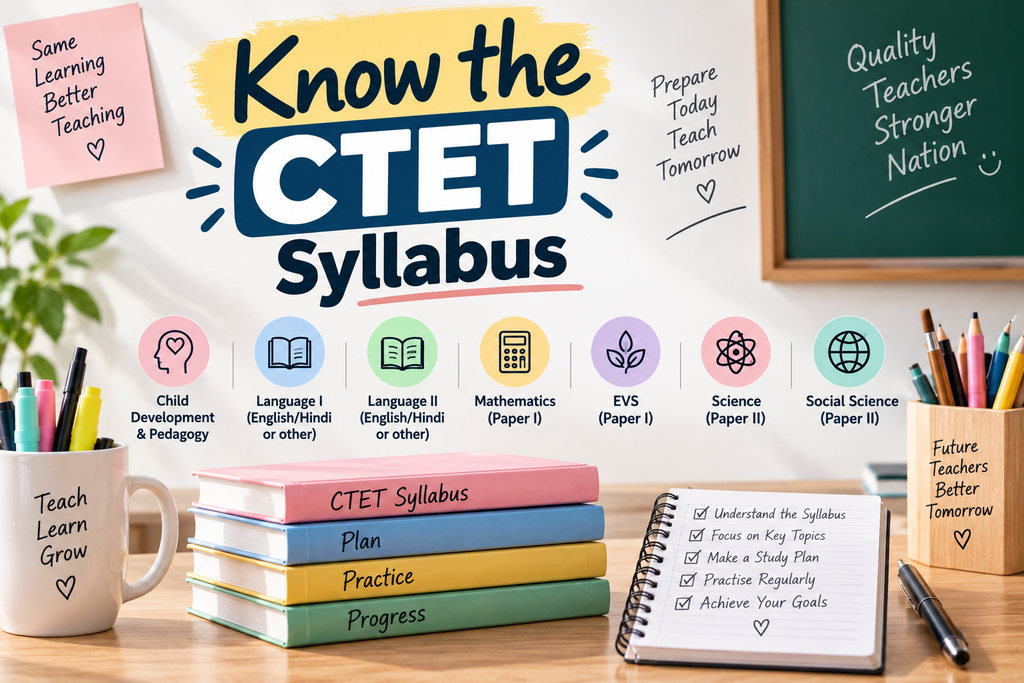
Understanding the CTET syllabus is the first step towards creating an effective CTET preparation strategy. The syllabus covers both subject knowledge and pedagogy, testing candidates on their understanding of concepts as well as their ability to apply effective teaching methods. Candidates should go through the complete syllabus before beginning their preparation and prioritize topics based on their strengths and weaknesses.
1. Child Development and Pedagogy
Child Development and Pedagogy is an important section of the CTET examination. It focuses on how children learn and develop and evaluates a candidate’s understanding of teaching and learning processes.
Key topics include:
- Child development and learning
- Inclusive education
- Learning and pedagogy
- Important educational theories and classroom practices
- Individual differences among learners
- Child-centered and progressive education
Candidates should focus on understanding concepts rather than relying only on memorization. Including this section consistently in your CTET preparation can help improve performance in pedagogy-based questions.
2. Mathematics
The Mathematics section tests candidates on fundamental mathematical concepts and their understanding of how these concepts can be taught effectively.
Important topics include:
- Number system
- Geometry
- Arithmetic
- Measurement
- Data handling
- Mathematical pedagogy
- Patterns and problem-solving
For effective CTET preparation, candidates should revise basic concepts and regularly practice numerical and application-based questions. Special attention should also be given to mathematical pedagogy and common difficulties faced by learners.
3. Environmental Studies
Environmental Studies (EVS) is included in Paper I and covers concepts related to children’s surroundings and everyday experiences. The section also evaluates candidates’ understanding of how EVS should be taught in the classroom.
Major topics include:
- Family and friends
- Food and shelter
- Water and travel
- Plants and animals
- Things we make and do
- EVS pedagogy
Reading relevant NCERT textbooks can help candidates develop a strong foundation for this section. Along with factual knowledge, CTET preparation should focus on understanding how children observe, explore, and learn about their environment.
4. Language I and Language II
The language sections assess candidates’ comprehension skills, language proficiency, and understanding of language teaching methods.
The CTET syllabus for these sections broadly includes:
- Reading comprehension
- Grammar and language development
- Language pedagogy
- Language acquisition and learning
- Principles of language teaching
Candidates should regularly practice comprehension passages and revise grammar concepts. Understanding language pedagogy is equally important because the questions assess not only language knowledge but also effective methods of teaching languages.
5. Mathematics & Science / Social Science
Paper II includes Mathematics and Science or Social Science, depending on the candidate’s chosen subject combination. Candidates should study the relevant subject concepts along with their pedagogical aspects.
The syllabus broadly covers:
- Subject-specific concepts
- Important concepts from relevant NCERT levels
- Problem-solving and application-based questions
- Pedagogy and teaching-learning methods
- Classroom practices and assessment
A thorough understanding of the CTET syllabus allows candidates to divide their study time effectively and avoid spending too much time on less important areas. Combining syllabus-based study with previous year papers, mock tests, and regular revision can make CTET preparation more structured and effective.
4-Week CTET Preparation Study Plan
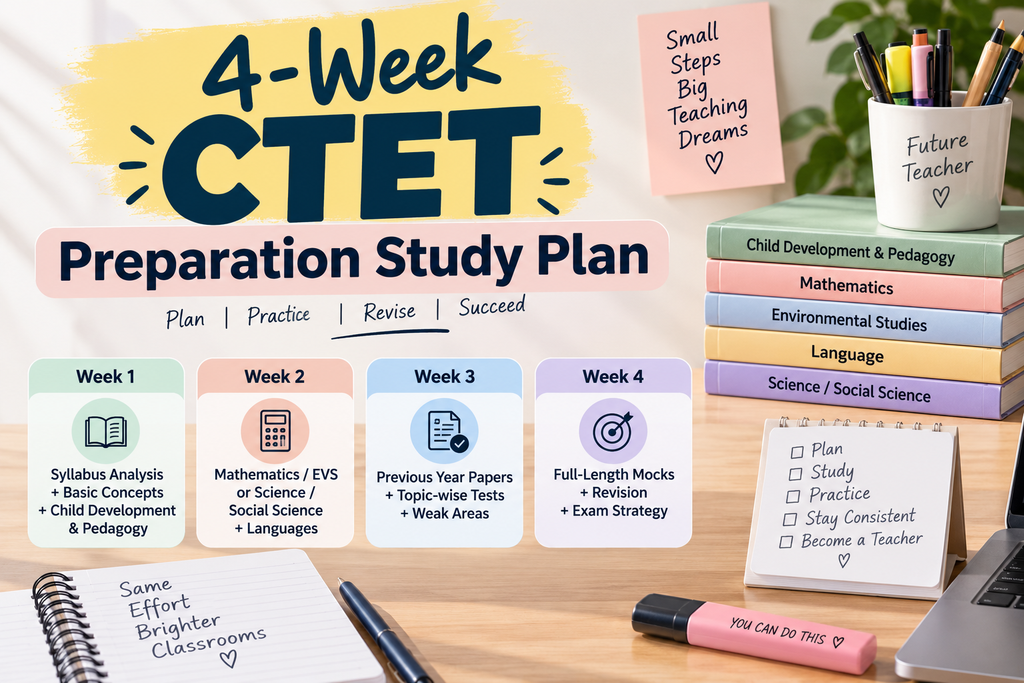
A structured CTET preparation plan helps you cover the syllabus, practice questions, and revise effectively. Aim for 4–6 focused hours daily, depending on your schedule.
| Week | Focus |
| Week 1 | Syllabus analysis + basic concepts + child development & pedagogy |
| Week 2 | Mathematics/EVS or Science/Social Science + Languages |
| Week 3 | Previous year papers, topic-wise tests + weak areas |
| Week 4 | Full-length mocks + revision + exam strategy |
For 4–6 hours of daily CTET preparation, follow this structure:
- 2 hours: Learn new concepts and cover the syllabus.
- 1 hour: Child Development & Pedagogy or Languages.
- 1–1.5 hours: Practice subject-wise and previous year questions.
- 30–45 minutes: Revise notes and important concepts.
- 30–45 minutes: Take a test or analyze mock-test mistakes.
Keep the first two weeks focused on concept building, Week 3 on practice, and Week 4 on mock tests and revision. Regularly analyze mistakes and revise weak areas to improve accuracy and confidence.
Best 6-Step CTET Preparation Strategy
A step-by-step approach makes CTET preparation more organized and effective. Follow these strategies to cover the syllabus, improve accuracy, and build confidence.
Step 1: Understand the Syllabus and Exam Pattern
- Read the official syllabus carefully.
- Understand the marks and weightage of each section.
- Identify important and high-priority topics.
- Create a realistic study schedule.
Step 2: Strengthen Your Basic Concepts
- Use NCERT textbooks for mathematics, EVS, science, and social science.
- Focus on understanding concepts rather than memorising them.
- Practice basic questions before moving to advanced problems.
Step 3: Prioritise Child Development and Pedagogy
- Understand child-centered and inclusive education.
- Study important learning theories and teaching methods.
- Practice application-based pedagogy questions.
- Include this section regularly in your CTET preparation.
Step 4: Practice Previous Year Question Papers
- Solve previous CTET papers regularly.
- Identify repeated concepts and question patterns.
- Check your answers and analyze mistakes.
- Revisit topics where you consistently lose marks.
Step 5: Take Regular Mock Tests
- Begin with topic-wise tests.
- Gradually attempt full-length mock tests.
- Practice completing the paper within the given time.
- Analyze every mock to improve speed and accuracy.
Step 6: Make Short Notes and Revise
- Prepare concise notes for theories, formulas, grammar rules, and key concepts.
- Revise these notes every week.
- Use the final days primarily for revision and practice.
- Consistent revision should remain an essential part of your CTET preparation.
Following these steps can help make your CTET preparation more focused, systematic, and result-oriented.
Common Mistakes to Avoid During CTET Preparation
Avoiding common mistakes is just as important as following the right CTET preparation strategy. Keep these points in mind:
- Starting without understanding the syllabus: Know the syllabus and exam pattern before beginning your CTET preparation.
- Ignoring Child Development and Pedagogy: Give this important section consistent attention.
- Relying only on rote learning: Focus on concepts and their practical application.
- Skipping NCERT textbooks: Use NCERT books to build strong subject fundamentals.
- Not solving previous year papers: Practice PYQs to understand question patterns and difficulty levels.
- Ignoring mock-test analysis: Don’t just take tests; review your mistakes and work on weak areas.
- Leaving revision for the end: Revise regularly to retain important concepts and avoid last-minute pressure.
A consistent and well-planned CTET preparation approach, combined with regular practice and revision, can help you avoid these mistakes and perform better in the exam.
Conclusion
Cracking CTET requires a clear strategy, consistent practice, and regular revision. Effective CTET preparation starts with understanding the syllabus and exam pattern, followed by building strong concepts and practicing questions regularly.
Candidates should focus on:
- Following a structured CTET preparation study plan.
- Strengthening concepts through NCERT textbooks.
- Giving adequate attention to child development and pedagogy.
- Solving previous year papers and mock tests.
- Analyzing mistakes and improving weak areas.
- Revising consistently throughout the CTET preparation journey.
Remember, successful CTET preparation is not about studying for long hours but about studying smartly and consistently. Avoiding common mistakes and managing your time effectively can further improve your performance.
With the right CTET preparation strategy, dedication, and confidence, you can move closer to achieving your teaching career goals. CareerGrowKaro brings you useful exam preparation guides and career resources to support you throughout your preparation journey.
Start your CTET preparation today, stay consistent, and keep working towards your goal of becoming a successful teacher.
FAQs
1. How should I start my CTET preparation?
Start by understanding the CTET syllabus and exam pattern. Then build your basic concepts, especially through NCERT textbooks, and gradually move to previous year papers and mock tests.
2. How many hours should I study for CTET?
Around 4–6 focused hours daily can be sufficient for many candidates. The ideal study time depends on your preparation level and available time.
3. Is NCERT enough for CTET preparation?
NCERT textbooks are excellent for building subject fundamentals. However, you should also practice previous year papers, mock tests, and pedagogy questions.
4. Which section is most important for CTET?
Child Development and Pedagogy is an important section in both papers. Candidates should also give adequate attention to their chosen subjects and languages.
5. Are previous year papers important for CTET preparation?
Yes. Previous year papers help you understand the question pattern, difficulty level, frequently tested concepts, and areas that need more practice.