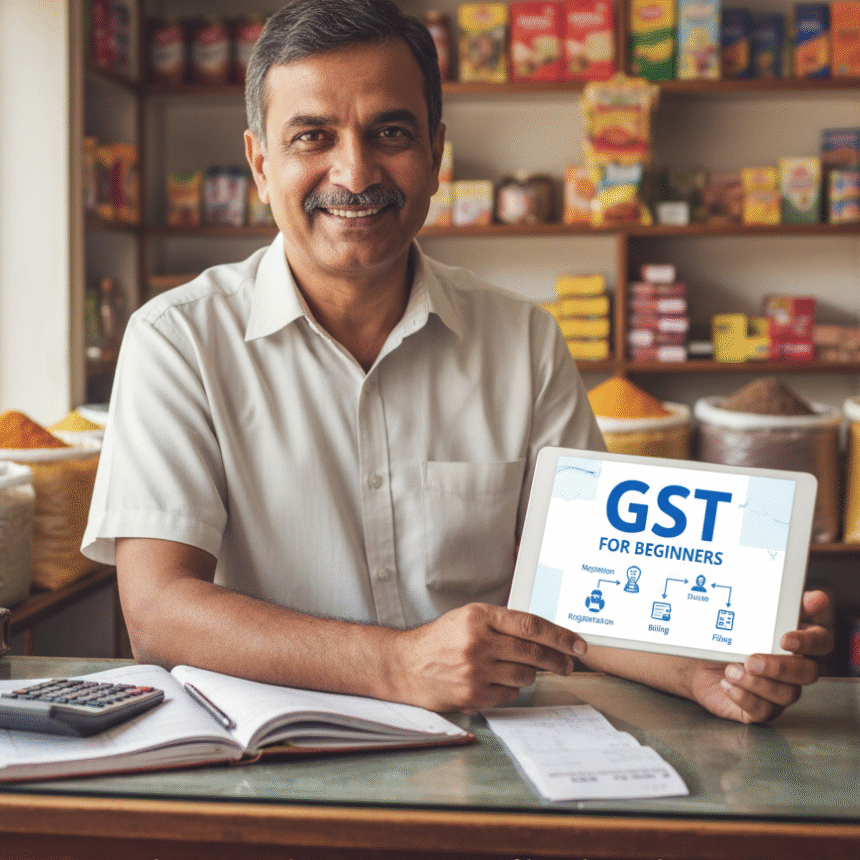
Why gst registration small business matters?
If you run a kirana store, a clothing shop, a small manufacturing unit, or even a service business in a town like Aligarh, Gaya, or Nashik, you’ve probably heard customers and suppliers talk about GST numbers.
- Why gst registration small business matters?
- What is GST in Simple Words?
- Why Should Small Shopkeepers Care About GST?
- Do You Need GST Registration?
- Main Benefits of GST Registration for Shopkeepers
- How to apply for gst registration small business online (step-by-step)
- Documents Required for GST Registration
- Common Mistakes to Avoid While Registering
- After GST Registration – What’s Next?
- Penalties for Not Registering When Required
- Practical Tips for Small Town Shopkeepers
- FAQs: GST for Small Businesses
- Final Word
But for many small shopkeepers, the term GST still feels complicated… full of government
jargon and difficult forms.
The good news? It’s actually simpler than it seems — and registering for GST can bring your business significant benefits.
This guide will walk you through GST registration for small business, step‑by‑step, in plain and simple language.
What is GST in Simple Words?
GST (Goods and Services Tax) is a single tax on goods and services that replaced multiple indirect taxes like VAT, service tax, and excise duty.
This gst registration small business guide helps shopkeepers understand GST easily.
If you’re registered under GST, you’ll have a unique GST Identification Number (GSTIN) — your business identity in the national tax system.
Why Should Small Shopkeepers Care About GST?
Even if you’re a small retailer in a Tier 3 city, GST can:
- Help you claim Input Tax Credit (ITC): You can reduce taxes by claiming credit for GST paid on purchases.
- Boost customer trust: Many bigger clients and businesses prefer dealing with GST‑registered sellers.
- Help in expansion: You can supply goods interstate without restrictions, sell on e‑commerce sites, and participate in government tenders.
- Simplify taxes: One unified system instead of handling multiple state/central taxes.
Do You Need GST Registration?
Mandatory Registration If:
- Your annual turnover is over ₹40 lakh (goods) or ₹20 lakh (services) — lower threshold for some states.
- You sell goods/services to customers in other states (interstate supply).
- You pay GST under the reverse charge mechanism (RCM).
- You sell through e‑commerce marketplaces like Amazon, Flipkart, etc.
- Even if you run a small shop, gst registration small business rules apply if your turnover crosses limits.
Voluntary Registration:
Even if your turnover is less, you can still register voluntarily to:
- Claim ITC.
- Appear more professional to clients and suppliers.
- Expand your business reach.
Main Benefits of GST Registration for Shopkeepers
- Input Tax Credit (ITC) Advantage: Reduce your tax liability by deducting the GST you’ve already paid on purchases.
- One of the biggest advantages of gst registration small business owners get is credibility in the market.
- Better Market Access: Supply goods to other states or online customers without the hassle of paperwork.
- Business Credibility: A GST number on your bill instantly increases trust.
- Ease of Compliance: Filing returns online is more transparent and simpler after some familiarisation.

How to apply for gst registration small business online (step-by-step)
(You can do this yourself online, no middleman needed)
Step 1:
Visit the official GST Portal.
Step 2:
Go to Services → Registration → New Registration.
Step 3:
Fill Part A with:
- PAN number
- Mobile number (linked to Aadhaar)
- Email ID
- Submit to receive an OTP.
Step 4:
You’ll get a Temporary Reference Number (TRN) on your mobile/email.
Step 5:
Log in with TRN → Fill Part B with:
- Business address
- Bank account details
- Business constitution (Proprietor/Partnership/Firm)
Step 6:
Upload required documents (see list below).
Step 7:
Submit the application with OTP/e‑sign/Digital Signature (for companies/LLPs).
Step 8:
After verification, you’ll get your GSTIN and the GST Registration Certificate.
Documents Required for GST Registration
- PAN of proprietor/firm/company.
- Aadhaar Card of proprietor/partners.
- During gst registration small business online filing, make sure PAN and Aadhaar match.
- Proof of business address — Rent agreement, electricity bill, property papers.
- Bank details — Cancelled cheque or first page of passbook.
- Photograph of the owner/partners.
- Digital Signature Certificate (for companies/LLPs).
Common Mistakes to Avoid While Registering
- Wrong details on PAN/Aadhaar: Keep details consistent to avoid rejection.
- Unreadable documents: Upload clear, legible scans.
- Delay in application: Once you cross the turnover threshold, apply within 30 days.
After GST Registration – What’s Next?
- Use GSTIN on invoices: All bills must carry your GST number.
- File GST returns: Monthly/quarterly as per your category.
- Maintain records: Save purchase/sales data, tax payments, invoices securely.
- Check due dates: Missing these can lead to penalties.
Penalties for Not Registering When Required
- Fine: 10% of tax due or ₹10,000, whichever is higher.
- For willful evasion: Penalty can be 100% of tax due + possible legal action.
Practical Tips for Small Town Shopkeepers
- Start early: Even if under threshold, voluntary registration can help you grow.
- Learn online filing: Free tutorials on the GST portal or YouTube can make you self‑sufficient.
- Consult only trusted CAs/agents: Avoid scams.
- Use reminders: Mark tax filing dates in your phone or diary.
FAQs: GST for Small Businesses
Q1. How to register for GST if I own a small shop?
Visit the official GST portal, create an account, fill in Parts A & B with your details, upload documents, and submit for verification.
Q2. What is the turnover limit for GST registration for small shopkeepers?
₹40 lakh for goods and ₹20 lakh for services — with lower limits for certain special states.
Q3. What are the benefits of GST registration for small shopkeepers?
Helps you claim ITC, expand to interstate sales, improve business credibility, and meet compliance easily.
Q4. Can I register for GST if my turnover is below the limit?
Yes, voluntary GST registration is possible and can benefit you in market expansion.
Q5. What happens if I don’t take GST registration when required?
You may face penalties starting from ₹10,000 and legal consequences like interest on pending tax.
Q6. Which documents are needed for GST registration small business?
PAN, Aadhaar, proof of business address, bank account proof, owner’s photograph, DSC (if applicable).
Final Word
GST may seem like “extra paperwork” at first, but for a small business in a Tier 2 or Tier 3 city, it can be the key to unlocking bigger opportunities.
Think of GST registration as an investment — it pays back in credibility, market access, and long‑term stability.
If you’ve been on the fence, take the first step today — visit the GST portal and start your application.