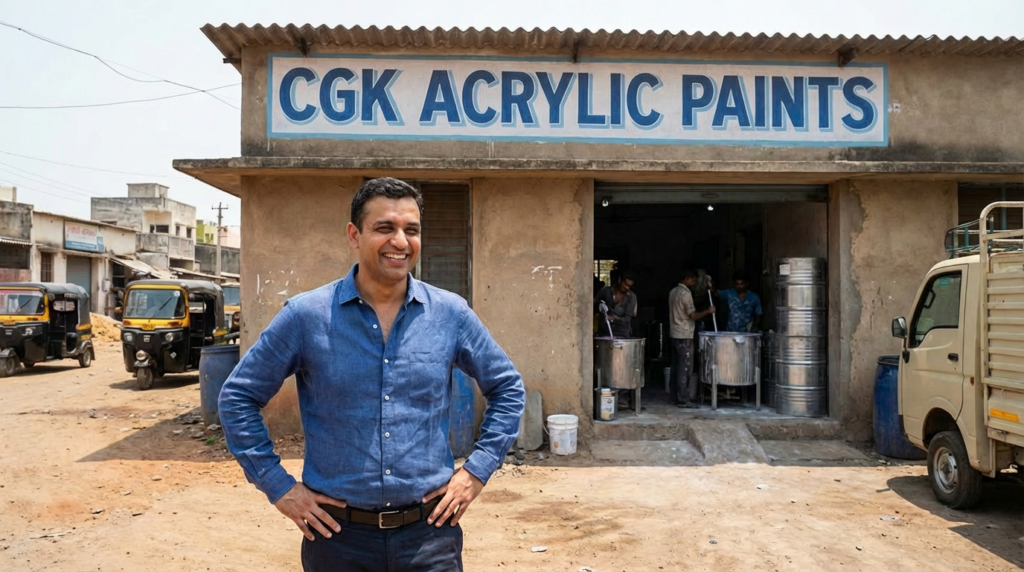
You can start an acrylic paint manufacturing business in India with ₹20–25 lakhs, in 800–1,000 sq ft of space, within 5–6 months.
Here’s what you need upfront:
- You can start an acrylic paint manufacturing business in India with ₹20–25 lakhs, in 800–1,000 sq ft of space, within 5–6 months.
- Why the Acrylic Paint Industry is Booming in 2026
- Market Potential: Who’s Buying & Why
- What is Acrylic Paint & Why It’s Different From Other Paints
- Investment Breakdown: Real Numbers for 2026
- Financing Options Available to You
- Step-by-Step Setup Guide: From Planning to First Sale (5-6 Month Timeline)
- Marketing Strategy That Actually Works
- Manufacturing Process (Easy-to-Understand Overview)
- Financial Projections: What to Expect (Conservative Estimates)
- Compliance & Registrations (Keep it Clean From Day 1)
- Realistic 5–6 Month Launch Timeline
- Frequently Asked Questions (FAQs)
- Your Action Plan: What to Do This Week
- Why CareerGrowKaro?
- Final Words
- Share Your Success Story
- Explore More CareerGrowKaro Resources:
- Machinery: Sand mill + high-speed disperser (core equipment)
- Key raw materials: Acrylic emulsion, titanium dioxide, DM water
- 3 mandatory licences: GST, Pollution Control Board clearance, Shop & Establishment
- Funding route: PMEGP subsidy (up to 35%) or Mudra loan (up to ₹20L)
- Revenue target: ₹72–105 lakhs by Year 1–2
The Indian paint market is projected to cross ₹1.3 trillion by 2025–26, growing at 9.38% CAGR through 2030 (Mordor Intelligence India Paints & Coatings Market Report, 2024–2029 and Wright Research ). Acrylic variants alone dominate the decorative segment at nearly 70% market share.
This CareerGrowKaro guide gives you exact numbers and systems: investment breakdown, 10-step setup roadmap, must-have licenses, the Painter & Dealer Activation System most guides skip, and conservative break-even projections — built specifically for Tier-2/Tier-3 Bharat entrepreneurs.
Bas shuru karo, kyunki .., the market is ready, government support is available, and this guide gives you everything else.
Why the Acrylic Paint Industry is Booming in 2026
Paint is not just “a product.” It’s tied to housing, real estate upgrades, infrastructure, and lifestyle spending. Let’s look at why this moment is right for new manufacturers entering the acrylic paint business..
Why is this happening? Three key drivers:
India’s Housing + Renovation Wave: The PM Awas Yojana has sanctioned over 1.18 crore urban homes (Ministry of Housing & Urban Affairs, 2024 Annual Report).Even when new construction slows, renovation doesn’t stop. Post-pandemic, families are upgrading interiors faster than ever and they want low-odor, water-based paints that are safe for children and pets.
Government Infrastructure Projects: The PM Gati Shakti National Master Plan and Smart Cities Mission (covering 100 cities) are generating continuous bulk demand for institutional-grade coatings.
This creates a real opportunity for small manufacturers to supply government tenders and contractor networks, especially in Tier-2 and Tier-3 districts.
Shift to Eco-friendly, Water-Based Paints (Health + Convenience): Global coatings are moving toward low-VOC and water-based systems — and India is catching up fast.
Acrylic paints win because they dry in 2–4 hours (vs. 12–24 hours for oil-based), have minimal odor, and are easier to clean. Painters love them. Homeowners prefer them. Contractors recommend them.
CareerGrowKaro Tip:Pick Your Timing Right. The best months to launch a paint business in India are January–March (pre-summer renovation season). Dealers stock up, painters are active, and demand is at its annual peak. Plan your 5–6 month setup so your first commercial batch is ready by February.
Market Potential: Who’s Buying & Why
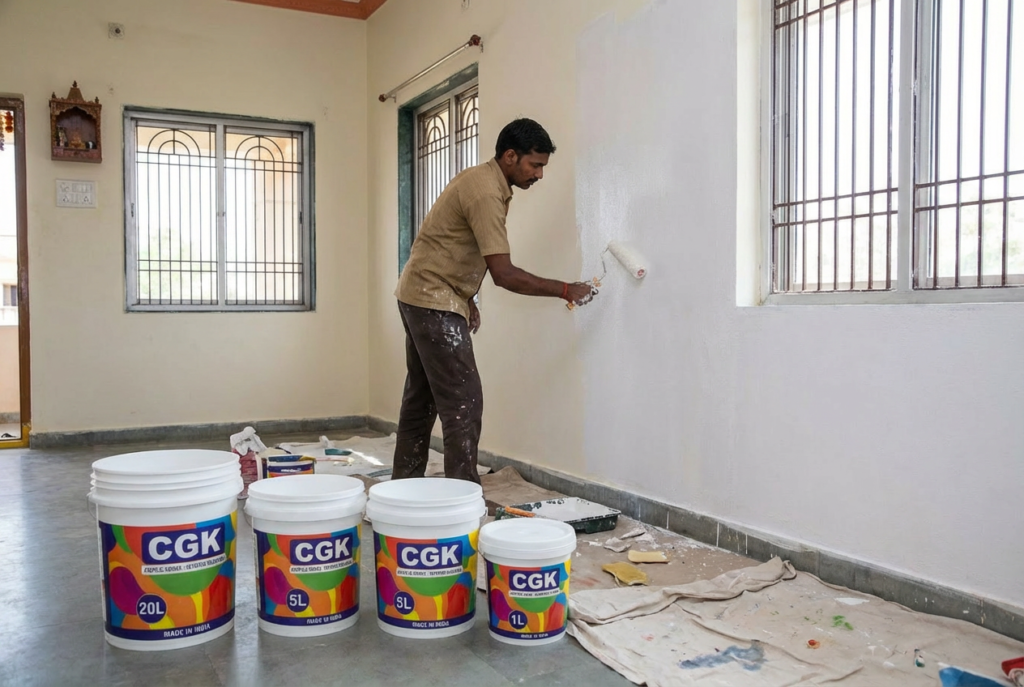
Understanding your customer base is crucial for your marketing and scaling strategy when planning your acrylic paint business plan.
Three Primary Market Segments:
A) Residential Segment (60% of market)
Who buys:
- Individual homeowners
- Real estate developers
- Interior designers and contractors
- E-commerce fulfillment centers (Amazon, Flipkart)
- Online decoration platforms
What they want:
- Consistent shade and coverage batch-to-batch
- Predictable drying time (2-4 hours)
- Low complaint rates (peeling, poor hiding, watery consistency)
- Eco-conscious, low-odor formulations
Your entry point: Economy interior emulsion, ₹180–250/litre range.
B) Commercial & Institutional (25% of market)
Who buys:
- Commercial builders
- Paint retailers and hardware stores
- Institutional buyers (schools, hospitals, government buildings)
- Local contractors and painting teams
What they want:
- Reliable supply with zero delays
- Fast complaint resolution (within 24 hours)
- 40–50% dealer margin built into pricing
- Marketing support (shade cards, sample boards etc)
- Training on application techniques
Your entry point: Bulk B2B supply contracts with local contractors.
C) Government & Infrastructure Orders (15% of market)
Who buys:
- Smart Cities authorities
- Local body purchases
- Small tenders (varies by state)
- Railway, airport, and institutional renovations
What they want:
- Stable quality and compliance certifications
- Ability to handle bulk orders (5,000-10,000+ liters per order)
- Formal registration (GST, Udyam, factory license for paint manufacturing)
- Competitive pricing on large volumes
Your entry point: Small district-level tenders once production exceeds 3,000L/month.
Multiple Applications Beyond “Wall Paint” (Hidden Profit Opportunities)
Most entrepreneurs think acrylic paint is only for walls. They’re wrong. This is where you find premium margins and customer loyalty:
- Exterior wall coating — Most profitable segment (premium pricing, 7-10 year warranty). Price point – ₹350–500/L
- Interior emulsion paints — Bulk volume, steady demand, 2-3 year lifecycle
- Primer coats — Used before main paint application, repeat purchase driver. Price point – ₹150–200/L.
- Specific-use paints — Tile paint, metal paint, wood primer (higher price points)
- Texture finishes — Premium products with 30-50% higher margins. Price point – ₹400–600/L
- Anti-bacterial coatings — Growing demand post-pandemic (hospitals, schools). Price point – ₹450–650/L
- Heat-reflective paints — Popular in hot Indian climates (energy-efficient trend). Price point – ₹400–550/L
- DIY furniture paint — Small packs (200ml, 500ml) for online sales. Price point – ₹80–150/pack
CareerGrowKaro Tip: Start with standard interior emulsion (easy production, wide market). Once you achieve ₹1+ crore annual revenue, add premium variants to increase your average selling price and paint business profit margin. This is how successful manufacturers scale in India.
→ Internal Link Suggestion: Aloe Vera Manufacturing Business Ideas You Can Start with ₹20–50 Lakhs
What is Acrylic Paint & Why It’s Different From Other Paints
Before you invest a single rupee, it’s crucial to understand how to manufacture paint and why customers prefer it.
The Basics (Simple Explanation)
Acrylic paint is a water-based coating made of three core components:
- Pigment (provides colour)
- Acrylic emulsion/polymer (the binder that forms the protective film and provides durability)
- Water + additives (to control flow, drying time, foam, shelf-life, etc.)
It is water-mixable when wet (easy cleanup) and becomes water-resistant after drying (durability). That’s the core magic of the paint manufacturing process and makes it ideal for Indian conditions.
Acrylic vs. Oil-Based Paint: Quick Comparison
| Feature | Acrylic Paint | Oil-Based Paint | Why It Matters |
| Drying Time | 2-4 hours | 12-24 hours | Projects complete quicker, painters can do 2-3 jobs/week |
| Odor | Minimal | Strong chemical smell | Safe for residential use, especially with children and pets |
| Durability | 7-10 years | 5-7 years | Better value for homeowners |
| Water Resistance | Excellent (once dry) | Good | Excellent for India’s harsh summers and monsoons |
| Eco-Friendly | Yes (low VOC) | No (high VOC) | Regulatory trend, health-conscious buyers |
| Price point | Budget-friendly | Higher cost | Lower price point attracts price-sensitive Indian customers |
| Easy Cleanup | Water-based | Solvent-based | Convenience for DIY users |
| Fade-Resistance | High (UV stable) | Moderate | Colors remain vibrant in harsh sun |
This makes acrylic paint the go-to choice for residential, commercial, and institutional applications.
Investment Breakdown: Real Numbers for 2026
Let me be transparent: actual costs vary based on location, supplier relationships, and your initial capacity. Costs below reflect realistic market rates for a small-scale unit targeting ₹1–2 crore annual revenue. Prices sourced from manufacturer quotes and MSME project reports (January–March 2026).
Fixed Assets (Plant & Machinery): ₹10-12 Lakhs
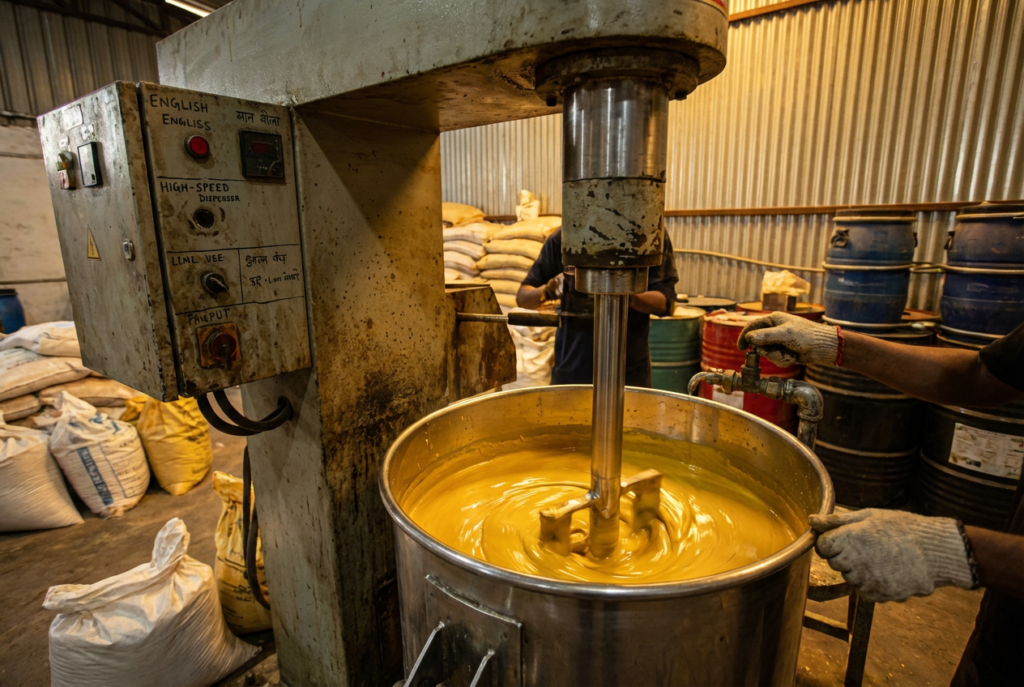
| Item | Specification | Est. Cost | Purpose |
| Sand Mill | 5 litre capacity, 5 HP | ₹3,00,000 | For fine grinding/texture consistency |
| High-Speed Disperser | 15 HP power | ₹1,80,000 | Breaks pigment lumps, ensures homogeneity |
| DM Water Plant | 25 L/hour capacity | ₹1,50,000 | Essential for consistent formulation |
| Quality Testing Equipment | Viscometer, color-matching machine, scrub tester | ₹80,000 | Non-negotiable for quality control |
| Weighing Machines + Accessories | Digital scales, beakers, measuring cylinders | ₹50,000 | Precision in batching |
| Overhead Tank & Utilities | Water storage, piping, drainage | ₹1,00,000 | Infrastructure backbone |
| Misc. Equipment & Tools | Pumps, hoses, safety gear, containers | ₹60,000 | Operational efficiency |
| ₹11,20,000 |
CareerGrowKaro Tip: The high-speed disperser (colour mixer) and sand mill are the heart of your production. A substandard disperser causes pigment lumps … leading to inconsistent texture, painter complaints, and dealer returns. Spend right here. Don’t compromise on quality.
Infrastructure & Civil Works: ₹3-4 Lakhs
| Item | Details | Est. Cost |
| Factory Space | 800-1,000 sq ft rented space @ ₹20,000/month deposit + first 2 months | ₹2,00,000 |
| Office Setup | Desk, chair, computer, basic furniture | ₹50,000 |
| Safety Equipment | Fire extinguishers, first aid, ventilation, PPE | ₹60,000 |
| Utilities Setup | Power connection upgrade (40 HP), water lines, drainage | ₹80,000 |
| ₹3,90,000 |
Raw Materials for Initial Stock: ₹4-5 Lakhs
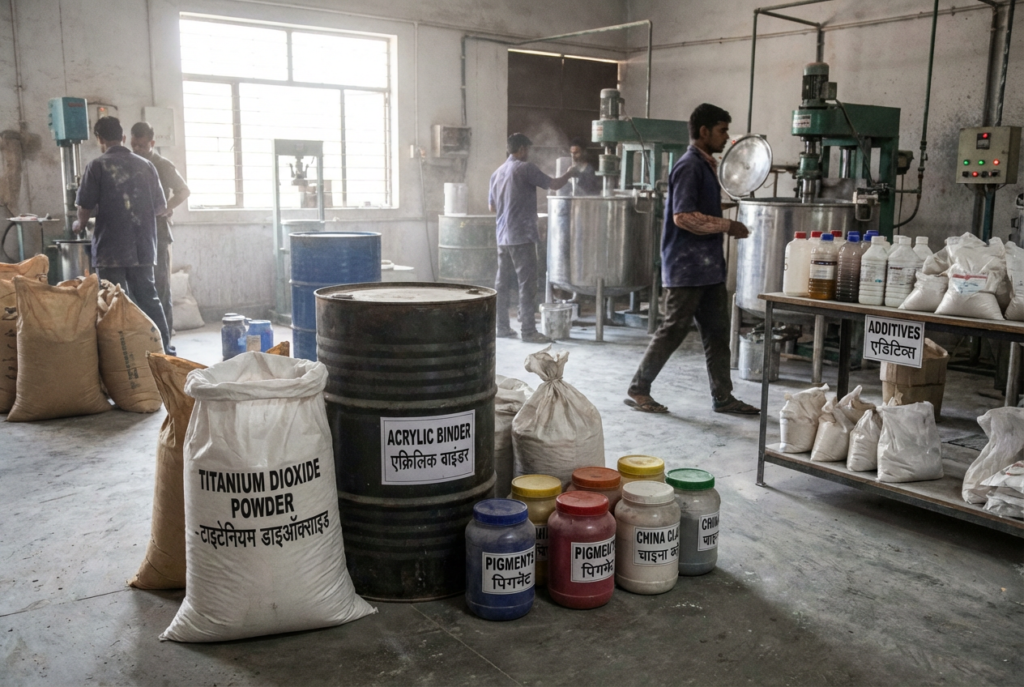
| Material | Quantity | Est. Cost | Purpose |
| DM Water | 5,000 liters | ₹50,000 | Base for formulation |
| Wetting Agents & Dispersants | 200 kg | ₹50,000 | Ensures pigment suspension |
| Titanium Dioxide | 500 kg | ₹80,000 | Provides whiteness and hiding power |
| China Clay + Calcite Extenders | 1,000 kg | ₹40,000 | Cost reduction, texture |
| Acrylic Emulsion (Binder) | 1,500 liters | ₹1,50,000 | Primary binder—most expensive component |
| Thickeners & Flow Agents | 50 kg | ₹30,000 | Viscosity control |
| Defoamer | 50 liters | ₹15,000 | Removes foam, improves finish |
| Preservatives & Biocides | 20 liters | ₹25,000 | Prevents mold, extends shelf-life |
| Packing Materials | Buckets, labels, cartons | ₹70,000 | First 1,000 buckets of paint |
| ₹5,10,000 |
Working Capital & Contingency: ₹3-4 Lakhs
| Item | Details | Est. Cost |
| Staff Salaries (First 2 Months) | Production supervisor, operators, helpers | ₹1,00,000 |
| Licenses & Registrations | GST, Shop & Establishment, Factory License, Udyam | ₹50,000 |
| Insurance (Annual) | Factory liability, product liability | ₹30,000 |
| Trademark + Legal | Brand name registration | ₹20,000 |
| Marketing & Launch | Samples, local ads, paint dealer visits | ₹150,000 |
| Contingency (10%) | Unforeseen costs | ₹50,000 |
| ₹4,00,000 |
Total Paint Manufacturing Business Investment: ₹23-25 Lakhs
| Category | Amount |
| Plant & Machinery | ₹11,20,000 |
| Infrastructure & Civil | ₹3,90,000 |
| Raw Materials (Initial) | ₹5,10,000 |
| Working Capital + Contingency | ₹4,00,000 |
| Total Project Cost | ₹24,20,000 |
Magic Box – Struggling to Figure Out Funding?
Don’t let the ₹24 lakh investment stop you. Government schemes like PMEGP can cover up to 35% of your project cost as a direct subsidy … that’s ₹8+ lakhs you don’t repay.
Use CareerGrowKaro’s PMEGP Eligibility & Business Plan Guide to understand exactly which scheme suits your category, state, and project size.
Financing Options Available to You
Seedha baat … you don’t need ₹24 lakhs in your savings account to start.
1) PMEGP (Prime Minister Employment Generation Programme)
- Subsidy: 25-35% for SC/ST/Women//NER entrepreneurs, 15% for general category
- Maximum Loan: Up to ₹50 lakhs
- Repayment Period: 5-7 years
- Interest Rate: Bank’s regular rate (typically 10-12%)
- Administered by: KVIC (Khadi & Village Industries Commission)
- Website: pmegp.gov.in
- Best for: First-time entrepreneurs seeking government backing. SC/ST/Women get highest subsidy. This PMEGP loan for manufacturing business is a key part of the Pradhan Mantri Udyog Yojana ecosystem.
Note: PMEGP subsidy rates and eligibility criteria are reviewed annually by KVIC. Always verify current rates at the official PMEGP portal before applying.
2) Mudra Loan Scheme (Pradhan Mantri Mudra Yojana)
- Maximum Loan: Increased to ₹20 Lakhs (as per Union Budget 2024-25) for the ‘Tarun’ category.
- Collateral: Not required for qualifying startups.
- Interest Rate: 9-11% (varies by lender)
- Documents Needed: Aadhaar, PAN, acrylic paint business plan, property proof
- Best for: Quick approval with minimal documentation
- Apply at: Any scheduled commercial bank or mudra.org.in
3) Bank Term Loan
- Maximum Loan: Up to ₹15-20 lakhs at competitive rates
- Interest Rate: 9-11% depending on bank and credit score
- Collateral Required: Personal guarantee or movable assets
- Best for: Established entrepreneurs with good credit history
4) Your Own Capital
- Recommended Contribution: 20-30% of total project cost (₹5-7 lakhs)
- Why: Demonstrates financial commitment to lenders, improves loan approval chances significantly
- Benefit: Reduces EMI burden, gives you operational buffer
Step-by-Step Setup Guide: From Planning to First Sale (5-6 Month Timeline)
Mehnat aur discipline … that’s what separates paint units that survive from those that shut down in Year 1. Here’s how to move from idea to first customer in 5-6 months without panic – the complete roadmap for how to start a paint company in India.
Phase 1: Pre-Launch & Market Research (Months 1-2)
Step 1: Market Research & Business Plan (Week 1-2)
What to do:
- Identify your target market segment: residential (60% market) OR commercial (25%) OR institutional (15%)
- Research 3-5 local competitors in your city/district
- What price ranges do they charge? (₹200-300/liter for economy, ₹350-500 for premium)
- What shades sell fastest? (White, off-white, pastel, bold colors?)
- How do they distribute? (Direct to dealers, contractors, or online?)
- Interview 10-15 painters and hardware store owners about their pain points
- Decide your unique selling proposition (USP) — faster drying? better coverage? local availability?
- Calculate break-even point and paint business profit margin
- Document everything in a formal acrylic paint business plan (required for PMEGP/Mudra applications)
Success metric: You should know exactly who your first 100 customers will be. This research forms the backbone of your acrylic paint business plan.
Step 2: Secure Your Factory Space (Week 2-3)
What to look for:
- Size: 800-1,000 sq ft space (can expand to 1,500 sq ft later) for your small scale paint manufacturing unit
- Location: Industrial area preferred (away from residential neighborhoods for regulatory compliance)
- Utilities: Ensure water availability (min. 2,000 liters/day) and reliable power (40 HP connection feasible)
- Layout: Separate zones for raw material (dry), raw material (liquids), production, finished goods, QC testing
- Neighbor approval: Check if nearby residents/businesses will object (pollution concerns)
- Rent negotiation: Aim for ₹15,000-20,000/month; include 2-3 months deposit
Why it matters: Bad space = quality issues, regulatory problems, inability to scale.
Step 3: Register Your Business (Week 3-4)
- Registrations needed (in order):
- GST Registration (Mandatory)
- Time: 5-7 working days
- Documents: PAN, Aadhaar, property proof (rental agreement), bank account
- Purpose: Allows you to buy raw materials tax-free, sell to dealers with GST
- Udyam Registration (MSME)
- Time: 2-3 days (online)
- Cost: Free
- Benefits: Subsidy eligibility, government scheme access, reduced bank interest rates
- Website: udyamregistration.gov.in
- Shop & Establishment License (From Municipal Corporation)
- Time: 10-15 days
- Cost: ₹5,000-10,000
- Purpose: Legal permission to operate manufacturing unit
- Pollution Control Board Clearance (State-specific)
- Time: 20-30 days
- Cost: ₹10,000-15,000
- Documents: Layout plan, machinery details, emission control measures
- Purpose: Ensures you meet environmental standards
- Factory License (If applicable)
- Required: When you employ 20+ workers
- Not needed initially (start with 5-6 staff)
- Can register later when scaling
- Trademark Registration (Optional but Recommended)
- Time: 18-24 months
- Cost: ₹10,000-20,000
- Purpose: Protects your brand name legally
- Total registration cost: ₹30,000-50,000
- Total time: 4-6 weeks
- Official portals:
- GST: gst.gov.in
- Udyam: udyamregistration.gov.in
- MSME Ministry: msme.gov.in
Phase 2: Setup & Installation (Months 2-3)
Step 4: Procure Machinery (Week 5-6)
How to source:
- Google “sand mill manufacturers India” .. you will find 50+ suppliers
- Contact 3-4 reputable machinery suppliers in industrial hubs (Mumbai, Delhi, Ahmedabad, Bangalore)
- Request quotes with specifications
Ask for:
- Equipment warranty (typically 1 year parts and labor)
- Installation support
- Spare parts availability
- Training for your team
- Post-sales service contact
Negotiation tips:
- Negotiate 5-10% discount for spot purchase or immediate payment
- Ask for payment terms (30 days common for established suppliers)
- Request demo/trial before finalizing order
- Get everything in writing (delivery date, specifications, payment terms)
- Timeline: 1-2 weeks for delivery + 1 week installation and testing. Your core machinery will include a sand mill and a high-speed color mixer machine (disperser).
Step 5: Install Infrastructure (Week 6-7)
Setup checklist:
- DM water plant installation and testing
- Overhead tank installation (minimum 5,000 liters capacity)
- Plumbing and drainage system
- 40 HP electrical connection and load testing
- Safety equipment (fire extinguishers rated for chemical fires, first aid kit, emergency eye wash)
- Ventilation system (prevents paint vapor accumulation)
- Material storage setup (dry and liquid storage separately)
- Finished goods racking (vertical stacking to save space)
Quality control corner setup:
- Viscometer (measures thickness/flow)
- Shade matching light box (ensures color consistency)
- Weighing scales (accuracy critical)
- Scrub test equipment (measures paint durability)
Step 6: Establish Raw Material Supply Chain (Week 7-8)
Identify suppliers for each raw material:
| Material | Key Suppliers (By Region) | Lead Time | Bulk Discount |
| Acrylic Emulsion | BASF, Dow Chemicals, Arkema, Indian companies like Deepak Fertilisers | 7-10 days | 5-10% on 1,000+ L |
| Titanium Dioxide | Chemours, Kronos, Huntsman, Indian dealers | 5-7 days | 8-12% on 500+ kg |
| China Clay/Calcite | Local suppliers, regional mines | 2-3 days | 10-15% on bulk |
| Additives (dispersants, thickeners) | BASF, Evonik, Arkema, local dealers | 7-14 days | 5-10% |
| DM Water | Local RO suppliers | Daily | Depends on contract |
Negotiation strategy:
- Approach 2-3 suppliers per material
- Request credit terms (15-30 days payment period)
- Secure volume discounts (10-15% typical for 3-6 month orders)
- Maintain 10-15 day buffer stock to ensure continuous production
- Build relationships (visit suppliers quarterly, communicate honestly)
CareerGrowKaro Insight: One bad supplier = production delays = missed orders = reputation damage. Choose reliability over 2% price savings.
Phase 3: Production & Quality Testing (Months 3-4)
Step 7: Hire & Train Your Team (Week 9-10)
Lean starter team (6 people):
| Role | Responsibility | Monthly Salary | Hiring Tips |
| Production Supervisor | Oversees production, quality checks, staff management | ₹18,000-22,000 | Hire from existing paint kcompanies if possible |
| Machine Operator (2 positions) | Operates sand mill, color mixer machine, disperser, maintains equipment | ₹12,000-15,000 each | Must understand machinery, safety protocols |
| Quality Tester | Viscosity testing, shade matching, batch documentation | ₹12,000-15,000 | Lab background helpful (chemistry diploma) |
| Helpers/Packaging (2 positions) | Material handling, bucket filling, labeling, dispatch | ₹8,000-10,000 each | Young, trainable, physically fit |
| Sales/Business Development (Add month 2) | Dealer outreach, customer relationship, orders | ₹15,000-18,000 | Critical role—affects cash flow directly |
Total monthly payroll (Year 1): ₹75,000-85,000
Training program (2-3 weeks before commercial production):
- Safety protocols (fire safety, chemical handling, first aid)
- Equipment operation and maintenance
- Quality testing procedures
- Production process step-by-step (paint manufacturing process)
- Hygiene and cleanliness standards
- Waste management and disposal
Invest in training seriously: A well-trained team produces consistent quality. Quality consistency = repeat customers = word-of-mouth growth.
Step 8: Run Trial Batches & Refine Formula (Week 10-11)
Trial batch process:
- Produce 100-200 liters of paint using your planned base formulation
- Run QC tests:
- Viscosity (should be 90-110 seconds using standard viscosity cup)
- Fineness (no lumps, smooth consistency)
- Shade (matches standard color card)
- Drying time (2-4 hours for acrylic)
- Coverage (should hide surface in 2 coats max)
- Washability (rub test on dry surface—should not fade after 100 rubs)
- Get real-world feedback:
- Give free samples (500ml-1L) to 10-15 painters in your area
- Ask them to apply on actual walls and report back
- Collect feedback on: drying time, coverage, color, ease of application
- Refine your formula based on feedback (add thickeners, adjust drying time, change pigment ratios)
- Stabilize your base formula:
- Document the exact recipe (down to grams) that works best for how to manufacture paint
- This is your “standard formulation”—don’t change it unless necessary
- Consistency = customer loyalty
Phase 4: Launch & Marketing (Months 4-5)\
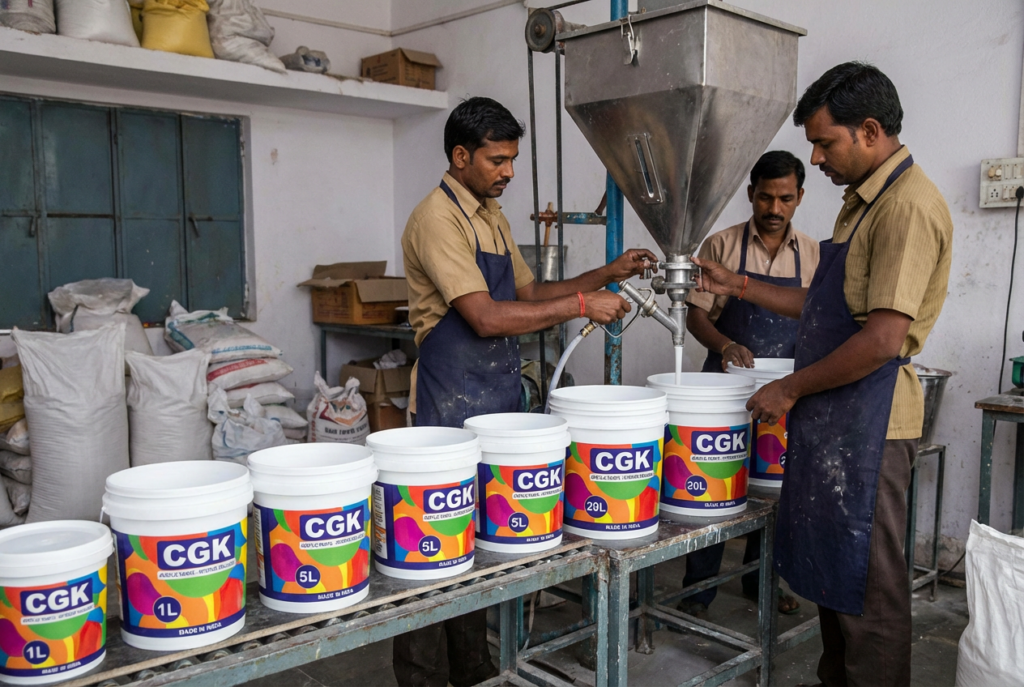
Step 9: Package & Brand Your Product (Week 12)
- Packaging essentials:
- Paint buckets: 500ml, 1L, 5L, 10L, 20L sizes
- Labels: Include brand name, shade name, batch code, usage instructions, expiry date, your contact info
- Cartons: For bulk shipment to dealers
- Cost: ₹10,000-15,000 for design + first 1,000 buckets with labels
- Branding tips:
- Create a brand name that’s memorable and relevant
- Use colors that reflect your paint (e.g., “ColorMax,” “ProAcrylic,” “PaintPro”)
- Include confidence-building elements on label: “ISO certified,” “Tested for durability,” “Made in India”
- Add usage instructions in simple Hindi + English
- Initial inventory:
- Stock 500-1,000 liters of paint before launch
- Focus on 3-4 core shades initially (white, off-white, light pink, light blue)
- Add more shades based on dealer demand
Step 10: Start Selling (Week 13-16)
Your B2B sales strategy (70% of business initially):
Strategy 1: Direct Hardware Store & Dealer Sales
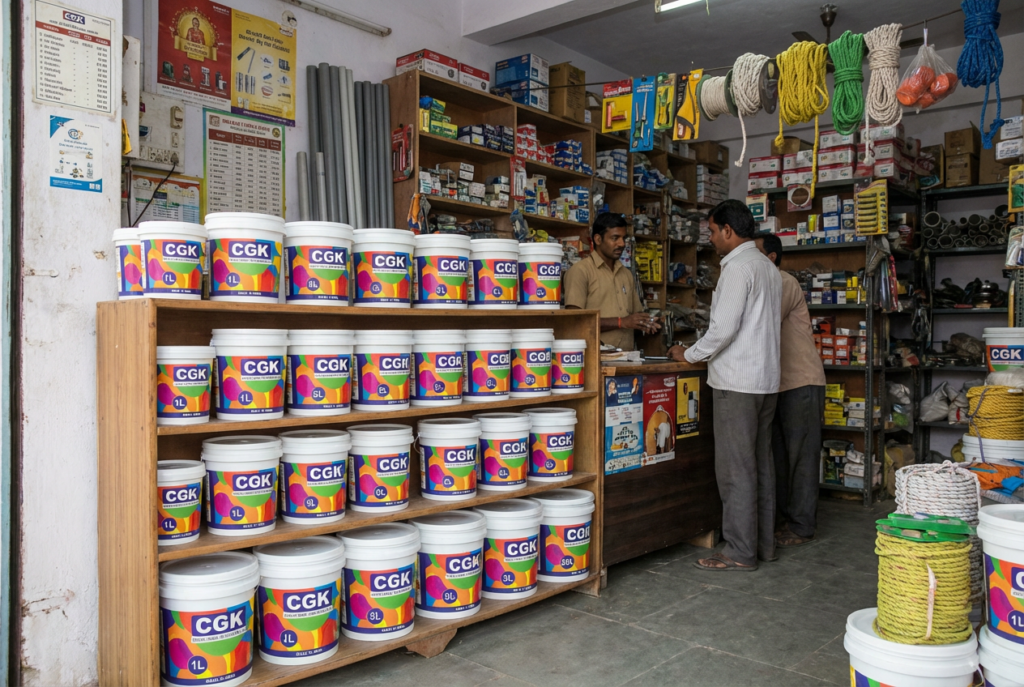
Target: Local paint retailers and hardware stores in your city/district
Action plan (First 60 days):
- Map 100+ retailers in your area using Google Maps + local business directories
- Visit 10-15 stores per week with samples, pricing sheet, and product literature
- Offer starter incentive: First order gets 10-15% discount + free shade cards + sample boards
- Propose margin: Dealers typically want 20-25% margin; offer them ₹50/liter (if you sell at ₹200/liter)
- Payment terms: Offer 15-30 day credit for repeat orders to build trust
- Loyalty program: 1% additional discount on orders above 100 liters/month
- Support system: Visit top 10 dealers monthly, solve complaints immediately, offer co-marketing
Expected result: One hardware store can sell 50-100 liters/month consistently.
Strategy 2: Painter & Contractor Activation
Painters influence brand choice daily. They are your best salesforce.
Painter relationship-building tactics:
- Weekly “chai + demo” meets at 3-4 key dealer points (Saturday mornings work best)
- Free T-shirts/ID cards with your logo (builds community, costs ₹200-300 per person)
- Per-liter incentive slabs:
- ₹2/liter on 500 liters/month
- ₹3/liter on 1,000+ liters/month
- Track with scratch coupons or QR code system
- Training workshops (free, 30 minutes): “How to avoid peeling using primer + emulsion system”
- Referral bonuses: ₹500 for every new dealer they introduce who places first order
Why this works: Painters become your brand ambassadors. One painter recommending your paint = 5-10 new orders/month.
Strategy 3: Contractor & Developer Partnerships
Target: Active construction contractors in your area (identify from local projects)
Approach:
- Identify 5-10 large contractors doing projects in your area
- Visit their site office with samples
- Propose custom branding: “ABC Builders” printed on your paint can (create emotional connection)
- Offer bulk discounts: ₹2-5/liter on orders of 5,000+ liters
- Request testimonials and before/after project photos for marketing
- Provide reliable supply (don’t miss delivery dates)
Result: One contractor = 500-1,000 liters/month recurring business. This is your cash flow engine.
Strategy 4: Digital Presence (Growing to 40% by Year 2)
Your digital stack (cost-effective, high-impact):
1. Google Business Profile (GBP)
- Create profile with factory photos, product images
- Add service area (your city + nearby districts)
- Collect reviews from dealers and painters
- Update with posts monthly
- Cost: Free | Impact: Shows up in Google Maps searches, builds credibility
- Local keywords to target on GBP:
- “acrylic paint manufacturer in [city]”
- “water-based paint dealer near me”
- “paint supplier in [district]”
2. WhatsApp Business
- Create product catalog with photos and prices
- Build dealer/painter broadcast lists (segment by location, order frequency)
- Send weekly updates:
- New shade launches
- Seasonal campaigns
- Customer success stories
- Exclusive dealer offers
- Respond to inquiries within 2 hours
- Cost: Free | Impact: Direct communication, high conversion (WhatsApp users = warm leads)
3. Local Facebook Groups
- Join “Painters in [City]” groups, “Interior Designers [City],” “Home Renovation [City]”
- Engage genuinely (answer questions, share tips, don’t hard-sell)
- Post before/after project photos monthly
- Share customer testimonials
- Run monthly giveaways (5L paint to lucky painter)
- Cost: ₹0-5,000/month | Impact: Brand awareness + word-of-mouth
4. Instagram Reels (Short-form video)
- 30-60 second videos showing:
- Paint application process (time-lapse)
- Drying time test (your paint vs. competitors)
- Color options showcase
- Customer testimonials
- Before/after room transformations
- Post 2-3 reels/week
- Use hashtags: #AcrylicPaint #PaintBusiness #HomeRenovation #DiyPaint [YourCity]
- Cost: ₹0 (DIY) or ₹5,000-10,000/month if outsourced | Impact: Viral potential, brand awareness
5. OLX & Quikr Listings
- Create detailed listings with high-quality photos
- List multiple SKUs (500ml, 1L, 5L, 10L)
- Respond to inquiries within 4 hours
- Build ratings through quality service
- Cost: Free | Impact: Captures searches from B2B buyers + retailers
6. Amazon & Flipkart B2B Program (Year 2+)
- Once you’re producing 500+ liters/day, apply to B2B seller programs
- These platforms connect you directly with registered dealers and retailers
- Higher volume potential, but lower margins (40-50% vs. 80-90% direct)
Strategy 5: Seasonal & Festival Campaigns
Timing-based promotions:
| Season/Festival | Campaign Focus | Discount | Messaging |
| Diwali (Sep-Oct) | “Fresh paint, fresh home” | 10-15% off | Appeal to festival-season renovation trend |
| Summer (Mar-May) | “Beat the heat with light colors” | Free shade consultation | Position light colors for cooling |
| Monsoon (Jun-Aug) | “Waterproof coating special” | 5% discount | Emphasize water resistance |
| Year-End (Nov-Dec) | Bulk buyer discounts | ₹5-10/liter for 5000+ L | Capture annual budget spending |
| Summer vacations | “Quick home makeover” | 10% off + free primer | Target renovation during holidays |
Dealer co-marketing:
- Provide printed posters for store displays
- Co-create WhatsApp announcements with dealers
- Offer dealer bonus if they push during peak season
What Really Decides Success: Quality + Consistency + Positioning
Here are the 5 most common reasons new paint units struggle:
- Inconsistent viscosity — Sometimes thick, sometimes watery
- Solution: Invest in viscometer, document exact recipes, train team rigorously
- Shade mismatch across batches — Customers complain “this doesn’t match sample”
- Solution: Use color-matching light box, keep batch records, accept replacements gracefully
- Low hiding/coverage — Painters hate re-coats (wastes their time)
- Solution: Increase titanium dioxide % slightly, test coverage on actual walls, get painter feedback
- Poor dealer margins or delayed supply — Dealers drop your brand
- Solution: Offer 20-25% margin, never miss delivery dates, replace faulty batches immediately
- No on-ground marketing support — Dealers don’t push your paint
- Solution: Regular dealer visits, painter meets, co-marketing, loyalty incentives
CareerGrowKaro insight: In the paint business, quality inconsistency is deadlier than competitors. One “watery batch” spreads bad word-of-mouth across 20+ painters faster than any competitor’s marketing.
Your strategy: Choose one segment (interior economy emulsion), own it locally, build reputation, then expand.
Marketing Strategy That Actually Works
Positioning Statement (Use Everywhere)
Don’t claim “we are the best paint.”
Instead, use proof-based promises:
- “Smooth finish in 2 coats” (not 3 like competitors)
- “Low-odor for occupied homes with children”
- “Shade consistency batch-to-batch” (emphasize quality control)
- “Fast support—replacement within 24 hours if issue”
- “Made locally, trusted regionally” (emphasize Indian manufacturing)
After-sales service is your marketing. In local markets, one solved complaint = 10 new orders through word-of-mouth.
Monthly Marketing Activities (First 12 Months)
| Month | Activities | Expected Output |
| Month 1 | Visit 50 hardware stores, start painter meets | 5-10 orders |
| Month 2 | Online: GBP setup, WhatsApp lists, Facebook groups | 100+ impressions/week |
| Month 3 | Dealer loyalty program launch, contractor outreach | 1,500+ liters sales |
| Month 4 | Instagram Reels launch, seasonal campaign start | 2,000+ liters |
| Month 5 | Expand to neighboring district (same strategies) | 2,500+ liters |
| Month 6 | Stabilize supply, build dealer testimonials | 3,000+ liters (break-even likely) |
| Months 7-12 | Scale to 5,000+ liters/month, add premium variants | Monthly 4,000-5,000 liters |
Manufacturing Process (Easy-to-Understand Overview)
Your production team will follow these steps every day in the paint manufacturing process::
- Pre-mix stage: Water + dispersing agents (break surface tension)
- Pigment stage: Add titanium dioxide, china clay, calcite (color + body)
- Dispersion: High-speed disperser (color mixer machine) breaks pigment lumps into fine particles
- Grinding: Sand mill grinds pigment to ultra-fine texture (smoothness)
- Let-down stage: Add acrylic emulsion (binder) + remaining water
- Adjustment: Add thickeners (for viscosity), defoamer (removes bubbles), preservatives (shelf-life)
- Shade matching: Visual inspection under standard light; adjust tint if needed
- Quality check: Test viscosity, coverage, drying time, stability
- Packing: Fill buckets, apply labels, batch coding, stack cartons
- Dispatch: Load on vehicles with delivery challan
CareerGrowKaro tip: In paints, your brand reputation is built in QC. One “watery batch” ruins 20 dealer relationships faster than any competitor’s marketing campaign.
Financial Projections: What to Expect (Conservative Estimates)
Based on realistic industry benchmarks (not overly optimistic), here’s what a small scale paint manufacturing unit paint unit typically achieves:
| Metric | Year 1 | Year 2 | Year 3 |
| Production Capacity Utilization | 40% | 55% | 70% |
| Annual Sales (Liters) | 90,000 | 1,25,000 | 1,60,000 |
| Average Selling Price (₹/L) | 200 | 210 | 220 |
| Annual Turnover (₹ Lakhs) | 72 | 105 | 140 |
| Cost of Goods Sold (60%) | 43.2 | 63 | 84 |
| Operating Expenses (25%) | 18 | 26 | 35 |
| Net Profit Margin | 8-10% | 10-12% | 12-15% |
| Net Profit (₹ Lakhs) | 5.76-7.2 | 10.5-12.6 | 16.8-21 |
| Break-even Point | 8-10 months | Already achieved | — |
| ROI | 27-34% | 45-60% | 65-80% |
What this means for your paint business profit margin:
- Year 1: You will likely reach break-even (recover initial ₹25L investment) between month 8-10
- Year 2: With expanded distribution, profit grows 50-75%
- Year 3: At scale, margins improve as fixed costs are spread across higher volume
Important notes:
- Financial Disclaimer: All projections above are based on conservative industry averages and publicly available MSME sector data as of Q1 2026. Actual results will vary based on your location, local competition intensity, execution quality, raw material price fluctuations (particularly titanium dioxide and acrylic emulsion, which are commodity-linked), and market absorption speed. These figures are indicative only and should not be treated as guaranteed returns. Consult a certified CA or MSME financial advisor before making investment decisions.
- These are conservative estimates (actual results depend on location, competition, execution quality)
- If you execute dealer strategy well, you could hit break-even by month 6
Compliance & Registrations (Keep it Clean From Day 1)
Essential Licenses You’ll Need:
| Registration | Timeline | Cost | Purpose |
| GST | 5-7 days | ₹0 | Legally sell paint, buy raw materials tax-free |
| Udyam (MSME) | 2-3 days | Free | Access subsidies, government schemes |
| Shop & Establishment License | 10-15 days | ₹5,000-10,000 | Municipal corporation approval |
| Pollution Control Board (PCB) | 20-30 days | ₹10,000-15,000 | Environmental compliance |
| Factory License | Variable | ₹5,000-10,000 | Required when you employ 20+ workers (later) |
| Trademark | 18-24 months | ₹10,000-20,000 | Protect your brand name legally |
Total cost: ₹30,000–50,000 | Total time: 4–6 weeks
Note: You cannot legally operate without GST, PCB Clearance, and Shop & Establishment Licence. Get these three done in Month 1 — no exceptions.
Useful government websites:
- GST registration: gst.gov.in
- Udyam registration: udyamregistration.gov.in
- MSME Ministry: msme.gov.in
Realistic 5–6 Month Launch Timeline
Here’s how to move from idea to consistent monthly sales without overwhelm:
| Phase | Month | Key Activities | Milestones | Output |
| Planning | 1 | Market research, location scouting, loan application | Layout finalized, PMEGP/Mudra applied | Supplier shortlist, location confirmed |
| Setup | 2 | Machinery ordered, registrations filed, utilities installed | All registrations approved, machinery en route | Installation plan ready |
| Production Prep | 3 | Trial batches, QC parameters set, team trained | Stable base formula achieved | 100-200L trial paint ready |
| Brand & Sales | 4 | Packaging designed, packaging + labels ordered, dealer outreach begins | First bookings from dealers | 500-1,000L inventory, 10-15 dealer relationships |
| Commercial Launch | 5 | Full production starts, painter meets begin, online presence launched | Repeat orders from 5-10 dealers | 2,000-2,500L monthly sales |
| Scaling | 6 | Expand to neighboring district, refine dealer network, add premium variants | Predictable monthly cycle achieved | 3,000-3,500L/month, likely break-even |
Frequently Asked Questions (FAQs)
How long does it take to get GST registration for an acrylic paint manufacturing business in India?
Answer: GST registration usually takes 5-7 working days if all documents are correct. Here’s what you’ll need:
- PAN card (individual or company)
- Aadhaar card
- Property proof (rental agreement for your factory space)
- Bank account details with NEFT capability
- Address proof
Timeline: Most entrepreneurs complete GST registration within 2 weeks (including document collection). At CareerGrowKaro, we recommend getting this done in Phase 1 itself so you don’t delay production.
What’s the difference between acrylic emulsion, acrylic enamel, and acrylic paint?
Answer: Great question—this confusion costs many startups revenue:
| Type | Base | Use | Lifespan | Price |
| Acrylic Emulsion | Water-based | Interior/exterior walls (most common) | 3-5 years | ₹200-300/L |
| Acrylic Enamel | Acrylic polymer + solvent | Wood, metal, surfaces needing shine | 7-10 years | ₹350-500/L |
| Acrylic Primer | Water-based acrylic | Undercoat before main paint | N/A | ₹150-200/L |
Strategy: Start with acrylic emulsion (easier to produce, 70% of market demand, lower competition). Once you achieve ₹1+ crore annual revenue, add acrylic enamel (premium variants with better margins). Primer is a natural add-on after 6-12 months.
How many liters of paint can I produce per day initially?
Answer: With one sand mill and one high-speed disperser (color mixer machine) running 8 hours/day, you can produce 700-900 liters of paint daily.
However, in Year 1, aim for 40-50% capacity utilization (300-400 liters/day) because:
- Quality consistency is more important than volume
- Market absorption takes time
- You need buffer for equipment maintenance
- Training team needs gradual ramp-up
Is it better to sell directly to customers or through distributors?
Answer: Start with direct B2B sales to contractors, painters, and hardware stores for effective paint dealer network building.
Here’s why:
| Channel | Margin | Effort | Speed | Best For |
| Direct | 80-90% | High | Months 1-6 | Building reputation, understanding market |
| Distributor | 40-50% | Low | After stabilization | Volume scaling (Year 2+) |
| Retail | 70-80% | High | Year 2+ | Brand building, e-commerce |
Strategy flow:
- Months 1-6: Direct sales (build margin, learn customer needs)
- Months 6-12: Mix of direct + approaching large dealers
- Year 2+: Approach paint distributors and organized retail (Nippon, Berger have dealer networks)
Direct sales give you 3x higher margins and direct customer feedback — both critical for survival in Year 1.
What licenses do I absolutely need to start acrylic paint manufacturing business in India? Can I skip any?
Answer: You cannot skip these three:
- GST Registration — Legal requirement; needed to bill customers
- Shop & Establishment License — Municipal requirement; enables factory operation
- Pollution Control Board Clearance — Environmental compliance; without it, you’re operating illegally
You can defer (initially):
- Factory License (required only when 20+ employees)
- Trademark (protects brand but not operational requirement)
CareerGrowKaro Recommendation: Get all three core licenses done in Months 1-2. The ₹25,000-40,000 investment is negligible compared to business risk if you operate without permits.
How do I ensure consistent quality across batches?
Answer: Quality consistency is what separates successful paint manufacturers from failures in your acrylic paint manufacturing business in India.
Here’s the system:
1. Invest in testing equipment (₹80,000 one-time)
- Viscometer (measures thickness)
- Color-matching light box (ensures shade consistency)
- Weighing scales (batch accuracy)
- Scrub test equipment (durability check)
2. Document everything rigorously
- Every batch: ingredients, quantities, drying time, viscosity reading
- Create batch record sheet template (Excel is fine)
- Review monthly trends (identify drift early)
3. Train QC team
- Quality tester must be trained thoroughly on the paint manufacturing process
- Monthly competency assessment
- Quarterly third-party testing (paint testing labs charge ₹5,000-10,000/month)
4. Customer feedback loop
- Every complaint is documented
- Trace which batch caused issue
- Adjust formulation if pattern emerges
- Inform customer + provide replacement
5. Monthly supplier audits
- Raw material quality varies
- Test each new batch of acrylic emulsion, titanium dioxide
- Maintain supplier relationships; don’t just chase lowest price
CareerGrowKaro insight: Your brand reputation is built on quality, not marketing. One “perfect batch” might impress 5 painters. One “watery batch” will damage your reputation with 50. Invest heavily in QC.
How do I find dealers for acrylic paint manufacturing business in India in Tier 2/3 cities?
Answer: This is where execution separates winners from failures. Here’s the systematic approach for paint dealer network building:
Week 1-2: Market Mapping
- Create Google Maps list of 100+ paint retailers in your city
- Drive/walk your locality; note hardware stores, paint shops
- Get phone numbers and addresses
Week 3-4: Cluster Approach
- Divide city into 5-6 clusters (east, west, north, south, central)
- Visit 8-10 retailers per cluster per week
- Approach in clusters so you can do follow-up visits efficiently
Week 5-8: Dealer Onboarding
- Offer starter scheme: ₹5,000-10,000 initial stock at special rate
- Provide shade cards + sample boards (free)
- Clear margin: ₹50/liter (if you sell at ₹200/liter)
- Promise: Easy replacement for genuine complaints
Ongoing: Painter Activation
- Weekly painter meets at top 5 dealer points (chai + demo)
- Free branded T-shirts for painters
- Per-liter incentive on bulk orders
Result: 25-40 dealers in first district by Month 6 = 2,500-3,500L/month consistent demand.
What are the key raw materials for acrylic emulsion paint (and typical costs)?
Answer: Here’s what goes into every bucket when you’re learning how to get into an acrylic paint manufacturing business in India, with approximate costs per liter:
| Material | Function | % in Paint | Cost/L | Supplier |
| Acrylic Emulsion (binder) | Forms protective film | 20-25% | ₹110-130 | BASF, Dow, Indian players |
| Titanium Dioxide | Whiteness, hiding power | 8-10% | ₹15-20 | Chemours, Kronos |
| Water | Thinner | 40-45% | ₹1-2 | Local RO supply |
| China Clay / Calcite | Extender, body | 15-18% | ₹8-12 | Local suppliers |
| Thickeners (HEC, Polymer) | Viscosity control | 0.5-1% | ₹4-6 | Evonik, BASF |
| Wetting/Dispersing Agents | Pigment suspension | 0.5-1% | ₹3-5 | BASF, Arkema |
| Defoamer | Removes bubbles | 0.3-0.5% | ₹2-3 | Various |
| Preservatives | Prevents mold | 0.3-0.5% | ₹2-3 | Various |
Total COGS per liter: ₹145-180 (for economy emulsion)
Selling price: ₹200-250/liter (direct to dealers)
Margin: ₹50-70/liter (25-35%)
CareerGrowKaro tip: The exact recipe depends on your target price point. Premium variants (₹300-350/L) use more titanium dioxide and better binders. Economy variants use more extenders to reduce cost.
What common mistakes should I avoid in Year 1?
Answer: Based on paint manufacturer interviews, here are the mistakes that kill new units:
| Mistake | Why It Fails | How to Avoid |
| Chasing too many SKUs | Confusion, poor execution | Start with 1 product, 3 shades |
| Underinvesting in QC | Inconsistency damages reputation | Budget ₹80,000 for testing equipment |
| Neglecting compliance | Operating illegally, risk closure | Get GST, PCB clearance in Month 1 |
| Poor team training | Low quality, high turnover | Invest 3 weeks in training before launch |
| Giving too much credit | Working capital dries up | Negotiate 15-30 day terms, don’t exceed |
| Not visiting dealers monthly | Relationship decay, they switch brands | Schedule monthly dealer visits, non-negotiable |
| Trying to compete on price alone | Race to bottom, margins vanish | Compete on quality + service, not price |
| Ignoring painter feedback | Products don’t meet real-world needs | Get feedback monthly, adjust formula |
How soon will I break even? What’s the realistic timeline?
Answer: Based on industry data, most small scale paint manufacturing units break even between Month 8-10 of commercial operation.
Break-even projection:
| Month | Monthly Sales (L) | Revenue (₹) | Expenses (₹) | Net Profit (₹) | Cumulative Profit (₹) |
| 3 | 1,000 | 2,00,000 | 1,50,000 | 50,000 | 50,000 |
| 4 | 1,500 | 3,00,000 | 1,80,000 | 1,20,000 | 1,70,000 |
| 5 | 2,500 | 5,00,000 | 2,50,000 | 2,50,000 | 4,20,000 |
| 6 | 3,000 | 6,00,000 | 2,80,000 | 3,20,000 | 7,40,000 |
| 7 | 3,500 | 7,00,000 | 3,20,000 | 3,80,000 | 11,20,000 |
| 8 | 4,000 | 8,00,000 | 3,50,000 | 4,50,000 | 15,70,000 |
| 9 | 4,500 | 9,00,000 | 3,80,000 | 5,20,000 | 20,90,000 |
| 10 | 5,000 | 10,00,000 | 4,00,000 | 6,00,000 | 26,90,000 |
You recover your ₹25 lakh investment by Month 10.
Key assumptions:
- Price: ₹200/liter (economy emulsion)
- COGS: 60% of revenue
- Operating expenses: 25% of revenue
- This assumes good execution of dealer strategy
If you execute well (hit 4,500L/month by Month 8), break-even happens at Month 9.
If execution is slow (only 2,500L/month by Month 10), break-even moves to Month 12.
Your Action Plan: What to Do This Week
Stop reading. Start acting.
Here’s what to do right now, this week:
Day 1-2: Market Research
- Research 3-5 competitors in your city (pricing, shades, distribution)
- Visit 5 hardware stores, ask about demand and pricing
- Connect with 5-10 painters, ask their pain points with current paints
Day 3-4: Logistics
- Identify 3 potential factory locations (check water, power, rent)
- Contact 2-3 machinery suppliers for quotes
- Research PMEGP/Pradhan Mantri Udyog Yojana/Mudra schemes, understand eligibility
Day 5-6: Business Planning
- Download PMEGP loan for manufacturing business application form
- Create basic acrylic paint business plan (target market, financials, timeline)
- Identify raw material suppliers in your state
Day 7: Decision
- Decide on market segment (residential economy vs. commercial premium)
- Set launch timeline (next 5-6 months realistic?)
- Commit to the journey or decide it’s not for you
Why CareerGrowKaro?
At CareerGrowKaro, we are committed to helping India’s youth turn ambitions into thriving businesses. This guide isn’t theoretical—it’s built on:
- Real industry trends and data
- Interviews with paint manufacturers across India
- Actionable strategies from successful entrepreneurs
- Understanding of Indian compliance, market nuances, and seasonal patterns
Whether you’re manufacturing paint, services, or products—the principles remain the same: Learn. Hustle. Grow.
We have covered the learning part here. Now it’s time to hustle.
Final Words
Starting an acrylic paint manufacturing business is not about installing machines. It’s about:
- Building trust in a market where painters and dealers don’t forgive inconsistency
- Delivering consistent quality that keeps customers coming back
- Supporting your channel partners through effective paint dealer network building so they push your brand
- Scaling smartly — from one district to regional dominance
If you can execute these four things, you’ll build a local brand that grows year after year, generating ₹5-20 lakhs annual profit by Year 2-3 with a strong paint business profit margin.
The time to start is now. Market conditions are favorable. Government support through PMEGP loan for manufacturing business and Pradhan Mantri Udyog Yojana is available. Demand is real.
What are you waiting for?
Share Your Success Story
If you use this guide to launch your paint business, we would love to hear from you. Email us at info@careergrowkaro.com with your story. Your experience could inspire thousands of other entrepreneurs.
Made with ❤️ by the CareerGrowKaro team for India’s entrepreneurs.
Explore More CareerGrowKaro Resources:
Sweet Dark Chocolate Business in India – How to Start & Profit in 2026
Areca Leaf Plate Business in India 2026 – Proven Profitable Startup Blueprint
Aloe Vera Gel Manufacturing Business in India: A 2026 Startup Guide