
Understanding how to write research paper manuscripts is one of the highest-leverage skills an ambitious college undergraduate can develop today. Whether you are aiming for fully funded postgraduate degrees abroad or specialized research roles, knowing how to write research paper drafts separates you from average applicants. Thousands of students build impressive semester projects, yet very few ever document their findings in a peer-reviewed academic venue.
- Why Publishing Undergraduate Research Changes Your Career
- Step 1: Selecting a High-Impact Research Topic
- Step 2: Conducting a Systematic Literature Review
- Step 3: Formulating Your Hypothesis and Methodology
- Step 4: Mastering the Standard IMRaD Structure
- Step 5: Drafting with LaTeX and Overleaf
- Step 6: Presenting Data, Graphs, and Derivations
- Step 7: Citations, Reference Managers, and Plagiarism Rules
- Step 8: Choosing Between Conferences and Journals
- Frequently Asked Questions (FAQs)
- Launch Your Academic Publishing Journey Today
Learning how to write research paper sections systematically transforms your raw laboratory experiments and code simulations into permanent scientific contributions. You do not need to wait until a doctoral program to publish your first paper in an international conference. By following a structured framework on how to write research paper outlines, even a third-year undergraduate can navigate the publication pipeline successfully.
This CareerGrowKaro guide breaks down every single phase of the scholarly writing workflow from topic ideation to journal submission. You will learn how to structure arguments, typeset mathematical derivations in LaTeX, and avoid predatory publishers completely. Start building your scholarly profile today by mastering how to write research paper publications right from your university hostel desk.
Why Publishing Undergraduate Research Changes Your Career
Securing a standout technical career or graduate admission has become intensely competitive across Indian engineering and science universities. When every applicant submits identical web development clones on their resume, a published manuscript provides undeniable proof of deep analytical capability. Figuring out how to write research paper deliverables early in college gives you an immediate unfair advantage during placements.
For students navigating campus placements with a moderate 6.5 CGPA or recovering from a past academic backlog, a peer-reviewed publication acts as a powerful equalizer. Selection committees and corporate R&D teams value candidates who can investigate complex, unsolved problems independently. Mastering how to write research paper reports proves that your intellectual curiosity extends far beyond standard classroom syllabus memorization.
Furthermore, if you are targeting specialized roles in quantum computing, machine learning, or core electronics, recruiters actively look for strong documentation habits. Knowing how to write research paper methodologies demonstrates that you can communicate complex architectural trade-offs with mathematical precision. A single indexed conference paper can completely change the trajectory of your technical interviews.
Even if you plan to enter product management or software engineering, the analytical rigor of academic writing sharpens your critical thinking permanently. Learning how to write research paper arguments teaches you to back every single claim with verifiable empirical data. Commit to publishing at least one solid manuscript before graduation to elevate your professional authority permanently.
Step 1: Selecting a High-Impact Research Topic
The biggest mistake first-time student researchers make is choosing a topic that is impossibly broad or already solved decades ago. You cannot write a meaningful paper titled “An Overview of Artificial Intelligence” or “Introduction to Quantum Mechanics.” Understanding how to write research paper proposals begins with narrowing your focus down to a specific, measurable micro-problem.
Start by examining the advanced elective courses you are already studying in your fifth or sixth semester. Whether you are exploring quantum teleportation circuits, microwave reflex klystrons, or algorithmic graph optimization, look for specific edge cases where standard models struggle. Learning how to write research paper introductions is infinitely easier when your topic addresses a concrete technical bottleneck.
Approach a supportive faculty member in your department who actively publishes in reputable international journals. Instead of asking them for a random topic, read two of their recent papers and propose a small extension to their existing experimental setup. Professors are much more eager to mentor undergraduates who already understand how to write research paper problem statements thoughtfully.
Ensure your chosen problem is feasible given your available hardware, software simulators, and semester timeline. You do not need a multi-crore laboratory if you can run rigorous computational simulations using Python, MATLAB, or C++. Selecting a tightly scoped computational problem is the smartest strategy when learning how to write research paper drafts on a student budget.
Step 2: Conducting a Systematic Literature Review
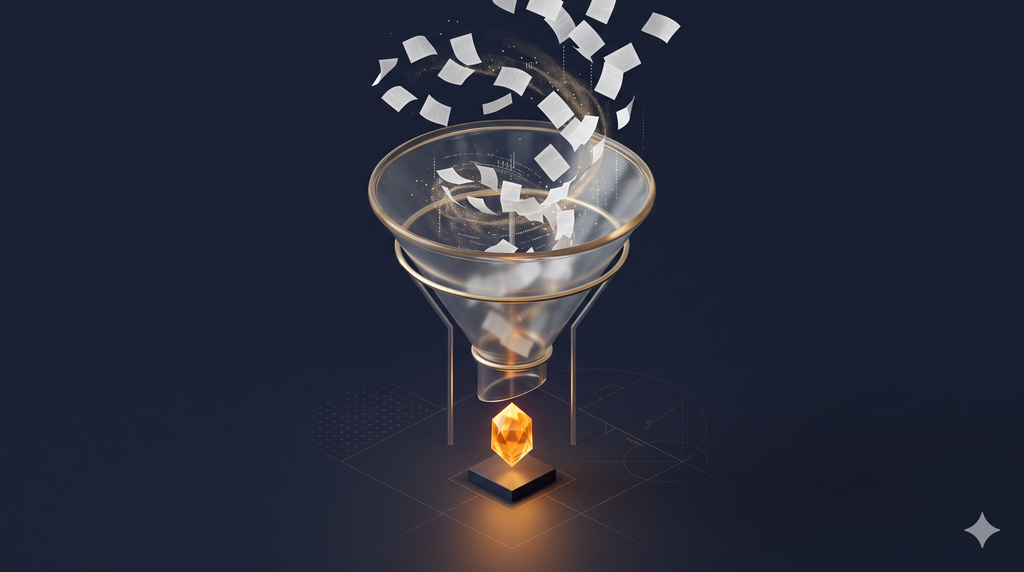
Before you write a single line of code or set up an experiment, you must map out what the global scientific community has already discovered. A sloppy literature review will result in immediate desk rejection because reviewers will point out that your idea is not novel. Mastering how to write research paper literature reviews requires disciplined searching across verified academic databases.
Use Google Scholar, IEEE Xplore, SpringerLink, and the arXiv preprint server to collect fifteen to twenty seminal papers in your niche. Do not waste weeks reading every single paper from the first word to the last page initially. When figuring out how to write research paper synthesis matrices, start by reading the abstract, introduction, and conclusion of each paper first.
Create a structured spreadsheet tracking the author names, publication year, core methodology, primary accuracy metrics, and stated limitations of each study. Look specifically for the “Future Work” section at the end of recent papers published within the last two years. Authors literally hand you ready-made research gaps that you can use when planning how to write research paper objectives.
Once you identify a specific limitation in three or four recent studies, you have found your exact scholarly hook. Your literature review section should never read like a boring laundry list of disconnected book summaries. Knowing how to write research paper background sections means grouping prior studies thematically to show why your proposed method is necessary.
Step 3: Formulating Your Hypothesis and Methodology
A genuine research manuscript is defined by its reproducible methodology and a clear, testable hypothesis. You must state explicitly what variable you are modifying and what quantitative improvement you expect to observe. Learning how to write research paper methodology chapters demands absolute transparency so another student could replicate your exact results.
If you are building a software algorithm or mathematical model, document your exact system architecture, dataset splits, and hyperparameter configurations. Avoid vague claims like “our algorithm runs much faster than previous methods.” Understanding how to write research paper technical sections requires specifying exact time complexity bounds, hardware specifications, and benchmark baselines.
When working on theoretical physics or applied mathematics problems, outline your foundational assumptions and boundary conditions clearly before jumping into derivations. Use step-by-step logical transitions such as Gram-Schmidt orthonormalization or matrix eigendecomposition to show how your equations evolve. Reviewers evaluating how to write research paper proofs hate it when authors skip five crucial algebraic steps without explanation.
Always design a fair baseline comparison to prove that your proposed technique actually works under stress. Compare your new model against two or three established standard methods using the exact same input parameters. A bulletproof experimental design is the backbone of knowing how to write research paper manuscripts that survive peer review.
Step 4: Mastering the Standard IMRaD Structure
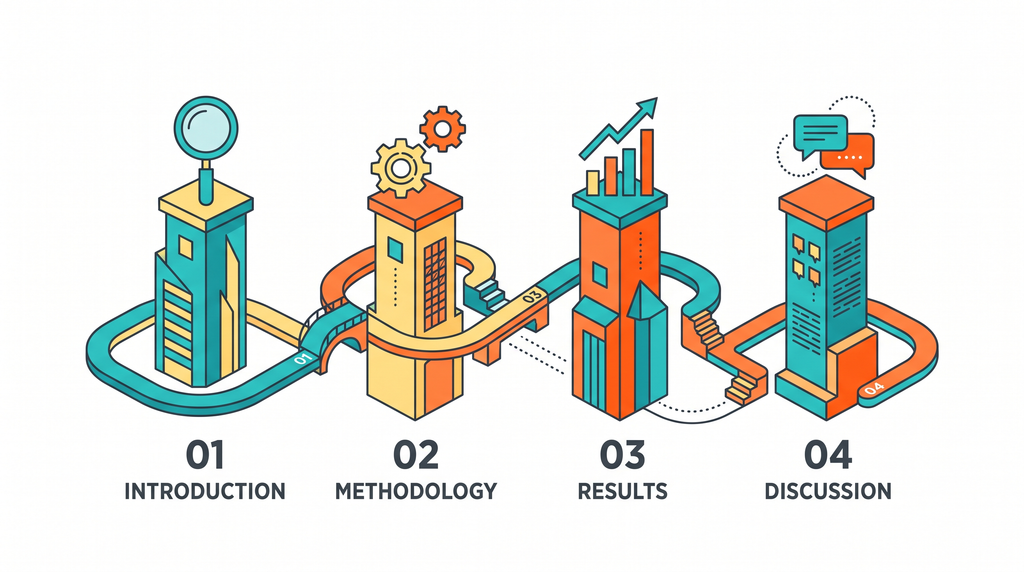
Almost every scientific and engineering publication in the world follows the universal IMRaD organizational framework. IMRaD stands for Introduction, Methodology, Results, and Discussion, preceded by a concise Abstract and followed by a Conclusion. Following this exact blueprint removes all guesswork when learning how to write research paper chapters from scratch.
The Abstract and Introduction
Your abstract is a standalone 150-to-250-word pitch that summarizes the background problem, your core method, key numerical results, and broader impact. The Introduction then expands on the real-world importance of the topic, summarizes the research gap, and lists your specific bulleted contributions at the end. When studying how to write research paper openings, remember that busy peer reviewers decide whether your paper is worth reading within the first page.
The Methodology and Experimental Setup
This section serves as the technical manual of your manuscript, utilizing clean block diagrams, system flowcharts, and algorithmic pseudocode. Explain every mathematical variable immediately after introducing an equation so the reader never gets lost. Knowing how to write research paper architecture sections means balancing deep technical rigor with visual clarity.
The Results and Discussion
Present your empirical findings objectively using high-resolution graphs and comparative tables before interpreting what those numbers mean. In the Discussion section, explain why your model outperformed the baseline and candidly acknowledge where your approach still struggles. Honesty about edge-case limitations is a hallmark of authors who truly know how to write research paper discussions professionally.
Step 5: Drafting with LaTeX and Overleaf
If you are submitting to a computer science, physics, or engineering venue, stop using Microsoft Word immediately. Word documents frequently corrupt complex mathematical formulas and shift figure placements unpredictably across different operating systems. A vital technical step in learning how to write research paper manuscripts is switching to LaTeX typesetting via Overleaf.
Overleaf is a free, cloud-based LaTeX editor that runs directly inside your web browser and allows real-time collaboration with your co-authors. Major publishers like IEEE, ACM, and Springer provide official LaTeX templates that automatically format your margins, two-column layouts, and headings. Using official templates ensures you never fail formatting checks while practicing how to write research paper drafts.
LaTeX allows you to typeset complex inline variables like $\psi$ or standalone matrix equations with publication-grade typographical precision. Furthermore, you can label equations and figures dynamically using \label{} and \ref{} commands so your numbering updates automatically whenever you reorder paragraphs. Mastering basic LaTeX syntax is a non-negotiable milestone when learning how to write research paper documents in STEM fields.
Do not waste time tweaking font sizes or line spacing manually when writing your initial rough draft. Focus purely on pouring your technical explanations into the Overleaf editor and let the underlying document class handle the visual aesthetics. Separating content drafting from visual layout is the most efficient workflow for how to write research paper publications rapidly.
Step 6: Presenting Data, Graphs, and Derivations
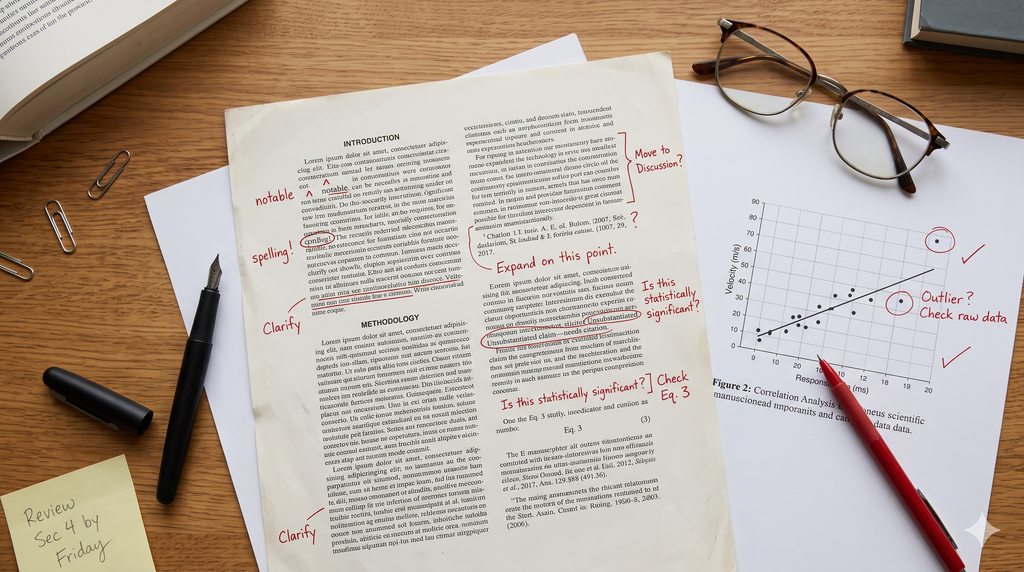
Peer reviewers scan your figures, system diagrams, and result tables long before they read your body paragraphs. Low-resolution screenshots pasted from a code terminal or blurry charts exported from Excel look amateurish and trigger immediate skepticism. Learning how to write research paper visual assets requires exporting all plots as crisp vector graphics in PDF or EPS formats.
Use Python libraries like Matplotlib or Seaborn to generate clean, publication-ready charts with legible axis labels, units, and legends. Ensure that your line styles are distinguishable even if a reviewer prints your paper in black and white. Attention to visual accessibility shows reviewers that you understand how to write research paper manuscripts at an international standard.
Every single table and figure must be explicitly referenced and analyzed inside your main text body. Never drop a massive table of numbers into a section expecting the reader to figure out the takeaway message themselves. When learning how to write research paper result sections, walk the reader through the exact percentage improvements highlighted in bold inside your tables.
Keep your captions self-contained and descriptive so a reader can understand the chart without hunting through three pages of text. A caption should state what is being compared, the sample size or dataset used, and the key trend visible. Clear data storytelling is half the battle when mastering how to write research paper drafts that get accepted.
Step 7: Citations, Reference Managers, and Plagiarism Rules
Academic writing builds upon prior human knowledge, which means every external fact, formula, or dataset must be cited accurately. Failing to cite a source or copying sentences verbatim from another paper constitutes academic plagiarism and can ruin your reputation permanently. Understanding how to write research paper bibliographies properly protects your scholarly integrity.
Never type out your bibliography manually at the bottom of your document, as different journals require completely different citation styles like IEEE, APA, or Nature. Instead, use a free reference manager like Zotero or Mendeley integrated with a .bib BibTeX file in Overleaf. Automating your references saves hours of tedious formatting when figuring out how to write research paper citations.
Whenever you read an important claim in another study, rewrite the core concept entirely in your own analytical voice before citing it. Most respected conferences and journals use Turnitin or iThenticate to scan incoming manuscripts, strictly requiring a similarity index below 10% to 15%. Learning how to write research paper prose in your own original phrasing ensures you pass automated plagiarism filters effortlessly.
Also, avoid citing unverified blog posts, Wikipedia articles, or random YouTube tutorials in an academic bibliography. Stick strictly to peer-reviewed journal articles, established conference proceedings, official technical standards, and foundational textbooks. High-quality bibliographic sources signal to editors that you know how to write research paper literature grounded in verified science.
Step 8: Choosing Between Conferences and Journals
Once your manuscript is complete, selecting the right publication venue determines how quickly your work reaches the scientific community. In computer science and electronics, top-tier conferences like IEEE, NeurIPS, or CVPR carry immense prestige and offer rapid review turnarounds of two to four months. For undergraduates learning how to write research paper submissions, reputable IEEE or Springer conferences are often the best starting point.
Journals indexed in Scopus or the Science Citation Index (SCI) require much deeper experimental validation and often take six to twelve months for peer review. If you are applying for Master’s or PhD programs next semester, factor these review timelines carefully into your submission strategy. You can also upload a preprint to arXiv so admissions committees can read your work while it undergoes formal peer review.
Beware of predatory “pay-to-publish” journals that spam student emails promising acceptance within forty-eight hours for a small fee. Publishing in a fake, unindexed journal actually damages your CV because faculty members recognize predatory venues immediately. Part of knowing how to write research paper submissions is verifying that your target venue is genuinely indexed in Scopus, Web of Science, or DBLP.
When your peer review feedback finally arrives, do not feel discouraged if the reviewers request “Major Revisions” or reject the paper initially. Even veteran professors face rejections regularly, and constructive reviewer critiques help you fix blind spots in your methodology. Learning how to write research paper rebuttal letters politely and addressing every reviewer comment systematically is what turns a good draft into an accepted publication.
Frequently Asked Questions (FAQs)
Can an undergraduate publish a paper without a professor as a co-author?
Yes, you can technically submit and publish a paper independently as a student author. However, collaborating with an experienced college professor helps you navigate methodology pitfalls, access departmental funding for conference registration fees, and learn how to write research paper drafts that meet strict peer-review standards
How long does it take to write and publish a research paper in college?
Conducting the experiments and drafting the manuscript typically takes two to four months of consistent effort alongside your semester classes. Once submitted, conference peer review takes roughly two to three months, while reputed journals can take six months or longer.
What is the ideal length for an undergraduate research paper?
Most standard IEEE two-column conference papers are strictly limited to 6 to 8 pages, including all figures and references. Journal articles are longer, usually ranging between 10 and 15 pages depending on the complexity of the experimental data.
Do I need to pay money to publish my research paper?
Many top-tier SCI and Scopus journals are completely free to publish in under the traditional subscription model. Conferences, however, usually require one author to pay a registration fee to present the paper, which your university department often reimburses if you apply for student travel grants.
How do I check if my paper has plagiarism before submitting?
Ask your faculty advisor or university central library to run your draft through official academic software like Turnitin or iThenticate. Avoid uploading your unpublished manuscript to random free plagiarism websites online, as unscrupulous portals sometimes steal and resell student papers.
Launch Your Academic Publishing Journey Today
The modern global academic and corporate environment heavily rewards ambitious undergraduates who take bold initiative to create original knowledge. Thousands of intelligent college peers continue listing generic classroom assignments on their resumes without ever testing their ideas in the peer-reviewed arena. Mastering how to write research paper manuscripts sets you apart instantly and permanently from this massive crowd of applicants.
It demonstrates exceptional analytical discipline, technical writing fluency, and deep mathematical maturity to both graduate admissions committees and R&D hiring managers. It actively proves that you can take an ambiguous, real-world problem and engineer a verifiable, data-backed solution from scratch. Understanding how to write research paper publications is a transformative milestone for any student aiming for elite global opportunities.
Do not wait until your final semester or a postgraduate degree to start exploring the scientific literature in your field. Open Google Scholar tonight, download three recent papers in your favorite subject, and start logging their limitations in a structured spreadsheet. The rewarding journey of learning how to write research paper drafts begins the exact moment you transition from a passive consumer of textbooks into an active creator of knowledge.
Your very first manuscript draft does not need to win a Nobel Prize or revolutionize an entire scientific discipline overnight. It simply needs to be methodical, honest, reproducible, and clearly typeset for your fellow researchers to evaluate. To streamline your typesetting workflow right away, explore official academic templates on Overleaf and start organizing your mathematical derivations cleanly. CareerGrowKaro is deeply committed to supporting every step of your academic and professional journey with practical, tested guidance.
Once your manuscript is submitted or accepted, make sure you highlight your publication properly on your CV by reviewing our guide on the Biggest Resume Mistakes to Avoid. If you are balancing intense laboratory simulations and paper drafting alongside your regular university semester exams, check out our Best Study Timetable for College Students to manage your daily schedule effectively. Open your editor, outline your methodology, and share your scientific discoveries with the world!