

The IBPS Clerk exam is one of the most sought-after banking examinations in India, offering aspirants an opportunity to build a stable and rewarding career in the banking sector. With thousands of candidates appearing every year, effective IBPS Clerk Preparation requires more than simply covering the syllabus. A well-planned strategy, consistent practice, strong time management, and regular revision can significantly improve your chances of performing well in the examination.
A structured preparation plan helps candidates understand what to study, how much time to dedicate to each subject, and where to focus their efforts. An effective preparation strategy should focus on:
- Understanding the syllabus and exam pattern before starting preparation.
- Building strong concepts in quantitative aptitude, reasoning, and English.
- Practicing regularly to improve speed and accuracy.
- Following current affairs and banking awareness for the Mains examination.
- Taking mock tests and analyzing mistakes to identify weak areas.
- Revising consistently to retain important concepts, formulas, and facts.
In this guide, CareerGrowKaro brings you a comprehensive approach to IBPS Clerk Preparation, covering the exam pattern and syllabus, subject-wise preparation strategies, a practical daily study plan, mock-test techniques, revision tips, and common mistakes to avoid. Whether you are starting your preparation from scratch or looking to improve your existing strategy, these tips can help you prepare more effectively and confidently for the exam.
Understand the IBPS Clerk Exam Pattern
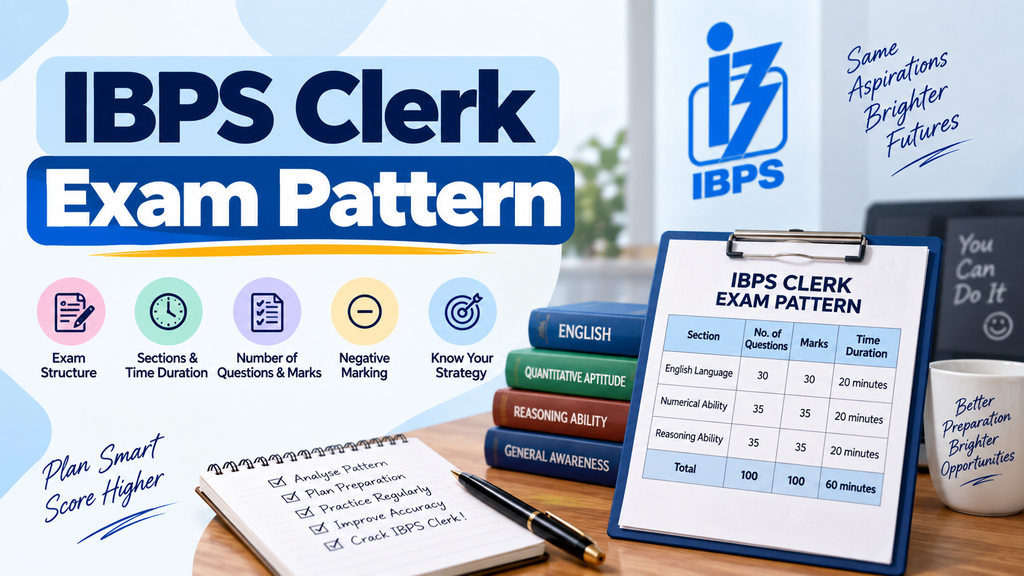
Before beginning your IBPS Clerk Preparation, it is essential to understand the exam pattern and selection process. Knowing the structure of the examination helps you plan your study schedule, prioritise important topics, and develop an effective attempt strategy.
The IBPS Clerk selection process is divided into two stages:
- Prelims Examination: The preliminary exam tests candidates on English Language, Numerical Ability, and Reasoning Ability. It acts as the first screening stage for candidates.
- Mains Examination: Candidates who qualify for Prelims appear for the Mains exam, which includes Reasoning Ability, Quantitative Aptitude, English Language, General/Financial Awareness, and Computer Knowledge.
During your IBPS Clerk Preparation, keep the following aspects of the exam pattern in mind:
- Sectional Timing: Each section has a fixed time limit, making it important to practise solving questions within the allotted time.
- Number of Questions and Marks: Understand the number of questions, marks assigned to each section, and the overall duration to plan your attempts effectively.
- Accuracy: Speed alone is not enough. Maintaining a high level of accuracy can help maximise your score.
- Negative Marking: Incorrect answers attract negative marks, so avoid random guessing and attempt questions strategically.
A clear understanding of the pattern should be the foundation of your IBPS Clerk Preparation. Once you know how the exam is structured, you can create a realistic study plan, practise according to sectional requirements, and gradually improve your speed and accuracy. Regularly revisiting the exam pattern during IBPS Clerk Preparation can also help you stay aligned with your target and avoid unnecessary preparation.
Know the IBPS Clerk Syllabus
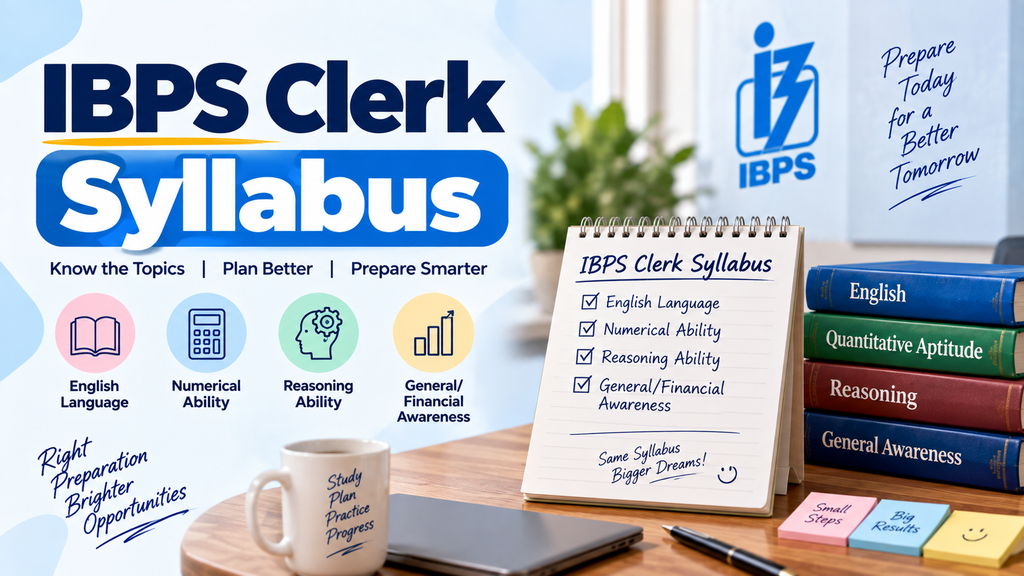
A clear understanding of the syllabus is an essential part of effective IBPS Clerk Preparation. Knowing which topics are covered in each section allows you to divide your study time wisely, identify your strengths and weaknesses, and avoid spending too much time on low-priority areas. During your IBPS Clerk Preparation, focus on building strong fundamentals before moving to advanced-level questions.
English Language
The English section evaluates your grammar, vocabulary, reading comprehension, and language skills. Regular practice can help improve both accuracy and speed.
- Reading comprehension
- Cloze test
- Error detection
- Fill in the blanks
- Para jumbles
- Vocabulary and grammar
2. Numerical Ability
Numerical Ability requires strong conceptual understanding along with quick calculations. As part of your IBPS Clerk Preparation, practise arithmetic questions regularly and work on improving calculation speed.
- Simplification and approximation
- Number series
- Percentage
- Profit and loss
- Ratio and proportion
- Average
- Time, speed and distance
- Data interpretation
3. Reasoning Ability
Reasoning tests your logical and analytical thinking skills. Give special attention to puzzles and seating arrangements, as these can require considerable time during the examination.
- Puzzles and seating arrangement
- Syllogism
- Inequality
- Coding-decoding
- Blood relations
- Direction sense
- Alphanumeric series
4. General/Financial Awareness
General and Financial Awareness becomes particularly important for the Mains examination. Include current affairs and banking-related topics in your daily IBPS Clerk Preparation routine and revise them regularly.
- Current affairs
- Banking awareness
- Financial terms
- Government schemes
- RBI-related updates
- Important national and international events
Breaking the syllabus into these sections makes IBPS Clerk Preparation more organised and helps you create a focused study plan for each subject.
Create an Effective IBPS Clerk Preparation Strategy
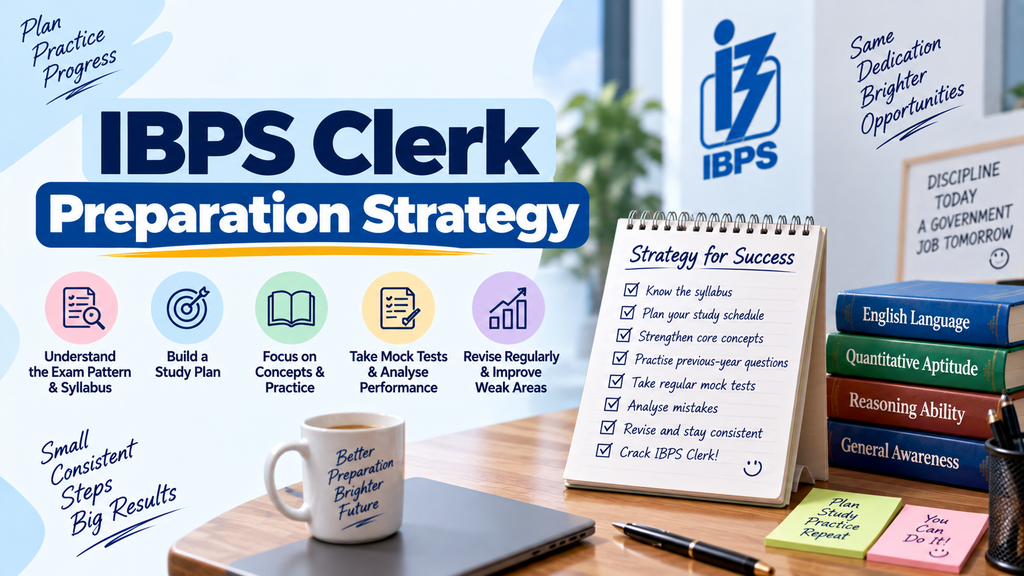
A well-planned strategy is the foundation of successful IBPS Clerk Preparation. Instead of trying to cover everything at once, candidates should follow a structured approach that combines concept building, regular practice, revision, and performance analysis. A focused strategy also helps you make better use of your preparation time and stay consistent.
1. Start with the Syllabus and Previous-Year Papers: Begin your IBPS Clerk Preparation by going through the complete syllabus and understanding the topics covered in each section. Solve a few previous-year papers to familiarise yourself with the question types, difficulty level, and frequently asked topics. This will help you identify high-priority areas and plan your preparation accordingly.
2. Assess Your Strengths and Weaknesses: Take a diagnostic mock test before following a detailed study schedule. Analyse your performance to determine which subjects and topics need more attention. Use this assessment to create a personalised preparation plan instead of spending equal time on every topic.
3. Set Realistic Daily and Weekly Targets: Set achievable daily and weekly goals for your IBPS Clerk Preparation. Break larger topics into smaller tasks and track your progress regularly. For example, you can dedicate specific time slots to Quantitative Aptitude, Reasoning, English, and General/Financial Awareness.
4. Balance Learning, Practice, and Revision: Do not spend all your preparation time learning new concepts. Maintain a healthy balance between understanding concepts, solving questions, and revising previously studied topics. Regular revision will help strengthen your fundamentals and improve retention.
5. Focus on Speed and Accuracy: Both speed and accuracy are crucial in the IBPS Clerk examination. Practise questions under timed conditions and gradually work on reducing the time taken to solve them. However, avoid blindly increasing your attempts, as accuracy should remain a priority.
6. Gradually Increase Difficulty and Solving Speed: Start with basic questions to build confidence and strengthen your concepts. Once your fundamentals are clear, move towards moderate and challenging questions. Regular timed practice during IBPS Clerk Preparation will help you improve your question-selection skills and overall solving speed.
Following these steps consistently can make your IBPS Clerk Preparation more focused, measurable, and effective. The key is to remain consistent and regularly adapt your strategy based on your performance.
Daily Study Plan for IBPS Clerk Preparation
A consistent daily routine is an important part of effective IBPS Clerk Preparation. Instead of studying for long, irregular hours, aspirants should create a balanced timetable that gives sufficient time to every subject while leaving room for practice, revision, and mock-test analysis.
| Study Area | Daily Time |
| English | 1 hour |
| Quantitative Aptitude | 1.5 hours |
| Reasoning | 1.5 hours |
| General/Financial Awareness | 45 minutes |
| Mock/Sectional Tests | 1 hour |
| Revision & Error Analysis | 45 minutes |
This schedule provides a structured framework for IBPS Clerk Preparation, but it can be adjusted according to your current level and availability. Beginners may initially spend more time on concept building, while candidates who have already covered the syllabus can dedicate additional hours to mocks, previous-year questions, and revision.
Final 30-Day IBPS Clerk Preparation Strategy
The final month can make a significant difference to your performance. Your IBPS Clerk Preparation during this period should focus on revision, timed practice, mock tests, and improving weak areas rather than trying to learn everything from scratch. Divide the last 30 days into three focused phases.
Days 1–10: Strengthen Concepts and Revise
Use the first 10 days to revise important concepts and identify topics that still require attention.
- Revise important formulas, grammar rules, vocabulary, and fundamental concepts.
- Practise previous-year questions from all sections.
- Identify weak topics through sectional tests.
- Work on improving accuracy before focusing heavily on speed.
- Avoid starting too many completely new topics.
Days 11–20: Increase Practice and Mock Tests
During the middle phase, make your IBPS Clerk Preparation more exam-oriented by increasing timed practice.
- Take regular full-length and sectional mock tests.
- Analyse every mock to identify mistakes and time-consuming questions.
- Practise previous-year questions under timed conditions.
- Revise current affairs, banking awareness, and important financial terms.
- Focus specifically on weak areas identified through mock-test analysis.
- Gradually improve your question-solving speed and accuracy.
Days 21–30: Final Revision and Exam Strategy
The final 10 days should focus on consolidating what you have already studied and developing a clear exam-attempt strategy.
- Take full-length mocks regularly and simulate the actual exam environment.
- Revise formulas, grammar rules, vocabulary, and current affairs from your short notes.
- Revisit frequently repeated topics and previously attempted questions.
- Avoid taking up major new topics unless they are essential.
- Finalise your section-wise question-attempt strategy.
- Focus on maintaining accuracy, speed, and confidence.
A disciplined approach during these three phases can make your final IBPS Clerk Preparation more focused and productive. The goal is to enter the examination with strong revision, sufficient mock-test practice, and a clear strategy for managing time effectively.
Common Mistakes to Avoid During IBPS Clerk Preparation
A good strategy is not only about knowing what to study but also about avoiding mistakes that can slow down your progress. During IBPS Clerk Preparation, many aspirants lose valuable time by following an unstructured approach or focusing on quantity rather than quality. Keep these common mistakes in mind:
1. Studying without knowing the syllabus: Starting preparation without understanding the syllabus can lead to unnecessary topics being prioritised while important areas are overlooked.
2. Using too many books and resources: Referring to multiple sources can create confusion. Choose a few reliable study materials and use them consistently.
3. Ignoring General/Financial Awareness: Do not neglect this section, particularly while preparing for the Mains examination. Include current affairs and banking awareness in your regular routine.
4. Neglecting revision: Learning new concepts without revisiting previously studied topics can lead to poor retention. Make revision a regular part of your IBPS Clerk Preparation.
5. Attempting mocks without analysing them: Simply taking mock tests is not enough. Analyse incorrect answers, skipped questions, and time-consuming problems to understand where you need improvement.
6. Focusing on speed at the expense of accuracy: Attempting questions quickly while making frequent errors can negatively affect your score. Work on speed while maintaining accuracy.
Avoiding these mistakes can make your IBPS Clerk Preparation more organised and effective. Focus on consistent practice, regular revision, and continuous performance analysis rather than simply counting the number of hours you study.
Conclusion
Cracking the IBPS Clerk exam requires a combination of consistent preparation, smart time management, regular practice, and effective revision. Understanding the syllabus and exam pattern, following a realistic study plan, solving previous-year questions, and taking regular mock tests can help you improve both speed and accuracy.
Remember, successful IBPS Clerk Preparation is not about studying for endless hours but about studying with the right strategy and staying consistent. Identify your weak areas, learn from your mistakes, and regularly track your progress to make your preparation more effective.
For aspirants looking for reliable exam preparation strategies, study guidance, and career-related resources, CareerGrowKaro can be a useful platform to support your journey. Stay focused, trust your preparation, and keep practising consistently to move closer to your goal of becoming an IBPS Clerk.
FAQs
1. How should I start my IBPS Clerk Preparation?
Start by understanding the latest exam pattern and syllabus. Then assess your current level through a mock test, identify weak areas, and create a realistic daily study schedule covering all subjects.
2. How many hours should I study for the IBPS Clerk exam?
Ideally, aim for 4–6 focused hours a day if you are preparing full-time. Working aspirants can adjust the schedule according to their availability. Consistency and quality of study matter more than the number of hours.
3. Which subjects should I focus on for IBPS Clerk Preparation?
Focus on English Language, Numerical Ability, and Reasoning Ability for the Prelims. For Mains, also give adequate attention to General/Financial Awareness and other sections included in the current exam pattern.
4. Are mock tests important for IBPS Clerk Preparation?
Yes. Mock tests help improve speed, accuracy, time management, and question selection. More importantly, analyse each mock to understand your mistakes and identify topics that need improvement.
5. How can I improve my speed and accuracy for the IBPS Clerk exam?
Practise questions regularly under timed conditions, strengthen your basics, learn efficient calculation techniques, and avoid spending too much time on a single question. Analyse your errors to improve accuracy.