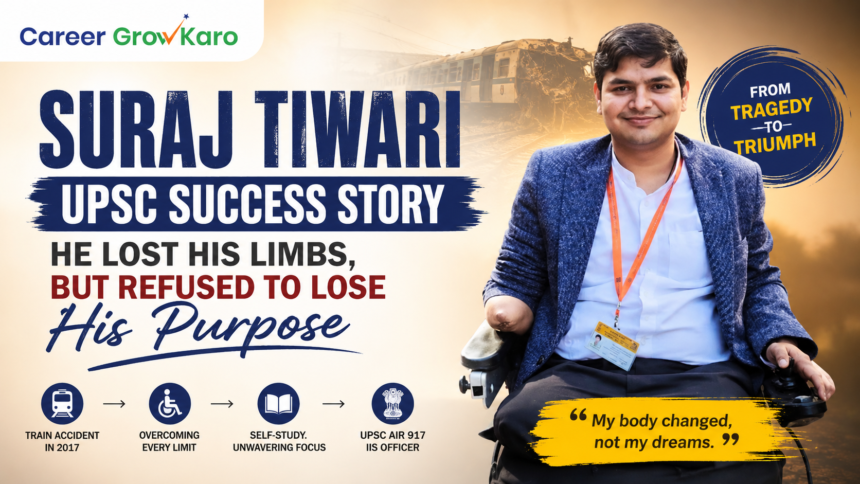
The Suraj Tiwari UPSC success story is a powerful reminder that a life-changing setback does not have to decide the future. There are moments that divide life into two parts: before that day and after that day. For Suraj Tiwari, one such moment came in 2017, when a devastating train accident changed his life forever.There are moments that divide life into two parts.
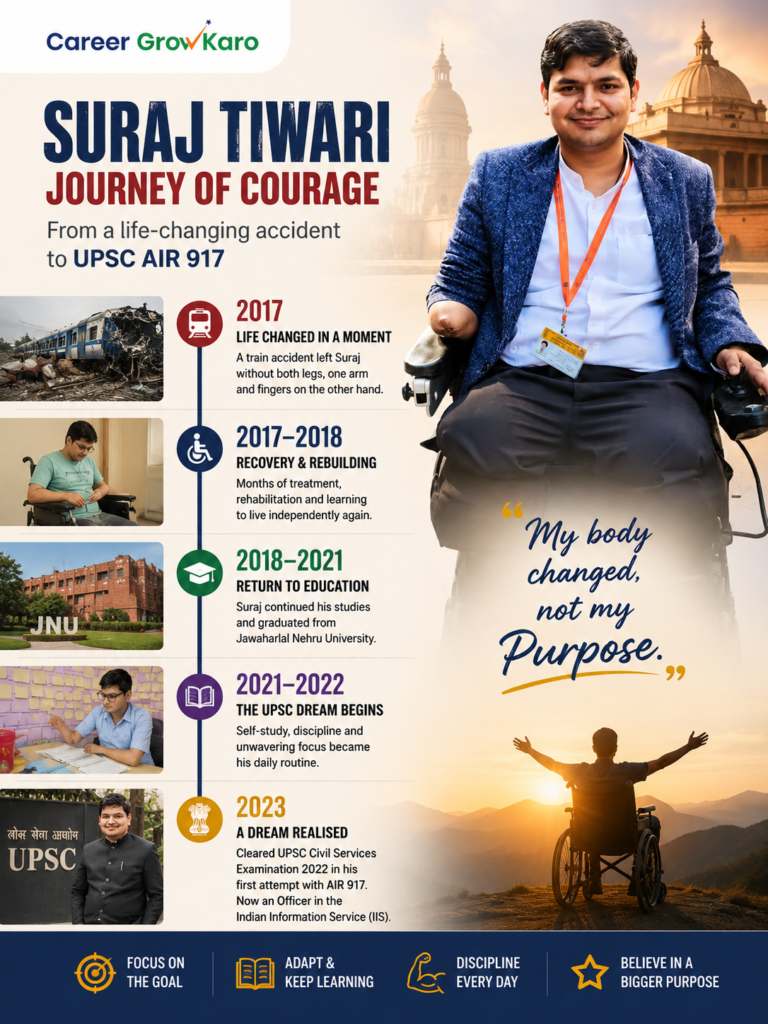
A train accident changed his life in ways that would have been difficult to imagine. He lost both his legs, his right arm and fingers on his left hand. The ordinary things most people perform without thinking—moving independently, writing, studying, travelling and managing daily routines—suddenly required a new approach.
For months, recovery became his reality.
But Suraj did not allow the accident to become the final sentence of his life.
He returned to education. He studied at Jawaharlal Nehru University. He prepared for one of India’s toughest competitive examinations without depending on conventional coaching. And in the UPSC Civil Services Examination 2022, he secured All India Rank 917 in his first attempt.
Today, Suraj Tiwari is an Indian Information Service (IIS) officer.
His journey is inspiring not because it tells us that life is easy.
It is inspiring because it shows what a person can do when life becomes unimaginably difficult—and they still decide that their future deserves another chance.
Suraj did not return to the life he had before the accident. He built a new life with a new method, a new routine and the same determination to move forward.
For students facing failure, financial pressure, family responsibilities, self-doubt or difficult circumstances, this may be the most important lesson:
You may not be able to control what happens to you. But you can still decide what you do next.
Suraj Tiwari at a Glance
Detail
Information
Name
Suraj Tiwari
Hometown
Mainpuri, Uttar Pradesh
Life-changing event
Train accident in 2017
Impact
Lost both legs, his right arm and fingers on his left hand
The exact number of fingers reported as lost varies across secondary accounts. This article therefore avoids overstating that detail and focuses on the consistently reported facts.
Suraj Tiwari UPSC Success Story: Who Is He?
Suraj Tiwari comes from Mainpuri in Uttar Pradesh.
His story is particularly relatable for students from small towns because it does not begin with extraordinary privilege, elite coaching or a perfectly planned academic journey.
Like many young people, he had ambitions, faced academic challenges and continued searching for a meaningful direction.
Reports have noted that Suraj did not have a flawless academic record. He reportedly failed Class 12 once before continuing his education.
That detail deserves attention.
In India, board results are often treated as life-defining events. A low score can create fear, comparison and pressure. Some students begin believing that one unsuccessful examination has permanently reduced their future opportunities.
Suraj’s journey challenges that belief.
A result can tell you how you performed in one examination.
It cannot predict everything you are capable of becoming.
The student who struggles in Class 12 may later excel in college.
The student who fails an entrance examination may find success through another path.
The student who takes longer to understand a subject may develop greater patience and resilience.
A setback is information.
It is not identity.
The 2017 Train Accident: When Life Changed Without Warning
In 2017, Suraj was involved in a serious train accident near Dadri in Ghaziabad.
The accident resulted in the loss of both his legs, his right arm and fingers on his left hand.
The physical injuries were severe.
But the deeper challenge was that the accident changed his relationship with everyday life.
Imagine waking up after a life-changing event and realising that even the simplest routines may now require assistance, adaptation or a completely different method.
How would you study?
How would you write?
How would you travel?
How would you continue your education?
How would you imagine a career?
And perhaps the hardest question of all:
Would your old dreams still have a place in your new life?
For many people, such questions could become overwhelming.
Suraj had to undergo treatment and spend months recovering. Reports describe a long period of hospitalisation followed by recovery at home.
But recovery was not only about healing from physical injuries.
It was also about rebuilding confidence.
It was about learning how to become independent again.
It was about finding a reason to look ahead when the future no longer looked like the one he had imagined.
He Did Not Ask, “Why Me?” Forever. He Asked, “What Next?”
A tragedy can create two kinds of questions.
The first is:
“Why did this happen to me?”
That question is human. It is natural. It may not have an easy answer.
But remaining trapped in that question can prevent a person from moving forward.
The second question is:
“What can I do now?”
That question creates possibility.
Suraj’s journey appears to have shifted from loss to action.
He could not undo the accident.
He could not return to his previous physical condition.
But he could continue learning.
He could build new routines.
He could adapt the way he studied.
He could pursue a career.
And he could still contribute to society.
This is where his story becomes more than a story about courage.
It becomes a story about agency.
Agency means recognising that some circumstances may be outside your control, while your next decision may still belong to you.
Students can apply this idea to their own lives.
You may not be able to change:
your family’s financial situation overnight
the marks you received last year
the quality of your previous school
the fact that you started preparing late
a difficult personal situation
But you may be able to change:
today’s study schedule
the number of hours you spend scrolling
how often you revise
whether you ask for help
the strategy you use after a poor test
You do not need control over everything to begin making progress.
Returning to Education: A New Life Needed a New Routine
After the accident, Suraj continued his education and joined Jawaharlal Nehru University (JNU).
Reports describe him moving around the campus in a wheelchair, often with books on his lap.
That image is powerful because it represents something larger than academic attendance.
It represents a return to participation.
He was not waiting for life to become exactly as it had been before.
He was learning how to continue within a changed reality.
For students, this offers an important perspective:
Sometimes, moving forward does not mean returning to your old path. It means creating a new path that still leads somewhere meaningful.
A student may need to change a study method.
A student may need to take an additional year.
A student may need to prepare from home instead of moving to a coaching hub.
A student may need to choose a different course after not receiving the expected rank.
None of these changes automatically mean failure.
The plan can change without the future becoming smaller.
The UPSC Dream: Choosing One of India’s Toughest Examinations
The UPSC Civil Services Examination is not a short-term test.
It requires broad knowledge, analytical ability, answer-writing skills, awareness of current affairs and consistent preparation across multiple stages.
For many aspirants, UPSC preparation itself is demanding.
Suraj’s journey can also help students look beyond a single examination and understand the wider landscape of public-sector opportunities. Students exploring civil services, banking, railways, SSC and other recruitment pathways can refer to CareerGrowKaro’s complete government exam list in India to compare major exams, eligibility requirements and career options.
For Suraj, preparation also involved overcoming physical and logistical challenges.
Yet he chose to pursue the examination.
That decision was significant because it was not based on the idea that circumstances would suddenly become easy.
It was based on the belief that a difficult goal could still be pursued through adaptation and disciplined effort.
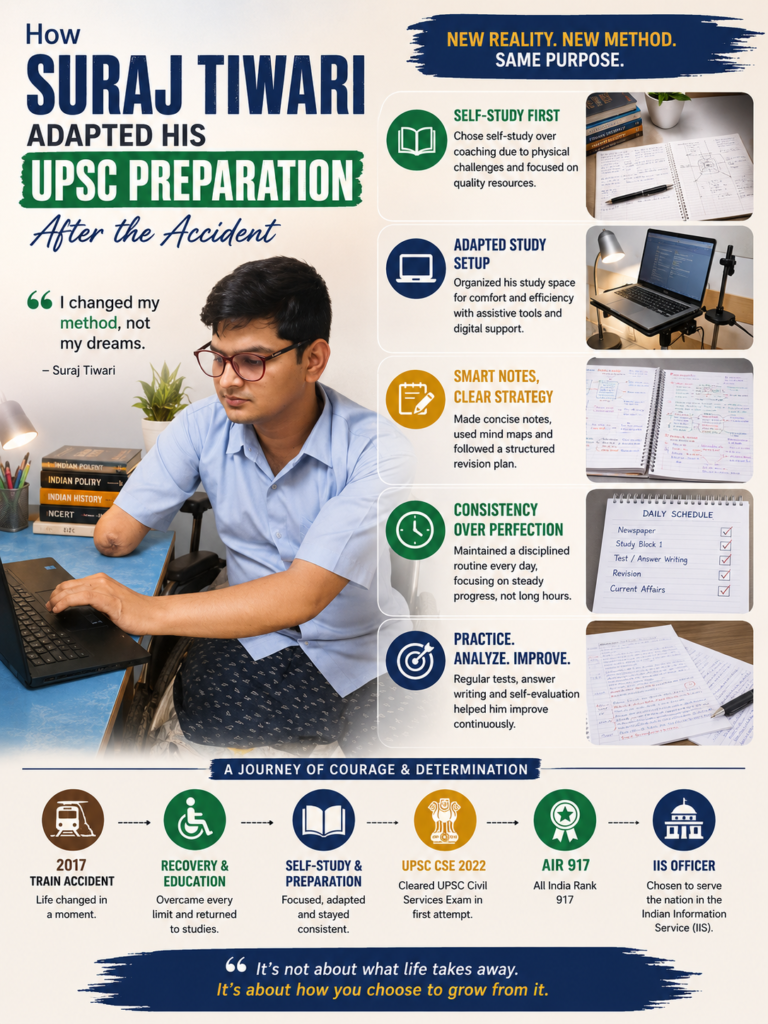
Suraj reportedly prepared largely from home through self-study because attending conventional coaching classes was difficult.
This does not mean coaching is unnecessary for everyone.
Coaching can provide:
structured guidance
mentorship
test series
answer evaluation
peer learning
accountability
But Suraj’s story proves something equally important:
A student’s progress is not determined only by where they study. It is also shaped by how consistently they learn, revise and improve.
How Suraj Tiwari Adapted His UPSC Preparation
He Changed the Process, Not the Goal
After the accident, conventional methods of studying and writing were no longer automatically available to Suraj.
He had to adapt.
This is one of the strongest themes emerging from his journey and public interviews: progress required practical adjustment, not only emotional strength.
Motivation alone cannot solve every problem.
Sometimes, the method must change.
If writing is difficult, use technology or alternative note-making systems.
If long study sessions cause fatigue, study in shorter blocks.
If coaching is inaccessible, use official documents, standard books, reliable online lectures and disciplined self-study.
If one timetable repeatedly fails, redesign it.
A changed method is not a weaker method.
It may be the method that finally works.
He Prepared Without Waiting for Perfect Conditions
Many students postpone preparation because they believe they need ideal circumstances.
They wait for:
a better study room
more money
a new laptop
the best coaching institute
complete confidence
a perfect timetable
fewer responsibilities
Some resources are genuinely useful.
But perfect conditions may never arrive.
Suraj’s journey suggests a different approach:
Begin with the conditions you have, then improve the system as you move forward.
Your first study session may not be ideal.
Your timetable may need changes.
Your notes may be incomplete.
Your confidence may be low.
Start anyway.
Action often creates confidence more reliably than waiting does.
He Treated Consistency as a Discipline
Some later accounts describe Suraj studying for very long hours. However, exact daily-hour claims vary across reports and should not be treated as a universal formula.
The more reliable lesson is not the number of hours.
It is consistency.
Students often ask:
“How many hours should I study?”
A better question is:
“How many focused hours can I sustain consistently?”
Six distracted hours may produce less learning than three focused hours.
A 14-hour timetable may look impressive but collapse after a week.
A realistic routine followed for six months can create meaningful progress.
Suraj’s result was not created by one motivational moment.
It was built through repeated effort.
A realistic study plan is more useful than an ambitious timetable that cannot be sustained. Students preparing for any competitive examination can also learn from structured preparation approaches such as CareerGrowKaro’s Railway NTPC preparation guide, which explains how to divide preparation into foundation-building, practice, revision and mock-test phases.
Clearing UPSC in the First Attempt
When the UPSC Civil Services Examination 2022 results were declared in May 2023, Suraj Tiwari secured All India Rank 917.
He had cleared the examination in his first attempt.
The result brought national attention to his journey.
But the rank was only the visible part of the story.
Behind AIR 917 were:
years of recovery
a return to education
physical adaptation
self-study
repeated daily effort
the courage to pursue a demanding goal despite uncertainty
Suraj was allotted the Indian Information Service (IIS) based on his rank and service allocation.
This distinction matters.
Many viral posts and video titles incorrectly describe him as an IAS officer. For accuracy, CareerGrowKaro should identify him as an IIS officer and UPSC CSE 2022 qualifier.
The truth is already powerful.
It does not need exaggeration.
From a UPSC Aspirant to an IIS Officer: Where Is Suraj Tiwari Now?
Suraj’s public Instagram identity reflects his present role as an IIS officer.
This is an important addition to the story because it shows that the UPSC result was not the end of his journey.
It was the beginning of a new chapter.
The public often remembers success stories only at the moment of the result:
The rank.
The photograph.
The celebration.
But a career begins after the result.
Suraj’s journey now represents public service, professional responsibility and continued visibility as a person whose life challenges common assumptions about disability and achievement.
His story has also become a source of motivation for students, aspirants and people facing difficult circumstances.
The message is not that every person must clear UPSC.
The message is that a life-changing setback does not automatically end a person’s ability to learn, work, contribute or build a meaningful future.
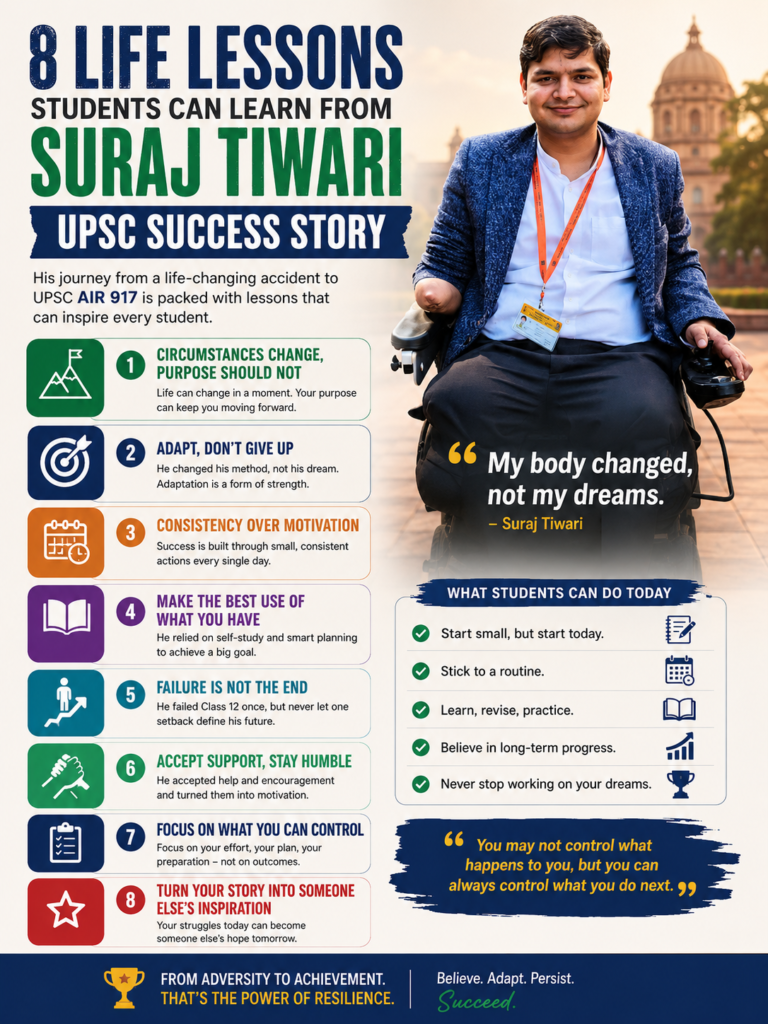
8 Lessons Students Can Learn From Suraj Tiwari
1. Your circumstances are not your complete identity
Your family background matters.
Your financial situation matters.
Your health, responsibilities and access to education matter.
But they do not tell the complete story of who you are.
Do not introduce yourself to the future only through your limitations.
You are also your effort, learning, choices and potential.
2. Adaptation is a form of strength
Strength is not always about pushing harder.
Sometimes, strength means changing the method.
If your current strategy is not working, do not keep repeating it only because it looks familiar.
Change the timetable.
Change the revision method.
Change the source.
Ask for help.
Adaptation is not surrender.
It is intelligent persistence.
3. Do not wait for motivation every day
Motivation changes.
Discipline helps you continue when motivation is absent.
On difficult days, reduce the task instead of abandoning it.
Read five pages.
Revise one topic.
Write one answer.
Take one short test.
Small actions protect momentum.
4. One failure cannot predict your entire future
A failed examination is painful.
But it is not a permanent verdict.
Suraj reportedly experienced academic setbacks before later clearing UPSC.
Do not ask only:
“Why did I fail?”
Also ask:
“What can this result teach me?”
5. Support is not weakness
No major achievement is entirely individual.
Students benefit from families, teachers, mentors, institutions and friends.
Accepting support does not reduce the value of your effort.
It helps you move forward with greater clarity.
6. Big goals must be converted into small actions
“Clear UPSC” is overwhelming.
“Complete one chapter today” is manageable.
Break the goal into tasks.
Long-Term Goal
Today’s Action
Prepare for UPSC
Study one syllabus topic
Improve current affairs
Read and note three important developments
Improve answer writing
Write one timed answer
Increase mock-test scores
Analyse five mistakes
Complete revision
Revise one unit
The future is built through today’s actions.
The same principle applies across competitive examinations: understand the syllabus, create a realistic schedule, revise regularly and analyse mistakes after every test. CareerGrowKaro’s guide to the top government exams in India can help students explore other public-sector career paths based on their qualification and interests.
7. Do not compare your journey with someone else’s
Students have different resources, responsibilities and starting points.
Comparison can create unnecessary pressure.
Instead of asking:
“Why am I behind?”
Ask:
“Am I moving forward from where I was last week?”
That is a more useful measure of progress.
8. Purpose can survive a changed life
Suraj’s life changed after the accident.
But his ability to build purpose did not disappear.
Your original plan may change.
Your career goal may evolve.
Your timeline may become longer.
That does not mean your future has ended.
It may mean you are creating a different version of it.
If You Are Struggling With Studies, Read This
Maybe you failed an examination.
Maybe you cannot afford expensive coaching.
Maybe you are studying from a small town.
Maybe your family expects you to start earning.
Maybe you have already taken several attempts.
Maybe you feel that everyone else is moving ahead.
You may not relate to every detail of Suraj’s life.
But you may relate to one feeling:
The fear that your circumstances have become bigger than your dreams.
When that happens, do not attempt to solve your entire future in one day.
Choose one useful action.
Open the book.
Make a list.
Complete one chapter.
Ask one teacher.
Register for one examination.
Apply for one opportunity.
Progress often begins before confidence arrives.
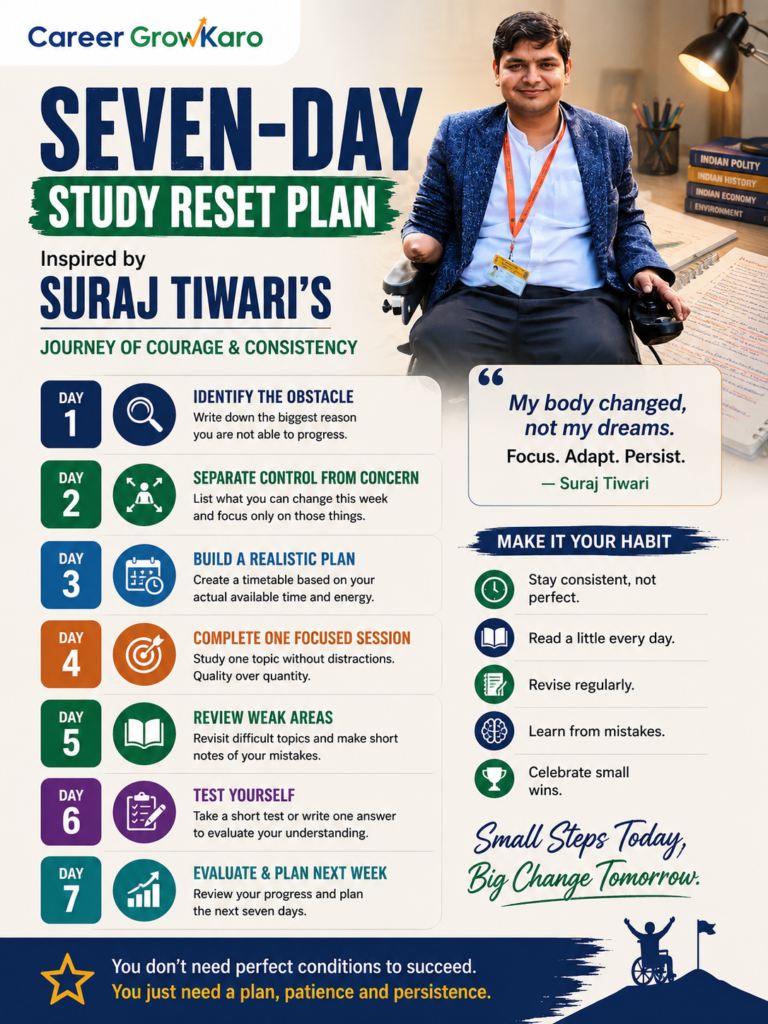
A 7-Day Study Reset Inspired by Suraj Tiwari’s Journey
Day
Focus
Action
Day 1
Identify the obstacle
Write the biggest reason you are unable to progress
Day 2
Focus on control
Separate problems you can change from those you cannot
Day 3
Create a realistic plan
Build a timetable around your actual available time
Day 4
Begin small
Complete one uninterrupted study session
Day 5
Fix weaknesses
Revise difficult topics and analyse mistakes
Day 6
Test yourself
Take a short test or write one answer
Day 7
Review
Evaluate progress and plan the next week
Do not try to change your entire life in seven days.
Build one habit you can repeat.
Suraj Tiwari’s Story Is Not About “Never Giving Up”
“Never give up” sounds inspiring.
But real resilience is more complex.
Sometimes, people need rest.
Sometimes, they need support.
Sometimes, the plan must change.
Sometimes, a different career path may be more suitable.
Resilience does not mean repeating the same action forever.
It means remaining committed to growth while being flexible about the method.
Suraj’s story is powerful because he did not pretend the accident had not changed his life.
He accepted that life had changed.
Then he decided that change would not remove his purpose.
That is not blind optimism.
That is practical courage.
Frequently Asked Questions
Who is Suraj Tiwari?
Suraj Tiwari is an Indian Information Service officer from Mainpuri, Uttar Pradesh. He cleared the UPSC Civil Services Examination 2022 with AIR 917 in his first attempt.
What happened to Suraj Tiwari?
Suraj was involved in a train accident in 2017. He lost both legs, his right arm and fingers on his left hand.
What rank did Suraj Tiwari secure in UPSC?
He secured All India Rank 917 in the UPSC Civil Services Examination 2022.
Did Suraj Tiwari clear UPSC in his first attempt?
Yes. He cleared the UPSC Civil Services Examination 2022 in his first attempt.
Is Suraj Tiwari an IAS officer?
No. Although some viral headlines and video titles use “IAS,” credible reporting identifies Suraj Tiwari as an Indian Information Service (IIS) officer.
Did Suraj Tiwari take UPSC coaching?
Reports indicate that he primarily relied on self-study and prepared from home because attending conventional coaching classes was difficult.
What can students learn from Suraj Tiwari?
Students can learn to adapt their methods, remain consistent, seek support, learn from setbacks and focus on actions that are possible today.
The Final Lesson: You Do Not Need to See the Whole Road
Suraj’s journey is one example of how persistence and adaptation can change the direction of a life. For more stories of ordinary people taking small but meaningful steps towards bigger goals, explore CareerGrowKaro’s collection of inspirational stories.
Suraj Tiwari’s story is not only about a UPSC rank.
It is about rebuilding after life changes.
It is about continuing education after loss.
It is about changing the method without abandoning the purpose.
It is about refusing to allow one tragic event to define an entire future.
You may not know where your journey will lead.
You may not have every resource.
You may not feel confident.
You may not be ready for the entire road.
But you can take the next useful step.
Read one chapter.
Solve one problem.
Write one answer.
Submit one application.
Ask one question.
Start one routine.
Then return tomorrow.
Because sometimes, the most courageous thing is not making a giant leap.
Sometimes, it is deciding that your future is still worth working for.
Life may change the way you move forward. It does not have to decide whether you move forward at all.