
What is FAANG?
You have probably heard someone in your college say — “Bhai, merko FAANG mein jaana hai.” But half the room has no idea what is FAANG actually means.
So let us clear this up right now.
FAANG is a term used to describe the top five biggest and most powerful tech companies in the world. These are the companies that pay the highest salaries, build the most used products, and hire the sharpest engineers on the planet.
If you are a student studying computer science, IT, or even data science in India, understanding what is FAANG is not optional. If you are still exploring the best career paths in tech, our guide on BCA Degree 2026 explains how students can build a successful career in the software industry. It is the first step to building a serious tech career.
And no, you do not need to be from IIT to get there. But you do need a plan.
That plan starts right here. CareerGrowKaro has broken everything down for you in simple language so that by the end of this guide, you know exactly what is FAANG, why it matters, and what you need to do next. No fluff. No timepass. Just clarity.
FAANG Full Form

Let us start with the basics. FAANG full form stands for:
- F — Facebook (now Meta)
- A — Amazon
- A — Apple
- N — Netflix
- G — Google (now Alphabet)
Each of these companies is not just big. They are category defining. Facebook changed how humans connect with each other. Amazon changed how the entire world shops and stores data. Apple changed what a phone can do in your pocket. Netflix changed how we consume entertainment. Google changed how we find any information about anything.
Together, these five companies employ hundreds of thousands of people, generate trillions of dollars in revenue every single year, and set the gold standard for what a great tech job actually looks like.
When people ask what is FAANG, they are really asking one deeper question — what does the absolute top of the tech industry look like? And now you have your answer.
What Are FAANG Companies?
Now that you know the FAANG full form, let us go one level deeper and understand what are FAANG companies in terms of what they actually do and why they matter for your career.
Facebook / Meta
Meta owns Facebook, Instagram, and WhatsApp. Over three billion people use Meta products every single day. They work heavily in artificial intelligence, virtual reality, and social technology. For engineers, data scientists, and product managers, Meta is a dream employer with some of the most complex technical challenges in the world.
Amazon
Amazon is not just an online shopping website. It runs AWS, which powers a massive chunk of the entire internet. Every time you use Netflix, Zomato, or thousands of other apps, there is a good chance AWS is running behind the scenes. Amazon also runs Alexa, Prime Video, and world class logistics technology. Amazon hires across engineering, product, data, and business roles at a truly massive scale globally.
Apple
Apple builds iPhones, MacBooks, iPads, AirPods, and the software ecosystems that run all of them. They are globally famous for their design philosophy, hardware quality, and culture of excellence. Getting into Apple means working on products that literally billions of people hold in their hands every single morning.
Netflix
Netflix is the world leader in streaming entertainment. Behind the scenes, Netflix runs incredibly complex engineering and data systems to deliver content smoothly to over two hundred million subscribers across every country. Their engineering blog is actually one of the most respected technical publications in the entire tech world.
Google / Alphabet
Google runs Search, YouTube, Gmail, Google Maps, Android, and Google Cloud. They also run DeepMind, one of the most advanced AI research labs in existence. Google is consistently ranked as one of the best places in the world to work and remains the single most talked about FAANG company among Indian engineering students every year.
Many students preparing for Google and Meta interviews also start with Data Analytics Courses 2026 to strengthen their problem-solving and analytical thinking.
So when someone asks what are FAANG companies, the honest answer is this: they are the five companies that define how the modern digital world actually works every single day.
FAANG vs MAANG: What Changed?
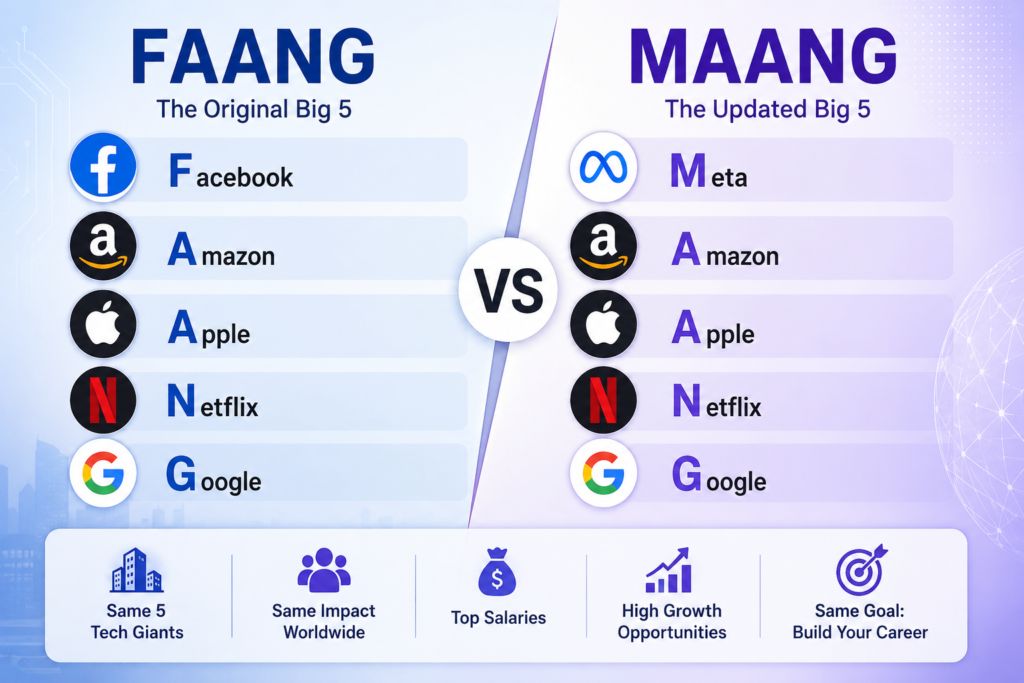
You might have heard the term MAANG floating around recently. So what exactly is the difference between FAANG vs MAANG?
Here is the simple story.
Facebook officially rebranded itself to Meta in October 2021. So the acronym got updated to reflect that change. MAANG stands for Meta, Amazon, Apple, Netflix, and Google.
Practically speaking, FAANG vs MAANG is nothing more than a naming update. The companies are exactly the same. The jobs are the same. The salaries are the same. The interview process is the same. The competition is absolutely the same.
Some people still use FAANG out of years of habit. Others use MAANG to sound more updated and current. In India, most students, college professors, and even recruiters still say FAANG because that is the term that first became famous and stuck in people’s minds.
For your career planning purposes, do not spend even five minutes worrying about FAANG vs MAANG. Focus on the companies and the preparation, not the acronym. Both terms point to the same five giants that you are trying to get into.
What is a FAANG Job?
Now here is where things start getting really exciting.
A FAANG job is not just any tech job. It is a role at one of these five companies that comes with a package that most people in Indian IT simply cannot imagine.
Salary
FAANG jobs in the United States offer total compensation packages ranging from one hundred fifty thousand dollars to five hundred thousand dollars per year even for mid level engineers. In India, FAANG offices in Bangalore and Hyderabad offer salaries ranging from thirty lakh to one crore plus rupees per annum for experienced roles. Freshers at FAANG India typically start between twenty five lakh and forty lakh per year.
Scale of Work
You work on problems that affect hundreds of millions or even billions of users. The engineering challenges you face at a FAANG company are simply not available anywhere else. One bug you fix might affect the experience of fifty million people the same evening.
Brand Value
Having a FAANG company on your resume opens doors for the rest of your professional life. Even if you leave after two years, the credibility that comes with that brand name stays with you permanently. Recruiters worldwide take your profile seriously the moment they see it.
Culture and Benefits
These companies invest heavily in employee development, learning opportunities, mental health resources, and career growth programs. The work can be demanding but the support systems are world class. Before applying to top companies, make sure your resume stands out because most recruiters ignore your resume due to avoidable mistakes students never notice.
Common FAANG job roles include Software Development Engineer, Data Scientist, Machine Learning Engineer, Product Manager, UX Designer, Site Reliability Engineer, and Business Analyst.
So what is a FAANG job in the simplest possible terms? It is the most competitive, most rewarding, and most respected job category in the entire tech industry. That is it.
Why Every Indian Tech Student Talks About FAANG
Let us be completely honest here. The FAANG obsession in India is very real.
Walk into any NIT, BITS, or Tier-2 engineering college and you will hear it in the canteen, in the hostel at midnight, and during every placement preparation session. Everyone wants to know what is FAANG and how to crack it.
Here is exactly why:
The Salary Gap is Life Changing
A normal IT services job in India pays somewhere between three and a half lakh to six lakh per year for a fresher. A FAANG job in India pays anywhere from twenty five lakh to fifty lakh per year for the same fresher profile. That is not a small difference. That is a completely different life trajectory for the person and their entire family.
The Prestige Factor is Real
Indian families understand big brand names very well. Saying you work at Google or Amazon carries enormous weight, at the dinner table, at family functions, and yes, even in the marriage market. We said it because everyone knows it is true.
The Global Exposure is Unmatched
Working at a FAANG company means working alongside some of the best engineers in the world, solving some of the biggest technical problems in the world. Your learning curve becomes incredibly steep and fast. In two years at a FAANG company, you can grow more than in six years at an average IT firm.
International Doors Open Up
Once you have FAANG experience on your resume, recruiters from the United States, United Kingdom, Singapore, and Europe start finding you on LinkedIn without you doing anything extra. Your career becomes genuinely global.
This is why CareerGrowKaro always tells students: understanding what is FAANG is not just about chasing a dream. It is about building a strategy that changes your entire career trajectory. You can also explore Career Advice: Your Complete Guide to Making Smart Decisions in 2026 if you are still confused between placements, higher studies, or skill-building paths.
Skills Needed for FAANG
Now the real question that every student actually wants answered. What skills do you need?
The skills needed for FAANG fall into two clear categories: Technical Skills and Soft Skills.
Technical Skills Needed for FAANG
Data Structures and Algorithms is the single most important technical skill. Every single FAANG interview, without exception, has DSA coding rounds. If your DSA is weak, nothing else will save you. This is not negotiable.
System Design knowledge is essential for mid level and senior roles. You need to understand how to design large scale distributed systems that handle millions of requests per second.
Strong command over at least one programming language is mandatory. Python, Java, and C++ are the most commonly used in FAANG interviews. Pick one, go deep, and master it completely before moving to another.
Computer Science fundamentals including Operating Systems, Database Management Systems, Computer Networks, and Object Oriented Programming concepts are tested regularly.
Consistent practice on competitive programming platforms like LeetCode, HackerRank, and Codeforces is how you actually build interview readiness. Reading theory is not enough. You must solve problems daily. At the same time, communication and presentation matter too, which is why improving your English communication skills can give you a major interview advantage.
Soft Skills Needed for FAANG
Clear communication is critical. FAANG interviewers do not just want the correct answer. They want to hear you explain your thinking clearly and logically as you work through the problem.
Structured problem solving matters more than people realise. Interviewers are evaluating your approach, not just your output. Thinking out loud and breaking problems into steps is a skill you must practice.
An ownership mindset is something all five FAANG companies explicitly look for. They want people who take initiative, think beyond their immediate task, and care about the bigger outcome.
Being a strong team collaborator is valued heavily, especially at companies like Amazon and Google where cross functional teamwork is central to how work gets done.
The most important thing CareerGrowKaro wants every student to remember about the skills needed for FAANG is this: DSA is your entry ticket. Without it, no amount of certifications, college projects, or internship experience will get you through the first interview round.
How to Get Into FAANG
This is the section everyone has been waiting for. Here is a realistic, honest, step by step path on how to get into FAANG as an Indian student.
Step 1: Build Your DSA Foundation Seriously
Start solving problems on LeetCode today. Begin with Easy level problems, get comfortable, then move to Medium, and eventually tackle Hard problems. Aim to solve a minimum of two hundred to three hundred problems before you start applying. Yes, this takes months. That is exactly the point.
Step 2: Learn System Design Gradually
Once your DSA is reasonably solid, begin learning system design concepts. Books like Designing Data Intensive Applications and free YouTube channels focused on system design are excellent starting resources that cost you nothing.
Step 3: Build Real Projects That Solve Real Problems
Do not just build another e-commerce clone that everyone builds. Build something that solves an actual problem, even a small one. Put it on GitHub with clean documentation. Write about it on LinkedIn. This signals to FAANG recruiters that you can actually ship real work.
Step 4: Get an Internship at a Good Company First
FAANG internships are a massive pipeline for full time offers. Getting any strong tech internship first, even outside FAANG, builds your resume credibility significantly before you apply to the big five.
Step 5: Apply Through Smart Channels
Apply through official company career portals like Google Careers and Amazon Jobs. Build a strong LinkedIn profile and stay active. Most importantly, work toward employee referrals because having someone inside the company refer you dramatically improves your chances of getting an interview call.
Step 6: Prepare Specifically for the Interview Process
FAANG interviews typically have four to six rounds including an Online Assessment with DSA problems, a Technical Phone Screen, multiple Coding Rounds, a System Design Round for experienced roles, and a Behavioral Round where Amazon specifically uses their Leadership Principles framework.
Step 7: Apply, Fail, Learn, and Apply Again
Most people who eventually get into FAANG did not crack it on their first attempt. Rejection is completely normal and expected. The students who ultimately succeed are the ones who treated every rejection as a data point, fixed their weak areas, and came back stronger the next time.
CareerGrowKaro tells every student this directly: how to get into FAANG is not a secret known only to IIT students. It is a process. Treat it like a process, follow it consistently, and your chances go up significantly.
FAANG Internships

FAANG internships deserve their own section because they are genuinely one of the most valuable experiences available to a student anywhere in the world.
What Are FAANG Internships?
FAANG internships are structured programs, usually ten to twelve weeks long, where students work on real production projects alongside full time employees. You are not making presentations or doing busy work. You are writing actual code that goes into real products used by millions of people.
How Much Do FAANG Internships Pay?
FAANG internships in the United States pay between seven thousand and twelve thousand dollars per month. In India, FAANG internship stipends at Bangalore and Hyderabad offices range from eighty thousand to two lakh rupees per month. Per month. For an intern. Let that number sink in.
Who Can Actually Apply?
You do not need an IIT tag. Students from NITs, BITS Pilani, VIT, and even lesser known private colleges have successfully landed FAANG internships purely through strong DSA skills and thorough preparation. What FAANG companies primarily test is your ability to solve problems, not the name of your college.
When Should You Apply?
Applications for summer FAANG internships typically open between August and November for the following year. Mark these dates in your calendar right now. Missing the application window means waiting a full year to try again.
How to Actually Land FAANG Internships?
Build a strong LeetCode profile with at least one hundred problems solved before you apply. Maintain an active GitHub with real projects. Create a clean resume that leads with your technical skills and achievements. Practice mock interviews regularly on platforms like Pramp or with your college friends who are also preparing.
FAANG internships are also a direct and well established path to a full time job offer. Stories like How Rekha from Jhansi Got Her First Job via Digital Course prove that consistent upskilling can completely change a student’s career journey. Many students who complete internships at Google, Amazon, or Meta receive a Pre Placement Offer before they even sit for their final exams. If converting an internship into a full time FAANG job is not motivation enough to start preparing right now, honestly nothing will be.
FAQs About FAANG
Q1. What is FAANG in simple words?
FAANG stands for Facebook (now Meta), Amazon, Apple, Netflix, and Google. These are the five biggest and most powerful tech companies in the world. They are known for paying the highest salaries in the tech industry, offering world class work culture, and hiring the most talented engineers globally. Getting a FAANG job is widely considered the top achievement in a technology career.
Q2. What is the FAANG full form?
FAANG full form is Facebook, Amazon, Apple, Netflix, and Google. Since Facebook officially rebranded to Meta in 2021, the updated version is now also called MAANG. However, most students, recruiters, and professionals in India still use the original term FAANG when referring to these five tech giants.
Q3. How much does a FAANG job pay in India?
A FAANG job in India at offices in Bangalore or Hyderabad typically pays between twenty five lakh and eighty lakh per annum for fresher and junior roles. Senior engineers and managers can earn well above one crore rupees annually. This is significantly higher than the average Indian IT salary which ranges from four to eight lakh per year.
Q4. Can a student from a Tier-3 college get into FAANG?
Yes, it is genuinely possible. FAANG companies primarily evaluate your DSA problem solving ability, technical communication, and coding skills during interviews. While students from IITs and NITs have some advantages in referrals and campus placements, many students from lesser known colleges have successfully cracked FAANG through consistent preparation, strong LeetCode practice, and solid project portfolios.
Conclusion
So now you know exactly what is FAANG, what the FAANG full form stands for, what are FAANG companies and what they actually do, how FAANG vs MAANG compares, what a FAANG job truly offers, the real skills needed for FAANG, the honest path on how to get into FAANG, and everything worth knowing about FAANG internships.
What is FAANG at the end of the day? It is a target. A high, difficult, absolutely worth chasing target that forces you to become a better engineer, a better communicator, and a sharper problem solver in the process.
The students who crack FAANG are not necessarily the most naturally talented people in the room. They are the most consistent ones. They solved DSA problems every single day. They applied even after multiple rejections. They treated the entire journey as a long game that rewards patience and persistence more than raw intelligence.
You can absolutely do the same thing.
Start today. Solve one problem on LeetCode. And if your long-term goal is financial freedom alongside career growth, learning how to earn money online as a student can help you build income early while preparing for bigger opportunities. Read one system design concept. Update your resume by one line. Take one small step toward your goal.
CareerGrowKaro is here to walk every step of that path with you, with practical guides, free tools, and real advice built specifically for Indian students and not for someone sitting in Silicon Valley with resources most of us will never have.
Your FAANG journey does not start when you feel ready. It starts right now.