Following a full-stack development roadmap for students is the absolute fastest way to land a high-paying software job without getting lost in endless internet tutorials. A full-stack engineer builds both the visual front of a website and the background database logic. You do not need expensive coaching fees to master this path. By spending two focused hours daily on frontend markups, backend servers, and database queries, you can become job-ready within six months. This CareerGrowKaro guide provides a complete full-stack development roadmap for students to help you build real applications and launch your coding career directly from your college hostel.
- Why Indian Engineering Students Need a Clear Web Development Plan
- Phase 1: Mastering Frontend Fundamentals
- Phase 2: Modern Frontend Frameworks and Styling Tools
- Phase 3: Backend Architecture and Server Logic
- Phase 4: Databases and Data Modeling
- Java Full Stack Developer Roadmap for Beginners vs MERN Stack
- The Role of Cloud Computing and Basic DevOps
- The Full-Stack Developer Roadmap GitHub Strategy
- 6-Month Action Plan and Semester Timeline
- Building 4 Real-World Projects That Beat Generic Clones
- Hackathons, Communities, and Open Source
- Freelancing vs Internships: Which Path to Choose First?
- Top 4 Mistakes Indian Engineering Students Make
- Frequently Asked Questions (FAQs)
- Conclusion and Next Steps
Why Indian Engineering Students Need a Clear Web Development Plan
Every semester, thousands of Indian engineering students buy discounted coding courses, watch three lectures, and abandon them. College syllabi in most universities are severely outdated. They still make students memorize static HTML tags or ancient C programs on paper instead of teaching how real cloud applications function today.
Without a structured plan, you will waste entire semesters jumping between random programming languages. A structured full-stack development roadmap for students gives you clear, daily direction. Instead of asking confused seniors what to learn next, you follow a tested path that connects basic syntax to real product development.
When you learn web development, you gain genuine career independence. You do not have to wait for campus placement companies to recognize your talent. You can build your own software tools, contribute to global open-source codebases, or start pitching startup founders for paid remote internships. For students living in Tier-2 and Tier-3 cities where off-campus job drives are rare, mastering a full-stack development roadmap for students creates equal career opportunities.
If you want to balance these new technical skills with quick earnings, read our guide on the Best Skills to Earn Money for College Students to start building financial independence early.
Phase 1: Mastering Frontend Fundamentals
The frontend is everything the user sees, clicks, and interacts with inside their browser. It is the visual layer of the internet, and mastering it forms the foundation of any reliable full-stack development roadmap for students.
Semantic HTML5
HTML is the skeleton of every website. Many beginners make the grave mistake of skimming HTML in two hours and moving on. Do not rush this step. You must understand semantic tags like header, nav, main, section, article, and footer. Semantic HTML ensures your website is accessible to screen readers and ranks higher on search engines. Learn how web forms work, how input validations behave, and how to embed images cleanly.
Modern CSS3 and Responsive Design
CSS brings style, layout, and visual identity to your bare HTML markup. The biggest test for any modern frontend developer is responsive design. Over eighty percent of internet users in India browse websites on budget smartphones. Your webpage must adjust smoothly across different screen dimensions.
- Master CSS Flexbox for simple one-dimensional layouts.
- Learn CSS Grid for complex, two-dimensional dashboard interfaces.
- Understand media queries to adapt font sizes and containers across mobile screens.
- Use modern CSS variables to manage colors, dark themes, and spacing effortlessly.
Instead of trying to memorize hundreds of CSS properties, refer to authoritative external resources like the MDN Web Docs to understand how web standards actually operate.
Modern JavaScript (ES6 and Beyond)
JavaScript gives life to your static pages. It handles button clicks, dynamic content updates, and communication with backend servers. Do not jump into heavy frameworks before your core JavaScript fundamentals are rock solid. When students skip vanilla JavaScript, their progress on any full-stack development roadmap for students slows down drastically.
- Variables, data types, and scope: understand let, const, and the dangers of var.
- Arrow functions, array methods like map, filter, and reduce, and object destructuring.
- The Document Object Model (DOM) manipulation and browser event listeners.
- Asynchronous JavaScript: master Promises, async/await, and the Fetch API.
To understand why core programming logic matters more than syntax tricks, check our foundational article on the Best Programming Languages to Learn First before picking up complex web frameworks.
Phase 2: Modern Frontend Frameworks and Styling Tools
Once your JavaScript basics are solid, building complex user interfaces with vanilla code becomes repetitive and messy. This is where modern frontend libraries step in to accelerate your full-stack development roadmap for students.
React: The Industry Standard
React remains the most popular frontend library across startups and top product companies in India. It allows you to break your user interface into small, reusable components. Instead of rewriting code for every page, you build a navigation bar or product card once and reuse it across your entire website. Integrating React into your full-stack development roadmap for students makes you instantly competitive for modern internship roles.
- Understand functional components and JSX syntax.
- Master React Hooks, especially useState for local data and useEffect for data fetching.
- Learn client-side routing using React Router so users can browse pages without full browser reloads.
- Handle state management cleanly using Context API or Zustand for larger web applications.
Utility-First Styling with Tailwind CSS
Writing separate CSS files for every single component can slow down your development speed. Tailwind CSS has become the preferred styling choice for modern full-stack developers. It allows you to style elements directly inside your markup using intuitive utility classes. It enforces clean spacing, typography scales, and responsive design right inside your templates.
When structuring a highly practical full-stack development roadmap for students, pairing React with Tailwind CSS creates the fastest path to building clean, professional-looking portfolio projects.
Phase 3: Backend Architecture and Server Logic
The backend is the engine room of the internet. It runs on remote cloud servers, processes user requests, executes business rules, and communicates with databases. A complete full-stack development roadmap for students gives equal weight to server logic.
Choosing Your Backend Environment: Node.js vs Python
As a college student, you want to minimize mental overload. Since you already learned JavaScript for the frontend, using Node.js allows you to use JavaScript on the server as well. Node.js is an asynchronous, event-driven JavaScript runtime built on Chrome V8 engine. It allows you to build fast, scalable network applications. When paired with Express.js, you can build production-ready web servers in just a few lines of code.
Alternatively, if you are interested in data science or artificial intelligence, Python frameworks like FastAPI or Django are fantastic alternatives. FastAPI provides automatic API documentation and incredible execution speed, making it a favorite for engineers following a full stack developer roadmap for beginners.
Core Backend Concepts Every Student Must Master
Regardless of which language you pick, your server fundamentals remain identical across any full-stack development roadmap for students:
- HTTP Protocol: Understand how GET, POST, PUT, and DELETE requests travel between clients and servers.
- RESTful API Design: Learn how to structure clean API endpoints that exchange data using JSON format.
- Middleware Functions: Understand how incoming requests pass through authentication checks and logging tools before reaching your main logic.
- Authentication and Security: Master user login systems using JSON Web Tokens (JWT) or secure cookies. Learn how to hash passwords safely.
- CORS and Environment Variables: Learn how to configure Cross-Origin Resource Sharing safely and protect secret API keys using dot-env files.
Following a disciplined full-stack development roadmap for students ensures that you do not leave dangerous security holes in your applications.
Phase 4: Databases and Data Modeling
Every useful web application needs to store information permanently. Whether it is user login credentials, blog posts, or e-commerce orders, data persistence is a mandatory skill on your full-stack development roadmap for students.
SQL vs NoSQL: Making the Right Choice
Databases generally fall into two broad categories: Relational (SQL) and Non-Relational (NoSQL). A balanced full-stack development roadmap for students must cover both systems so you know exactly when to pick each one.
- Relational Databases (PostgreSQL / MySQL): These systems store data in strict tables with rows and columns. They enforce relationships through foreign keys. PostgreSQL is currently the most popular relational database for modern web applications because of its stability and advanced querying features.
- Non-Relational Databases (MongoDB): MongoDB stores data in flexible, JSON-like documents. It is easy to use for beginners because the data looks exactly like JavaScript objects. It is ideal for rapid prototyping and apps where data structures change frequently.
Object Relational Mapping (ORMs)
Writing raw SQL queries directly in your backend code can be tricky and vulnerable to SQL injection attacks. Modern developers use ORMs like Prisma for SQL databases or ODMs like Mongoose for MongoDB. These tools allow you to interact with your database using native JavaScript functions while providing automatic type safety. Learning these modern abstractions is a critical milestone in any full-stack development roadmap for students.
Java Full Stack Developer Roadmap for Beginners vs MERN Stack
One of the biggest questions Indian engineering students ask is whether they should focus on Java or the JavaScript MERN stack (MongoDB, Express, React, Node.js). Both paths lead to great careers, but they target completely different areas of the job market.
The Corporate Standard: Java Full Stack
If your goal is cracking on-campus placements at top IT service firms, multinational banks, and traditional enterprise companies, mastering Java is a massive advantage. Enterprise corporations rely on Java because of its strict type system, exceptional long-term stability, and vast ecosystem.
- Core Language: Java 17 or Java 21 LTS versions.
- Backend Framework: Spring Boot for microservices, dependency injection, and REST API creation.
- Database Integration: Spring Data JPA with Hibernate for seamless database management.
- Frontend: React or Angular paired with enterprise UI libraries.
Many students look for a Java Full Stack Developer roadmap for Beginners or download a Java Full Stack Developer roadmap pdf to prepare for corporate hiring rounds. If you want structured corporate stability, this path is exceptionally reliable.
The Startup Favorite: MERN Stack
If your dream is working at fast-paced product startups, remote global agencies, or launching your own software products, the JavaScript ecosystem offers unmatched speed. You write JavaScript across the entire stack, meaning you do not have to mentally context-switch between different programming syntaxes.
Both routes are valid variations of an overall full stack developer roadmap for beginners. Pick the stack that aligns with the specific companies you want to target over the next two years as part of your full-stack development roadmap for students.
The Role of Cloud Computing and Basic DevOps
Writing code on your local laptop is just the beginning. A complete full-stack development roadmap for students must include the basics of Cloud Computing and DevOps. When you apply for internships, companies want to know if you can take a local project and make it live on the internet.
Understanding Modern Hosting Platforms
In the past, deploying a website was complicated and painful. Today, cloud platforms have simplified this process completely.
- Frontend Deployment: Platforms like Vercel and Netlify allow you to deploy your React or plain HTML projects for free. They connect directly to your repositories.
- Backend Deployment: For hosting your Node.js or Spring Boot servers, services like Render, Railway, or Fly.io are perfect for beginners.
- Database Hosting: Never store a database on your local machine for a live project. Use cloud database providers like MongoDB Atlas for NoSQL or Supabase for PostgreSQL.
Linux Basics and Docker Fundamentals
While you do not need to become a full-time DevOps engineer, a modern full stack developer roadmap 2026 expects students to know basic Linux terminal commands. Navigating directories, checking active server ports, and managing file permissions via the command line is an everyday task for a working software engineer.
Additionally, understanding the absolute basics of Docker will put you in the top tier of college freshers. Docker allows you to package your application and its dependencies into a single container, ensuring that if your code works on your laptop, it will run identically on the company server. Integrating these cloud concepts into your full-stack development roadmap for students bridges the gap between academic coding and production engineering.
The Full-Stack Developer Roadmap GitHub Strategy
Code that lives only on your personal laptop does not exist to recruiters. Learning Git and maintaining an active profile on GitHub is non-negotiable for every aspiring software engineer following a full-stack development roadmap for students.
Essential Git Commands for Daily Use
You do not need to memorize every single Git command on day one. Master these core commands:
git initto initialize a new local repository.git statusto check your modified files.git add .andgit commit -m "message"to save your code checkpoints.git branchandgit checkout -b branch-nameto build features without breaking the main codebase.git push origin mainto upload your local commits to GitHub.
How to Structure Your Repositories for Recruiters
Recruiters and hiring managers spend less than one minute evaluating a student’s GitHub profile. To stand out, treat every public repository like a finished product. Write Professional README Files. Explain what problem the application solves, list the technologies used, provide installation steps, and include screenshots or live demo links.
Searching for a full-stack developer roadmap GitHub repository gives you access to open-source project structures and developer community discussions. Following a full stack development roadmap for students github repository helps you learn how experienced engineers format their folders, document functions, and write automated tests.
6-Month Action Plan and Semester Timeline
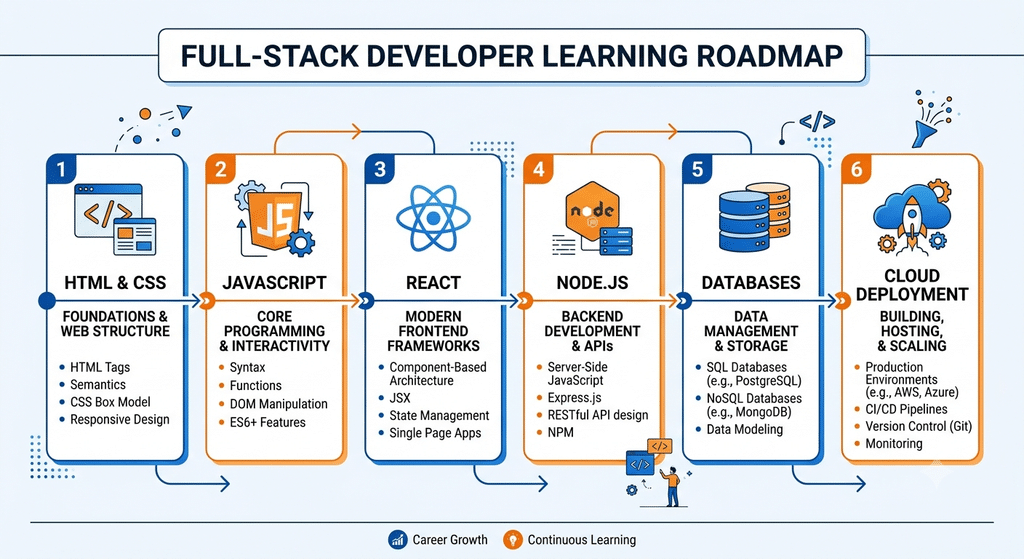
To help you organize your daily routine, here is a structured semester timeline built directly into this full-stack development roadmap for students.
Month 1: Web Foundations and Version Control Spend your first month getting comfortable with layout structures and version control. Build three static websites. Create a personal biography page, a product landing page, and a multi-column magazine layout. Push every single line of code to GitHub.
Month 2: JavaScript Mastery Stop styling and focus purely on logic. Build a browser-based calculator, a functional to-do list with local storage persistence, and an interactive quiz app. Learn how to fetch data from free public APIs, such as weather data or cryptocurrency trackers.
Month 3: Modern Frontend Frameworks Move into React. Learn component architecture, state management, and props passing. Rebuild your previous JavaScript projects inside React to see how component state simplifies DOM updates. Add Tailwind CSS to style your applications quickly.
Month 4: Backend Logic and Server Design Step into the server world. Set up an Express.js or Spring Boot server. Create clean RESTful routes for a basic blogging platform. Learn how to accept data from frontend forms, validate input fields, and return clean JSON responses.
Month 5: Database Modeling and Authentication Connect your backend server to PostgreSQL or MongoDB. Learn how to create schemas, run queries, and establish one-to-many relationships. Implement secure user registration and login flows using hashed passwords and JSON Web Tokens.
Month 6: Full Integration and Cloud Deployment Connect your React frontend with your secure backend database. Deploy your frontend on Vercel or Netlify. Deploy your backend servers on cloud platforms like Render. Point both services to a managed cloud database. You now have a live, production-grade full-stack web application accessible to anyone on the internet.
Following this structured full stack developer roadmap 2026 prevents burn-out and guarantees steady, measurable progress every single week. Many students prefer keeping a downloaded Full Stack Developer roadmap pdf or a printed study sheet on their desk to track these milestones.
Building 4 Real-World Projects That Beat Generic Clones

Do not fill your portfolio with generic weather apps, Netflix clones, or basic to-do lists that you copied line-by-line from a YouTube tutorial. Every Indian engineering student has those exact clones on their resume. Recruiters ignore them instantly.
A great full-stack development roadmap for students focuses entirely on original, problem-solving web applications. Here are four high-impact project ideas that prove you know how to build real software.
Project 1: Hyperlocal Campus Resource Exchange
Students in college hostels struggle to buy, sell, or rent second-hand engineering textbooks, lab coats, and draft boards. Build a marketplace where students from your university can register using their official college email IDs, post listings with photos, and chat in real-time. This project uses React, Tailwind CSS, Node.js, and PostgreSQL. It demonstrates relational database modeling and authenticated file uploads.
Project 2: Micro-SaaS Invoice and GST Calculator for Freelancers
Indian student freelancers often struggle to generate clean, GST-compliant PDF invoices for their clients. Create a lightweight web application that allows users to input their hourly rates, calculate relevant taxes, save client profiles, and export branded PDF invoices instantly. This project demonstrates business logic and financial math, making it a stellar highlight in your full-stack development roadmap for students.
Project 3: Collaborative Real-Time Code Scratchpad
Friends studying for coding interviews need a quick way to write and review code together without screen-sharing on heavy video apps. Build a browser-based code editor where two users can type in the same document simultaneously, with live syntax highlighting and execution previews using WebSockets. Working with WebSockets proves you understand low-latency networking beyond simple REST APIs.
Project 4: Automated Placement Tracking Dashboard
Final-year college students apply to dozens of off-campus jobs and easily lose track of interview dates, assignment deadlines, and recruiter responses. Develop a Kanban-style job tracking board with automated email reminders, interview preparation checklists, and company review notes using Java Spring Boot, MySQL, and React. This project serves as a perfect showcase for students following a Java Full Stack Developer roadmap for Beginners.
Once you complete these projects, document them in your portfolio. Read our guide on how to Build a Developer Portfolio with Zero Experience to present your projects in a way that catches the attention of top engineering managers.
CareerGrowKaro Magic Box
Struggling to balance university exams with your daily web development coding practice? Many Indian engineering students get overwhelmed trying to manage tough college semester subjects, lab manuals, and daily coding goals on their full-stack development roadmap for students. Without structured planning, exam stress destroys your coding momentum.
Use CareerGrowKaro’s guide on Smart Budgeting Tips for Indian Students and related time-management tools to divide your daily hours into balanced blocks. Learn how to protect your coding practice while easily maintaining a high college GPA. Clear your academic stress in minutes!
Hackathons, Communities, and Open Source
A successful full-stack development roadmap for students is never meant to be followed in complete isolation. You can read every full stack development roadmap for students pdf available on the internet, but if you do not network with other developers, your career growth will remain slow.
Why You Must Participate in Hackathons
Hackathons are 24-hour or 48-hour coding competitions. They force you to build a working prototype under extreme time pressure. You learn how to collaborate with UI/UX designers and other backend developers. You also get to pitch your software directly to industry judges and potential recruiters. Attending a local college hackathon accelerates your full-stack development roadmap for students because you learn more in a single weekend than you would in a month of passively watching video lectures.
Contributing to Open Source
Open source means the source code of a software project is publicly available for anyone to modify and improve. Contributing to open-source projects is a massive resume booster. Search for a full-stack developer roadmap GitHub repository that lists beginner-friendly open-source projects. Start small. Fix a typo in the documentation, resolve a minor CSS bug, or translate a readme file into Hindi.
Freelancing vs Internships: Which Path to Choose First?
Once you are halfway through your full-stack development roadmap for students, you will face an important career decision. Should you look for a corporate internship or start freelancing?
The Case for Freelancing First
Freelancing gives you absolute flexibility. You can take up small projects like building a digital menu for a local cafe or a booking website for a neighborhood clinic. You earn your own money quickly, learn how to communicate with real clients, and understand the commercial value of software. If you need immediate pocket money, integrating freelancing into your full-stack development roadmap for students is highly practical.
For broader career guidance and industry insights, you can review national skill initiatives through the National Skill Development Corporation (NSDC) to supplement your technical portfolio. Check out our complete breakdown on How to Earn Money Online for Students 2026 to discover safe side hustles that make you financially self-reliant during college.
The Case for Corporate Internships
An internship at a product-based startup or an IT firm provides structured learning. You get to read production-level code, understand agile sprint cycles, and receive feedback from experienced engineers who review your pull requests. The smartest students combine both paths. In your second year, use the skills gained from your full-stack development roadmap for students to do small freelance gigs. In your third year, use that impressive portfolio to secure a high-paying corporate internship.
Real-world outreach works wonders. Read How Rekha from Jhansi Got Her First Job via Digital Course to see how direct practical learning opens doors. To explore even more financial channels, browse our comprehensive list of Income Ideas for Students in India.
Top 4 Mistakes Indian Engineering Students Make
Even when students follow a solid full stack developer roadmap for beginners, many fail to land jobs because of these four common traps.
Mistake 1: Getting Trapped in Tutorial Hell
Watching someone else code on YouTube gives you a false feeling of accomplishment. Your brain thinks you understand the concept, but when you open an empty editor, you have no idea where to start. Follow the 20-80 rule. Spend twenty percent of your time watching instructional videos and eighty percent of your time writing original code without looking at solutions.
Mistake 2: Learning Five Frameworks at Once
Many students try to learn React, Angular, Vue, Node, Django, and Go all in the same semester. This leads to superficial knowledge where you cannot build a production-ready application in any single technology. Pick one frontend tool and one backend runtime. Master them thoroughly before touching anything else on your full-stack development roadmap for students.
Mistake 3: Ignoring Version Control and Clean Documentation
Writing functional code is not enough in professional teams. If your code is messy, uncommented, and lacks a Git commit history, team leads will hesitate to hire you. Commit your progress daily on GitHub. Write descriptive commit messages like “fix: resolve mobile navigation overflow” instead of typing random letters.
Mistake 4: Disregarding Computer Science Fundamentals
Some web development bootcamps tell students that Data Structures and Algorithms (DSA) do not matter. This is completely false in the Indian tech market. While your web projects get you past the initial resume screening, clearing technical interview rounds at top tech companies still requires a solid understanding of arrays, strings, hash maps, and algorithmic complexity. Balance your practical full-stack development roadmap for students with basic logic problem solving. You can review industry trends in the annual Stack Overflow Developer Survey to see which core engineering capabilities remain most valued globally.
Frequently Asked Questions (FAQs)
How long does it realistically take to complete a full-stack development roadmap for students?
If you dedicate two to three focused hours every day, you can complete the core roadmap and build four original projects within six months. The key is consistent daily practice rather than studying only on weekends.
Do I need a high-end laptop to learn full-stack web development?
No, you do not need an expensive gaming laptop. A basic computer with an Intel i3 or Ryzen 3 processor, 8GB of RAM, and an internet connection is more than enough to run VS Code, modern browsers, and local database servers smoothly.
Which stack is best for campus placements: Java Full Stack or MERN?
For traditional Indian campus placements and large enterprise companies, Java Full Stack with Spring Boot is highly preferred. For modern product startups, remote internships, and early-stage companies, the JavaScript MERN stack offers significantly more immediate opportunities.
Should I learn Data Structures and Algorithms along with web development?
Yes. While web development allows you to build real-world software applications, basic algorithmic problem-solving is necessary to pass technical screening rounds during job interviews. Spend one hour on DSA problem solving and two hours on full-stack development daily.
Where can I find open-source projects suitable for college students?
You can explore beginner-friendly open-source projects on GitHub by filtering issues tagged with “good first issue” or “help wanted”. Contributing to documentation or small bug fixes helps you understand how professional development teams collaborate on shared codebases.
Is full-stack development better than specializing in frontend or backend?
For college students, understanding the full stack gives you a massive advantage because you understand how all pieces of a system connect together. Once you land your first role, you can choose to specialize deeply in frontend design, backend infrastructure, or cloud DevOps based on your personal interests.
Conclusion and Next Steps
Mastering web development is one of the smartest and most empowering decisions you can make during your college years. It transforms you from a passive consumer of technology into an active creator who can build scalable digital products from scratch. By following this full-stack development roadmap for students, you bypass outdated college curriculums and equip yourself with the exact skills companies compete to hire.
Do not worry about learning every new framework that trends on social media. Focus on the core building blocks: semantic HTML, responsive CSS, modern JavaScript, secure backend APIs, and efficient database design. Build original projects that solve real problems, push your clean code to GitHub daily, and share your technical progress openly on LinkedIn.
As you sharpen your technical capabilities, explore our Skills Category Hub to find practical roadmaps on technical interviews, portfolio optimization, and career progression. Your journey from a confused engineering fresher to an independent, job-ready full-stack developer begins today. Open your code editor, write your first lines of code, and let CareerGrowKaro support your growth every single step of the way!