Want to score 90+ in your board exam? The secret is not just studying hard but writing your board exam copy the right way. Board exam copy writing means presenting your answers clearly with proper headings, underlines, and structured points. Most students lose 10-15 marks just because their answer presentation is messy. In this guide, CareerGrowKaro will show you exactly how to write answers in board exams that impress examiners and get you maximum marks.
- What is Board Exam Copy Writing?
- Why Your Board Exam Copy Presentation Matters
- Golden Rules for Writing Board Exam Answers
- Step-by-Step Guide: How to Write Board Exam Copy
- Subject-Specific Answer Writing Tips
- Time Management Tricks for Board Exams
- Common Mistakes That Cost You Marks
- Last 7 Days Strategy
- FAQs About Board Exam Answer Writing
- Conclusion
What is Board Exam Copy Writing?
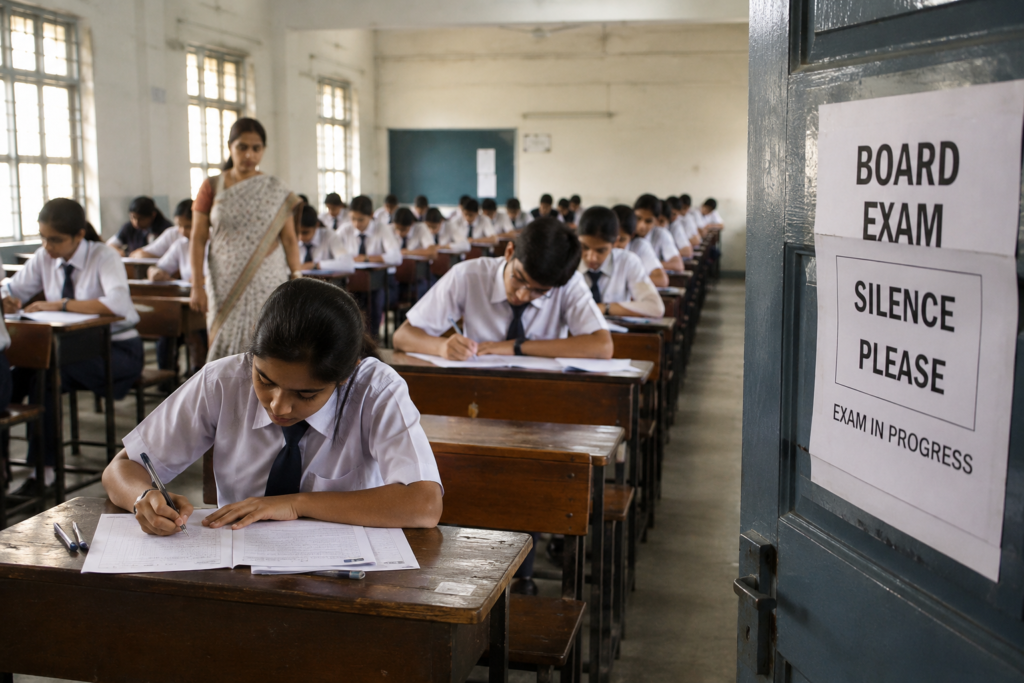
Board exam copy writing is not just about writing correct answers. It is about how you present those answers on paper. Your board exam answer sheet is called a copy. How you structure this copy decides whether you get 7 marks or 10 marks for the same answer.
Think of it like this. Two students know the same answer. One writes it in a messy paragraph. Another writes it with proper headings, bullet points, and underlines. The second student will always score more. Why? Because the examiner checks 40-50 copies per day. They look for keywords and clear structure. A well-written board exam copy makes their job easier.
The way you write your board exam copy shows your understanding. Clean presentation equals better marks. This is true for CBSE, ICSE, and all state boards. Every board exam follows this pattern.
Students who are still planning their future after boards should also explore our complete guide on Career Advice: Your Complete Guide to Making Smart Decisions in 2026.
Why Your Board Exam Copy Presentation Matters
Let me share something most students do not know. Board exam papers are checked by external examiners. These teachers check hundreds of copies in a few weeks. They get tired. They have marking deadlines. Your neat and well-structured board exam copy stands out immediately.
Here is what happens when you write a good board exam copy:
- Examiner finds keywords quickly
- Your answer looks complete even if it is average
- You get benefit of doubt for partial answers
- Presentation marks add up across all answers
- Your overall percentage increases by 5-8 percent
Bad handwriting alone can cost you 10 marks in a board exam. But even if your handwriting is average, proper formatting saves you. This is why learning how to write board exam copy is as important as learning the subjects.
Many toppers say this openly. They did not know everything. But they knew how to write answers in board exams. Students aiming for engineering careers after boards should also check out Best Engineering Colleges in Delhi 2026 – Complete Guide to understand future opportunities and college options early. They mastered the presentation game. You can too.
Golden Rules for Writing Board Exam Answers
Before we go into step-by-step methods, remember these 7 golden rules. These apply to every board exam answer you write.
Rule 1: Read the Question Twice
Sounds basic but most mistakes happen here. Students miss keywords like “explain,” “define,” “differentiate,” or “analyze.” Each word needs a different answer style. Read the question. Underline the main keyword. Then write.
Rule 2: Use Headings and Subheadings
Every answer above 3 marks must have headings. For a 5-mark question, use at least 2-3 subheadings. This breaks your answer into clear parts. The examiner sees structure immediately.
Rule 3: Underline Important Terms
Underline definitions, formulas, dates, names, and technical terms. Use a scale and pencil. One clean line under the keyword. This highlights what matters. Examiners look for these underlined terms while marking.
Rule 4: Leave Proper Spacing
After every answer, leave 2-3 lines blank. Between paragraphs, leave one line. This makes your board exam copy look clean. It also gives you space to add points if you remember later.
Rule 5: Write in Points When Possible
Long paragraphs are harder to check. Wherever possible, write in bullet points or numbered lists. For example, if a question asks for 5 advantages, write them as Point 1, Point 2, and so on. This is how to write answers in board exams smartly.
Rule 6: Draw Diagrams Neatly
In Science, Maths, or Geography, diagrams carry marks. Always draw with a pencil and scale. Label everything. Even a rough diagram with proper labels gets you marks. A beautiful diagram without labels gets zero.
Rule 7: Never Leave a Question Blank
Even if you do not know the full answer, write something. Write the definition. Write what you remember. Attempt every question. Blank answers get zero. Partial answers can get 2-3 marks.
Step-by-Step Guide: How to Write Board Exam Copy

Now let us get into the exact process. Follow these steps for every answer in your board exam copy.
Step 1: Plan Before You Write
When you get your question paper, do not start writing immediately. Spend the first 15 minutes reading all questions. Mark the easy ones. Decide which questions you will answer first. This planning saves time later.
For each question, quickly note down 3-4 points you will cover. Do this rough work on the last page of your board exam copy. This rough work is allowed. It helps you organize thoughts.
Step 2: Start With Easy Questions
Always begin your board exam with questions you know well. This builds confidence. It also ensures you finish your best answers properly. If you start with hard questions, you may panic and waste time.
Easy questions done well = guaranteed marks. Hard questions tried badly = stress and lost marks. Choose wisely.
Step 3: Write the Question Number Clearly
This sounds simple but students forget. Write the question number in the margin box clearly. If you are answering Question 5(a), write it exactly like that. Do not write just 5 or just (a). The examiner should not have to guess.
Step 4: Structure Your Answer Properly
Here is the winning format for how to write board exam copy for different mark questions:
For 1-2 Mark Questions:
- Direct answer in 2-3 lines
- Define or state the fact
- Underline the main term
- No need for headings
For 3-5 Mark Questions:
- Start with a one-line introduction
- Write 3-4 points with subheadings
- Each point should be 2-3 lines
- End with a small conclusion if needed
For 6-10 Mark Questions:
- Introduction (2-3 lines)
- Main Body with 4-5 headings
- Each heading with 3-4 lines explanation
- Diagram if required
- Conclusion (2 lines)
This structure works for every board exam. CBSE, ICSE, state boards – all follow similar marking schemes.
Step 5: Use the STAR Method for Long Answers
STAR stands for:
- Situation: Set the context
- Task: What is being asked
- Action: Explain the process or points
- Result: Conclude the answer
This method is especially useful for Social Science and English Literature answers. It keeps your board exam copy organized and logical.
Step 6: Check Your Answer Before Moving On
After finishing each answer, take 10 seconds to review. Did you answer what was asked? Did you underline keywords? Is the spacing proper? This quick check prevents silly mistakes.
Subject-Specific Answer Writing Tips
Different subjects need different answer styles in your board exam copy. Here is how to write answers in board exams for each major subject.
Mathematics Board Exam Copy
Maths is about steps, not just the final answer. Even if your final answer is wrong, you can get step marks. Here is what works:
- Write the formula first and underline it
- Show every calculation step clearly
- Box the final answer
- Draw diagrams with scale and pencil
- Never do rough work on the answer sheet
- If stuck, move to the next question
Pro tip: In your board exam, attempt all questions even if you cannot solve them completely. Write the formula and first 2-3 steps. You will get partial marks.
Science Board Exam Copy
Science has three parts: theory, diagrams, and numericals. Your board exam copy should reflect all three clearly.
- Start with definitions (always underlined)
- Use scientific terms correctly
- Draw labeled diagrams (5 marks questions usually need diagrams)
- For numericals, follow the same rule as Maths
- Write chemical equations properly
- Balance equations and show the process
In Biology, diagrams are very important. Even if you write a perfect answer without the diagram, you lose marks. Practice drawing diagrams before your board exam.
Medical aspirants can also check out our practical NEET Preparation 2026: Simple Guide to Crack NEET Exam for subject-wise preparation tips.
Social Science Board Exam Copy
This is where answer presentation matters the most. Social Science answers are checked very strictly for structure.
CareerGrowKaro recommends this format:
- Introduction: Define the topic (1-2 lines)
- Body: Write 4-5 points with headings
- Each point: 3-4 lines of explanation
- Add relevant examples (India-specific)
- Conclusion: Summarize in 2 lines
Use dates, names, and events. Underline them all. For map questions, label everything clearly. Use different colors if allowed.
English Board Exam Copy
English is unique. Grammar has fixed answers but literature is subjective. Here is how to score well:
For grammar section:
- Read the instruction carefully
- Rewrite the full sentence in answers
- Underline the corrected part
- Be very neat
For literature section:
- Quote from the text (small quotes, 1 line max)
- Explain the quote in your own words
- Connect to the theme or character
- Give your opinion if asked
- Write in proper paragraphs
Letter and essay writing: Follow the exact format. Introduction, body with 3-4 paragraphs, conclusion. Your board exam copy for English should look like a clean notebook page.
Along with board preparation, improving your communication can boost confidence during viva and interviews, which is why many students also read How to Build English Communication Skills That Actually Help in 2026.
Hindi/Regional Language Board Exam Copy
Same rules apply as English. Additionally:
- Write in clean script
- Use proper matras (vowel marks)
- Do not mix Hindi and English unnecessarily
- For essays, stick to the topic
- Grammar answers need full sentences
Time Management Tricks for Board Exams
You can know everything but still fail if you cannot manage your 3-hour board exam time properly. Here is a tested strategy:
First 15 Minutes: Reading Time
- Read all questions carefully
- Mark easy, medium, and hard questions
- Decide your attempt order
- Plan which question gets how much time
Next 150 Minutes: Writing Time
Divide your time based on marks. Simple formula: 1 mark = 1.5 minutes. So a 5-mark question should take 7-8 minutes maximum.
| Question Type | Time Allowed | What to Do |
| 1 mark | 1-2 minutes | Write direct answer |
| 2 marks | 3-4 minutes | 3-4 lines with definition |
| 3 marks | 5-6 minutes | 3 points, properly structured |
| 5 marks | 7-8 minutes | Introduction + 3-4 points + conclusion |
| 8-10 marks | 12-15 minutes | Detailed answer with diagram |
Last 15 Minutes: Revision Time
This is critical. Do not write new answers in the last 15 minutes. Use this time to:
- Check question numbers
- Add any missed points
- Verify all diagrams are labeled
- Ensure name and roll number on every sheet
- Read through your board exam copy once
Many students skip revision and regret it later. Those 15 minutes can save you from silly mistakes worth 5-10 marks.
Common Mistakes That Cost You Marks
After checking thousands of board exam copies, examiners see the same mistakes repeatedly. Avoid these and you automatically score better.
Mistake 1: Writing Too Much for Small Questions
A 2-mark question needs 3-4 lines, not a full page. Students waste time writing long answers for short questions. Then they rush through high-value questions. Write according to marks allotted.
Mistake 2: Poor Handwriting in a Rush
Your board exam copy will be checked by someone who does not know you. If they cannot read your handwriting, they cannot give you marks. Write clearly. If you have bad handwriting, write slowly and leave extra spacing.
Mistake 3: Not Following Word Limits
In English and Hindi, word limits matter. If a question asks for 120-150 words, write within that range. Too short = incomplete answer. Too long = wasted time and possible negative marking.
Mistake 4: Overconfidence or Underconfidence
Some students think board exam is very easy and do not prepare presentation. Others panic and write anything. Both approaches fail. Treat your board exam seriously but stay calm.
Students struggling with focus and discipline should also explore 10 Daily Habits to Build Confidence in Interviews, as many of those habits improve exam performance too.
Mistake 5: Using Wrong Pen or Pencil
Only use blue or black pen for writing. Use pencil only for diagrams, graphs, and maps. Do not use colorful pens or highlighters in your board exam copy. It is not allowed and creates a bad impression.
Mistake 6: Cutting Answers Messily
If you make a mistake, draw one clean line through it. Do not scribble over it multiple times. Do not use whitener. A single neat line shows you are organized.
Mistake 7: Ignoring Instructions
Every board exam paper has specific instructions. Read them. Some boards want answers in a particular order. Some have internal choices. Missing these instructions can disqualify answers.
Last 7 Days Strategy

One week before your board exam, shift focus from studying to practicing how to write board exam copy.
Day 7-5 Before Exam:
- Solve 2-3 previous year papers
- Time yourself strictly
- Write complete answers, not just points
- Check your own copy against marking schemes
Day 4-3 Before Exam:
- Practice only weak subjects
- Focus on answer presentation
- Memorize important definitions and formulas
- Prepare your stationery kit
Day 2 Before Exam:
- Revise key points and formulas
- Practice 2-3 diagrams for each subject
- Relax and sleep well
- Do not study anything new
Day 1 Before Exam:
- Light revision only
- Check exam center and hall ticket
- Pack your exam kit: pens, pencils, scale, eraser, admit card
- Sleep early
Exam Day Morning:
- Have a proper breakfast
- Carry a water bottle
- Reach the center 30 minutes early
- Stay calm and confident
Struggling to prepare for your board exam?
Use CareerGrowKaro’s free study planners and time management tools to organize your preparation in minutes. Get subject-wise checklists, revision timetables, and answer writing templates designed for Indian students.
FAQs About Board Exam Answer Writing
1. How many times should I revise my board exam copy during the exam?
Revise once properly in the last 15 minutes. Do a quick check after each long answer (just 10 seconds). Full revision at the end helps catch mistakes. During writing, focus on accuracy. During revision, focus on completeness.
2. What if I make a mistake in my board exam copy?
Draw one clean line through the wrong answer. Write the correct answer next to it or below. Never use whitener or scribble. A neat correction shows clarity. Examiners appreciate honesty. Messy cutting creates doubt.
3. Should I write extra points to be safe?
Only write relevant points. Quality over quantity always. If a question asks for 4 points, writing 6 random points does not help. Examiners check only the best 4. Wrong points can even reduce marks in some boards.
4. Can I use short forms in my board exam copy?
Avoid short forms in the main answer. You can use them in rough work. Write full forms for technical terms the first time. After that, standard abbreviations like DNA, UK, or CBSE are fine. When in doubt, write the full form.
5. How important is handwriting in board exam scoring?
Handwriting matters but is not everything. Even average handwriting works if it is readable and clean. Focus on neatness over beauty. Use proper spacing, clean margins, and clear letters. Presentation is more important than perfect handwriting.
6. What should I do if I run out of time in my board exam?
If you have 10 minutes left and 2 questions pending, write answers in point form. Give headings and one-line explanations. Attempting is better than leaving blank. You will get partial marks. Manage time from the beginning to avoid this situation.
Conclusion
Scoring well in your board exam is not just about knowing the content. It is about presenting that knowledge in a way that gets you maximum marks. Learning how to write board exam copy properly can increase your score by 10-15 percent without studying anything extra.
Remember the key points: structure your answers with headings, underline important terms, manage your time wisely, and always revise your board exam copy in the last 15 minutes. Practice these techniques with previous year papers before your actual exam.
CareerGrowKaro believes every student can score better by mastering answer presentation. Your hard work deserves full marks. Make sure your board exam copy reflects that effort.
If you want motivation during exam season, read How Rekha from Jhansi Got Her First Job via Digital Course, a relatable story about consistency and self-improvement.
Start practicing these techniques today. Your board exam is not just a test of knowledge but also a test of smart presentation. Master both and success is guaranteed.
Many students also start exploring career income opportunities early, which is why our guide on How to Earn Money Online for Students 2026 (₹5K–₹25K) has become popular among board aspirants.
Explore more exam preparation guides and free tools on CareerGrowKaro to make your board exam journey stress-free and successful.