
A makhana business means earning from fox nuts at any stage: farming, popping, roasting and flavouring, packing, or trading. Most makhana comes from Bihar. The easiest start is buying graded popped makhana and roasting, flavouring and packing it under your brand. A government model report costs a small 10 kg/hour unit at ₹27.23 lakh, using older prices. Margins are thin, so cost every kilo at today’s Bihar rates.
- Key Numbers (as of November 2026)
- 1. Which makhana business can you actually start?
- 2. Is makhana business profitable in India in 2026?
- 3. How is makhana made? From pond seed to pop
- 4. How much does a makhana processing unit cost?
- 5. Which makhana machines do you need, and what do they cost?
- 6. Where do you buy raw makhana? Bihar wholesale prices and grades
- 7. Which licences do you need for a makhana business?
- 8. Which government schemes support a makhana unit?
- 9. How do you sell makhana? Wholesale, retail, online or export
- 10. How do you market a makhana brand on a small budget?
- 11. What are the real risks in a makhana business?
- 12. Your first 30 days: a step-by-step plan
- Frequently Asked Questions
- Conclusion: start small, cost honestly, then grow
Key Numbers (as of November 2026)
- India’s makhana production: 80,590 MT in 2025–26 (second advance estimate) — PIB, Aug 2026
- Bihar’s share: about three-fourths of India’s output and 80–85% of world supply — PIB
- Average price: about ₹500/kg (2020–22) → about ₹1,250/kg (2025) — PIB
- Demand grew 17–18% a year (2021–22 to 2024–25); production grew only 4–5% — PIB
- Market expected to reach ₹11,000–12,000 crore by 2029–30 — PIB
- Popping yield: 35–40% of raw seed weight — NIFTEM PMFME DPR
- Government model unit (10 kg/hour): ₹27.23 lakh project cost — NIFTEM PMFME DPR
- Central Sector Scheme for makhana: ₹476.03 crore for 2025–26 to 2030–31 — PIB
Your feed is full of makhana success stories. Some posts promise a tiny setup cost and big profits. Before you put your savings into a makhana business, you deserve real numbers.
This CareerGrowKaro guide uses the government’s own project reports, PIB data and 2026 Bihar prices. You will see four ways to start, what each costs, which licences and schemes apply, and exactly where small units lose money. Then you can decide with a clear head.
1. Which makhana business can you actually start?
A makhana business is any business that earns from fox nuts (Euryale ferox) — by farming them, popping raw seeds, roasting and flavouring popped makhana, packing it under a brand, or trading and exporting it. Most raw makhana comes from North Bihar, so most small businesses either work near Bihar or buy from Bihar suppliers.

The PIB backgrounder (Aug 2026) splits the value chain into three stages:
- Farm level: pond or field cultivation and manual harvesting from water.
- Primary processing: cleaning, drying, roasting and popping the hard seed. This is mostly done at household or village level.
- Secondary processing: grading, polishing, flavouring, packing — plus new products like makhana flour and ready-to-eat snacks.
Each stage is a different business with a different budget. Here is the honest comparison:
| Model | Best for | Starting capital | Biggest risk |
| Trade & repack (buy graded popped makhana, pack under your brand) | First-timers anywhere in India | Mostly stock and packaging. 100 kg of 5 Suta at ~₹800/kg is ₹80,000 of stock alone (Oct 2026 listing) | Thin margin if you sell loose |
| Roast & flavour unit (about 10 kg/hour) | Learners ready for a small factory in a Tier 2/3 town | ₹27.23 lakh in the PMFME model DPR (older prices — see Section 4) | Working capital at 2026 prices |
| Popping & grading plant (200 MT/year) | Traders and FPOs near Bihar mandis | ₹172.31 lakh in Bihar’s model DPR | Raw seed supply and skilled labour |
| Farming (pond or field system) | Families with ponds or low land in North Bihar | Separate guide needed | Weather and harvest labour |
CareerGrowKaro recommendation: start with trade & repack. Learn grades, buyers and packing first. Move to a roast & flavour unit only after a few months of steady repeat orders.
Your next step: Write down which of the four models fits your money, your location and your time. Pick one. Do not try all four.
2. Is makhana business profitable in India in 2026?

Yes, a makhana business can be profitable, but the margins are thin, not fat. Both official model reports show modest profits, not the 30–40% you see in viral posts.
- PMFME model DPR (10 kg/hour unit): profit after tax is ₹2.05 lakh in Year 1 (2.5% of sales), rising to ₹8.13 lakh by Year 5 (about 6.1% of sales). Before tax, Year 5 is ₹9.11 lakh, or 6.81%. The unit breaks even only at 56–57% capacity while it runs at 65% in Year 1, which is a thin cushion. Source: NIFTEM DPR.
- Bihar BAIPP model DPR (200 MT/year plant): profit after tax of 9.0% of sales rising to 13.4%”, with a 16% IRR. But this is a ₹172-lakh plant running at scale. Source: Bihar Horticulture DPR.
What decides your profit is the spread: your selling price minus what each sellable kilo really costs you. The headline market price matters less than that gap.
Why is makhana so costly right now?
Four reasons, all from official sources:
- Demand is running ahead of supply. The domestic market grew 17–18% a year from 2021–22 to 2024–25, while production grew only 4–5% (PIB).
- Harvesting is hard, manual work. Seeds are collected underwater by skilled workers, and mechanisation is still limited (PIB).
- Popping loses most of the weight. Yield is only 35–40% of raw seed weight (NIFTEM DPR). So one kilo of popped makhana needs roughly 2.5–2.9 kg of raw seed.
- Big sizes are rare. Larger, higher-quality makhana fetches higher prices (PIB).
Real example: Pearl Mithila Makhana, Darbhanga
Pratibha Bondia Kheria started Pearl Mithila Makhana in Darbhanga in 2020, as reported by The Better India (June 2025). She works with about 500 farmers, and every makhana is handpicked and sorted by hand. She sells through Instagram, and most of her buyers are young mothers.
Her bestseller is a large “rasgulla” grade of about 22 mm. She says only about 1 kg of this size comes out of a 100 kg batch — so it is scarce and premium.
What to learn: she did not fight on price. She built trust on grade, sourcing and story.
Your next step: Before you invest, write your expected buying price and selling price per kilo. If you cannot fill both numbers, you are not ready to buy machines yet.
3. How is makhana made? From pond seed to pop
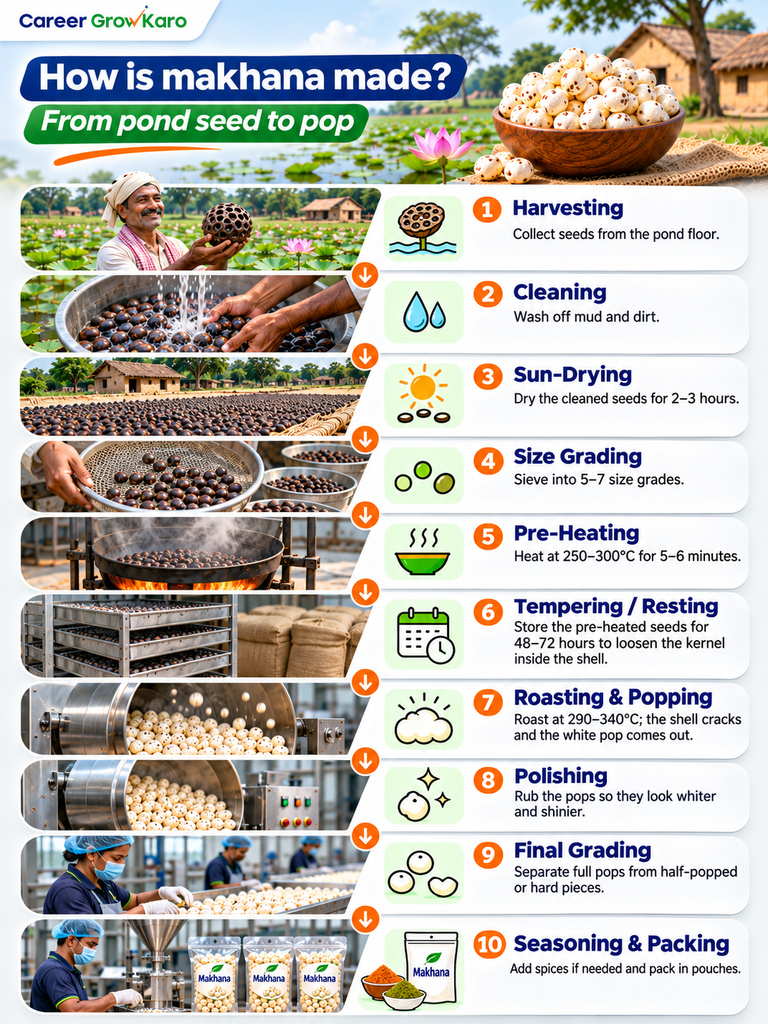
Here is how makhana is made, step by step, as described in the NIFTEM PMFME project report:
- Harvest: seeds are collected from the pond floor, mostly August to October, in the morning hours.
- Clean: wash off mud and dirt with clean water.
- Sun-dry: spread for 2–3 hours on a mat or cement floor, or use a hot-air dryer.
- Size-grade: sieve the seeds into 5–7 size grades so each batch heats evenly.
- Pre-heat: heat at 250–300°C surface temperature for about 5–6 minutes, stirring all the time.
- Temper: store the pre-heated seeds for 48–72 hours. This loosens the kernel inside the hard shell.
- Roast and pop: roast at 290–340°C. In about 1.5–2.2 minutes the shell cracks and the white pop (lawa) comes out.
- Polish: rub the pops together so they look whiter and shinier.
- Grade: separate full pops (lawa) from half-popped, hard pieces (thurri).
- Season and pack: add spices if making flavoured makhana, then pack.
If you choose the trade & repack or roast & flavour model, you start at step 9 or 10. Steps 1–8 happen in Bihar’s villages and popping units.
Your next step: Watch the full process once — in person in Darbhanga, Madhubani or Purnia if you can. Seeing grading with your own eyes will save you from bad buys later.
4. How much does a makhana processing unit cost?
The best public benchmark for makhana processing costs is the PMFME model DPR by NIFTEM, under the Ministry of Food Processing Industries. It plans a 10 kg/hour unit on rented premises of 2,000–2,500 sq ft.
| Cost item (PMFME model DPR) | Amount |
| Plant & machinery (excluding GST and transport) | ₹16.60 lakh |
| Miscellaneous fixed assets (water, furniture, computer) | ₹3.50 lakh |
| Working capital | ₹7.13 lakh |
| Total project cost | ₹27.23 lakh |
| Funding in the DPR: own money (min 10%) | ₹2.71 lakh |
| Funding: PMFME subsidy @35% (max ₹10 lakh) | ₹7.04 lakh |
| Funding: term loan / working-capital loan | ₹11.06 lakh / ₹6.42 lakh |
Note how the subsidy is worked out: ₹7.04 lakh is 35% of the ₹20.10 lakh capital cost (machines plus fixed assets). Working capital gets no subsidy. You fund it yourself or through a bank limit.
Key assumptions: 8-hour shift, 300 days a year, 10% wastage, 7 workers plus 3 office staff, 14 kW power, raw material at ₹320/kg and selling price at ₹600/kg (1 kg pack), both rising 5% a year, and 11% interest on loans.

The DPR trap: re-costing the model at 2026 prices
CareerGrowKaro analysis — read this before you take a loan
1. Input price has jumped. The DPR assumes ₹320/kg. On 8 Oct 2026, 5 Suta standard makhana was listed at about ₹800/kg in Darbhanga. At ₹800, the Year-1 raw material bill rises from ₹49.92 lakh to about ₹1.25 crore (15,600 kg × ₹800).
2. Working capital grows with it. Stock and buyer credit cost more when every kilo costs more. Scaling the DPR’s ₹7.13 lakh by the price rise gives roughly ₹17.8 lakh.
3. The yield trap. The DPR names “harvested foxnut seed” as raw material but assumes only 10% wastage. That works only if you buy popped makhana. If you start from raw seed, yield is 35–40% — a completely different business.
4. The machine list does not match either. It includes a seed washer and hot-air dryer (raw-seed equipment) but no popping machine. So it cannot pop raw seed. The only reading that makes its numbers work is a unit that roasts, flavours and packs popped makhana. That is how this guide treats it.
Here is a simple break-even check per kilo, using the DPR’s own Year-1 running costs (wages, power, packing, rent, staff, repairs, selling and interest = ₹29.12 lakh ÷ 14,040 kg ≈ ₹207/kg):
| Buy price (popped) | Cost per sellable kg (after 10% loss) | Running cost per kg | Cash break-even selling price |
| ₹320 (DPR) | ₹356 | ₹207 | ₹563 |
| ₹800 (Oct 2026 listing) | ₹889 | ₹207 | ₹1,096 |
| ₹900 | ₹1,000 | ₹207 | ₹1,207 |
Notice the first row: break-even of ₹563 against the DPR’s ₹600 selling price. That is why the DPR’s margin is only 2.5%. At 2026 prices, a small unit must sell above roughly ₹1,100/kg ex-factory just to break even. Running costs also rise with inflation, and depreciation adds about ₹20/kg more.
Selling loose at mandi rates will not work at this scale. You need a brand premium, a better grade, or a fixed B2B contract.
Your next step: Fill the break-even table with three real supplier quotes and your own rent and wages. Show it to a CA before you apply for any loan.
5. Which makhana machines do you need, and what do they cost?
The right makhana processing machine depends on your model. A roast & flavour unit needs roasters, a flavouring drum and a packing machine. A popping plant also needs seed washers, graders and popping machines.
| Machine (PMFME model DPR) | What it does | Price (ex-GST) |
| Inclined material feeding conveyor | Moves makhana into the line | ₹1.10 lakh |
| Automatic rotary roaster | Roasts popped makhana evenly | ₹1.25 lakh |
| Rotary roaster with masala flavouring | Coats with spice and oil | ₹1.30 lakh |
| Four-head packing machine | Weighs and fills pouches | ₹4.90 lakh |
| Air dryer, seed washer, bucket elevator, etc. | Drying and handling | ₹4.00 lakh |
| Bins, trolleys, silos, weighing scale, etc. | Material handling | ₹3.50 lakh |
| Air compressor + hot-foil batch coder | Air supply; prints batch and date | ₹0.35 + ₹0.20 lakh |
| Total | ₹16.60 lakh |

Makhana popping machine: the real game-changer
Popping by hand is slow, hot and hard work. ICAR launched a makhana popping machine in Darbhanga in 2013, developed by ICAR-CIPHET, with popping efficiency above 90% (ICAR). ICAR says its mechanised system cuts the process from 2–3 days to about 20 hours and fetches at least ₹50/kg more than hand-popped makhana (ICAR).
The National Research Centre for Makhana (NRCM), Darbhanga, has licensed a seed washer, seed grader, primary roaster, popping machine and popped-makhana grader to manufacturers (PIB; Lok Sabha reply). In Bihar’s 200 MT model DPR, the full popping line costs ₹27.36 lakh.
Makhana roasting and making machine prices in the open market
Seller listings on IndiaMART (2026) show roasting machines from about ₹1.65 lakh (100 kg/hour) to ₹4.5 lakh, graders from ₹2.5 lakh to ₹9 lakh, and a 50 kg/hour SS304 popping/puffing machine at ₹7.85 lakh. These are listing prices, not final quotes.
Before you buy any makhana making machine, check these:
- Get three written quotes with GST, transport and installation shown separately.
- Ask for a trial run with your own makhana — not the seller’s sample.
- Food-contact parts should be food-grade stainless steel (SS304 or better).
- Check the power load your premises can take before you order.
- Ask whether the maker holds an ICAR/NRCM technology licence, and where the nearest service engineer is.
Your next step: Start with the smallest machine set your model needs. In trade & repack, a weighing scale and a pouch sealer are enough to begin.
6. Where do you buy raw makhana? Bihar wholesale prices and grades
Popped makhana is traded by size grade, called Suta. A bigger Suta number means a bigger pop and a higher price.
According to Bihar’s model DPR, the main trading hubs are Gulobara bazaar in Darbhanga, Madhubani town, Katihar and Purnia. Each trades thousands of tonnes a year. Big national wholesale markets include Khari Baoli (Delhi), Nayaganj (Kanpur) and Varanasi.
| Grade (Darbhanga) | Listed price | Date | Source |
| 4 Suta, standard | ₹470/kg | 8 Oct 2026 | makhanamandi.in |
| 5 Suta, standard | ₹800/kg | 8 Oct 2026 | makhanamandi.in |
| 5 Suta, handpicked | ₹870/kg | 8 Oct 2026 | makhanamandi.in |
| 6 Suta, standard | ₹1,070–1,150/kg | 8 Oct 2026 | makhanamandi.in |
| 5 Suta, handpicked | ₹940/kg | 19 Jun 2026 | IndiaMART |
Honest caveat: these are trader listings, not official mandi data. Makhana wholesale prices in Bihar can move week to week.
Smart buying rules for your first orders:
- Buy samples of 2–3 grades first. Check pop size, colour, crunch and broken pieces.
- Fresh stock arrives after the August–October harvest. Plan your big purchases around it.
- Ask every makhana supplier in Bihar for a GST bill and their FSSAI number.
- Keep your first order small. Avoid paying 100% in advance to a new supplier.
- Popped makhana absorbs moisture fast. Ask how it was stored and packed before dispatch.
Your next step: Call five suppliers across two districts. Compare price, grade consistency and payment terms before you place a single order.
7. Which licences do you need for a makhana business?
This is where most makhana guides stay silent. Here is the full list, matched to your model:
| Licence / rule | Who needs it | Notes |
| FSSAI registration or licence | Every food business, including repackers and online sellers | From 1 Apr 2026: registration up to ₹1.5 crore turnover; State licence ₹1.5–50 crore; Central above ₹50 crore. |
| Udyam registration | All MSMEs — needed for most schemes and bank loans | Free, online |
| GST registration | Above the turnover limit, and usually for e-commerce selling | |
| Legal Metrology packer registration | Anyone selling pre-packed makhana | Label must show net weight, MRP, packer address and packing date |
| FSSAI labelling rules | All packed food | FSSAI logo and number, ingredients, nutrition facts, veg mark, best-before date |
| Pollution Control Board consent | Factory units (roasting/popping) | Listed in Bihar’s model DPR |
| Factories Act / trade licence / fire NOC | Larger units and local rules | Depends on worker count and city |
| IEC + APEDA RCMC | Exporters | Plus the buying country’s food rules |
| “Mithila Makhana” GI tag | Only if you use the GI name/logo | GI granted in 2022; use needs authorised-user registration |
Big 2026 change: FSSAI raised the basic registration limit from ₹12 lakh to ₹1.5 crore turnover, effective 1 April 2026 (summary of the FSSAI order). Many small makhana units now need only basic registration (fee ₹100/year). Note that Maharashtra has challenged FSSAI’s reforms in the Bombay High Court (Business Standard), so check FoSCoS before you apply.
If you have made other food products, these rules will feel familiar — our guide to start a dark chocolate business in India walks through FSSAI for a similar small food unit.
Your next step: Get Udyam and FSSAI done before your first sale. Both are online and cheap, and buyers will ask for your FSSAI number.
8. Which government schemes support a makhana unit?
| Scheme | Support | Best for | Status (Nov 2026) |
| PMFME | 35% credit-linked capital subsidy, max ₹10 lakh; min 10% own money | Micro food units, ODOP products | Term ended 30 Sep 2026; extension proposed |
| PMEGP | 15–35% margin-money subsidy; manufacturing projects up to ₹50 lakh | New units only | Running |
| MUDRA | Loans up to ₹20 lakh (Tarun Plus only after repaying a Tarun loan) | Small working-capital and machine loans | Running |
| Bihar BAIPP | Capital grant 15% (individual) / 25% (FPOs) | Units in Bihar | |
| National Makhana Board + Central Sector Scheme | ₹476.03 crore for research, seeds, training, post-harvest, branding, exports | Farmers, FPOs, ecosystem | Active; individual benefits via state calls |
PMFME: the most useful scheme — check its status first
PMFME gives a 35% credit-linked capital subsidy, up to ₹10 lakh per unit, and makhana processing units are explicitly covered. Credit-linked means the subsidy is adjusted against a bank loan; it is not cash in hand. Bihar leads the country in PMFME sanctions, and youth and SHGs from Samastipur, Darbhanga and Madhubani sent a record number of applications for makhana units (ETV Bharat, Sep 2026).
Status warning: PMFME was approved for 2020–21 to 2024–25 and then extended. Its temporary extension ran to 30 September 2026, and the ministry has proposed continuing it for 2026–31 (Business Standard, Aug 2026). Check the PMFME portal for the latest before you plan around it.
PMEGP, MUDRA and Stand-Up India
Under PMEGP, general-category applicants get 15% (urban) or 25% (rural) subsidy; special categories, including women and SC/ST, get 25% or 35%. Manufacturing projects can go up to ₹50 lakh (PMEGP summary). Only one person per family can use PMEGP. Women and SC/ST founders can also look at Stand-Up India loans of ₹10 lakh to ₹1 crore.
Bihar’s capital grant (BAIPP)
Bihar’s Agriculture Investment Promotion Policy offers capital grants for agri-processing, including makhana units — 15% for individuals and 25% for farmer groups, as reported by Zee Business. The model DPR says the grant is released in two instalments: after machines are installed and after commercial production starts.
What is the Makhana Board, and what does it do for you?
The National Makhana Board was announced in the Union Budget 2025–26 and launched in Purnea, Bihar, on 15 September 2025 (PIB). A Central Sector Scheme worth ₹476.03 crore (2025–26 to 2030–31) backs it. It funds research, quality seeds, farmer training, better harvest and post-harvest methods, value addition, branding, exports and quality control.
In 2025–26, 8,159 farmers benefited under the scheme (PIB). Be realistic: this is mainly ecosystem support, not a direct subsidy for your startup. Its biggest value for you is better seed, more supply and stronger “Indian makhana” branding over time.
Your next step: Make one folder with Aadhaar, PAN, bank statements, Udyam, FSSAI, three machine quotes and a DPR. Every scheme and bank will ask for these.
9. How do you sell makhana? Wholesale, retail, online or export
PIB estimates India eats 3,000–3,500 MT of popped makhana a month, rising to about 5,000 MT in festive months. Branded players sell 1,800–2,000 MT a month; loose and unorganised retail sells 1,200–1,400 MT, mostly in Tier 2 and Tier 3 markets.
| Channel | Who buys | What you need | Watch out for |
| Local kirana & sweet shops | Daily and festive buyers in your town | Clean packs, steady supply | Credit periods; price comparison |
| Wholesale markets | Traders in Delhi, Kanpur, Varanasi | Bulk volume, consistent grade | Lowest margins |
| Modern trade & quick commerce | Urban snack buyers | GST, FSSAI, barcodes, strong packaging | Listing terms and deductions |
| Your own Instagram/WhatsApp (D2C) | Loyal repeat customers | Good photos, fast delivery | Courier cost on light, bulky packs |
| B2B & gifting | Offices, gyms, caterers, festive gift hampers | Samples, invoice, reliability | Big orders, tight deadlines |
| GeM portal | Government buyers | Udyam, GST, product listing | Paperwork |
Is export worth it for a beginner?
Not in year one. But know the map. The US (40%), Canada (20%) and UAE (17%) take 77% of India’s makhana exports, at average prices of $19.5, $15.8 and $13.3 per kg. Germany ($26/kg), Nepal ($21.6/kg) and Australia ($21/kg) pay more but buy less (PIB). A separate HSN code for popped makhana came in 2025, which makes export tracking easier.
Your next step: List 10 local buyers — kiranas, a sweet shop, a gym, an office — and offer each a free 100 g sample with your price card.
10. How do you market a makhana brand on a small budget?
Most makhana looks the same in a bowl. Marketing is how you give a buyer a reason to pick your pack. Search interest shows this: people actively search for flavoured makhana and compare makhana brands online. Here is a low-cost playbook:
Pick one clear position
- Grade premium: bigger, uniform pops — like Pearl Mithila Makhana’s 22 mm grade.
- Use-case: office snack, kids’ tiffin, gym snack, or fasting (vrat) packs.
- Flavoured makhana for a region: peri-peri for college towns, pudina or chaat masala for local taste.
- Value for Tier 2/3 kirana: honest grade, fair price, small packs.
Make your pack do the selling
- Use nitrogen-flushed, resealable packs. Makhana goes soft when exposed to air (Bihar DPR).
- Print the grade and size on the front. Buyers compare crunch and size.
- Start with 2–3 flavours only. Add more after you see repeat orders.
Know what you cannot claim
Under FSSAI’s Advertising and Claims Regulations, 2018, words like “natural”, “fresh”, “pure”, “traditional”, “authentic” can be used only under set conditions, and disease-treatment claims are restricted (FSSAI). So never write “cures diabetes” or “100% pure” on your pack or in reels. Nutrition and health claims must follow the regulation.
Build trust where your buyers already are
- Sampling: kirana counters, gyms, office pantries, temple-side shops in Navratri.
- Instagram and WhatsApp Business: show your sourcing and grading process. Real process videos build more trust than ads.
- Festive and gifting calendar: plan stock early for festive peaks, when demand rises to about 5,000 MT a month (PIB).
- Marketplaces: keep your FSSAI number, GST and clear photos ready. Reviews matter more than discounts.
Measure repeat orders, not likes. If people do not buy a second pack, fix the product or price before you spend more on promotion.
Your next step: Write one line that says why your makhana is different. If you cannot write it, you do not have a brand yet — only a product.
11. What are the real risks in a makhana business?
- Price swings: average prices moved from about ₹500/kg to about ₹1,250/kg in a few years (PIB). Fix: buy in smaller lots and review your selling price every month.
- Moisture: makhana goes soft quickly. Fix: nitrogen packing, dry storage and first-in, first-out stock.
- Working capital lock: stock and buyer credit eat cash. Fix: short credit terms and part-advance from B2B buyers.
- Grade disputes: mixed sizes in one bag. Fix: samples first, clear grade on every invoice.
- Labour and ethics: harvesting and hand-popping are hard work, and harvesters often stay poor even as prices rise (Business Today). Fix: buy through FPOs or fair-paying aggregators, and say so honestly.
- Funded competition: big brands have bigger ad budgets. Fix: win a niche — your town, a grade, or a use-case.
- Policy uncertainty: scheme timelines can change, as with PMFME in 2026. Fix: never make the subsidy your only plan.
Your next step: Write your top three risks and one fix for each. Keep that page with your project report.
12. Your first 30 days: a step-by-step plan
- Days 1–3: Pick your model (Section 1). Write your target buyer and one-line positioning.
- Days 4–7: Call five suppliers in Darbhanga, Madhubani, Purnia or Katihar. Order small samples of 2–3 grades.
- Days 8–10: Register on Udyam and apply for FSSAI registration on FoSCoS.
- Days 11–15: Get packaging quotes. Design an FSSAI- and Legal Metrology-compliant label.
- Days 16–22: Pack a small test batch. Sell it through three channels: kirana, WhatsApp and one B2B buyer.
- Days 23–27: Fill the break-even table with your real numbers. Track who reordered.
- Days 28–30: Decide: scale up, change grade or price, or stop. If you scale into machines, get three quotes and a DPR made.
Your next step: Block these 30 days on your calendar today. A small, honest test beats a big, borrowed bet.
Frequently Asked Questions
How much investment is needed to start a makhana business in India?
It depends on the model. Trade and repack needs mostly stock and packaging — 100 kg of 5 Suta makhana alone costs about ₹80,000 at Oct 2026 listed prices. A 10 kg/hour roast and flavour unit was costed at ₹27.23 lakh in the PMFME model DPR, before 2026 price rises.
Is makhana business profitable?
It can be, but margins are thin. The government’s PMFME model DPR shows profit after tax of about 2.5–6.1% of sales over five years. Bihar’s larger 200 MT model shows 9–13%. Profit depends on the gap between your buying cost per sellable kilo and your selling price.
Why is makhana so expensive?
Demand grew 17–18% a year while production grew only 4–5%, according to PIB. Seeds are harvested underwater by hand, and popping keeps only 35–40% of raw seed weight. So each kilo of popped makhana needs about 2.5–2.9 kg of raw seed.
Do I need an FSSAI licence to sell makhana?
Yes, every food business needs FSSAI registration or a licence. From 1 April 2026, businesses with turnover up to ₹1.5 crore need basic registration, ₹1.5–50 crore need a State licence, and above ₹50 crore need a Central licence. Confirm your category on FoSCoS before applying.
What is the Makhana Board and how does it help?
The National Makhana Board was launched in Purnea, Bihar, on 15 September 2025. With a ₹476.03 crore scheme, it supports research, better seeds, farmer training, post-harvest methods, value addition, branding and exports. It mainly helps farmers and the wider sector rather than giving direct startup subsidies.
Can I start a makhana business from home?
You can start trade and repack from home with FSSAI registration, clean storage and compliant labels. Keep makhana dry and use sealed packs. Roasting at scale needs proper premises, power and, in many cases, pollution and local permissions — so start small at home, then move.
Conclusion: start small, cost honestly, then grow
A makhana business is real, and demand is strong. But the money is in the spread, not the hype. Start with trade and repack, learn grades and buyers, and test the numbers with your own small batch. Scale into machines only when repeat orders prove the demand.
Exploring other ideas too? Compare this with the Alum (Phitkari) Manufacturing Business in India: Full 2026 Guide, areca leaf plate business in India or an aloe vera gel manufacturing business.
CareerGrowKaro is here to guide you at every step — explore more CareerGrowKaro guides and join our free community for one clear next step at a time.