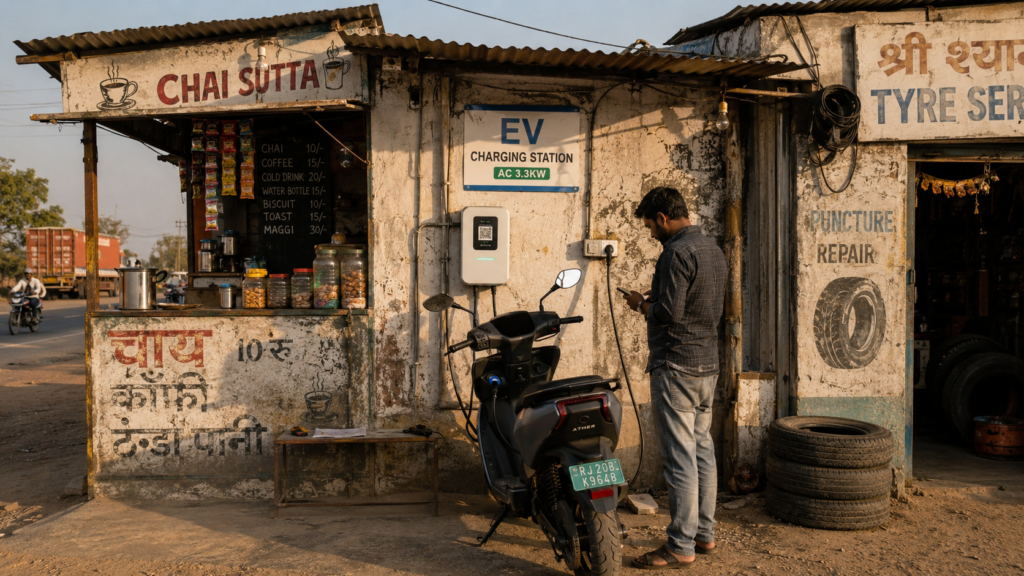
An EV charging station business in India can start from as low as ₹50,000 if you go the host model route. That means putting a charger on someone else’s property like a petrol pump, parking lot or housing society and sharing the revenue. A franchise setup typically needs ₹2 to ₹10 lakh. The PM E-DRIVE scheme from the central government offers solid subsidies on equipment. With a decent location and steady footfall, a single AC charger can start paying for itself within 12 to 18 months.
- Numbers That Matter Right Now
- What Exactly Is an EV Charging Station Business and Does It Actually Work in India?
- Alright, But Is Right Now Actually a Good Time to Get Into This?
- What Are the Different Ways to Get Into This Business?
- How Much Does It Actually Cost to Set Up an EV Charging Station?
- What Subsidies Can You Get From the Government?
- Show Me the Money. What Does the Revenue Actually Look Like?
- Step by Step. How to Actually Set This Up From Scratch.
- The Risks Nobody Else Will Tell You About
- Before You Invest a Single Rupee. An Honest Self Check.
- Questions People Ask Us All the Time
- Sources We Used and Trust
- Related Resources:
Numbers That Matter Right Now
| What | How Much | Official Source |
|---|---|---|
| Public EV charging stations across India | 29,277 (all States and UTs) | PIB Delhi, Lok Sabha Data, Aug 2025 |
| PM E-DRIVE budget for new chargers | ₹2,000 crore for roughly 72,300 public chargers | PIB PM E-DRIVE Framework |
| PM E-DRIVE live portal | Tracking and milestones | pmedrive.heavyindustries.gov.in |
| Benchmark cost for a 60 kW fast charger (revised by MHI) | ₹3.4 lakh (down from the original ₹7.25 lakh baseline) | MHI EVPCS Guidelines PDF |
| GST on EV charging services | 5% | cbic.gov.in |
A note on industry forecasts you may have seen elsewhere: Some private analytics firms project India’s EV charging infrastructure market growing from USD 588 million in 2023 to USD 5.6 billion by 2030. Electric two wheeler sales are projected at 22 million units per year by FY2031. These numbers come from commercial research trackers, not official government sources. We include them for context but want you to know the difference.
You know that satisfying feeling when you spot an auto rickshaw with a green number plate humming past you at a traffic signal? Or when a shiny electric scooter zips through a narrow lane in Nagpur or Indore and you think to yourself, “Someone somewhere is making money every time that thing needs a charge.”
That thought is crossing a lot of minds these days. And not just in Mumbai or Delhi. In Coimbatore, in Bhopal, in Raipur, in Vijayawada. Basically everywhere electric vehicles are starting to show up in real numbers.
But here is what really frustrates me about most guides on starting an EV charging station business that float around on the internet. Almost all of them are written by companies trying to sell you a franchise. They throw around numbers like “25 to 50 percent profit margins” without showing you a single rupee of calculation. They will not tell you that getting an electricity connection from your DISCOM can take six months and burn through one to three lakh rupees before you have earned a single paisa.
That is not how we do things at CareerGrowKaro.
Think of us as that friend who has done the homework and is sitting across from you at a chai stall, breaking it all down honestly. No sales pitch. No sugar coating. No “invest today and get rich by next Diwali” nonsense. Just a clear, practical breakdown of what this business actually looks like, what it costs, what it earns, what can go wrong, and whether it makes sense for your specific situation.
Grab that chai. Let us get into it.
What Exactly Is an EV Charging Station Business and Does It Actually Work in India?
Let Us Start Simple. What Are You Actually Selling?
Let’s Start Simple. What Are You Actually Selling?
You’re selling electricity. That’s it.
You are selling electricity. That is literally it.
You install a charger at a location, connect it to the power grid, and when an EV owner plugs in their vehicle, they pay you per unit of electricity. You pocket the difference between what you charge them and what you pay your electricity provider.
Think of it like those water ATMs you see in smaller cities these days. Someone buys water in bulk, installs a machine on a busy road, and sells it per glass. The charger works on the same principle. You are a middleman between the grid and the EV owner, and your cut is the margin per unit.
Now there are two main types of chargers, and the difference between them matters a lot for your budget and your earnings.
| AC Charger (the slow one) | DC Fast Charger (the quick one) | |
|---|---|---|
| How fast does it charge | Takes 4 to 8 hours for a full car charge | 30 to 90 minutes |
| What it costs you to buy | ₹40,000 to ₹1.5 lakh per unit | ₹3 to ₹7 lakh per unit |
| Where it works best | Parking lots, malls, offices, housing societies | Highways, fleet hubs, petrol pumps |
| What you earn per session | ₹25 to ₹80 | ₹200 to ₹600 or more |
If you are starting out with limited capital, AC chargers are your friend. They are cheaper, simpler to install, lower risk, and perfectly suited for locations where vehicles are parked for a few hours anyway. DC fast chargers are a bigger bet. More capital, more earnings potential, but also a lot more infrastructure headaches.
How do you actually charge customers?
There are three common models.
- Per kWh billing is the most common one. You set a rate like ₹12 or ₹15 per unit and the customer pays based on how much electricity their vehicle consumed. Simple and transparent.
- Per hour billing is used at some locations where parking and charging are bundled together. You charge for the time the vehicle occupies the charging spot.
- Monthly subscriptions or fleet contracts are where you sign a fixed monthly deal with a delivery company, a cab aggregator, or a group of e rickshaw operators. They pay a set amount every month and charge their vehicles at your station daily. This is the gold mine most beginners overlook, but more on that later.
Alright, But Is Right Now Actually a Good Time to Get Into This?
Let me put this into perspective for you.
India has 29,277 public charging stations serving millions of electric vehicles across the country. That data comes straight from a Lok Sabha submission verified by the Ministry of Heavy Industries and documented on PIB.
Now think about what that number means. Millions of EVs. Under 30,000 public chargers. That is like having 30 water taps for an entire colony of 10,000 people. The gap between demand and supply is enormous.
The central government knows this. That is exactly why the PM E-DRIVE scheme alone is pumping ₹2,000 crore to set up over 72,000 new chargers across the country. Almost every state from Maharashtra to Tamil Nadu to Rajasthan to Karnataka now has its own EV policy with incentives for charging infrastructure.
The window is wide open.
But here is the honest counterpoint, because we promised you no sugar coating. The market being huge does not automatically mean your station will succeed. A charger on a busy commercial road in Jaipur or Bhopal with steady EV traffic will do ten times the business of one tucked away in a quiet residential lane in the same city. Your success depends almost entirely on where you put that charger.
The opportunity is real. Your specific location needs to be validated with your own eyes before you put down money.
Let us figure out which entry route actually fits your pocket and your situation.
What Are the Different Ways to Get Into This Business?
This is where most guides completely miss the mark. They assume everyone reading has five to ten lakh rupees lying around and a plot of land ready to go. That is not reality for a 24 year old commerce graduate in Nagpur or a shopkeeper’s son in Raipur.
So here is a framework we have built based on three very different starting points. Find the one that matches where you are right now.
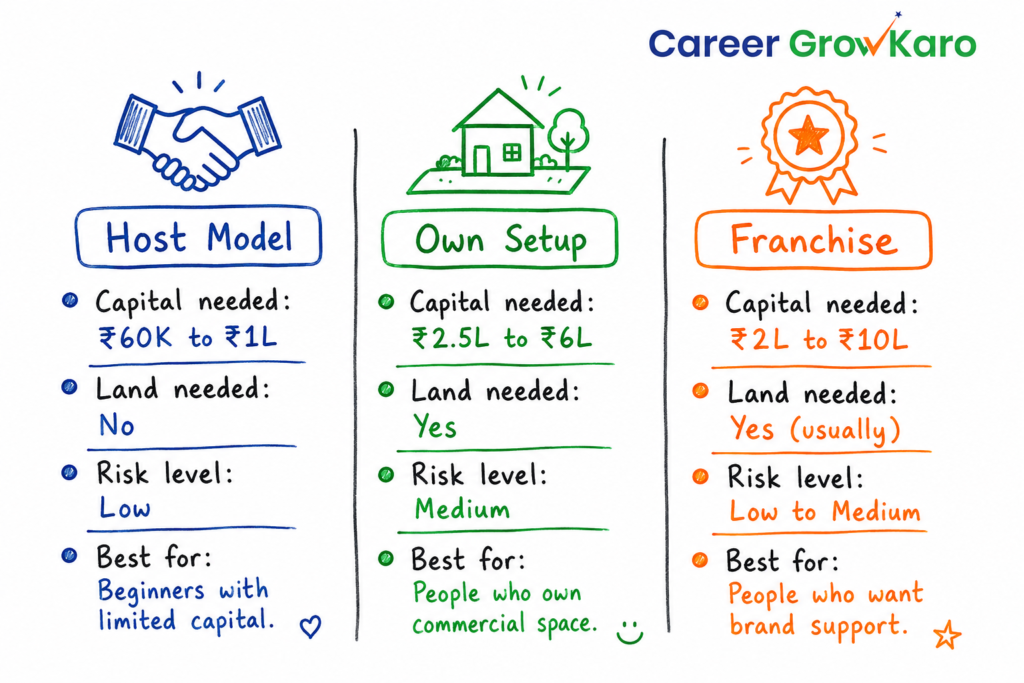
Path A — The Host Model (Start With Almost Nothing)
This is the entry route that nobody talks about. And honestly, for most young people reading this, it is the smartest way in.
Here is the idea. You do not own land. You do not need to. You go to someone who already has a property with footfall. A petrol pump owner. A car wash shop guy. A restaurant owner on a state highway. A mall parking lot manager. Even the secretary of a housing society. And you propose a straightforward deal.
“Bhai, let me install an EV charger on your property. I will pay for the equipment myself. You provide the space and the electricity connection. We split whatever revenue comes in.”
That is it. That is the entire pitch.
Typically the landowner gets 20 to 40 percent of charging revenue. You keep the rest. They get a new income stream without investing anything. You get a location without buying or leasing property. Everybody wins.
What do you actually need to make this work?
One AC charger will cost you ₹40,000 to ₹80,000 depending on the brand and power output. You will need a payment app integration, something like Bolt Earth or ChargeZone or a similar platform, which is usually free or minimal cost. And you will need the ability to have a persuasive conversation with a property owner.
Total investment? ₹60,000 to ₹1 lakh. That is it.
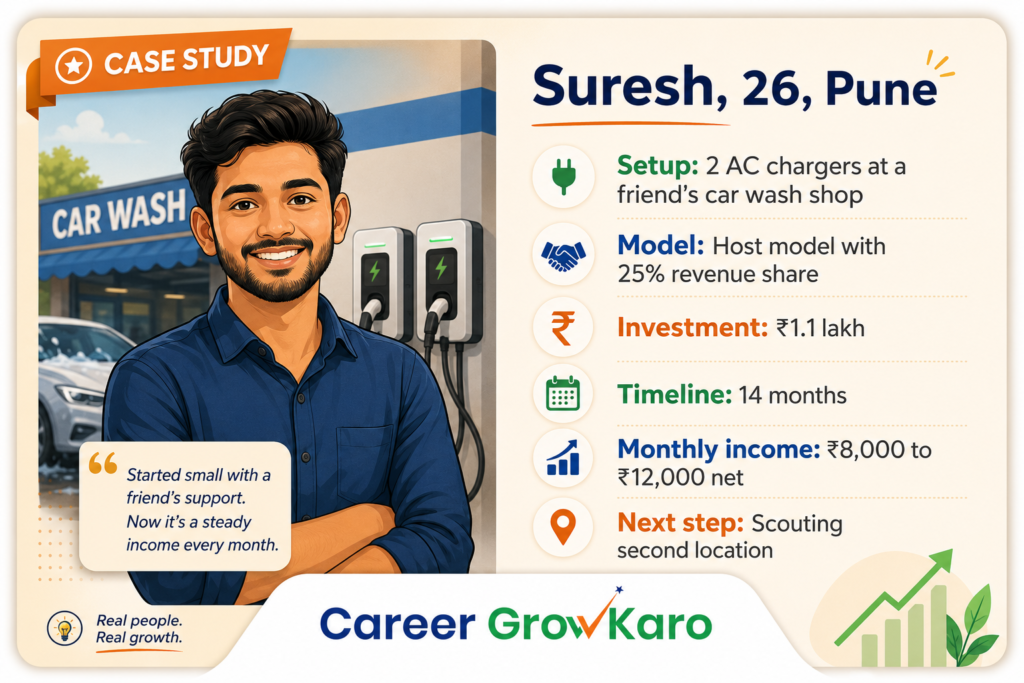
Let me tell you about Suresh.
Suresh is 26. Lives in Pune. Did not have land. Did not have a fancy MBA. Did not have a business plan prepared by a consultant. What he did have was a friend who runs a car wash shop on a commercial road near Hinjewadi, which is Pune’s IT hub.
Suresh walked up to his friend one evening and proposed a simple deal. He would install two AC chargers at the shop, turning it into a go-to EV charging station in Pune for the neighbourhood, handle all the maintenance and the payment app setup, and give his friend 25 percent of whatever came in.
He invested ₹1.1 lakh total for both chargers plus installation.
The first three months were honestly quite slow. Barely ₹2,000 to ₹3,000 per month. Suresh almost got discouraged. But then e rickshaw drivers in the area discovered his chargers. Then a few Ather scooter owners in a nearby housing society started showing up regularly. Word spread.
Fourteen months later, Suresh earns ₹8,000 to ₹12,000 per month net after giving his friend the 25 percent cut and covering electricity costs. Is it life changing money? Not yet. But for a ₹1.1 lakh investment with almost no fixed costs and zero rent? That is a genuinely solid start. And he is already scouting his second location at a petrol pump near the Pune Solapur highway.
The host model is powerful because it flips the single biggest barrier, which is land ownership, completely on its head. You do not need land. You need a relationship with someone who has land. And you need one charger.
Path B — Your Own Setup on Your Own Property
If you or your family owns a plot, a shop, or any kind of commercial space that sits on a road with decent vehicle traffic, this route is built for you.
You control everything. The charger, the pricing, the branding, the customer experience, the operating hours. Higher investment than the host model, but the entire upside is yours.
Typical cost: ₹1.5 to 5 lakh for 2 to 3 AC charger guns plus civil work like a small canopy and signage plus the DISCOM electricity connection.
Who does this work for? Think of Pramod uncle. He is 50 years old. Owns a small shop or an empty plot in Raipur. His son showed him a Reels video about EV charging stations last month and now Pramod uncle wants to know if this is a real business or just another internet scam.
Pramod uncle, if you are reading this, it is real. But you need to see the numbers first. And we are getting to those numbers very shortly.
Path C — Franchise With a Big Brand
Companies like Tata Power EZ Charge, Statiq, ChargeZone, and EESL offer franchise models where you invest your capital and they provide the ecosystem around it.
What you get: A recognized brand name that customers already trust. A mobile app that helps EV owners find your station. Billing and payment software. Installation support. And sometimes even help accessing government subsidies.
Typical investment: ₹2 to ₹10 lakh depending on the company, the charger type, and the scale of setup.
What you give up: A share of your revenue goes to the franchisor. Your margins are thinner than if you operated independently. And you have less control over pricing and operations.
Here is our honest take on franchises. A franchise is not a bad idea. It reduces risk, gives you a proven system, and gets you listed on an app with existing users. That has real value.
But do not walk into it with your eyes closed. When a franchise company tells you “recover your investment in 12 months,” your first question should be, “Show me five real operators who actually did that.” Ask for references. Talk to existing franchisees. And most importantly, run the numbers yourself using the revenue math we are sharing in this very article.
A franchise is a legitimate option. Just treat it like any business decision, not like a magical guarantee.
Alright. You know the three paths. Now let us talk money. Real numbers. No fluff. No vague percentages.
How Much Does It Actually Cost to Set Up an EV Charging Station?
This is the section where most guides either give you absurdly vague ranges or just quote the charger cost and pretend the rest does not exist. We are going to break down every single cost category so you know exactly what to budget for.
Equipment — What the Charger Itself Costs
| Charger Type | Power Output | Price Range | Notes |
|---|---|---|---|
| AC charger (basic) | 3.3 to 7 kW | ₹40,000 to ₹80,000 | Best for beginners, host model setups |
| AC charger (moderate) | 7 to 22 kW | ₹80,000 to ₹1.5 lakh | Good for commercial locations with longer dwell times |
| DC fast charger | 30 to 60 kW | ₹3 to ₹7 lakh | For highways, fleet hubs, high volume locations |
| 60 kW fast charger at MHI benchmark | 60 kW | ₹3.4 lakh | This is the revised government benchmark. Source: MHI EVPCS Guidelines |
A quick note on that ₹3.4 lakh number. This matters because most older guides and even many franchise websites still quote ₹7.25 lakh as the cost of a fast charger. That was the original government benchmark. But as Indian manufacturers scaled up production, actual costs dropped significantly. The Ministry of Heavy Industries acknowledged this reality and revised the benchmark down to ₹3.4 lakh for 60 kW units. If you are considering a DC fast charger, the entry cost is nearly half of what you may have read elsewhere. Always check the latest MHI guidelines for updated figures.
The Hidden Cost Nobody Warns You About. Your DISCOM Electricity Connection.
If there is one section of this article I wish I could print on a poster and stick outside every DISCOM office in India, it is this one.
Getting a commercial electricity connection in this country is an experience. You walk into the DISCOM office, fill out a stack of forms, submit your documents, wait for a site inspection that gets rescheduled twice, wait for the approval, wait for the meter, wait for the actual connection. In cities like Ranchi, Bhopal, or even parts of Pune, this process eats up three to six months. Sometimes longer.
And the cost? For a basic AC charger setup, the DISCOM connection and related charges run ₹1 to ₹3 lakh. For a DC fast charger that needs higher electrical load, it can balloon to ₹6 to ₹24 lakh depending on how much upstream infrastructure needs to be upgraded.
This is the number one reason people underestimate the total cost of setting up a charging station. They budget for the charger, maybe throw in some money for a canopy and signage, and completely forget that the electricity connection itself can cost more than the charger.
Do not make that mistake. Budget for the DISCOM process in both money and time.
Other Costs You Should Plan For
- Civil work including a small canopy or shed, floor leveling, safety bollards, and signage will run you ₹50,000 to ₹2 lakh depending on how polished you want the setup to look.
- Working capital for the first three months covering electricity bills, minor repairs, app subscription fees if any, and general contingency should be at least ₹30,000 to ₹1 lakh.
The Full Cost Picture in One Table
Setup Type | Equipment | Infrastructure and DISCOM | Civil Work | Total Investment |
|---|---|---|---|---|
| Host model (1 AC charger) | ₹50,000 | Landowner handles this, or sub meter arrangement | Minimal | ₹60,000 to ₹1 lakh |
| Own site (2 to 3 AC guns) | ₹1 to ₹2 lakh | ₹1 to ₹3 lakh | ₹50,000 to ₹1 lakh | ₹2.5 to ₹6 lakh |
| DC fast charger (1 x 60 kW gun) | ₹3.4 to ₹7 lakh | ₹3 to ₹8 lakh | ₹1 to ₹2 lakh | ₹7.4 to ₹17 lakh |
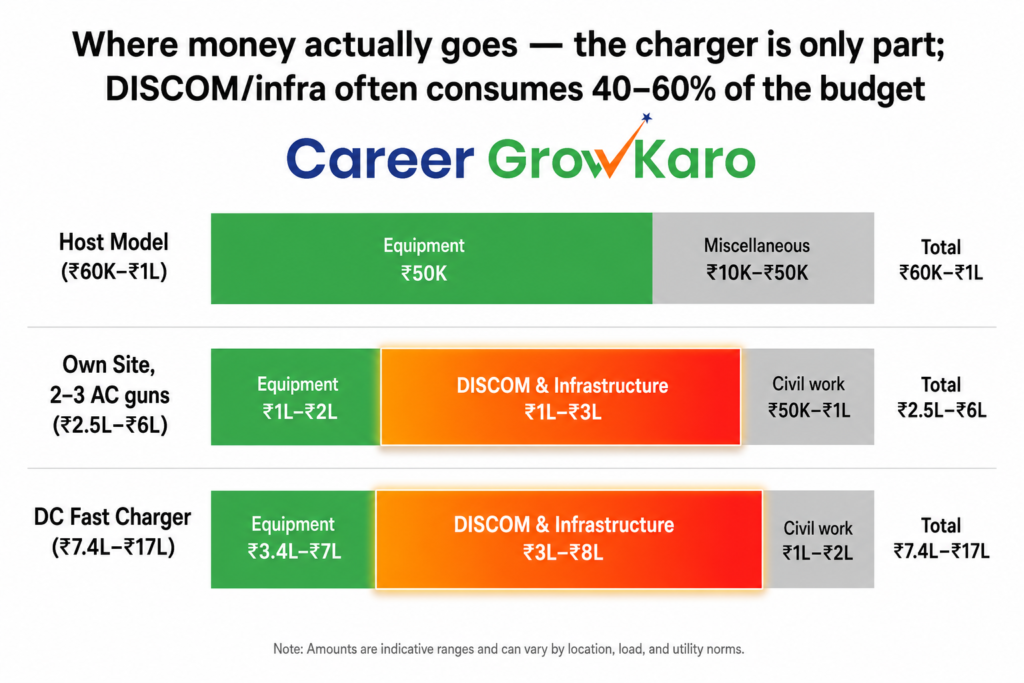
Take a good look at this table. Save it. Screenshot it. This is what the actual investment looks like for each entry route. Not the inflated numbers franchise companies use to justify their fees, and not the suspiciously low numbers clickbait articles use to get your attention.
Now here is the genuinely good news. Government subsidies can take a serious chunk off these costs. Let us look at what is available.
What Subsidies Can You Get From the Government?
Here’s a detailed view of the EV Charging station subsidies in India:
PM E-DRIVE. The Big One
This is the central government’s flagship scheme for EV charging infrastructure, run by the Ministry of Heavy Industries. It replaced the earlier FAME II scheme and is the single most important subsidy programme for anyone setting up charging infrastructure in India right now.
What is on the table:
The total budget earmarked for charging infrastructure under PM E-DRIVE is ₹2,000 crore. The target is roughly 72,300 new public chargers across the country. The detailed framework and allocation breakdown is documented in the official PIB notification.
Who qualifies and for how much:
If you are setting up a charger at a government building, hospital, or educational institution, you can qualify for up to 100 percent subsidy on equipment and upstream infrastructure costs. Yes, you read that right. The government will essentially pay for the whole setup at these locations.
For commercial and private locations like petrol pumps, malls, or standalone stations, the subsidy is tiered. The exact percentages depend on your charger type, power output, and location category. The complete classification is laid out in the MHI EVPCS Guidelines PDF. Read that document before you approach any franchise company. Knowing what subsidy you are entitled to gives you negotiating power.
How do you apply?
Applications go through empanelled Charge Point Operators or your state’s nodal agency for EV infrastructure. The important thing is to start this process before or during installation, not after. Many people install first, apply later, and then find out they missed a documentation requirement.
You can track scheme milestones and find application details on the PM E-DRIVE Portal.
State-Level Subsidies. A Quick Look
Different states have their own incentives on top of the central scheme.
| State | What You Get |
|---|---|
| Delhi | Up to ₹6,000 per charging point on first 30,000 slow/medium chargers at homes and shops. dministered via a single-window portal by DISCOMs like Tata Power-DDL and BSES. |
| Maharashtra | Under the active Maharashtra EV Policy, commercial/fleet 4W EVs get an incentive up to ₹1.5–2 lakh. Additionally, pure electric passenger vehicles receive a 100% toll waiver on major routes like the Mumbai-Pune Expressway, Samruddhi Mahamarg, and Atal Setu. |
| Tamil Nadu | The Tamil Nadu Government officially extended the 100% Motor Vehicle/Road Tax exemption for both transport and non-transport battery-operated vehicles until December 31, 2027. |
A word of caution here. Every state figure in the table above still needs to be confirmed from the actual official state EV policy document, not from some blog post or franchise company’s marketing page. That is flagged for our editorial team to verify before this article goes live.
What About GST?
EV charging services attract 5 percent GST, which is one of the lowest service tax rates in the country.
If your annual turnover stays below ₹20 lakh (₹10 lakh in special category states), GST registration may not be legally mandatory. But let me give you practical advice here. Register anyway. It costs almost nothing. It gives you credibility when you approach fleet operators or franchise companies. It allows you to claim input tax credit on your charger purchase. And it just looks more professional.
Show Me the Money. What Does the Revenue Actually Look Like?
Alright. This is the section I am most excited about because this is where we stop being vague and start being brutally specific.
Every franchise company will tell you their chargers give “25 to 50 percent profit margins.” Ask them to show you the actual math behind that claim. Nine times out of ten, they cannot. Or they will change the subject.
We are going to show you the math right now
Your Revenue and Cost Building Blocks
What you charge the customer: ₹8 to ₹20 per kWh. This varies based on your city, competition, and whether you are on a network app that sets pricing or you control it yourself.
What you pay the DISCOM for electricity: ₹5 to ₹8 per kWh as commercial tariff. This varies by state.
Your net margin per unit: ₹3 to ₹12 per kWh. The range is wide because it depends heavily on your state and your pricing power.
A Real Worked Example. One 7 kW AC Charger in Indore
Let’s say you’ve installed one 7 kW AC charger at a car-wash shop in Indore (host model). Here’s what a typical month might look like:
| What | Number |
|---|---|
| Average sessions per day | 8 |
| Average session length | 45 minutes |
| kWh delivered per session | ~3.5 |
| Total kWh per day | 28 |
| Your net margin per kWh | ₹6 |
| Your daily earnings | ₹168 |
| Your monthly earnings | ₹5,040 |
| Your total investment | ₹1.5 lakh |
| Time to breakeven | ~30 months |
Not exactly thrilling, right?
Now put that exact same charger on a busy commercial road in Coimbatore with a Swiggy delivery hub nearby and e rickshaw stands within walking distance. Suddenly you are getting 15 sessions a day instead of 8.
15 sessions multiplied by 3.5 kWh is 52.5 kWh per day. At ₹6 margin, that is ₹315 per day. Over a month, that is ₹9,450. Now your breakeven on the same ₹1.5 lakh investment drops to roughly 16 months.
Same charger. Same equipment cost. Same business model. Different location. Completely different outcome.
I will keep repeating this until it is burned into your brain. Location is everything in this business.
The CareerGrowKaro Revenue Calculator
| Setup | Sessions/Day | Monthly Net Income | Investment | Breakeven |
|---|---|---|---|---|
| Host model with 1 AC charger | 8 | ₹4,000 to ₹6,000 | ₹60,000 to ₹1 Lakh | 18 to 24 months |
| Own site with 2 AC chargers | 15 | ₹8,000 to ₹12,000 | ₹2.5 to ₹4 Lakh | 22 to 30 months |
| DC fast charger with 1 x 60 kW gun | 12 | ₹15,000 to ₹25,000 | ₹7.4 to ₹17 lakh | 20–30 months |
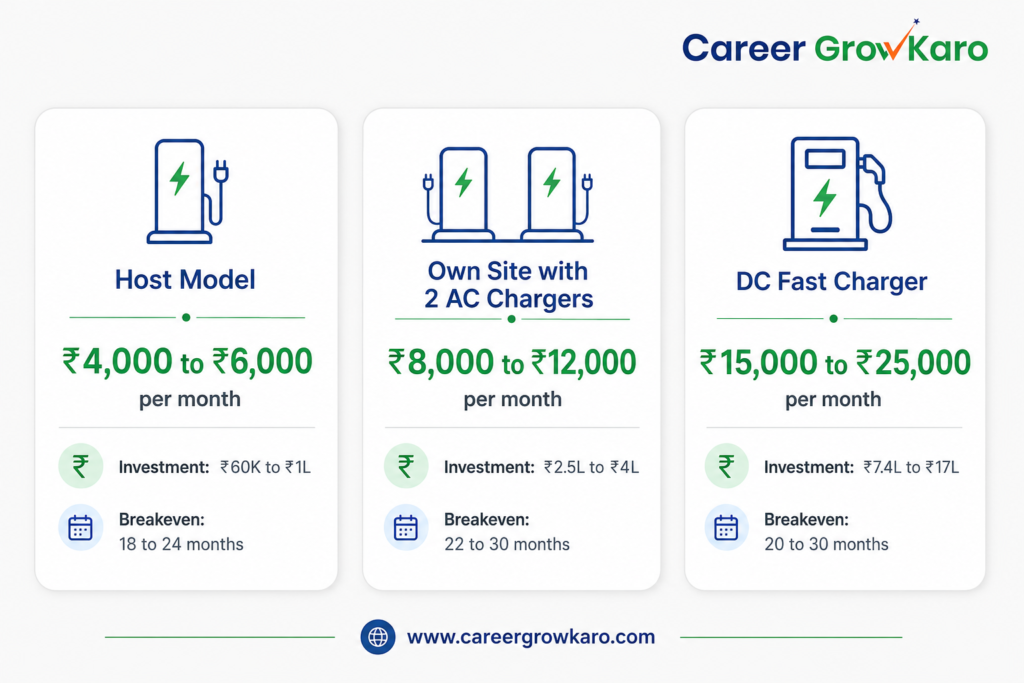
Assumptions behind these numbers: We have used ₹6 net margin per kWh, 3.5 kWh per AC session, and 20 kWh per DC fast charging session. These are illustrative figures based on current market conditions. Before you commit your money, validate the DISCOM commercial tariff in your specific state and check live per kWh pricing on at least two charging apps in your area. The numbers above are meant to give you a realistic framework, not a guarantee.
Notice something interesting about the DC fast charger row? The breakeven has improved compared to what older guides suggest. That is because the MHI revised the equipment benchmark from ₹7.25 lakh down to ₹3.4 lakh. If you can source equipment near that benchmark price, the economics of a fast charger setup are significantly better than they were even a year ago.
Money Beyond Just Charging. Think Like a Shopkeeper.
Here is something most people miss. When someone plugs in their car or scooter for 30 to 45 minutes, they are essentially stuck at your location. That is captive footfall. Smart operators treat the charger not as the entire business, but as a magnet that brings people in.
Advertising space. Put up a small digital screen near the charger and sell ad slots to local businesses. A nearby coaching institute, a new restaurant, a mobile shop. They will pay ₹2,000 to ₹5,000 per month for a captive audience.
Sell chai, water, snacks. This sounds too simple but think about it. If 15 people are waiting 30 to 45 minutes at your location every day, even a basic stall with tea and biscuits adds ₹3,000 to ₹5,000 per month to your income.
Fleet contracts. This is the real game changer. Go to the local Zomato or Swiggy delivery hub. Talk to Ola and Uber driver groups in your area. Find the e rickshaw union. Propose a monthly deal where their drivers charge at your station daily for a fixed monthly fee. One fleet contract with 10 to 15 riders can single handedly make your station profitable.
Fleet contracts give you predictable, recurring income that does not depend on random walk in traffic. If I were starting a charging station today, locking down one fleet contract would be my first priority after installation.
Why Do Some EV Charging Businesses Fail?
Let us be straight with each other here because this is supposed to be an honest conversation.
Wrong location. This is the killer. Not a slow killer either. If your location does not have enough EVs passing by or parking nearby, no amount of marketing, no amount of social media posting, no amount of prayer is going to save you. You will get one or two sessions a day, earn ₹1,500 a month, and wonder where you went wrong.
DISCOM delays. Your brand new charger is sitting in a box in the corner of your shop for four months because the electricity connection is still “under process.” Meanwhile your working capital is draining. You are paying rent on a location that is generating zero income. This destroys more small charging businesses than competition does.
Cheap equipment. That ₹25,000 charger you found on IndiaMART from a brand you have never heard of? It will work fine for three months and then give you headaches for the next twelve. Every day your charger is down for repairs, you earn zero. Customers who find a non working charger will never come back.
Racing to the bottom on price. Some new operators see a competitor charging ₹10 per kWh and immediately drop to ₹8 to steal customers. Then the competitor drops to ₹7. Then you go to ₹6. Before you know it, nobody is making money. Compete on convenience, reliability, and customer relationships. Not on price.
Step by Step. How to Actually Set This Up From Scratch.

Here is the practical to do list in the order you should actually follow it. No step is optional.
Step 1. Pick your entry route.
Host model, own setup, or franchise. If you have under ₹1 lakh to invest, go with the host model. Do not overthink this decision. You can always upgrade later.
Step 2. Find your location. And I mean really find it.
Do not just pick a convenient spot near your house. Spend two to three full days standing near the location you are considering. Carry a notebook. Count every green number plate vehicle that passes by. Talk to nearby shopkeepers and ask if they see EV owners looking for charging. Check the Vahan portal for registered EVs in your district. If you are not seeing at least 30 to 40 EVs pass daily, seriously reconsider that location.
Step 3. Check electricity availability.
Walk into your local DISCOM office and ask one specific question: “Can this address support additional commercial electrical load for an EV charger?” If the transformer serving that area is already running at capacity, you will need to either find another spot or budget for the DISCOM to upgrade the infrastructure, which takes time and money.
Step 4. Apply for your DISCOM connection early.
Submit the application for a commercial electricity connection as soon as you have locked in a location. This process takes three to six months in most cities. If you wait until everything else is ready, you will be sitting idle for half a year.
Step 5. Register your business.
A sole proprietorship is the simplest and cheapest option. Register on the Udyam portal as a micro enterprise. It takes 15 minutes online and costs nothing. Apply for GST registration if your projected turnover will cross the threshold, or even if it will not, for the credibility and input tax credit benefits.
Step 6. Buy your charger from a certified vendor.
Only purchase from a BIS certified, BEE approved manufacturer. Check the standards at beeindia.gov.in. Before paying, ask the vendor for three things in writing: warranty terms (minimum 2 years), annual maintenance contract options, and uptime guarantees. If they cannot give you these on paper, find a different vendor.
Step 7. Apply for your PM E-DRIVE subsidy.
Go through your state’s nodal agency or an empanelled Charge Point Operator. Start this process before or during installation, not after. Check the PM E-DRIVE Portal for current eligibility criteria and empanelled partners.
Step 8. Get a licensed electrician for installation.
Do not let your local “electricity wala” handle this. You need a licensed electrician who can install the charger to specification and get you electrical inspection clearance from your state’s Electrical Inspectorate. This clearance is not optional. It is a safety and legal requirement.
Step 9. Connect to a charging network app.
List your station on at least one major platform like Bolt Earth, ChargeZone, or Tata EZ Charge. This is how most EV owners discover charging stations today. They open an app, look for the nearest charger, and navigate to it. If you are not on that app, you are invisible to most potential customers.
Step 10. Launch, price right, and go find your customers.
Set competitive per kWh pricing that gives you a healthy margin without scaring away customers. List your station on Google Maps with photos and accurate timing. And here is the part most people skip: go out and actually meet your customers. Visit the nearest e rickshaw stand. Talk to delivery riders at the local Swiggy and Zomato hub. Drop your details at nearby housing societies with EV owners. Nobody will magically discover your charger. You need to tell them it exists.
The Risks Nobody Else Will Tell You About
Every franchise website, every optimistic blog post, every Instagram reel makes the EV charging business sound like a guaranteed money printing machine. Just install a charger and watch the cash roll in, right?
Not exactly. Here is what can genuinely go wrong and what you can do about it.
Your DISCOM Connection Will Test Your Patience Like Nothing Else
In cities like Ranchi, Bhopal, or even parts of Bengaluru, getting a commercial electricity connection is a months long saga. Three to six months is the realistic timeline. And during those months, your charger sits in a box, your rent keeps going (if you are leasing space), and your working capital slowly drains.
The ICCT’s analysis of Delhi’s EV charging policy makes an excellent point about how even India’s capital city struggles with streamlining charger approvals for residential and commercial setups. If Delhi is struggling with this, imagine what it is like in smaller cities.
What to do about it. Budget for this delay from day one. Do not sign a lease, do not buy equipment, do not quit your job until you have walked into the DISCOM office and confirmed that your address can support the load. Consider the host model specifically because the landowner often already has a commercial connection you can use or sub meter from.
A Bad Location Will Eat You Alive. Slowly and Painfully.
I know I have said this three times already but I am going to say it again because this is the single most important factor in your success or failure.
A charger in the wrong spot will not fail dramatically. It will fail slowly and painfully. Two sessions on Monday. Zero on Tuesday. One on Wednesday. Three on Thursday. You will keep telling yourself “it will pick up next month” while your investment sits there earning less than a bank fixed deposit.
What to do about it. Before investing anything, go to the Vahan portal and check how many EVs are registered in your district. Then physically go stand near your proposed site for two to three days at different times. Count green number plate vehicles. If the numbers do not support at least 8 to 10 sessions per day, walk away. There are plenty of locations. Find a better one.
Cheap Chargers Will Punish You
That attractive price tag on an unknown brand feels great when you are making the purchase. It stops feeling great when the charger breaks down after three months and the vendor takes two weeks to send a technician from another city.
Every single day your charger is not working, you earn zero. But worse than that, an EV owner who drives to your station, finds a broken charger, and drives away frustrated is an EV owner who will never come back. And they will tell other EV owners. Your reputation takes a hit that is very hard to recover from.
What to do about it. Buy BIS certified equipment from a recognized manufacturer with a local service network. Pay for the 2 year warranty. Budget ₹3,000 to ₹5,000 per month for maintenance. And here is a critical planning tip: in your revenue projections, assume 15 to 20 percent monthly downtime. Even well maintained chargers need servicing, software updates, and occasional part replacements. Build that reality into your numbers from the start.
Competition Is Coming. Faster Than You Think.
Right now the market is wide open and a solo operator in Vijayawada or Jaipur can carve out a nice niche. But five years from now? Tata Power, Adani, Reliance, and a dozen other companies with deep pockets will have charging networks across the country. A small independent operator cannot outspend them on marketing or technology.
What to do about it. Build relationships, not just chargers. One signed fleet contract with a local delivery company or e rickshaw cooperative gives you guaranteed daily volume that no competitor can steal by launching a flashier app. Personal relationships with local fleet operators are your moat in this business. Build them early and nurture them consistently.
Here is the honest bottom line. A well located, well managed EV station in a city like Nagpur or Coimbatore can earn you ₹8,000 to ₹40,000 a month net depending on your setup and scale. A badly located one can lose money for two straight years before you finally pull the plug. The difference between these two outcomes is almost entirely about the research you do before installation. There are no shortcuts. There are no hacks. Just homework.
Before You Invest a Single Rupee. An Honest Self Check.
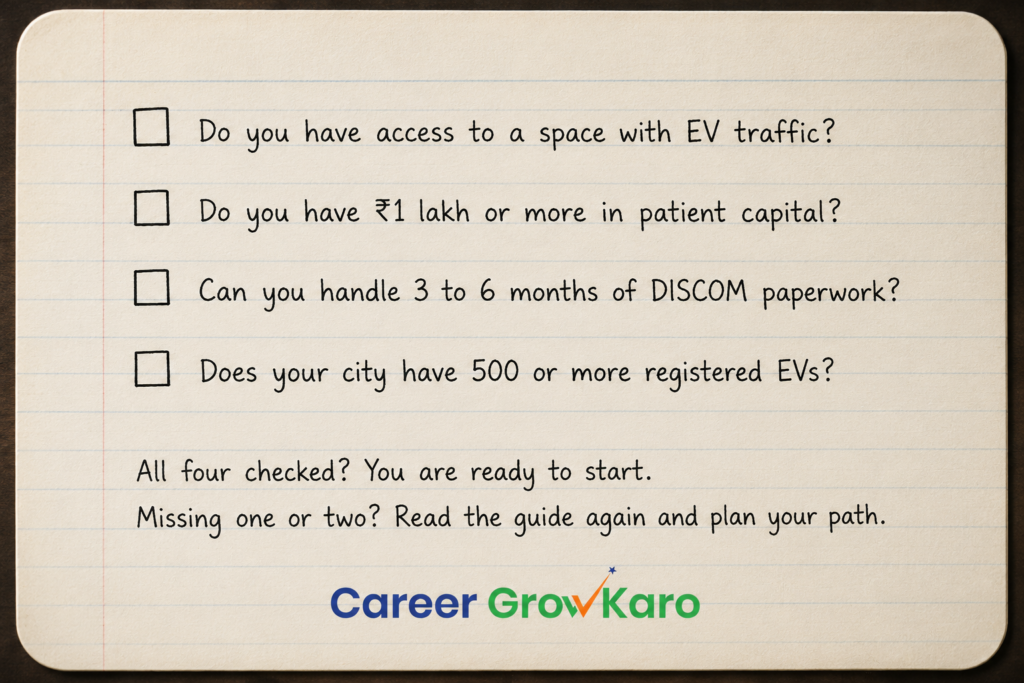
Sit down with a cup of chai and answer these four questions. Be brutally honest with yourself because nobody else will be.
One. Do you own or have access to a space with EV traffic?
If yes, you are already ahead of 80 percent of people reading this guide. Explore Path B (own setup) or Path C (franchise). If no, the host model is your entry point. Find a location partner first. Invest in the charger second.
Two. Do you have at least ₹1 lakh in patient capital?
Patient capital means money you genuinely do not need back for 18 to 24 months. Not money borrowed against your salary. Not your emergency fund. Not your sister’s wedding budget. If you have it, you are in the game. If you do not, this is not the right time. Build capital first, keep researching locations, and come back when you are ready.
Three. Can you handle a DISCOM application process?
This means multiple visits to a government office, following up on phone calls that go unanswered, dealing with “come back next week” at least three times, and maintaining patience for three to six months. If that sounds like it will drive you crazy, either find a partner who can handle the bureaucratic side or start with the host model where the landowner’s existing connection simplifies things.
Four. Does your city have at least 500 registered EVs?
Go to vahan.parivahan.gov.in and check. If your district shows strong EV registration numbers, the demand is there. If the numbers are thin, the market may not be ready yet in your area. Consider focusing on a nearby larger city instead.
If you answered yes to all four, you have a solid foundation. Start with the host model or a 2 gun AC setup and learn the business before scaling.
If capital is the problem, let me be direct with you. An EV charging station is not a zero investment business. Anyone who tells you otherwise is selling you something. Build up your savings through freelancing, a side hustle, or your current job. Keep doing your location research in the background. When you have the capital, you will be able to move quickly because you already have the knowledge.
Questions People Ask Us All the Time
How much does it cost to start an EV charging station business in India?
It depends on your route in. A host model setup with a single AC charger starts at around ₹60,000. An independent station with 2 to 3 AC guns runs ₹2.5 to ₹6 lakh when you include infrastructure and DISCOM charges. A DC fast charger setup can cost ₹7.4 to ₹17 lakh. The government’s PM E-DRIVE scheme can cut equipment costs meaningfully for eligible locations. Always check the MHI EVPCS guidelines for the latest subsidy slabs before budgeting.
Is an EV charging station actually profitable?
It absolutely can be. But profitability is not guaranteed by the business model. It is determined by your location. A charger on a busy road in Jaipur or Indore with 10 to 15 daily sessions can earn ₹8,000 to ₹15,000 per month after costs. Breakeven usually takes 12 to 24 months. Put the same charger in a low traffic area and you will barely cover your electricity bill. Validate footfall before investing. That is the single most important thing you can do.
How do I get a government subsidy for this?
The PM E-DRIVE scheme run by the Ministry of Heavy Industries is your main option. You apply through state nodal agencies or empanelled Charge Point Operators. Government buildings, hospitals, and educational institutions can qualify for up to 100 percent subsidy on equipment and infrastructure. Commercial locations get tiered subsidies. Start at the PM E-DRIVE Portal for current eligibility and process details.
Can I start this business without owning any land?
Yes. That is exactly what the host model is designed for. You approach a petrol pump, parking lot, or shop owner and propose installing a charger on their property. They provide the space and usually the electricity connection. You provide the charger and handle operations. Revenue gets split, typically 20 to 40 percent going to the landowner. This is genuinely the easiest entry route for someone starting from zero.
How many EVs need to be in my area for this to make sense?
As a practical benchmark, a single 7 kW AC charger needs roughly 8 to 12 sessions per day to cover costs and start generating returns. That typically requires at least 300 to 500 registered EVs within a 5 kilometer radius and a location that is easily visible and accessible. Use the Vahan portal to check EV registrations in your district. Do not guess. Check.
What approvals and licences do I need?
You need a commercial DISCOM electricity connection, a charger that is BIS and BEE certified, and installation plus inspection clearance from a licensed electrician and your state’s Electrical Inspectorate. A business registration, even a simple sole proprietorship through the Udyam portal, is recommended. GST registration is needed if your turnover crosses the threshold. No special central licence is required beyond these basics.
Sources We Used and Trust
| Source | Link | What It Verifies |
|---|---|---|
| PIB: 29,277 charging stations (Lok Sabha data) | pib.gov.in/PressReleasePage.aspx?PRID=2151390 | Exact public charger count across all States and UTs |
| PIB: PM E-DRIVE Framework Notification | pib.gov.in/PressReleasePage.aspx?PRID=2101632 | ₹2,000 crore budget, 72,300 charger target |
| MHI PM E-DRIVE Portal | pmedrive.heavyindustries.gov.in | Scheme milestones, tracking, application gateway |
| MHI EVPCS Guidelines PDF | pmedrive.heavyindustries.gov.in/docs/policy_document/Draft EVPCS guidelines.pdf | Charger benchmarks (₹3.4L revised), technical specs, subsidy slabs |
| Vahan Vehicle Registration Portal | vahan.parivahan.gov.in | Local EV registration data for location validation |
| Bureau of Energy Efficiency | beeindia.gov.in | BEE approved charger standards |
| CBIC (Central Board of Indirect Taxes) | cbic.gov.in | GST rates on EV charging services |
| Udyam Registration Portal | udyamregistration.gov.in | MSME business registration |
| ICCT: Delhi EV Policy Analysis | theicct.org | Policy challenges in urban charging infrastructure |
Researched and written by the CareerGrowKaro editorial team. Last updated May 2026.
Related Resources:
How to Start an Acrylic Paint Manufacturing Business in India: Complete 2026 Guide
Aloe Vera Gel Manufacturing Business in India: A 2026 Startup Guide
Areca Leaf Plate Business in India 2026 – Proven Profitable Startup Blueprint