The best village business ideas in India include dairy, a flour mill, organic vegetables, a kirana-plus-digital store, and food processing — most start with ₹10,000 to ₹1 lakh. New for 2026, modern options like drone spraying services, solar cold storage, D2C farm brands, and a rural pickup point can earn even more. And you don’t need your own savings: schemes like Mudra, PMEGP, and Namo Drone Didi fund the cost. Pick one, start small, grow steady.
- Introduction
- How Much Can a Village Business Really Earn?
- Best Village Business Ideas — Grouped by What You Already Have
- Modern Village Business Ideas for 2026 (Learning From the World)
- Which Need No Skill and Little Money?
- How Does the Government Fund Your Village Business?
- Which Licenses Do You Actually Need?
- How to Pick the Right Business for Your Village
- Your First 30 Days — A Starting Checklist
- Not sure which village business fits your land, budget, and local demand?
- Frequently Asked Questions
- The One Clear Next Step
Introduction
Everyone says there’s no work in villages. That’s not true — there’s less competition, which is a huge advantage if you start the right business. The problem is that most village business ideas lists online are just names, with no honest numbers and no mention of the government money that will fund you.
At CareerGrowKaro, we fixed that. This guide gives you 25 real village businesses — traditional and modern — with honest ₹ figures and the exact schemes that pay for them. No hype. One clear path to your first income.
How Much Can a Village Business Really Earn?
A village gives you three things a city can’t: low costs, low competition, and resources you may already own — land, animals, or a shop-front. Used well, these turn into steady income.
Here’s the honest shape of it. Most village businesses earn little in the first month, then grow as local trust builds. Results depend on effort and consistency, not luck.
- Month 1–2: ₹3,000–₹10,000. Getting your first customers.
- Month 6: ₹15,000–₹40,000. Regular buyers and word-of-mouth.
- Year 1+: ₹40,000–₹1 lakh+. A known name, and maybe hired help.
The opportunity is real and growing. A NITI Aayog report shows India’s flexible, self-employed workforce will more than triple by 2029–30 — and rural India is a big part of that shift, helped by cheap solar power, UPI, and digital selling.
Your next step: decide your monthly target first — ₹15,000 or ₹50,000 — and choose from the lists below based on what you already have.
Best Village Business Ideas — Grouped by What You Already Have
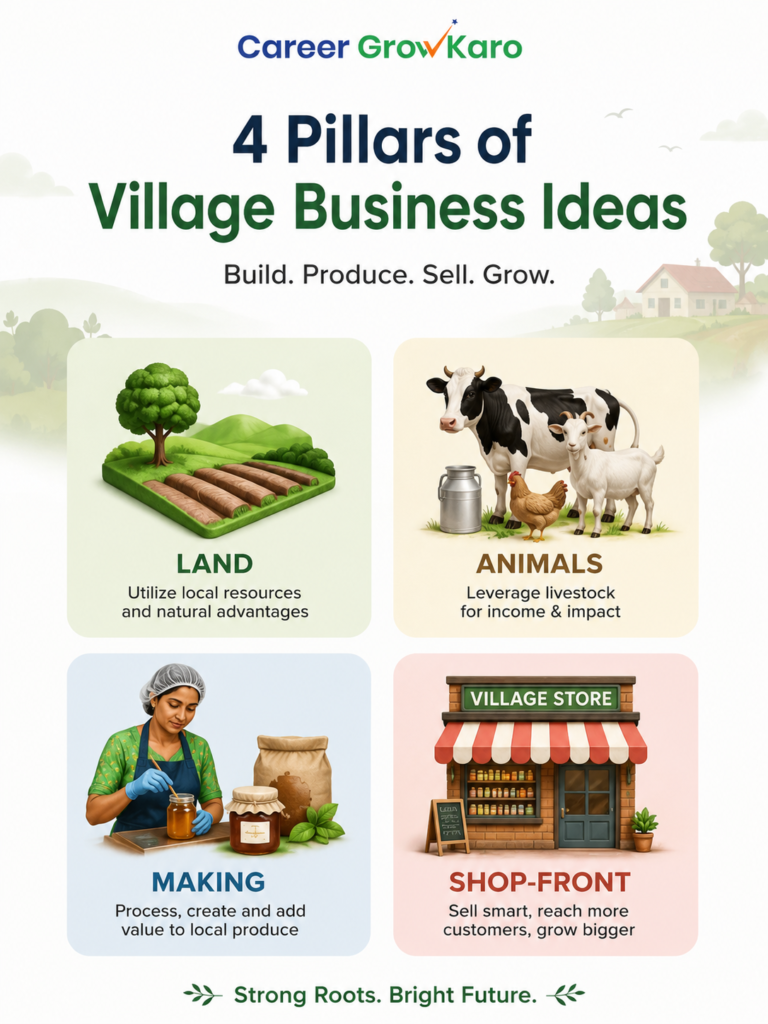
The smartest way to choose is by the resource you already own. Every number below is an honest estimate of typical Indian costs — a guide, not a guarantee.
If you have land — farming & agri businesses
| Business | To start (₹) | Profit/month (₹) | Note |
|---|---|---|---|
| Organic vegetables & fruits | 10,000–50,000 | 15,000–40,000 | Sell to mandis, city stores, apps |
| Mushroom farming | 8,000–25,000 | 15,000–40,000 | Small space, high demand |
| Vermicompost / bio-fertiliser | 5,000–20,000 | 10,000–30,000 | Growing organic demand |
| Floriculture (flowers) | 15,000–40,000 | 12,000–35,000 | Weddings, temples, festivals |
If you have animals — livestock businesses
| Business | To start (₹) | Profit/month (₹) | Note |
|---|---|---|---|
| Dairy (2–5 cows/buffaloes) | 50,000–2 lakh | 30,000–1 lakh | Supply to Amul-type collection centres |
| Poultry (layer/broiler) | 30,000–1 lakh | 20,000–60,000 | Fast returns, steady demand |
| Goat farming | 40,000–1.5 lakh | 20,000–50,000 | Low maintenance, good resale |
| Fishery / backyard pond | 30,000–1 lakh | 15,000–45,000 | Where water is available |
If you can process or make things — small manufacturing
| Business | To start (₹) | Profit/month (₹) | Note |
|---|---|---|---|
| Flour mill (atta chakki) | 50,000–1.5 lakh | 15,000–35,000 | Every household needs it |
| Oil mill (cold-pressed) | 60,000–2 lakh | 20,000–50,000 | Premium demand for wood-pressed oil |
| Papad, pickle & masala | 5,000–15,000 | 8,000–20,000 | Great as an SHG group business |
| Agarbatti / candle making | 10,000–30,000 | 10,000–25,000 | Machine + raw material |
If you have a shop-front or main-road spot — retail & services
| Business | To start (₹) | Profit/month (₹) | Note |
|---|---|---|---|
| Kirana + digital store | 20,000–60,000 | 12,000–30,000 | Add UPI, recharge, bill pay |
| Fertiliser & seed shop | 50,000–1.5 lakh | 20,000–50,000 | Steady farmer demand (needs licence) |
| Mobile & gadget repair | 15,000–30,000 | 15,000–35,000 | Short course, high demand |
| Tailoring & readymade | 15,000–40,000 | 12,000–30,000 | Everyday need |
Let’s now look at the ideas that make this a 2026 guide, not a 2016 one.
Modern Village Business Ideas for 2026 (Learning From the World)
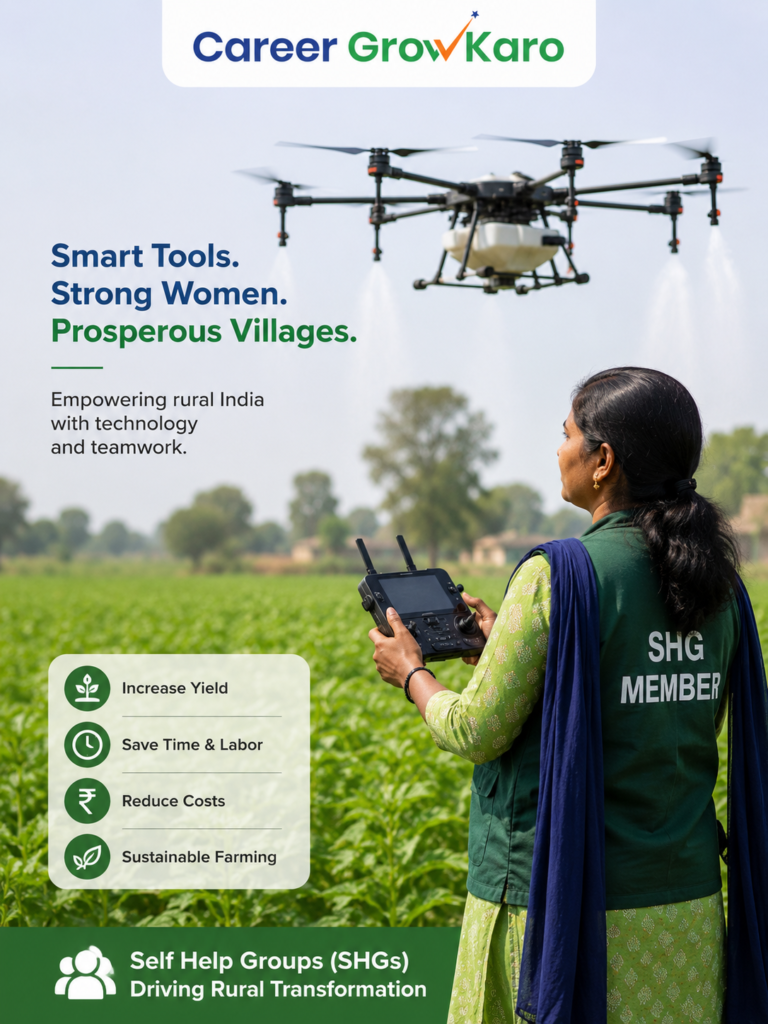
Three things have quietly changed Indian villages: cheap solar power, digital rails (UPI, ONDC, cheap internet), and strong government subsidies. Together, they make business models that already work in developed countries — and in China’s booming rural economy — finally possible here. These are the ideas your competition down the road hasn’t started yet.
Drone spraying service — the flagship
In the US and Europe, farmers hire specialists to spray fields from the air. India now has its own version, built for rural women. Under the Namo Drone Didi scheme, women’s Self-Help Groups get a drone with an 80% government subsidy — up to ₹8 lakh — and the rest as a low 3% loan, then earn by renting spraying services to nearby farmers. The government estimates around ₹1 lakh a year in extra income per group. You put in as little as 20%, and the training is free. Details are on the official Lakhpati Didi portal.
Solar cold storage (rental)
Inspired by the dense cold chains of the Netherlands and the US, small solar-powered cold rooms now let a village entrepreneur rent chilled space to farmers, cutting the huge losses from spoiled produce. Setup runs ₹3–8 lakh, but horticulture and food-processing subsidies cover a big share. Best run by a group or Farmer Producer Organisation (FPO).
D2C farm brand — sell direct to the city
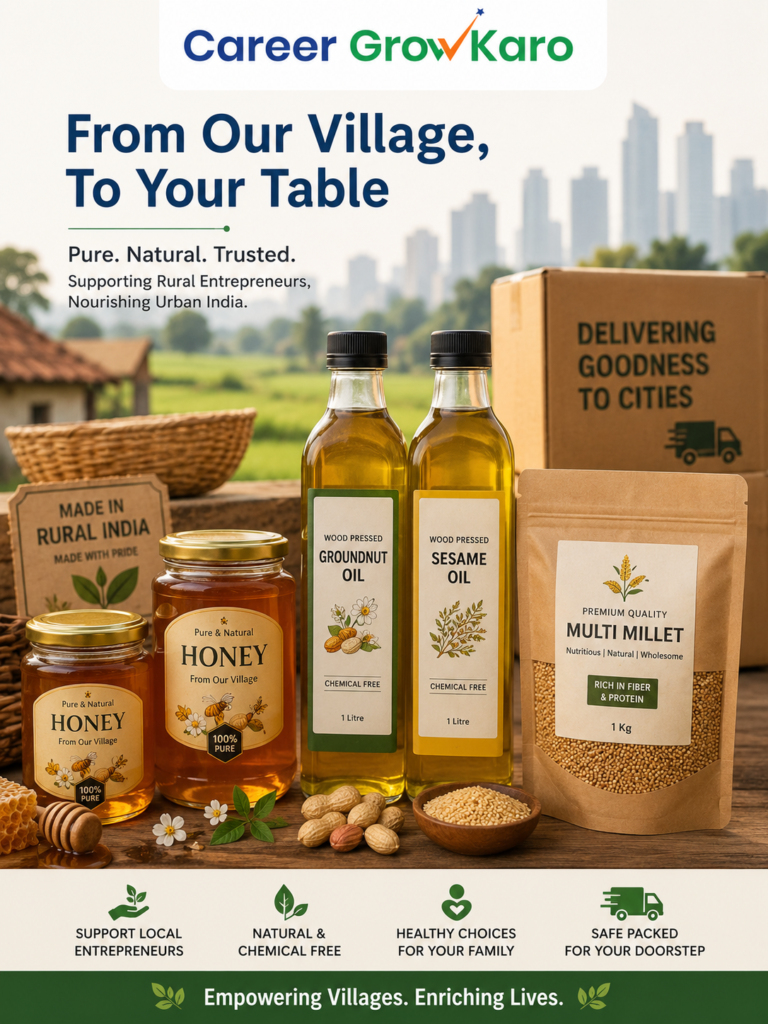
This is India’s version of the American farm-box (CSA) model: skip the middleman and sell your own branded produce — millets, A2 ghee, cold-pressed oil, honey, dry fruits — straight to city buyers through Instagram, WhatsApp, and ONDC. Investment is small (₹15,000–₹50,000 for packaging and a phone), and the margins are far higher than selling raw at the mandi.
Rural livestream & social commerce
In China, village creators sell produce to millions through live video. India is at the start of the same wave. With just a phone, a village youth can sell local crafts, food, or produce through Reels and YouTube Live to urban buyers. Near-zero investment — your effort and consistency are the capital.
ONDC seller + delivery pickup point
China’s “Taobao Villages” turned whole villages into e-commerce hubs. You can begin small: list local products as an ONDC seller, or run an Amazon/Flipkart rural pickup point where neighbours collect their online orders. ₹10,000–₹40,000 to start, and it brings daily footfall.
Custom hiring centre — “Uber for tractors”
Most small farmers can’t afford a tractor, but they’ll happily rent one. A farm-machinery rental centre (tractor, tiller, harvester) is heavily subsidised — 40–80% — under the government’s farm-mechanisation scheme (SMAM). Best as a group venture.
Polyhouse for high-value crops
Borrowed from Dutch greenhouses and Israeli drip farming, a polyhouse lets you grow exotic, high-price crops — coloured capsicum, cherry tomatoes, lettuce, strawberries — for city restaurants and supermarkets. ₹1–5 lakh with up to 50% horticulture subsidy. Higher effort, higher reward.
Agri-waste to compostable products
Europe is banning single-use plastic, and the demand for areca-leaf plates, banana-fibre products, and other compostable goods is rising fast — including for export. Turn farm waste into money with ₹50,000–₹3 lakh and a PMEGP loan.
Rural digital point (CSC 2.0)
In developed countries every service is online. In rural India, you can be that access point. A Common Service Centre offers government form-filling, bill payments, micro-ATM banking, and even doctor consultations via eSanjeevani telemedicine — steady income from ₹15,000–₹50,000 of setup, and perfect for a 12th-pass youth.
Your next step: pick one modern idea that matches your budget. If you have almost nothing, start with a D2C farm brand or livestream selling today — both need only a phone.
Which Need No Skill and Little Money?
You don’t need a degree or a big loan to start. These work for youth, homemakers, and first-timers:
- Kirana + digital store — daily-needs goods plus UPI, recharge, and bill payments.
- D2C farm brand / reselling — sell branded local produce or sourced products online.
- Livestream / social commerce — sell through your phone, zero stock.
- ONDC pickup point — a small setup that brings daily footfall.
If you’d rather have a steady job than run a business, or want to earn from home first, see our guides on genuine work from home jobs for housewives , ghar baithe paise kaise kamaye and simple ways to earn money online.
Your next step: if your budget is near zero, begin with reselling or livestream selling this week.
How Does the Government Fund Your Village Business?
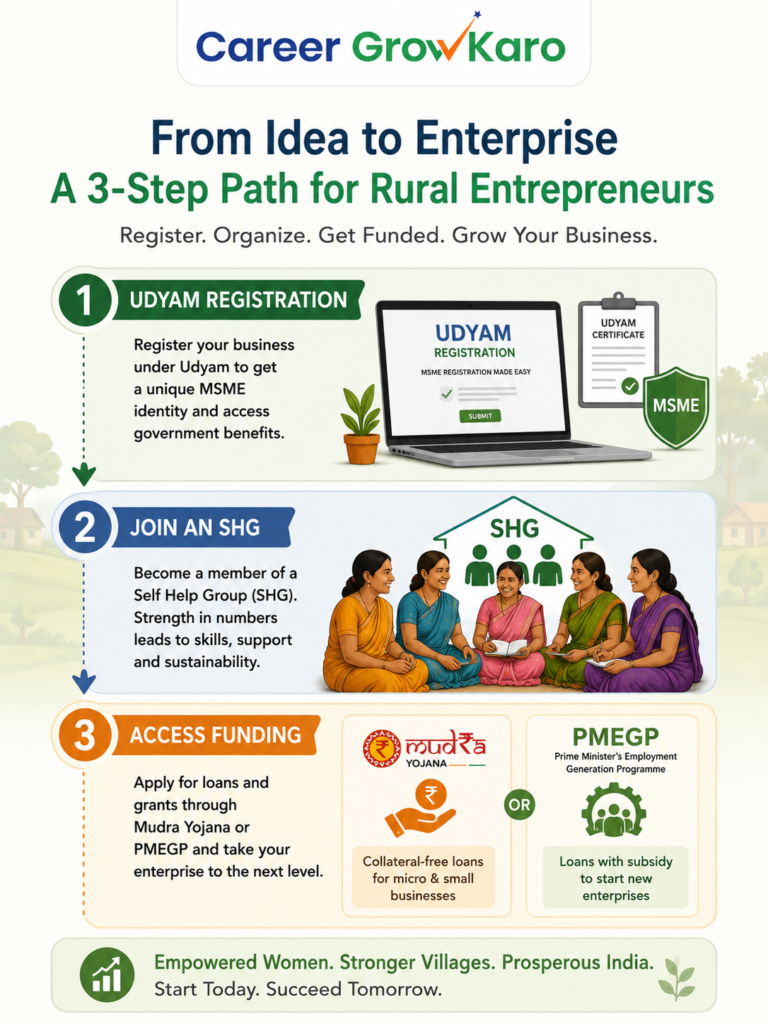
This is what almost no one explains properly: you rarely need your own savings. The government runs several schemes that give small, low-cost or collateral-free loans and free training to rural entrepreneurs.
| Scheme | What you get | Best for | Where to apply |
|---|---|---|---|
| PM Mudra Yojana | Collateral-free loan: Shishu up to ₹50,000, up to ₹20 lakh in higher tiers | Almost any small business | Any bank, or mudra.org.in |
| PMEGP | 15–35% subsidy on project cost (rural women get 35%) | New manufacturing/service units | kviconline.gov.in |
| PMFME | Subsidy + loan for micro food-processing units | Flour/oil mill, pickle, dairy | pmfme.mofpi.gov.in |
| Namo Drone Didi | 80% subsidy on a drone (up to ₹8 lakh) | Women SHGs, drone service | lakhpatididi.gov.in |
| SMAM | 40–80% subsidy on farm machinery | Custom hiring centre | agrimachinery.nic.in |
| DAY-NRLM (SHG loans) | Cheap group loans via Self-Help Groups | Village women, group ventures | aajeevika.gov.in |
| Udyam Registration | Free MSME registration (unlocks benefits) | Every business | udyamregistration.gov.in |
How to use these, step by step:
- Do your free Udyam registration online — 10 minutes, makes you an official MSME.
- Join or form a Self-Help Group (SHG) if you’re a woman — it unlocks the cheapest loans and schemes like Namo Drone Didi.
- Apply for a Mudra or PMEGP loan at your bank for setup and raw material.
- For food or farm-machinery businesses, apply under PMFME or SMAM for extra subsidy.
For more government-scheme guides in plain language, explore CareerGrowKaro’s Sarkari schemes section.
Your next step: register free on the Udyam portal this week — it’s the single document that unlocks every other benefit.
Which Licenses Do You Actually Need?
Most village businesses need very little paperwork — but don’t skip what’s required.
- Udyam registration — Free, and useful everywhere as proof and for loans.
- FSSAI registration — For any food business (dairy, flour mill, pickle, food processing). Basic registration covers turnover up to ₹12 lakh a year, at fssai.gov.in.
- Shop / trade licence — For a retail shop, from your Gram Panchayat.
- Special licences — Fertiliser and seed shops need a specific dealer licence from the agriculture department.
Your next step: for a food business, get FSSAI basic registration before your first sale — it builds trust and keeps you safe.
How to Pick the Right Business for Your Village
Don’t start five things. Start one. Ask three questions:
- What do you already have? Land → farming. Animals → dairy/poultry. A shop-front → kirana/services. Just a phone → D2C brand, livestream, ONDC.
- How much can you spare? ₹0–₹15,000 → reselling, livestream, D2C brand. ₹15,000–₹60,000 → kirana, mobile repair, papad, digital point. ₹1 lakh+ → dairy, mill, polyhouse (mostly funded by schemes).
- What does your village actually need or grow? Match the business to local demand and local crops.
The best business is where all three meet — your resource, your budget, and real local demand. Not the one with the biggest number.
Your next step: write down your answer to all three. Where they overlap is your business.
Your First 30 Days — A Starting Checklist
- Week 1: Pick one business. Do your free Udyam registration.
- Week 2: Test demand — talk to 20 potential customers or farmers. Set one fair price.
- Week 3: Get any licence needed (FSSAI for food). Arrange raw material or stock.
- Week 4: Start serving your first customers. Apply for a Mudra/PMEGP loan only once you need to grow.
One tip that gets loans approved: for a scheme loan, banks want a simple project report (DPR) — 8–15 pages with realistic numbers: what you’ll make, monthly sales, costs, and profit. Show honest figures, not 80% profit fantasies. That single habit clears most rejections.
Start before you feel fully ready. Progress beats waiting.
Not sure which village business fits your land, budget, and local demand?
Use the three-question test above, then explore CareerGrowKaro’s full Business and Sarkari-scheme guides for step-by-step help on the idea and the loan you choose.
👉 Find Your Business — Explore CGK Guides →
Submission note for product team: this article needs a “Village Business + Scheme Matcher” tool (resource × budget → idea + eligible scheme). Linked to the Business category page as a temporary measure.
Frequently Asked Questions
Which is the most profitable village business in India?
Dairy farming is one of the most reliable and profitable, earning ₹30,000 to over ₹1 lakh a month at scale. For higher-tech, higher-margin options, a drone spraying service (funded by Namo Drone Didi), a polyhouse for exotic crops, or a D2C farm brand can earn strongly with government support.
Which village business can I start with just ₹10,000?
With ₹10,000 you can start mushroom farming, papad or pickle making, a small D2C farm brand, or livestream selling of local products. Begin small, reinvest your profit, and grow slowly and steadily.
What is the best village business for women?
Women do very well with dairy, papad and pickle making, tailoring, and Self-Help Group ventures. A standout modern option is the Namo Drone Didi scheme, which gives women’s SHGs a drone at an 80% subsidy to run a farm-spraying service.
How can I get a government loan for a village business?
First do your free Udyam registration online. Then apply for a collateral-free Mudra loan (up to ₹50,000 in the Shishu category) or a PMEGP loan with a 15–35% subsidy at your bank. Food and farm-machinery businesses get extra subsidy under PMFME and SMAM.
Are modern businesses like drone services really possible in a village?
Yes. The Namo Drone Didi scheme gives women’s Self-Help Groups a drone with an 80% subsidy and free training to offer spraying services to farmers. Solar cold storage, D2C farm brands, and rural e-commerce pickup points are all working in Indian villages today, thanks to cheap solar power and digital payments.
Do I need a licence for a village food business?
Yes. Any food business — dairy, flour mill, pickle, food processing — needs FSSAI registration. Basic registration covers a yearly turnover up to ₹12 lakh and is inexpensive and online at fssai.gov.in.
The One Clear Next Step
You now have 25 real village business ideas — traditional and modern — with honest numbers and the government schemes that fund them. The hard part isn’t the money. It’s choosing one and starting.
Do these three things this week:
- Pick one business using the resource-budget-demand test.
- Do your free Udyam registration.
- Talk to 20 potential customers to test demand before you spend a rupee.
You don’t need a city, a degree, or big savings to build something in your village. You need one idea, one honest step, and the patience to grow. CareerGrowKaro is here to guide you at every step.