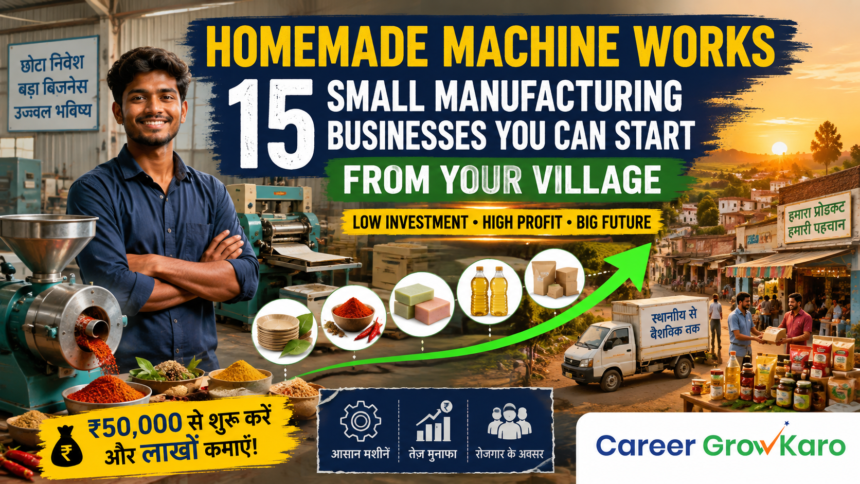
Homemade machine works is emerging as one of the most practical ways for students and young people in India’s Tier-2 and Tier-3 cities to start a manufacturing business without leaving their hometown. From paper-plate machines and spice grinders to candle-making and food-processing units, thousands of young Indians are discovering that entrepreneurship does not always require moving to Mumbai or Bengaluru. If you have a small room, basic capital and the willingness to learn, homemade machine works can become the foundation of a profitable local business.
- What Does “Homemade Machine Works” Mean?
- Why Small-Town Manufacturing Is Growing in India
- Before Buying Any Machine, Ask These Five Questions
- 7 Homemade Machine Businesses You Can Start
- Business Idea #1: Spice Grinding Unit
- Real Story: Women Entrepreneurs Built a Spice Business
- Business Idea #2: Paper Plate Manufacturing
- Real Story: Minakshi Padhi from Odisha
- Business Idea #3: Mustard-Oil Processing
- Real Story: Sarita Singh from Uttar Pradesh
- Business Idea #4: Flour Mill
- Business Idea #5: Soap and Detergent Manufacturing
- Business Idea #6: Candle Manufacturing
- Business Idea #7: Food Packaging Business
- What We Learned From These Real Stories
- Homemade Machine Works: How to Get Funding, Find Customers and Build a Profitable Business
- Government Schemes That Can Help You Buy Machines
- Reality Check: Don’t Depend Entirely on Loans
- How to Validate Demand Before Spending a Single Rupee
- How to Sell Products Without Opening a Shop
- Real Story: How PMEGP Helped Sarita Singh Build an Oil Mill
- Five Mistakes That Destroy Small Manufacturing Businesses
- A 90-Day Roadmap to Start Your Homemade Machine Works Business
- The Bigger Opportunity: Solve Local Problems
- FAQ
Before investing in any machine, it is important to understand whether manufacturing is the right path for you. If you are still exploring different options, CareerGrowKaro’s guide on best business ideas with low investment compares home businesses, digital services and small manufacturing opportunities so that you can choose a business that matches your budget and skills. Readers who want to think beyond traditional jobs can also explore Profitable Startup Ideas for Beginners in 2026, which explains how small ideas can gradually turn into sustainable income streams.
The best part? Many of these businesses start with a machine costing less than ₹1 lakh.
If you’re a student, graduate or someone who wants to build a business without leaving your hometown, this guide on homemade machine works is for you.
What Does “Homemade Machine Works” Mean?
In simple terms, homemade machine works refers to small-scale manufacturing businesses that can be started from a home workshop, a garage or a small rented space.
These businesses usually require:
- A low-cost machine
- Limited manpower
- Basic technical knowledge
- Local demand
- A small initial investment
Unlike traditional startups that require coding skills or venture capital, machine-based businesses solve real problems in local markets.
Examples include:
- Spice grinding
- Paper-plate manufacturing
- Oil extraction
- Soap making
- Flour milling
- Candle manufacturing
- Detergent production
- Food packaging
Why Small-Town Manufacturing Is Growing in India
Homemade machine works is not just about operating machines; it is about understanding demand, margins and long-term scalability. If you’re wondering whether manufacturing can actually become a profitable career, CareerGrowKaro’s article on which is the most profitable business in India breaks down sectors such as food processing, logistics and local services that continue to grow across India. Young readers looking for additional earning opportunities can also explore Paise Kaise Kamaye, which covers more than fifty practical income ideas for students and fresh graduates.
There are four reasons why machine-based businesses are booming outside metros.
1. Lower operating costs
Rent in villages and Tier-3 towns is significantly lower than in large cities.
2. Government support
The PMEGP scheme has generated more than 36 lakh employment opportunities, and nearly 80% of PMEGP units are located in rural areas.
3. Digital selling
Today, a small manufacturer in Bihar can sell products through WhatsApp, Instagram, Meesho and Amazon.
4. Rising local demand
Villages and small towns need packaged food, detergents, spices, oil and disposable products just as much as cities do.
Before Buying Any Machine, Ask These Five Questions
Many young entrepreneurs fail because they buy machinery first and think about customers later.
Before spending even ₹10,000, ask yourself:
- Who will buy my product?
- Is there enough demand in my town?
- How much money can I invest?
- How long will it take to recover my investment?
- Can I sell online if local demand slows down?
If you cannot answer these questions, do more research before buying any equipment.
7 Homemade Machine Businesses You Can Start
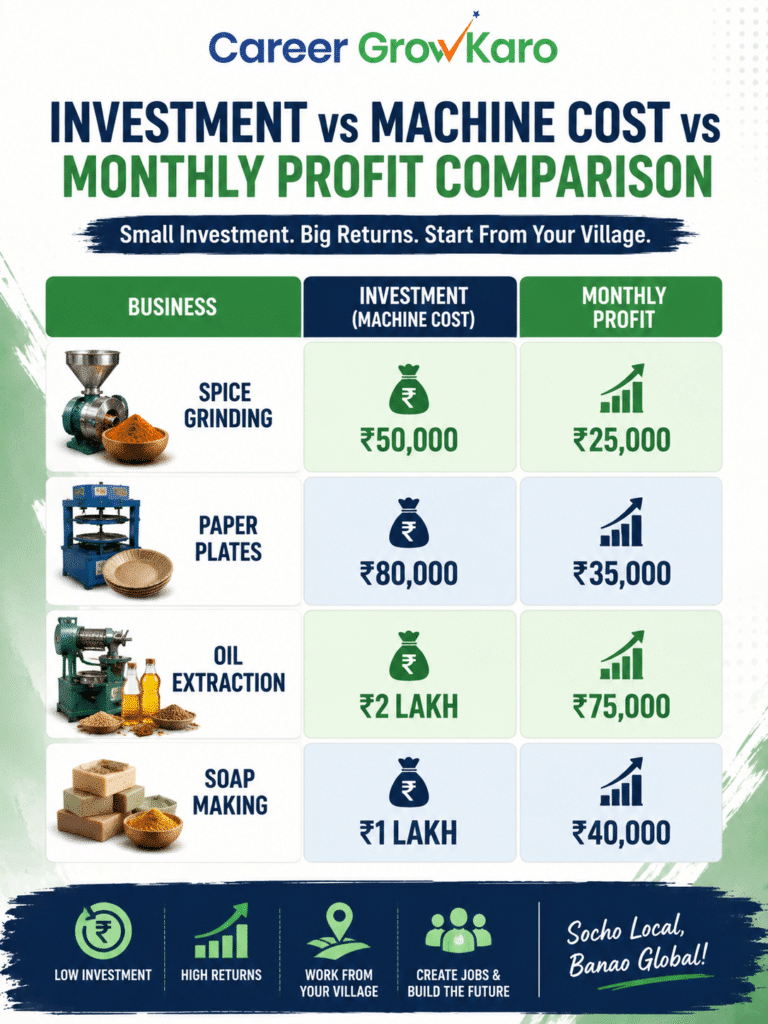
| Business | Investment | Space Required | Potential Monthly Income |
|---|---|---|---|
| Spice grinding | ₹30,000–₹1 lakh | 150 sq ft | ₹20,000–₹60,000 |
| Paper plates | ₹50,000–₹2 lakh | 200 sq ft | ₹25,000–₹70,000 |
| Mustard oil | ₹1–3 lakh | 250 sq ft | ₹40,000–₹1 lakh |
| Flour mill | ₹70,000–₹2 lakh | 200 sq ft | ₹30,000–₹80,000 |
| Soap making | ₹50,000–₹2 lakh | 150 sq ft | ₹30,000–₹70,000 |
| Candle making | ₹20,000–₹75,000 | 100 sq ft | ₹15,000–₹40,000 |
| Detergent production | ₹50,000–₹2 lakh | 150 sq ft | ₹30,000–₹80,000 |
Note: Actual profits depend on location, demand and operating costs. Investment and income numbers are indicative.
If you are considering products such as agarbatti, food items, paper products or paints, CareerGrowKaro already has detailed guides on several manufacturing niches. For example, the Areca Leaf Plate Business blueprint explains investment and machinery requirements, while the Acrylic Paint Manufacturing Business guide covers production setup, licensing and profit margins. Entrepreneurs planning larger setups can also read Top Manufacturing Business Ideas Under ₹50 Lakhs to understand how small factories scale over time.
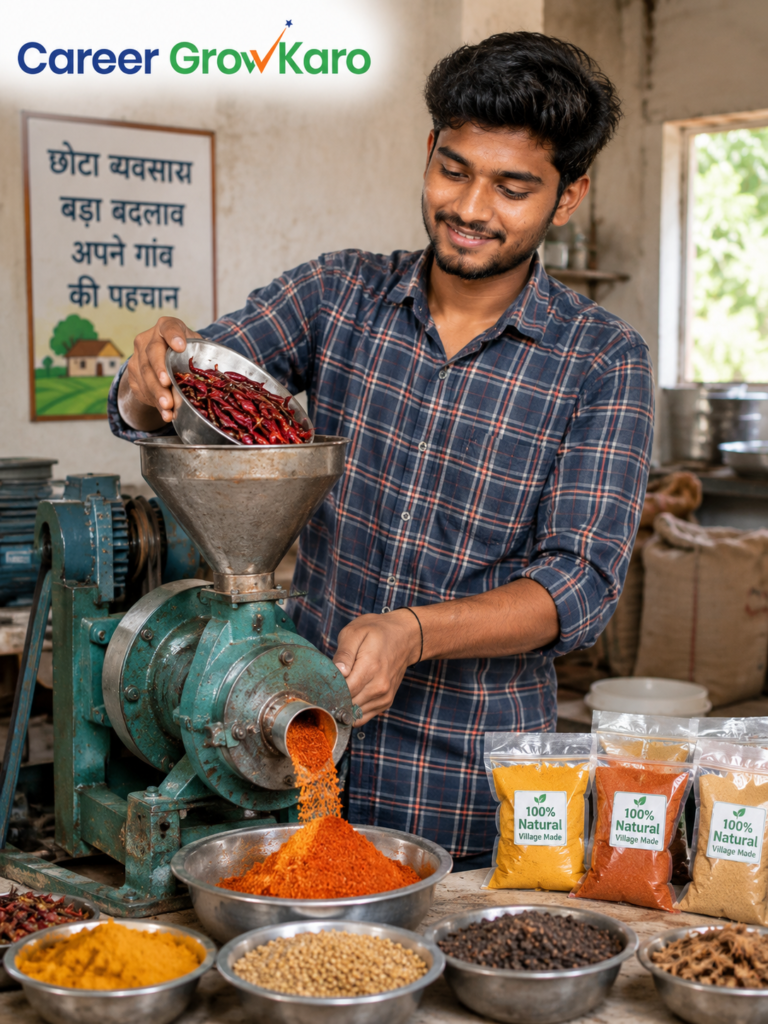
Business Idea #1: Spice Grinding Unit
India consumes spices every day.
Instead of selling loose spices, you can build a local brand that sells:
- Turmeric powder
- Chilli powder
- Coriander powder
- Garam masala
- Cumin powder
Start small.
Sell to:
- Kirana stores
- Restaurants
- Local markets
- Housing societies
- WhatsApp groups
Real Story: Women Entrepreneurs Built a Spice Business
In Delhi’s Tilak Nagar, a group of women supported by social organisations started a spice-processing business using grinding machines. They began with turmeric, cumin and coriander and gradually expanded production for nearby markets.
The lesson?
You don’t need a huge factory to begin. Start with one product and scale gradually.
Business Idea #2: Paper Plate Manufacturing
Paper plates are used in:
- Weddings
- Tea stalls
- Sweet shops
- Street-food outlets
- Religious events
Demand exists in almost every town.
Real Story: Minakshi Padhi from Odisha
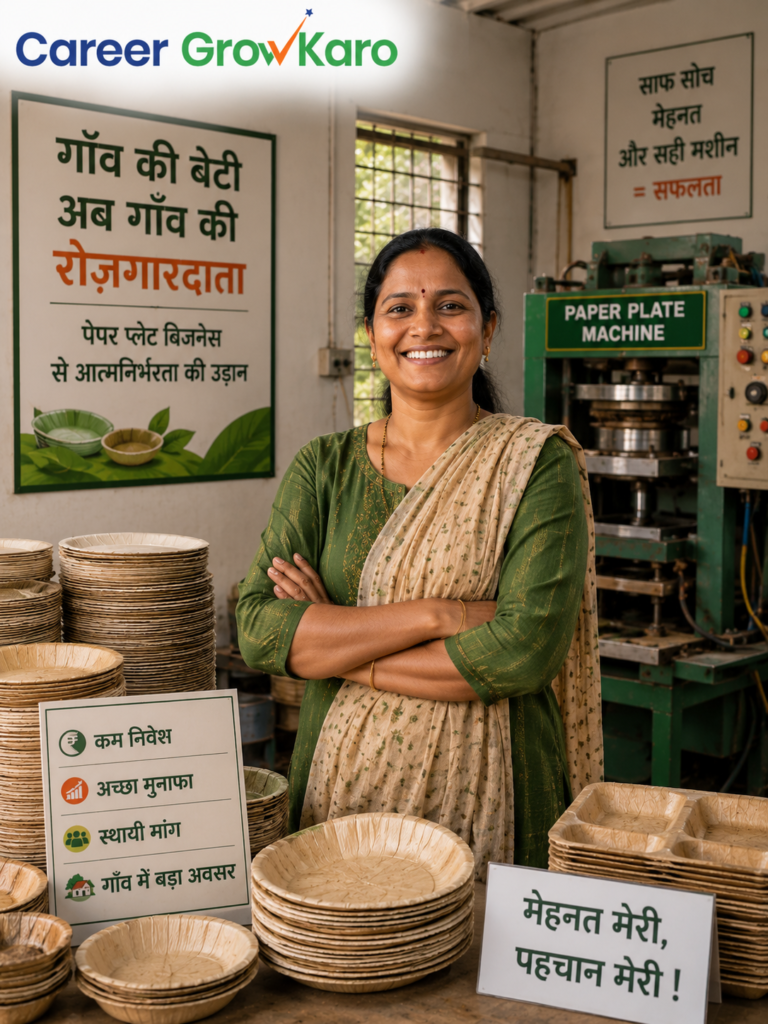
Minakshi Padhi, a resident of Rayagada district in Odisha, started a paper-plate unit after facing financial difficulties. Later, she shifted to eco-friendly leaf plates made from forest leaves.
Today, her business supplies products across multiple districts and generates annual revenue of around ₹14 lakh.
Her story proves that even a small machine can become the foundation of a sustainable business.
Business Idea #3: Mustard-Oil Processing
If your district produces mustard, groundnut or sesame, an oil-extraction machine can be a strong opportunity.
Customers increasingly prefer:
- Cold-pressed oil
- Locally made oil
- Chemical-free products
Real Story: Sarita Singh from Uttar Pradesh
Sarita Singh from Lakhimpur Kheri established an oil mill with support from the PMEGP scheme. Her business now supplies processed mustard oil to local traders and supports her family’s income.
Business Idea #4: Flour Mill
Every village needs:
- Wheat flour
- Rice flour
- Besan
- Millet flour
You can begin with local customers and later package your products under your own brand.
Business Idea #5: Soap and Detergent Manufacturing
Small towns have thousands of customers who buy:
- Washing powder
- Dishwashing liquid
- Bath soap
- Floor cleaners
With proper packaging and branding, margins can be attractive.
Business Idea #6: Candle Manufacturing
Candle demand spikes during:
- Festivals
- Religious ceremonies
- Power cuts
- Decorations
- Hotels and restaurants
A basic candle-making setup can start at less than ₹50,000.
Business Idea #7: Food Packaging Business
As local brands grow, packaging demand also increases.
You can manufacture:
- Pouches
- Labels
- Boxes
- Sealing packs
This business can serve dozens of nearby shops.
What We Learned From These Real Stories
The biggest lesson from successful entrepreneurs is not that they had more money.
It’s that they:
- Started small.
- Solved a local problem.
- Focused on one product.
- Reinvested profits.
- Built trust slowly.
You don’t need to become the next unicorn founder.
Sometimes, a single machine and a small workshop can change an entire family’s future.
Homemade Machine Works: How to Get Funding, Find Customers and Build a Profitable Business
You Don’t Always Need ₹5–10 Lakh to Start
One of the biggest myths among first-time entrepreneurs is that starting a manufacturing business requires huge capital.
In reality, many businesses start with:
- Family savings
- Small partnerships
- Self-help groups (SHGs)
- Government loans
- Mudra loans
- PMEGP subsidies
The key is to start small and expand only after customers begin paying.
Government Schemes That Can Help You Buy Machines
1. PMEGP: The Scheme Designed for Rural Entrepreneurs
The Prime Minister’s Employment Generation Programme (PMEGP) is one of India’s largest schemes for first-generation entrepreneurs. It supports new manufacturing and service businesses in rural and urban areas and is implemented by KVIC, District Industries Centres and banks. Manufacturing projects of up to ₹50 lakh are eligible under the scheme.
According to the official PMEGP dashboard, more than 29 lakh rural enterprises have already been assisted, generating employment opportunities across the country.
Subsidy structure
| Category | Own contribution | Subsidy (Rural) |
|---|---|---|
| General | 10% | 25% |
| Women, SC, ST, OBC | 5% | 35% |
Source: Ministry of MSME.
2. Mudra Loan: For Small Manufacturing Units
Under the Mudra scheme, entrepreneurs can apply for collateral-free loans to start manufacturing, trading or service businesses. The scheme offers different categories based on business size and requirements.
Mudra categories
| Category | Loan amount |
|---|---|
| Shishu | Up to ₹50,000 |
| Kishor | ₹50,001–₹5 lakh |
| Tarun | ₹5–10 lakh |
| Tarun Plus | ₹10–20 lakh |
The scheme is specifically designed for small businesses and manufacturing units.
Reality Check: Don’t Depend Entirely on Loans
Many YouTube videos make it seem as though loans are “free money.”
They are not.
A loan is useful only if:
- You already know who your customers are.
- You have calculated your monthly expenses.
- You understand your break-even point.
- You have a backup plan.
Never buy a machine just because a subsidy is available.
How to Validate Demand Before Spending a Single Rupee
Before investing ₹50,000 or ₹1 lakh in machinery, spend one week doing market research.
Step 1: Visit 20 local shops
Ask:
- Which products sell fastest?
- Which brands are expensive?
- Which products are always out of stock?
Step 2: Visit weekly markets
Observe:
- Customer footfall
- Popular products
- Pricing
- Packaging quality
Step 3: Study online marketplaces
Check:
- Amazon
- Flipkart
- Meesho
- IndiaMART
Look for:
- Customer reviews
- Price points
- Demand trends
Step 4: Test manually
Suppose you want to start a spice business.
Don’t buy the machine on Day 1.
Produce 20 packets manually and see whether customers reorder.
If people come back, you’ve found product-market fit.
How to Sell Products Without Opening a Shop
One of the biggest advantages today’s youth have is the internet.
You no longer need an expensive storefront.
Channel 1: WhatsApp
Create:
- Product catalogue
- Price list
- Order form
- Customer group
Many rural businesses now generate repeat sales through WhatsApp.
Channel 2: Local Kirana Stores
Offer retailers:
- Better margins
- Free samples
- Promotional posters
Start with five shops before expanding.
Channel 3: Instagram and Facebook
Post:
- Manufacturing videos
- Customer testimonials
- Packaging process
- Before-and-after stories
People trust products when they see how they are made.
Channel 4: Meesho and Amazon
Ideal for:
- Pickles
- Masalas
- Candles
- Handmade soaps
- Detergents
- Eco-friendly products
Real Story: How PMEGP Helped Sarita Singh Build an Oil Mill
Sarita Singh from Lakhimpur Kheri, Uttar Pradesh, started a mustard-oil processing unit with support from the PMEGP scheme. Today, her business supplies oil to local traders and has become an important source of income for her family.
Her story teaches three lessons:
- Start with local demand.
- Use government schemes wisely.
- Scale slowly.
Building a product is only half the battle; finding customers is equally important. CareerGrowKaro’s How to Grow a Local Business guide explains how entrepreneurs in small towns can attract customers through referrals, WhatsApp groups and local partnerships. Similarly, 5 Low-Investment Products You Can Sell Online from a Small Town shows how even village-based businesses can reach customers across India through marketplaces and social media.
Five Mistakes That Destroy Small Manufacturing Businesses
1. Buying the machine before finding customers
Customers come first.
Machines come later.
2. Ignoring branding and packaging
The same spice can sell for ₹80 or ₹180.
Packaging creates the difference.
3. Depending on a single customer
If one customer accounts for 80% of your revenue, your business is at risk.
Diversify.
4. Borrowing more than you can repay
Take loans based on cash flow, not emotion.
5. Expanding too fast
Many businesses fail because they grow faster than demand.
A 90-Day Roadmap to Start Your Homemade Machine Works Business
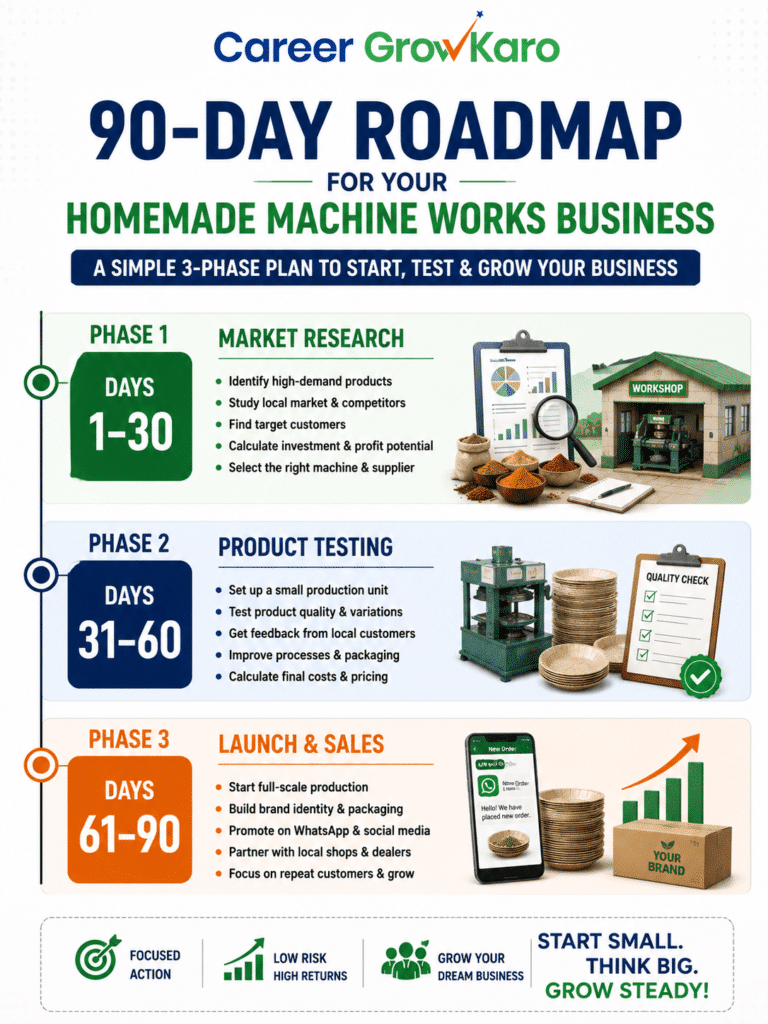
Month 1: Research
- Visit local shops.
- Study competitors.
- Decide your product.
- Estimate costs.
Month 2: Validation
- Produce samples.
- Get customer feedback.
- Finalize packaging.
- Register the business.
Month 3: Launch
- Purchase machinery.
- Start production.
- Create WhatsApp marketing.
- Approach retailers.
The Bigger Opportunity: Solve Local Problems
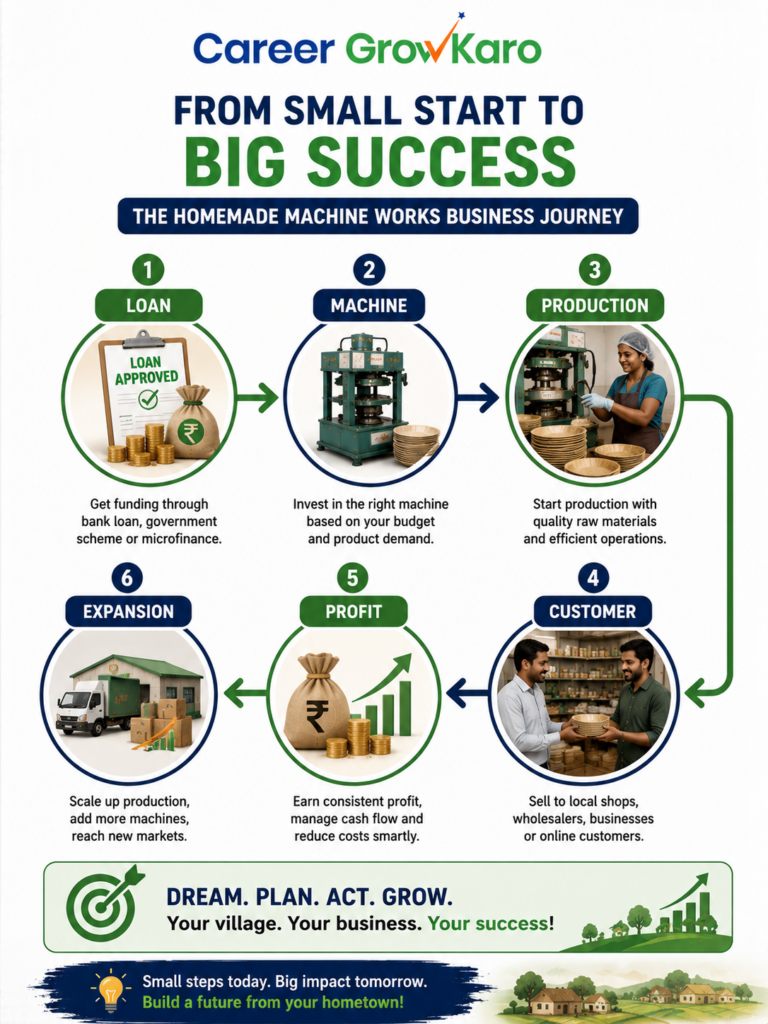
Most villages already have:
- Farmers
- Grocery stores
- Schools
- Tea shops
- Small businesses
Every one of them needs products.
The winners of the next decade may not come only from Bengaluru startups.
They may come from villages where a young entrepreneur decided to start with a single machine, one product and a willingness to solve a local problem.
That’s the true spirit of homemade machine works.
FAQ
Can I start a homemade machine works business with ₹50,000?
Yes. Businesses such as candle making, spice grinding and paper-plate manufacturing can often be started within this range.
Which machine business is best for villages?
Spice grinding, flour mills, oil extraction, agarbatti making and paper plates are among the most popular options.
Can students start a machine-based business?
Yes. Students can begin on a small scale during weekends or vacations and gradually expand.
Which government loan is best?
PMEGP and Mudra are among the most popular schemes for first-time entrepreneurs.