


Preparing for the Common Admission Test (CAT) is a crucial step for MBA aspirants aiming to secure admission to prestigious IIMs and other leading business schools in India. Every year, lakhs of candidates appear for the exam, making a well-planned CAT strategy essential for achieving a high percentile. Success in CAT is not just about studying hard; it is about studying smart with the right preparation plan, consistent practice, and regular revision.
Whether you are beginning your preparation early or have only a few months left, following an effective CAT strategy can help you improve your speed, accuracy, and confidence. From understanding the exam pattern and strengthening concepts to taking mock tests and analyzing your performance, every step plays an important role in your preparation journey.
This comprehensive guide by CareerGrowKaro covers everything you need to build a winning CAT strategy for 2026. With expert tips, section-wise preparation methods, practical study plans, and proven exam techniques, CareerGrowKaro will help you prepare efficiently and move closer to your dream MBA college. Start your CAT strategy today and maximize your chances of success.
Understanding the CAT Exam Pattern
A successful CAT strategy begins with understanding the CAT exam pattern thoroughly. Before creating your study plan, it is essential to know the exam structure so you can build an effective CAT strategy that covers every section equally.
The CAT exam generally consists of three sections:
- Verbal Ability and Reading Comprehension (VARC)
- Data Interpretation and Logical Reasoning (DILR)
- Quantitative Aptitude (QA)
The exam is computer-based and follows sectional time limits, meaning candidates cannot switch between sections during the allotted time. Therefore, a balanced CAT strategy that focuses on all three sections is crucial for maximizing your overall percentile.
Although the official CAT 2026 exam pattern will be announced closer to the examination, aspirants should prepare according to the latest pattern while remaining flexible for any changes. Understanding the exam format early allows you to develop a smarter CAT strategy, improve time management, and practice effectively. A well-informed CAT strategy ensures that you enter the exam with confidence and a clear plan for tackling every section.
Step-by-Step CAT Strategy to Crack CAT 2026
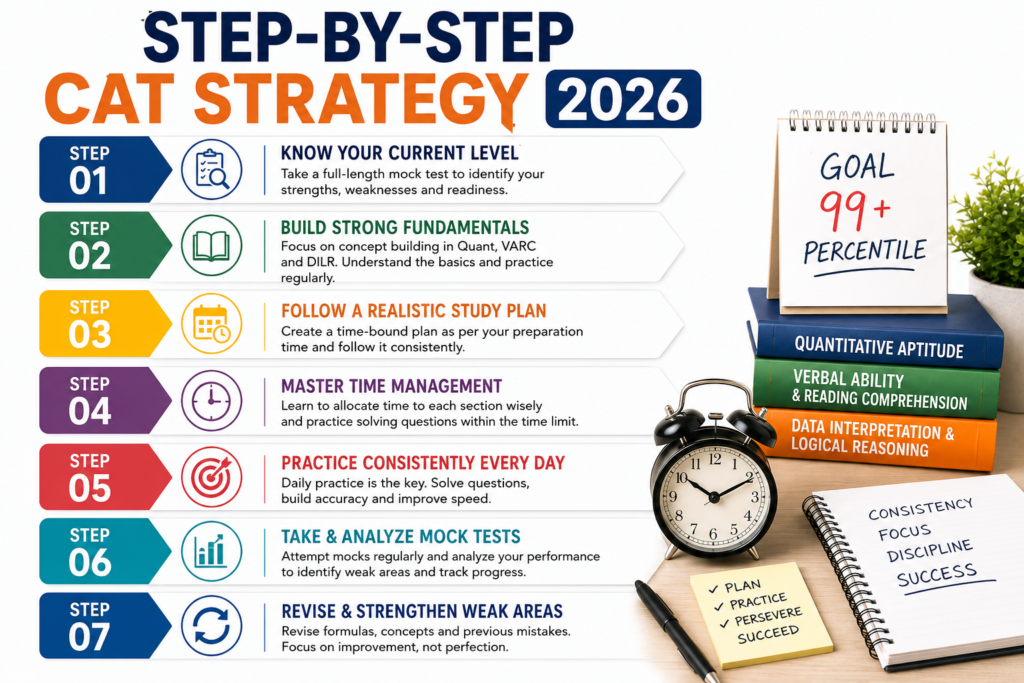
A well-planned CAT strategy is the key to achieving a high percentile in the CAT exam. Instead of studying randomly, follow these seven essential steps to prepare systematically. This CAT strategy focuses on building strong fundamentals, improving accuracy, managing time effectively, and maximizing your performance through consistent practice and revision.
Step 1: Know Your Current Level
Every successful CAT strategy begins with understanding your current preparation level. Before diving into your studies, attempt one full-length mock test without worrying about your score. The purpose is to evaluate your strengths and weaknesses so you can create a preparation plan based on your actual performance.
Your first mock test will help you identify:
- Strong subjects and topics
- Weak concepts that need improvement
- Time management issues
- Accuracy level
- Overall exam readiness
Analyze the results carefully and note the areas that require more attention. This assessment will help you develop a personalized CAT strategy instead of following a one-size-fits-all approach.
Step 2: Build Strong Fundamentals
The next step in your CAT strategy is strengthening your conceptual foundation. Before focusing on speed, ensure that you understand the basics of every subject.
1. Quantitative Aptitude (QA)
Start by covering high-weight topics such as
- Arithmetic
- Algebra
- Geometry
- Number System
- Modern Mathematics
Rather than memorizing formulas blindly, understand their applications and practice different question types from each chapter.
2. Verbal Ability and Reading Comprehension (VARC)
Improve your reading skills by regularly reading:
- Newspapers
- Editorials
- Business magazines
- Non-fiction books
Alongside reading, practice:
- Reading Comprehension passages
- Para Jumbles
- Summary Questions
- Odd Sentence Out
Developing comprehension and logical thinking is far more beneficial than simply learning difficult vocabulary.
3. Data Interpretation and Logical Reasoning (DILR)
Practice various DILR question types, including:
- Tables
- Charts
- Graphs
- Seating Arrangements
- Puzzles
- Games and Tournaments
- Caselets
Initially, focus on understanding the logic behind each set before attempting them under timed conditions.
Step 3: Follow a Realistic Study Plan
A practical study schedule is one of the most important components of an effective CAT strategy. Your preparation timeline should depend on the amount of time available before the exam.
If you have 12 months:
- Focus on building concepts
- Practice daily
- Revise weekly
- Take monthly mock tests
If you have 6 months:
- Increase practice sessions
- Attempt topic-wise tests
- Take sectional tests regularly
- Write weekly mock tests
- Revise every day
If you have 3 months:
- Prioritize mock tests
- Solve previous-year CAT-level questions
- Revise completed topics
- Focus on weak areas
Avoid trying to complete entirely new topics during the final months. Instead, strengthen your existing knowledge through revision and practice.
Step 4: Master Time Management
A good CAT strategy is not only about solving questions correctly but also about solving them within the limited time available. Since every section has a fixed time limit, learning to manage your time effectively is essential.
Some useful time management tips include:
- Solve easy questions first.
- Skip lengthy or confusing questions initially.
- Return to difficult questions if time permits.
- Avoid spending too much time on a single problem.
- Balance speed with accuracy instead of rushing through the paper.
Remember, attempting fewer questions accurately often results in a better percentile than attempting many questions with multiple mistakes.
Step 5: Practice Consistently Every Day
Consistency is one of the biggest factors behind a successful CAT strategy. Studying for a few hours every day is more effective than studying for long hours occasionally.
A balanced daily routine may include:
| Activity | Recommended Time |
| Reading | 30–45 minutes |
| Quantitative Practice | 1–2 hours |
| DILR Sets | 1 hour |
| VARC Practice | 45–60 minutes |
| Revision | 30 minutes |
Following a consistent study routine helps improve conceptual clarity, increases speed, and builds confidence over time.
Step 6: Take and Analyze Mock Tests Regularly
Mock tests are one of the most valuable tools in any CAT strategy. They simulate the actual exam environment and help you measure your preparation level.
Initially, attempt one mock test every two weeks. As the exam approaches, increase the frequency to one or two mocks per week. During the final two months, you may attempt two to three mocks weekly, depending on your preparation.
However, taking mocks alone is not enough. Spend sufficient time analyzing every test by identifying:
- Questions you solved correctly
- Questions you skipped
- Mistakes caused by conceptual gaps
- Errors due to poor time management
- Topics requiring additional revision
Maintain an error notebook and revisit it regularly to avoid repeating the same mistakes.
Step 7: Revise and Strengthen Weak Areas
The final step of your CAT strategy is regular revision and continuous improvement. Every student has strong and weak sections, but ignoring difficult topics can significantly affect your overall percentile.
Strengthen weak areas by:
- Revising concepts regularly
- Solving topic-wise practice questions
- Attempting sectional tests
- Practicing previous years’ questions
- Reviewing mock test mistakes
Create a revision schedule that includes daily formula revision, weekly topic reviews, and monthly comprehensive revision sessions. As the exam approaches, avoid learning entirely new concepts and focus on refining what you have already studied.
Following these seven steps consistently will help you build a smart CAT strategy, improve your performance in all three sections, and increase your chances of securing a high percentile in CAT 2026.
Best Resources for CAT Preparation
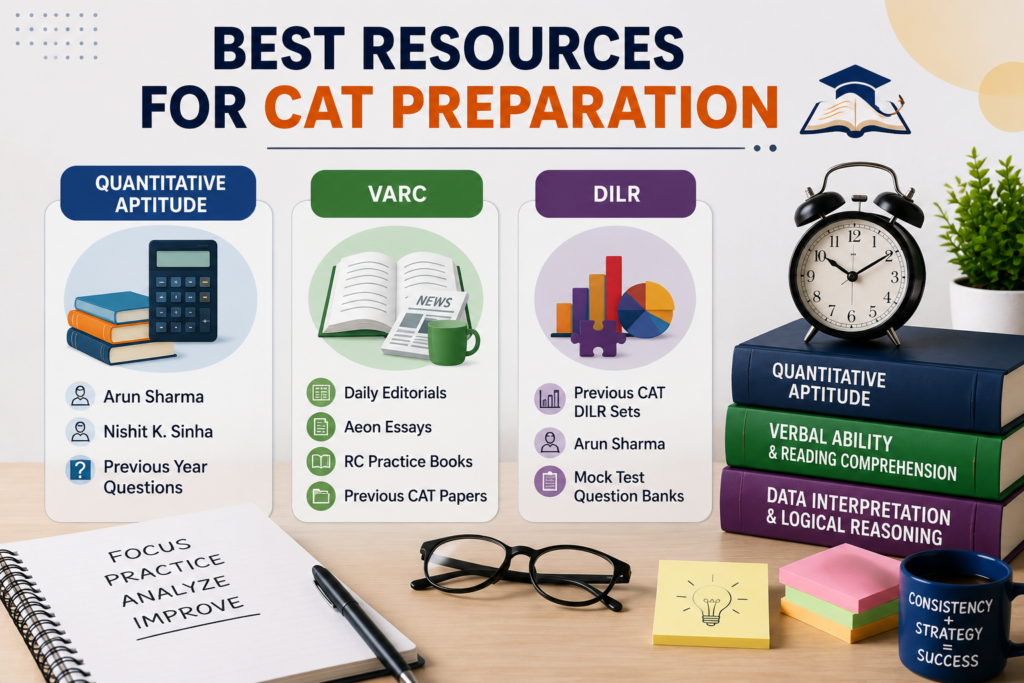
Choosing the right study material is an important part of an effective CAT strategy. Many aspirants make the mistake of collecting too many books and resources, which often leads to confusion and incomplete preparation. Instead, focus on a few trusted resources and revise them multiple times. A well-planned CAT strategy emphasizes quality over quantity, helping you build strong concepts and improve accuracy.
1. Quantitative Aptitude (QA)
For quant preparation, use resources that explain concepts clearly and provide ample practice questions.
Recommended books:
- How to Prepare for Quantitative Aptitude for CAT by Arun Sharma
- Quantitative Aptitude for CAT by Nishit K. Sinha
- Previous Year CAT Questions
These resources cover fundamental concepts, advanced problem-solving techniques, and CAT-level practice questions, making them essential for your CAT strategy.
2. Verbal Ability & Reading Comprehension (VARC)
Improving reading speed and comprehension is crucial for scoring well in VARC.
Recommended resources:
- Daily newspaper editorials (such as The Hindu or The Indian Express)
- Aeon Essays
- Reading Comprehension practice books
- Previous Year CAT Papers
Regular reading combined with consistent RC practice will strengthen comprehension, vocabulary, and analytical skills, making your CAT strategy more effective.
3. Data Interpretation & Logical Reasoning (DILR)
DILR requires regular practice with diverse question sets to improve logical thinking and problem-solving speed.
Recommended resources:
- Previous Year CAT DILR Sets
- How to Prepare for Data Interpretation for CAT by Arun Sharma
- Mock Test Question Banks
Practice a variety of puzzles, graphs, charts, and logical reasoning sets to become familiar with different question patterns.
Last 30 Days CAT Strategy
The final month before the exam is one of the most crucial phases of your CAT strategy. At this stage, your focus should shift from learning new concepts to refining your existing knowledge, improving accuracy, and building confidence. A smart CAT strategy during the last 30 days can significantly boost your overall performance and help you avoid unnecessary mistakes on exam day.
1. Prioritize Full-Length Mock Tests
Continue taking full-length mock tests under actual exam conditions. These tests help you improve time management, identify your strongest sections, and develop an effective question-selection strategy. Analyze every mock thoroughly to understand your mistakes and refine your CAT strategy accordingly.
2. Revise Important Formulas and Concepts
Dedicate time each day to revising important formulas, shortcuts, grammar rules, and frequently tested concepts. Avoid starting entirely new topics during this period, as it may create confusion and affect your confidence.
3. Analyze Your Errors
Review your mock test mistakes carefully and maintain an error notebook. Identify recurring errors, understand why they occurred, and ensure you do not repeat them. Learning from mistakes is an essential part of a successful CAT strategy.
4. Continue Reading Practice
Maintain your daily reading habit by solving reading comprehension passages and reading quality editorials or articles. This keeps your comprehension skills sharp and helps improve speed and accuracy in the VARC section.
5. Focus on Mental Preparation
Your mindset plays a vital role during the final weeks. Stay positive, avoid comparing your preparation with others, and trust the effort you have put in over the past months. A calm and confident approach is just as important as academic preparation.
Following a disciplined CAT strategy during the last 30 days will help you maximize your strengths, minimize errors, and enter the examination hall with confidence and clarity.
Conclusion
A successful CAT strategy is built on consistency, conceptual clarity, regular practice, and continuous improvement. Instead of relying on last-minute preparation, focus on creating a structured study plan that allows you to strengthen your fundamentals, improve your speed and accuracy, and build confidence through mock tests and revision. Remember, CAT is not just a test of knowledge but also of smart decision-making and time management.
Keep these key takeaways in mind throughout your preparation:
- Build strong fundamentals before focusing on speed and advanced questions.
- Take and analyze mock tests regularly to identify weaknesses and improve your exam strategy.
- Revise consistently and avoid learning completely new topics during the final weeks.
- Stay disciplined and maintain a healthy routine to perform at your best on exam day.
For more expert exam preparation guides, MBA admission updates, and career resources, CareerGrowKaro is a trusted platform to help you stay informed and prepare with confidence. With the right CAT strategy and dedicated effort, you can maximize your chances of securing a high percentile and getting into your dream B-school.
Frequently Asked Questions (FAQs)
1. What is the best CAT strategy for beginners?
The best CAT strategy for beginners is to start by understanding the exam pattern, building strong conceptual foundations in VARC, DILR, and Quant, following a realistic study plan, and taking regular mock tests. Consistent practice and revision are key to improving your percentile.
2. How many months are enough to prepare for CAT 2026?
Ideally, 8–12 months of preparation is recommended for CAT 2026. However, candidates with a strong academic background can also achieve a good score with 4–6 months of focused and disciplined preparation.
3. How many hours should I study daily for CAT preparation?
Most aspirants should aim to study 3–5 focused hours daily. The quality of study, regular revision, and mock test analysis are more important than simply spending long hours studying.
4. Are mock tests important for CAT preparation?
Yes. Mock tests are an essential part of any CAT preparation strategy. They help improve time management, boost accuracy, identify strengths and weaknesses, and familiarize you with the actual exam pattern.