
NEET, CUET or JEE — Which Exam Should You Choose?
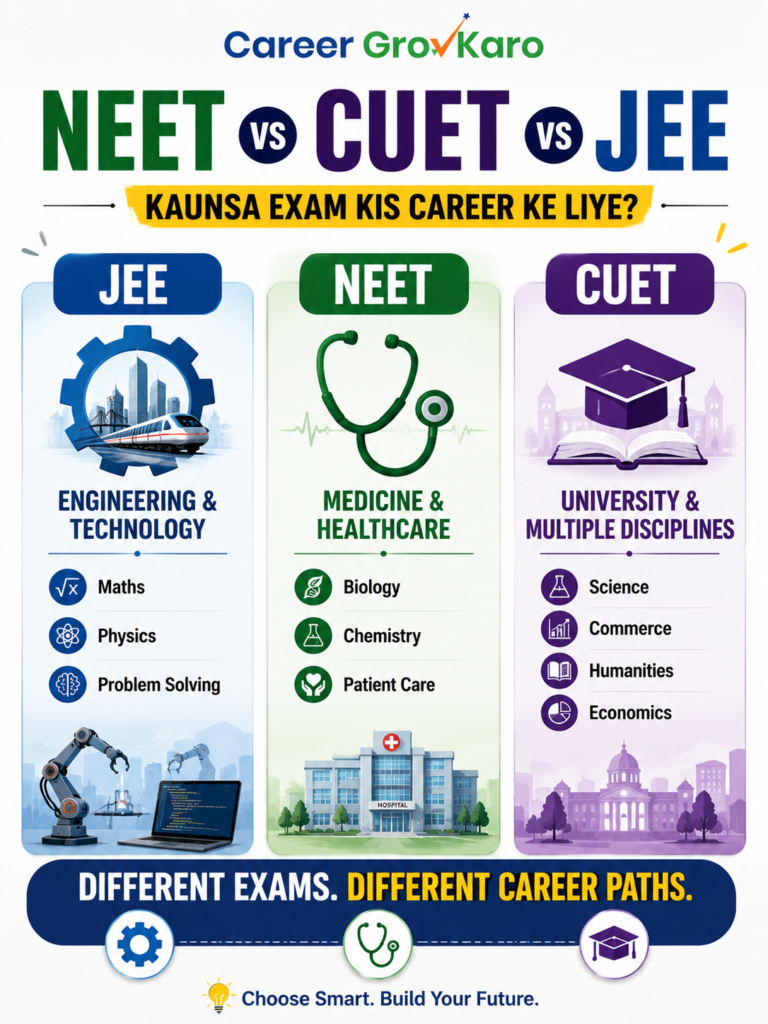
Choose JEE if you want to build a career in engineering, technology, architecture or other technical fields and genuinely enjoy Maths-based problem-solving.
- NEET, CUET or JEE — Which Exam Should You Choose?
- Don’t Choose the Exam First. Choose the Career First.
- NEET vs CUET vs JEE: Comparison Table at a Glance
- What Is JEE and Which Careers Does It Lead To?
- What Is NEET and Which Careers Does It Lead To?
- What Is CUET and Which Careers Can It Open?
- The Real Difference Between JEE, NEET and CUET
- JEE vs NEET vs CUET: The Career Comparison That Actually Matters
- Which Exam Should PCM Students Choose?
- Which Exam Should PCB Students Choose?
- Can You Prepare for JEE and CUET Together?
- Can You Prepare for NEET and CUET Together?
- The Biggest Mistake: Choosing NEET, JEE or CUET Based on Prestige
- A 7-Question Career Test Before Choosing NEET, JEE or CUET
- Three Student Scenarios: Which Exam Makes Sense?
- CareerGrowKaro Decision Box
- Final Decision: Should You Choose JEE, NEET or CUET?
- NEET vs CUET vs JEE: Frequently Asked Questions
- Your Exam Is Not Your Career
Choose NEET if you want to enter medicine or eligible healthcare pathways and are comfortable with a long, specialised academic journey.
Choose CUET if you want broader undergraduate options across participating universities and want to pursue courses in science, commerce, humanities, economics, social sciences or other fields.
The most important rule, however, is simple: do not choose the exam first. Choose the career direction first.
Your entrance exam is only the gate. Your career is the road after that.
Don’t Choose the Exam First. Choose the Career First.

After Class 12, one of the biggest questions for Indian students is simple but stressful: Should I prepare for NEET, JEE or CUET?
The problem is that students often start with the wrong question.
They ask:
Which exam is better?
Or:
Which exam has more scope?
Or:
Which exam is easier to crack?
But those questions come later.
The first question should be:
What kind of career do I actually want to build?
At CareerGrowKaro, we believe an entrance exam should follow your career decision—not replace it.
JEE can open doors to engineering and technology. NEET is the primary common entrance route for undergraduate medical education and several specified healthcare pathways. CUET can provide access to a wide range of undergraduate programmes at participating universities.
But here is the part many students realise too late:
Being good at Biology does not automatically mean you should become a doctor.
Being good at Maths does not automatically mean engineering is the right career for you.
And choosing CUET does not mean you have failed to choose a “bigger” exam.
Each route can be the right choice for the right student.
Let’s compare them properly.
NEET vs CUET vs JEE: Comparison Table at a Glance
| Factor | JEE | NEET | CUET |
|---|---|---|---|
| Main purpose | Engineering and technical admissions | Undergraduate medical education and specified eligible healthcare pathways | Admission to undergraduate programmes at participating universities |
| Best suited for | Students interested in Maths, technology and engineering | Students interested in Biology, medicine and healthcare | Students seeking broader degree and university options |
| Core academic focus | Physics, Chemistry and Mathematics | Physics, Chemistry and Biology | Depends on the programme and subjects selected |
| Career path | Relatively specialised | Highly specialised | Broad and course-dependent |
| Flexibility after admission | Depends on degree and institution | More specialised professional pathway | Usually wider because of programme variety |
| Typical student interest | Problem-solving, technology, design, engineering | Biology, healthcare, clinical work | Commerce, humanities, sciences, economics and multidisciplinary fields |
| Main decision to make | Which engineering/technical path? | Do I genuinely want a healthcare career? | Which degree and career direction fit me best? |
Important: Eligibility rules, subject requirements, participating institutions and admission processes can change. Students should always check the latest official information bulletin before applying.
For 2026, the National Testing Agency has published official information bulletins and notices for JEE Main, NEET UG and CUET UG.
What Is JEE and Which Careers Does It Lead To?
JEE, or the Joint Entrance Examination, is primarily associated with undergraduate engineering and technical education in India.
For most students, the JEE journey is linked with two stages:
- JEE Main
- JEE Advanced
JEE Main is used for admission to a range of engineering and related programmes and also serves as the qualifying route for JEE Advanced for eligible candidates. The official JEE Main information bulletin should always be checked for the latest eligibility, paper structure and admission rules.
Who Should Seriously Consider JEE?
JEE may be a good fit if you genuinely enjoy:
- Mathematics
- Physics
- Logical problem-solving
- Understanding how things work
- Technology
- Computers and coding
- Designing systems or products
- Building and improving things
The key word here is genuinely.
Many students choose JEE because they scored well in Class 10 Maths. Others choose it because their coaching institute recommends the PCM route.
Neither reason is enough on its own.
You will spend years studying technical subjects after clearing the exam. Your interest in the work that comes after college matters much more than the prestige attached to the entrance examination.
JEE Is Not the Career. Engineering Is the Career Decision.
This distinction is important.
Students often say:
“Mujhe JEE karna hai.”
But JEE is an examination. It is not a profession.
A better question is:
“Do I want to spend the next several years building a career around engineering, technology, science or technical problem-solving?”
If the answer is yes, JEE may be the right route.
If the answer is no—or “I don’t know”—you should pause before committing your entire Class 11 and 12 preparation to one exam.
Career Directions JEE Can Lead Towards
The degree and branch you eventually choose can influence your early career direction.
Depending on your programme, your interests and the skills you build, engineering education can lead towards areas such as:
- Software engineering
- Artificial intelligence
- Machine learning
- Data analytics
- Data science
- Mechanical engineering
- Civil engineering
- Electrical engineering
- Electronics and communication
- Robotics
- Product development
- Manufacturing
- Research and development
- Technical consulting
- Technology entrepreneurship
One important reality: your JEE rank does not decide your entire career.
The college, branch, internships, projects, technical skills and work you do after admission can all influence your future.
A student who gets into engineering but never enjoys the subject may struggle to stay motivated.
At the same time, a student from a less glamorous branch or college can build an excellent career by developing strong skills.
That is why CareerGrowKaro recommends choosing JEE because you see yourself in the career ecosystem, not simply because engineering sounds safe.
Also read – JEE Mains 2026 Ultimate Guide: With Strategies, Syllabus & Exam Pattern and NRI Quota JEE Main 2026: Complete Guide to Eligibility, Cut Off and Admission Process
JEE May Be Right for You If…
Consider JEE seriously if most of these statements sound like you:
- I enjoy Maths beyond just scoring marks.
- I like solving difficult problems.
- I am curious about technology.
- I can imagine working in an engineering or technical role.
- I enjoy understanding systems, machines, software or data.
- I am comfortable with a career that may require continuous technical learning.
- I am choosing this path for myself—not only because my family expects it.
If most of these statements do not sound like you, JEE may still be possible—but you should explore other options before deciding.
What Is NEET and Which Careers Does It Lead To?
NEET, or the National Eligibility-cum-Entrance Test (UG), is the common entrance examination used for undergraduate medical education in India and for several other specified pathways covered under current regulations.
According to the official NEET UG 2026 information available through the National Testing Agency, NEET is used for admission to undergraduate medical education in medical institutions and is also applicable to specified Indian systems of medicine and homeopathy programmes under the relevant laws. NEET qualification is also used for shortlisting in the specified Military Nursing Service BSc Nursing admission process.
Because admission rules can change, students should always verify the latest course-specific eligibility requirements before making decisions.
Who Should Consider NEET?
NEET may be the right route if you have a genuine interest in:
- Biology
- Human health
- Medicine
- Patient care
- Clinical work
- Healthcare sciences
- Understanding diseases and the human body
But there is one question that deserves more attention.
Do you enjoy studying Biology—or do you actually want to work in healthcare?
These are not the same thing.
A student may love Biology but dislike the idea of:
- Working directly with patients
- Clinical responsibility
- Long years of specialised education
- High-pressure healthcare environments
- The emotional demands of medical work
That does not mean the student has failed.
It simply means the student needs to make a career decision more carefully.
Biology Student Does Not Automatically Mean Doctor
This is one of the biggest career myths in Indian education.
A PCB student is often told that the obvious route is:
Class 12 → NEET → Medical college → Doctor
For some students, that is exactly the right path.
For others, it is not.
Biology can also lead students towards broader areas depending on the course, institution and admission route, including life sciences, research, biotechnology and other science-related fields.
The correct question is not:
“I took Biology. What else can I do?”
The better question is:
“What kind of work do I want to do with my knowledge of Biology?”
That answer should guide your exam and course strategy.
The NEET Career Commitment Reality
Medicine is a highly specialised professional path.
The National Medical Commission’s undergraduate education framework and curriculum reflect the structured and competency-based nature of medical education. The NMC also separately regulates compulsory rotating medical internship requirements and postgraduate medical education.
For students, the practical takeaway is simple:
Choose NEET because you are prepared for the journey—not only because becoming a doctor has social prestige.
Medicine can be deeply meaningful and rewarding.
But it also requires sustained commitment.
You should not enter the preparation cycle blindly because:
- “Doctor ki respect hoti hai”
- “PCB liya hai toh NEET dena hi hai”
- “Family mein sab chahte hain”
- “Engineering mujhe pasand nahi, toh doctor ban jaunga”
A career should be more than the alternative you choose after rejecting another career.
NEET May Be Right for You If…
Consider NEET seriously if most of these statements sound like you:
- I genuinely enjoy Biology.
- I am interested in healthcare.
- I can imagine working with patients or in a healthcare environment.
- I understand that professional medical education is a long-term commitment.
- I am willing to continue learning and training after undergraduate education.
- I am choosing this path because I want this career—not only because others want it for me.
If you love Biology but cannot imagine yourself in healthcare, take time to explore other science pathways before assuming NEET is your only option.
Also read – NRI Quota JEE Main 2026: Complete Guide to Eligibility, Cut Off and Admission Process
What Is CUET and Which Careers Can It Open?
CUET, or the Common University Entrance Test, is designed for admission to undergraduate programmes at participating universities.
This is where many students make a major mistake.
They treat CUET as:
“The exam I will give if JEE or NEET does not work.”
That thinking is outdated.
For many students, CUET can be a deliberate Plan A.
The right university and degree combination can provide access to strong academic and career pathways across multiple disciplines.
The exact participating universities, programmes, subject requirements and admission rules should be checked through the latest official CUET UG information bulletin and individual university admission pages.
Who Should Seriously Consider CUET?
CUET can make sense for students who want to explore undergraduate programmes across areas such as:
- Commerce
- Economics
- Sciences
- Humanities
- Social sciences
- Languages
- Business-related disciplines
- Interdisciplinary programmes
- Other participating university courses
The exact opportunities depend on the university and programme you choose.
The important difference is this:
CUET is primarily a university-and-course decision.
You are not simply choosing an exam.
You are choosing:
- A university
- A degree
- A possible career direction
That makes research extremely important.
CUET Is Not a “Backup Exam”
Let’s make this clear.
A student who chooses CUET may be doing so because they want:
- Economics instead of engineering
- Psychology instead of medicine
- Commerce and finance instead of a specialised professional course
- Humanities and social sciences
- Pure sciences
- Research
- A multidisciplinary degree
- A particular university programme
That is not settling for less.
That is choosing a different road.
The problem begins when students prepare for CUET without knowing which courses they actually want.
You should never say:
“CUET bhi de deta hoon. Dekhenge.”
Instead, say:
“These are the three courses I want. These are the universities offering them. CUET is one of my admission routes.”
That is a career strategy.
The Biggest Advantage of CUET: Career Flexibility
Compared with highly specialised entrance routes, CUET can offer broader flexibility because the available undergraduate programmes span multiple disciplines.
However, flexibility can also create confusion.
More options do not automatically mean a better decision.
A student choosing CUET still needs to answer:
- Which subject do I actually want to study?
- What jobs can that degree lead to?
- What skills will I need in addition to the degree?
- Which universities offer the programme?
- What is my Plan A and Plan B?
Career flexibility works only when you use it strategically.
Otherwise, students can spend three years completing a degree without building a clear direction.
Also read – How to Crack CUET PG 2027: A Complete Preparation Guide for Success
CUET May Be Right for You If…
Consider CUET seriously if:
- You do not want to lock yourself into one highly specialised path immediately.
- You have identified specific degree programmes you want to pursue.
- Your interests extend beyond engineering or medicine.
- You are interested in economics, commerce, sciences, humanities or other university disciplines.
- You want to compare multiple universities and programmes.
- You are building a clear academic and career Plan A + Plan B.
The Real Difference Between JEE, NEET and CUET
The easiest way to understand the three exams is this:
JEE asks:
Do you want to enter an engineering or technical pathway?
NEET asks:
Do you want to enter a specialised medical or eligible healthcare pathway?
CUET asks:
Which university programme and academic direction do you want to pursue?
That is why comparing only the difficulty of these exams can be misleading.
A difficult exam for one student may be the right path.
An easier exam for another student may still lead to the wrong career.
The goal is not to choose the easiest exam.
The goal is to choose the right direction.
JEE vs NEET vs CUET: The Career Comparison That Actually Matters
Most students compare NEET, JEE and CUET using three questions:
- Which exam is tougher?
- Which exam has more competition?
- Which exam gives better career opportunities?
These questions are understandable—but they can also lead to the wrong decision.
A better comparison is to ask:
What kind of life and career does each path prepare me for?
The National Testing Agency conducts all three examinations, but they serve fundamentally different admission purposes. JEE Main is associated with engineering and technical admissions, NEET UG is the common entrance route for undergraduate medical education and specified courses, while CUET UG is used for admission to undergraduate programmes at participating universities.
That means comparing the exams only on difficulty is like comparing three different roads based only on how much traffic they have.
The destination matters too.
NEET vs CUET vs JEE: Career Comparison
| Career Question | JEE Path | NEET Path | CUET Path |
|---|---|---|---|
| What are you primarily choosing? | Engineering or technical education | Medical or specified healthcare education | A university programme and degree |
| How specialised is the path? | High | Very high | Depends on the programme |
| Core academic orientation | Maths and technical problem-solving | Biology and healthcare sciences | Depends on selected course |
| Career flexibility | Moderate, depending on degree and skills | More specialised professional route | Generally broader across disciplines |
| Best suited for | Students who enjoy technology and analytical problem-solving | Students interested in healthcare and medicine | Students exploring a wider range of academic disciplines |
| Typical next question after admission | Which technical specialisation suits me? | Which healthcare or professional pathway do I want to pursue? | How will I turn my degree into a career advantage? |
| Biggest risk | Choosing engineering without liking technical work | Choosing medicine without understanding the commitment | Choosing a degree without a career plan |
The biggest difference is not necessarily the exam itself.
It is how early you are specialising.
A student entering a medical pathway is usually making a more specialised professional commitment from the beginning.
An engineering student is also entering a specialised academic ecosystem, although the skills developed can be applied across multiple industries.
A CUET aspirant may have a wider range of programme choices—but that flexibility requires stronger decision-making because the student still needs to decide what to do with the degree.
JEE: A Good Choice If You Want to Build, Solve or Create Through Technology
JEE is generally best understood as a route for students who are comfortable with a technical and analytical academic journey.
You do not need to know your exact job title at the age of 17.
You do not need to say:
“I want to become a software engineer at Company X.”
But you should broadly be able to say:
“I enjoy technology, analytical problem-solving and technical subjects enough to explore engineering seriously.”
JEE Main currently covers different papers for B.E./B.Tech and specified architecture/planning programmes, and the latest official information bulletin should always be checked for programme and eligibility details.
The JEE Career Advantage
Engineering can give students a strong technical foundation.
Depending on their branch, skills and interests, graduates may move into:
- Technology
- Software
- Data
- Product development
- Core engineering
- Manufacturing
- Infrastructure
- Consulting
- Research
- Entrepreneurship
However, there is one uncomfortable truth students should hear early:
Getting into engineering is not the same as enjoying engineering.
A student may clear JEE successfully and later realise that coding, engineering design or technical problem-solving is not something they want to do every day.
That is why the exam should not become the only goal.
The career should remain visible throughout the preparation journey.
NEET: A Good Choice If You See Yourself in Healthcare
NEET requires an even more specialised career decision.
The official NEET UG framework for 2026 describes the examination as the common and uniform entrance test for undergraduate medical education in medical institutions. It also applies to BAMS, BUMS and BSMS under the relevant framework and to BHMS, while NEET qualification is used for shortlisting for the specified Military Nursing Service BSc Nursing admissions.
This means a student choosing NEET should think beyond one question:
“Can I score enough marks?”
The bigger question is:
“Can I see myself building a future around healthcare?”
Healthcare careers can offer purpose, professional identity and the opportunity to make a direct difference in people’s lives.
But they also demand commitment.
Students should think about:
- The length of the education journey
- Professional training requirements
- Clinical responsibilities
- Continuous learning
- The emotional nature of healthcare work
- The possibility of working in demanding environments
This is not meant to discourage NEET aspirants.
It is meant to ensure that students choose NEET for the right reason.
CUET: A Good Choice If You Want More Academic Routes Before Specialising
CUET works differently because the exam is linked to a wide range of undergraduate programmes offered by participating universities.
The 2026 CUET UG framework covers admission to undergraduate programmes at Central Universities and participating State, Deemed and Private Universities. The available subjects include languages and a broad range of domain subjects, although the exact requirements depend on the university and programme.
This makes CUET potentially suitable for students who want to pursue areas such as:
- Economics
- Commerce
- Sciences
- Humanities
- Social sciences
- Languages
- Interdisciplinary programmes
- Other participating university courses
The major advantage is breadth.
But breadth also comes with responsibility.
A student cannot simply say:
“I’ll get into a good university and figure out the career later.”
That approach can work for some people—but it can also create confusion.
The better approach is:
Choose the degree with a broad idea of the career possibilities, then keep building skills during college.
Which Exam Should PCM Students Choose?
One of the biggest assumptions in Indian education is:
PCM student = JEE aspirant.
That is simply too narrow.
Yes, JEE is a natural and important route for PCM students interested in engineering and technology.
But PCM students are not limited to engineering.
A student may enjoy Mathematics and still be more interested in:
- Economics
- Statistics
- Data-oriented fields
- Pure sciences
- Research
- Architecture or planning, subject to programme requirements
- Business and analytics
- University programmes that combine mathematics with other disciplines
This is where CUET can become an important option for eligible students and programmes.
The correct strategy depends on the career direction—not on the stream label.
Also read – Exams After 12th Science: Ultimate Powerful Guide to Top Career Options
Choose JEE If You Are a PCM Student Who…
JEE may be your primary focus if:
- You enjoy Physics and Mathematics.
- You like solving complex problems.
- You are interested in engineering or technology.
- You can see yourself working with technical systems, software, machines, infrastructure or data.
- You want access to engineering and technical institutions that use JEE-based admissions.
For students targeting the IIT ecosystem and other technical institutions, the admission route and qualifying examination requirements should be checked through the official JEE and JoSAA platforms. For the 2026 academic cycle, JoSAA manages joint seat allocation across IITs, IISc Bengaluru, NITs, IIEST, IIITs and other participating Government-funded technical institutions, with the relevant JEE Main or JEE Advanced qualifications depending on the programme and institution.
Consider CUET If You Are a PCM Student Who…
CUET may deserve serious consideration if:
- You enjoy Mathematics but are not interested in engineering.
- You want to explore economics, sciences or other university disciplines.
- You are targeting a specific university programme.
- You want a broader academic Plan B.
- You are still exploring your long-term career direction.
The important thing is to avoid treating CUET as a random backup.
Before deciding to take CUET, identify:
- The degree you want.
- The universities offering that degree.
- The subject combination required.
- The career possibilities after graduation.
- Your Plan B if you do not get your first-choice university.
That turns CUET from an extra exam into a deliberate strategy.
PCM Student: A Simple Decision
Ask yourself:
“Do I want to solve technical problems as part of my career?”
If the answer is strongly yes, explore JEE seriously.
“Do I enjoy Maths but do not necessarily want engineering?”
Explore CUET programmes and other degree routes that match your interests.
“I am not sure yet.”
Do not panic.
You do not have to discover your entire life plan in Class 11.
But you should explore your options before investing two years of preparation into an exam simply because everyone around you is doing the same thing.
Which Exam Should PCB Students Choose?
PCB students face a similar—but often more intense—problem.
The assumption is:
PCB liya hai toh NEET dena hi padega.
Again, this is too simplistic.
NEET is the right choice for students who genuinely want to enter the medical and specified healthcare pathways covered under current regulations.
But taking Biology does not automatically mean that clinical medicine is the only meaningful future.
A student may enjoy Biology and be more interested in:
- Life sciences
- Biotechnology
- Research
- Environmental sciences
- Psychology, depending on programme requirements
- Other science and university pathways
The exact admission route will vary by course and institution, which is why students should verify requirements before making assumptions.
Choose NEET If You Are a PCB Student Who…
NEET should be your primary focus if:
- You genuinely want a healthcare or medical career.
- You enjoy Biology beyond textbook learning.
- You can imagine yourself in a clinical or healthcare environment.
- You understand that the professional journey can be demanding and long-term.
- You are comfortable committing to a specialised path.
The official NEET UG 2026 framework remains the key source for understanding eligibility and the courses covered under NEET regulations.
Consider CUET If You Are a PCB Student Who…
CUET may be worth considering if:
- You like Biology but are uncertain about clinical medicine.
- You want to explore broader university programmes.
- You have identified specific science or interdisciplinary degrees.
- You want a genuine Plan B alongside NEET.
- You want to keep more academic options open.
This is an important distinction.
A Plan B is not a sign that you lack confidence.
A well-designed Plan B is a sign that you understand uncertainty.
Competitive examinations are uncertain by nature.
Even highly capable students can have one bad day, one difficult paper or a score that does not match their expectations.
Your entire future should not depend on the assumption that one examination will definitely go exactly as planned.
Can You Prepare for JEE and CUET Together?
Yes, for some students, preparing for both can make strategic sense.
But it should not be done automatically.
The first step is to check whether your target CUET programmes actually align with your interests and whether their subject requirements overlap with what you are already studying.
CUET UG offers a broad subject structure, while JEE Main preparation is centred around the relevant Physics, Chemistry and Mathematics requirements for engineering pathways.
That creates potential overlap—but not complete overlap.
When JEE + CUET Can Make Sense
The combination may work if:
- JEE is your primary engineering route.
- You also have specific CUET programmes you genuinely want.
- The CUET subjects required overlap substantially with your academic preparation.
- You have enough time to prepare without damaging your main goal.
For example, a PCM student may have:
Plan A: Engineering through JEE
Plan B: A mathematics, science, economics or other identified university programme through CUET, depending on eligibility and admission requirements.
That is a coherent strategy.
When JEE + CUET May Not Make Sense
Avoid taking CUET simply because:
“Sab exam bhar dete hain.”
Multiple exams mean:
- More forms
- More schedules
- Different preparation demands
- More mental load
- More decision-making
If your CUET choices have no connection to your actual interests, you may end up spending time preparing for options you never intended to pursue.
A backup should still be a path you are willing to walk.
A Practical JEE + CUET Strategy
Start with these three questions:
1. What is my Plan A?
Be specific.
Not:
“A good college.”
Instead:
“Engineering through JEE.”
2. What is my Plan B?
Again, be specific.
Not:
“CUET.”
CUET is an examination, not a career plan.
Your answer should be closer to:
“A specific undergraduate programme at identified universities.”
3. Is there genuine academic overlap?
Check the latest CUET programme requirements and subject eligibility before assuming that your JEE preparation automatically covers everything.
Can You Prepare for NEET and CUET Together?
Yes, this combination can also make sense for some students—especially those who want a genuine academic alternative alongside their primary NEET preparation.
NEET UG 2026 remains centred on the relevant qualifying and examination requirements for Physics, Chemistry and Biology/Biotechnology, while CUET UG offers programme-dependent subject choices across participating universities.
That means the amount of overlap depends heavily on the course and university you are targeting through CUET.
When NEET + CUET Can Make Sense
This combination may work if:
- NEET is your primary goal.
- You have identified university programmes you would genuinely consider joining.
- Your CUET subject requirements align reasonably with your academic preparation.
- You want to avoid having your entire admission year depend on one result.
For example:
Plan A: NEET-based medical or healthcare admission
Plan B: A specific science-related undergraduate programme through a university route
That is a thoughtful strategy.
When NEET + CUET Becomes Counterproductive
The combination can become problematic when students try to prepare for every possible course without a clear reason.
For example:
NEET because family wants medicine.
CUET because friends are applying.
Another exam because the coaching institute recommends it.
This creates activity without direction.
And during Class 12 preparation, unnecessary activity can become a serious distraction.
The better approach is:
Fewer exams. Clearer reasons. Stronger preparation.
The Biggest Mistake: Choosing NEET, JEE or CUET Based on Prestige
Let’s address one of the most uncomfortable realities of career decisions in India.
Students are often influenced by the perceived prestige of a path.
You may hear:
“Doctor banoge toh life set hai.”
Or:
“Engineering mein scope bahut hai.”
Or:
“Top university mil jaye bas.”
The problem is that these statements are incomplete.
A career cannot be judged only by:
- Social prestige
- Salary headlines
- Family approval
- Coaching advertisements
- College rankings
- What your friends are choosing
A path that looks impressive from the outside may still be wrong for you.
“Doctor Ki Bahut Respect Hai”
Yes, medicine is a respected profession.
But respect cannot complete assignments for you.
Respect cannot make you enjoy clinical work.
And respect cannot replace genuine interest when you are facing years of demanding education and professional training.
If you want to become a doctor, choose the path because the work matters to you—not only because the title sounds prestigious.
“Engineering Mein Bahut Scope Hai”
Engineering can lead to excellent opportunities.
But “engineering” is not one job.
It includes multiple branches, industries and career directions.
Technology also changes quickly.
Students entering engineering need to be prepared to keep learning, developing skills and adapting to new tools and industries.
Do not choose engineering simply because someone told you it has “scope.”
Ask:
Which part of engineering interests me enough to build skills in it?
“CUET Is Easier, So Keep It as a Backup”
This is also a weak decision framework.
An exam being comparatively suitable for your preparation style does not mean the degree you enter through it is automatically the right one.
The value of CUET depends on what you plan to do with the opportunity.
A strong university programme can be an excellent Plan A.
A poorly researched course choice can create confusion even if you successfully secure admission.
The CareerGrowKaro Rule: Choose the Road, Not the Crowd
When thousands of students around you are preparing for the same examination, it is easy to assume that they must know something you do not.
But popularity is not career guidance.
Your friend may love coding.
You may hate it.
Your cousin may genuinely want to become a doctor.
You may be interested in research, economics or another field.
The same exam cannot be the best answer for everyone.
Before deciding, ask:
If nobody judged my choice, which career path would I actually explore?
That question may not give you an instant answer.
But it will give you a more honest starting point.
A 7-Question Career Test Before Choosing NEET, JEE or CUET

Still confused about NEET vs CUET vs JEE?
Don’t immediately search for another comparison article.
Instead, take five minutes and answer these seven questions honestly.
You do not need to have your entire life planned.
But your answers can help you identify which direction deserves more serious exploration.
1. Which Subject Can You Study Deeply for Years?
Not just for one board exam.
Ask yourself:
Which subject can I continue studying even when it becomes difficult?
For example:
- If you enjoy Mathematics, Physics and analytical problem-solving, technical pathways may be worth exploring.
- If Biology genuinely interests you and you are curious about healthcare, NEET-related pathways may deserve serious consideration.
- If your interests are broader or spread across subjects, university programmes available through CUET may offer more suitable options.
The important distinction is between:
“I score well in this subject”
and
“I genuinely want to continue learning this subject.”
These are not always the same.
A student can score 95 in Biology and still dislike the idea of working in healthcare.
Similarly, a student can score well in Mathematics but have no interest in becoming an engineer.
Marks tell you what you can currently perform well in.
They do not automatically tell you what career will keep you interested for years.
2. What Kind of Problems Do You Enjoy Solving?
This question can reveal more than students realise.
Think about the problems that naturally interest you.
You may lean towards JEE-related pathways if you enjoy:
- Mathematical problems
- Logical puzzles
- Building systems
- Technology
- Machines
- Coding
- Understanding how things work
You may lean towards NEET-related pathways if you enjoy:
- Biology
- Human health
- Understanding diseases
- The human body
- Healthcare problems
- Clinical sciences
You may want to explore CUET-based programmes if you are drawn towards:
- Economics
- Society and human behaviour
- Business
- Commerce
- Languages
- History
- Politics
- Science beyond a narrowly defined professional route
- Multiple academic disciplines
Your career should ideally involve solving problems you do not mind thinking about repeatedly.
3. Do You Want a Specialised or Flexible Career Path?
This is one of the most important differences between the three routes.
JEE and NEET generally involve earlier specialisation.
You are making a relatively strong decision about your academic direction.
That can be excellent if you are confident about the field.
CUET can offer broader academic flexibility.
Depending on the university and programme, students can choose from a wider range of disciplines and later build specialised skills.
But more flexibility is not automatically better.
Some students thrive when they have a clearly defined professional direction.
Others prefer exploring before committing.
Ask yourself:
Would I feel more comfortable choosing a specialised path now, or do I need more time and academic flexibility?
There is no universally correct answer.
The right answer depends on you.
4. Can You Realistically Commit to the Preparation Journey?
Students often think only about the examination day.
But the exam is the final stage of a much longer preparation journey.
Ask yourself:
- Can I study these subjects consistently?
- Do I understand the level of competition?
- Am I choosing this exam because I genuinely want the destination?
- Can I remain motivated when preparation becomes repetitive?
- Do I have a realistic preparation plan?
JEE, NEET and CUET all require different strategies depending on the subjects and programmes you target.
The official information bulletins should be the starting point for understanding the latest examination structure, subject requirements and eligibility—not coaching advertisements or social media rumours.
5. What Happens If Plan A Does Not Work?
This question does not mean you should expect failure.
It means you should understand risk.
Competitive examinations can be unpredictable.
Your score may be affected by:
- Exam-day performance
- Competition
- Cut-offs
- Seat availability
- Admission rules
- Counselling outcomes
A strong student can still miss a particular target.
That is why every serious aspirant should ask:
What is my Plan B—and would I actually be happy to pursue it?
For example:
JEE Aspirant
Plan A: Engineering through the targeted JEE-based admission route.
Plan B: A specific science, mathematics, economics or other identified undergraduate programme, depending on eligibility and interest.
NEET Aspirant
Plan A: A NEET-linked medical or healthcare pathway.
Plan B: A specific university programme that genuinely matches the student’s interests.
CUET Aspirant
Plan A: A preferred programme and university combination.
Plan B: Other identified universities or programmes—not simply “whatever seat is available.”
The best Plan B is not random.
It is a route you can genuinely imagine choosing.
6. Are You Choosing the Career—or Choosing the Prestige?
This question can be uncomfortable.
But it matters.
Ask yourself honestly:
Would I still choose this path if nobody was impressed by it?
Many students unconsciously choose careers because of:
- Family expectations
- Social prestige
- Peer pressure
- Coaching culture
- Salary headlines
- College brand value
These factors are not completely irrelevant.
College quality and career opportunities matter.
But they should not become the entire basis of your decision.
A prestigious career that does not suit your strengths can become exhausting.
A less fashionable degree that matches your interests can become a powerful foundation when combined with relevant skills and experience.
7. If Nobody Judged You, What Would You Choose?
Imagine that:
- Your relatives have no opinion.
- Your friends cannot see your choice.
- Nobody can compare your college with anyone else’s.
- Your salary will not be discussed at family functions.
What would you explore?
You may still choose medicine.
You may still choose engineering.
You may still choose a CUET-based university programme.
But your answer is likely to be more honest.
And honesty is a good place to start a career decision.
Three Student Scenarios: Which Exam Makes Sense?
These are illustrative scenarios, not universal recommendations.
Every student’s academic profile, finances, interests and admission eligibility are different.
But the examples can help you understand how a career-first decision works.
Scenario 1: Rahul — PCM Student Who Loves Technology
Rahul is studying Physics, Chemistry and Mathematics.
He enjoys:
- Mathematics
- Coding
- Computers
- Solving logical problems
However, Rahul is not completely sure whether he wants Computer Science, Electronics or another technical field.
A sensible strategy for Rahul could be:
Primary route: JEE-based engineering admissions.
Additional option: Selected CUET programmes that genuinely align with his interests and eligibility.
Why?
Because Rahul’s Plan A and Plan B are connected.
Both are based on his interest in analytical and technical subjects.
He is not taking CUET simply because “everyone is filling the form.”
He has identified what he might study if his first-choice engineering route does not work out.
The lesson:
Multiple exams make sense when they support one career direction.
Scenario 2: Ananya — PCB Student Who Loves Biology but Is Unsure About Medicine
Ananya enjoys Biology.
She scores well in the subject and initially assumed she had to prepare only for NEET.
But when she thought more deeply, she realised she was unsure whether she wanted a clinical healthcare career.
She liked:
- Biology
- Research
- Science
- Learning how living systems work
But she was not certain about becoming a doctor or entering a clinical profession.
A sensible strategy for Ananya could be:
Explore NEET seriously only if she is genuinely interested in the healthcare pathway while also researching eligible university programmes that match her interests.
Depending on programme requirements, she may explore science-related university pathways through CUET or other applicable admission routes.
The lesson:
Liking Biology and wanting to practise medicine are two different career decisions.
A PCB student should understand that distinction before spending years preparing for a path chosen mainly because of the subject combination.
Scenario 3: Arjun — Student Interested in Economics and Business
Arjun enjoys:
- Economics
- Mathematics
- Business
- Understanding markets
He has no interest in engineering or clinical medicine.
For Arjun, preparing for JEE or NEET simply because they are considered major entrance examinations would make little sense.
His stronger strategy would be to:
- Identify the degrees he wants.
- Identify the universities offering those programmes.
- Check the latest admission requirements.
- Prepare for the relevant entrance route.
CUET can become a meaningful primary pathway for students like Arjun when the target programmes and participating universities align with their academic goals. The 2026 CUET UG framework covers admission to undergraduate programmes at Central Universities and participating universities, with programme requirements varying by institution.
The lesson:
The biggest exam is not necessarily the right exam.
The exam that leads to your intended academic and career direction is the one that deserves your attention.
CareerGrowKaro Decision Box
Still Confused? Use This Career-First Formula
Before choosing your entrance exam, write down:
Step 1: Three careers you are genuinely curious about.
Do not write what your parents want.
Write what interests you.
Step 2: Find the degree required for each career.
For example, your target career may require:
- Engineering education
- Medical education
- A specific university degree
- Additional professional qualifications
Step 3: Check the admission route.
Identify whether the programme requires:
- JEE
- NEET
- CUET
- Another entrance examination
- Institution-specific admission
Step 4: Build Plan A and Plan B.
Your Plan B should be a career path you are willing to pursue—not just another examination form.
Interest → Career Direction → Degree → Entrance Exam
This is the order CareerGrowKaro recommends students follow.
Not:
Popular Exam → Coaching Class → Two Years of Preparation → Career Confusion
Final Decision: Should You Choose JEE, NEET or CUET?
If you have read this far, the answer should now be clearer.
There is no universal winner in the NEET vs CUET vs JEE debate.
The best exam depends on where you want to go.
Choose JEE If…
Choose JEE as your primary route if:
- You genuinely enjoy Mathematics and analytical thinking.
- You are interested in engineering or technology.
- You enjoy solving technical problems.
- You can see yourself exploring a technical career.
- The engineering programmes you want use the relevant JEE-based admission route.
The latest JEE Main information bulletin and official admission platforms should be checked before finalising programme and eligibility decisions.
Choose NEET If…
Choose NEET as your primary route if:
- You genuinely want a medical or eligible healthcare pathway.
- You enjoy Biology.
- You understand that healthcare education can require long-term commitment.
- You can imagine yourself working in a healthcare-related professional environment.
- The course you want falls under the applicable NEET admission framework.
The latest NEET UG information bulletin should always be your final source for eligibility and admission-related details.
Choose CUET If…
Choose CUET as your primary route if:
- You have identified university programmes that genuinely interest you.
- You want to pursue a broader academic discipline.
- Your career interests extend beyond specialised engineering or medical routes.
- You have researched participating universities and programme requirements.
- You want flexibility but are still prepared to make informed course choices.
CUET is strongest as a strategy when you know what you are applying for—not when you are simply applying everywhere.
The latest CUET UG information bulletin and university admission pages should be checked for programme-specific requirements.
Consider More Than One Exam If…
Taking multiple entrance examinations can make sense if:
- Your options are genuinely connected to your interests.
- You have a clear Plan A and Plan B.
- You can manage the preparation without harming your primary goal.
- You have researched the programmes behind each exam.
Do not take multiple examinations simply because:
“Forms bharne mein kya jaata hai?”
Your time and mental energy also have value.
NEET vs CUET vs JEE: Frequently Asked Questions
Which is better: NEET, JEE or CUET?
None is universally better. JEE is generally suited to engineering and technical pathways, NEET to undergraduate medical education and specified healthcare pathways, and CUET to a broad range of undergraduate programmes at participating universities. The right choice depends on your intended career and degree.
Is CUET easier than NEET and JEE?
Comparing the exams only as “easy” or “difficult” can be misleading because they serve different purposes and have different subject and programme requirements. A student may find one exam more suitable based on their academic strengths and target programme. Always check the latest official syllabus and examination structure.
Can PCB Students Give CUET Instead of NEET?
Yes, PCB students may apply for CUET-based programmes where they meet the relevant eligibility and subject requirements. However, CUET does not automatically replace NEET for courses covered under the NEET admission framework. Students should check the latest requirements for their specific course and university.
Can PCM Students Give CUET Instead of JEE?
Yes, PCM students can pursue CUET-based undergraduate programmes if they meet the relevant university and programme requirements. However, for engineering and other programmes using JEE-based admissions, CUET may not replace the applicable entrance requirement. Students should decide based on the course they want—not simply their Class 12 stream.
Can I Prepare for JEE and CUET Together?
Yes, if your target CUET programmes genuinely align with your academic interests and preparation. Before attempting both, check the required CUET subjects and programme eligibility. The combination works best when CUET supports a meaningful Plan B rather than becoming an additional exam without a clear purpose.
Can I Prepare for NEET and CUET Together?
Yes, some students prepare for both to maintain a genuine alternative academic pathway. However, the strategy should be based on specific target courses and their subject requirements. Preparing for multiple exams without identifying the courses you would actually join can create unnecessary pressure.
Your Exam Is Not Your Career
NEET, JEE and CUET can all open important doors.
But clearing an entrance exam is only one stage of a much longer journey.
The real question is not:
“Which exam is the biggest?”
It is:
“Which path can I genuinely see myself walking?”
JEE may be the right choice for the student who loves technology and technical problem-solving.
NEET may be the right choice for the student who genuinely wants to build a future in healthcare.
CUET may be the right choice for the student who has identified a university programme that aligns with their interests and wants broader academic possibilities.
There is no shame in choosing a different path from your friends.
There is no prize for preparing for an exam that leads to a career you do not want.
And there is nothing wrong with changing your mind after learning more about yourself.
One Clear Next Step
Before registering for your next entrance examination, do this:
Write down three careers you would genuinely consider.
Then identify:
Career → Required Degree → College/University Options → Entrance Exam
Only then finalise your preparation strategy.
Because your entrance exam is a gate.
Your career is the road after it.
Choose the road first.