

The RRB NTPC exam is one of the most popular railway recruitment examinations in India, offering candidates opportunities to secure various undergraduate and graduate-level posts in the Non-Technical Popular Categories. With a large number of applicants competing for limited vacancies, effective preparation is essential to perform well at every stage of the selection process. A well-planned approach to RRB NTPC preparation can help candidates cover the syllabus systematically while improving their speed, accuracy, and confidence.
The examination primarily tests candidates in mathematics, general intelligence & reasoning, and general awareness. Each section requires a different preparation strategy, making it important to balance conceptual learning with regular practice and revision. Solving previous-year question papers and taking mock tests can further help aspirants understand the exam pattern, identify weak areas, and improve time management.
In this RRB NTPC Preparation Guide, CareerGrowKaro provides a practical strategy, subject-wise preparation tips, a study plan, and common mistakes to avoid. Whether you are starting your preparation or looking to improve your existing strategy, following a structured routine can help you make your preparation more focused and effective.
Understand the RRB NTPC Exam Pattern
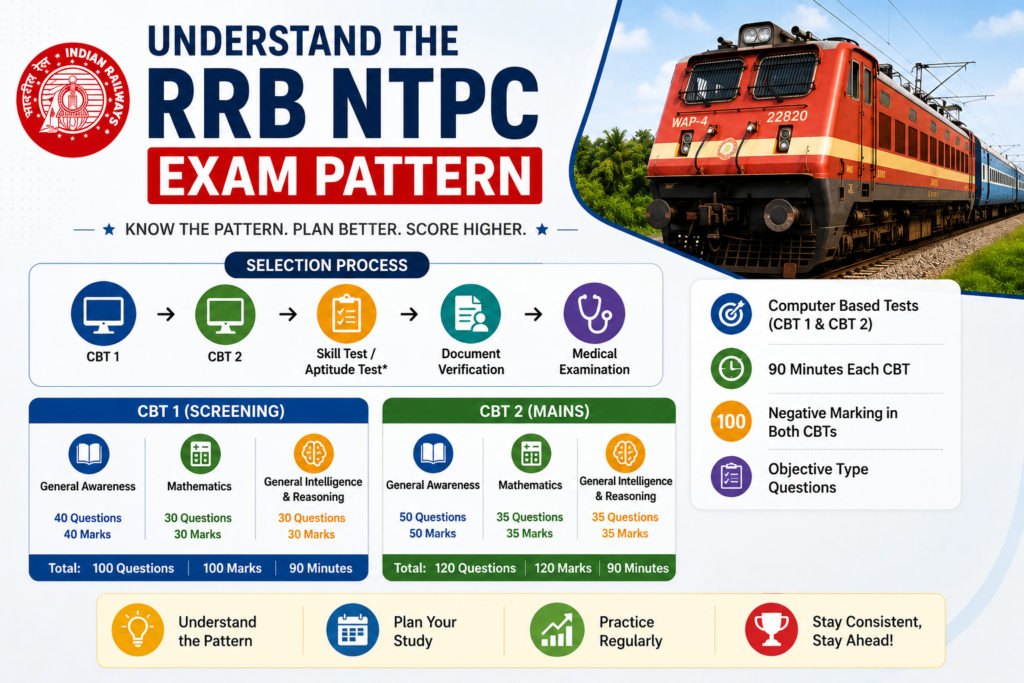
Before starting your RRB NTPC preparation, it is important to understand the exam pattern and selection process. Knowing the stages, subjects, number of questions, and marking scheme helps candidates plan their preparation time more effectively and avoid surprises during the examination.
The RRB NTPC selection process generally includes Computer Based Test (CBT) 1, CBT 2, a skill test or aptitude test wherever applicable, document verification, and a medical examination. The exact requirements may vary depending on the post applied for. Candidates should therefore check the latest official notification for post-specific eligibility and selection details.
CBT 1
CBT 1 is generally conducted as a screening stage. It consists of 100 questions carrying 100 marks, with a duration of 90 minutes. The paper covers mathematics, general intelligence and reasoning, and general awareness.
| Section | Questions | Marks |
| General Awareness | 40 | 40 |
| Mathematics | 30 | 30 |
| General Intelligence & Reasoning | 30 | 30 |
| Total | 100 | 100 |
CBT 2
CBT 2 is more comprehensive and plays a significant role in the selection process. It consists of 120 questions for 120 marks, with candidates generally getting 90 minutes to complete the paper.
| Section | Questions | Marks |
| General Awareness | 50 | 50 |
| Mathematics | 35 | 35 |
| General Intelligence & Reasoning | 35 | 35 |
| Total | 120 | 120 |
For both CBT stages, candidates should be mindful of negative marking. Generally, 1/3 of the mark is deducted for every incorrect answer. Therefore, blindly attempting questions can reduce your overall score. As part of an effective RRB NTPC preparation strategy, focus on maintaining a balance between speed and accuracy.
Candidates should also remember that qualifying for CBT 1 does not mean the preparation is complete. A strong RRB NTPC preparation plan should cover CBT 2 from the beginning, along with regular mock tests and previous-year question practice. Understanding the exam structure early allows you to allocate more time to high-weightage sections and build the accuracy required to perform well.
Note: Exam patterns and post-specific stages can change with official notifications. Always verify the latest RRB notification before finalizing your RRB NTPC preparation strategy.
Know the RRB NTPC Syllabus Thoroughly
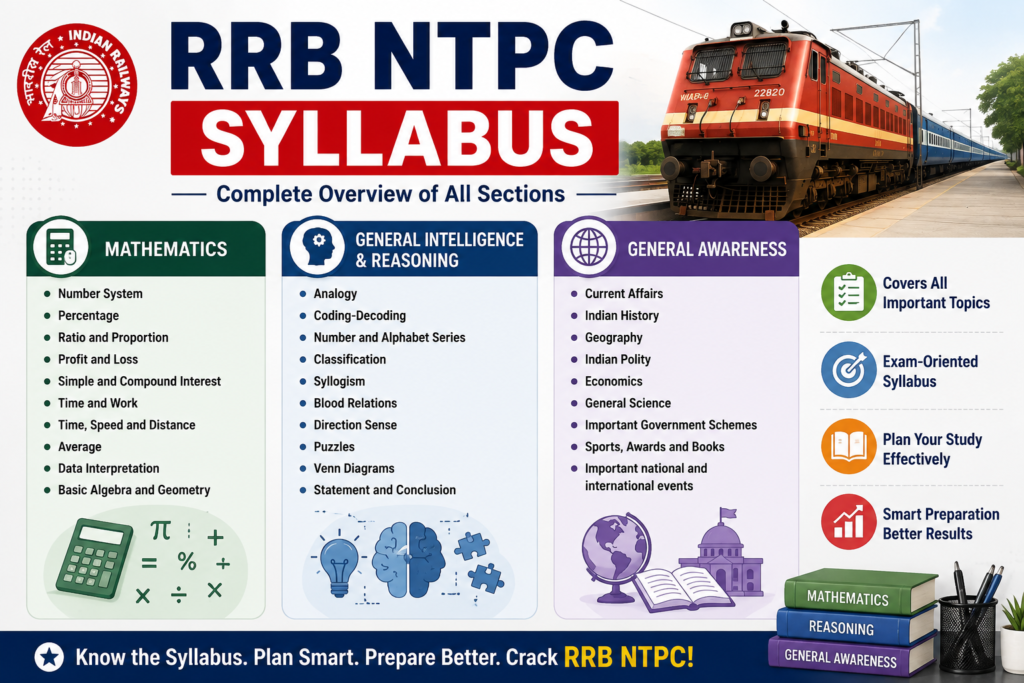
A clear understanding of the syllabus is the foundation of effective RRB NTPC preparation. Before choosing books, watching lectures, or taking mock tests, candidates should know which topics are covered in each section. This helps you prioritize important areas, create a realistic timetable, and avoid spending excessive time on topics that have limited relevance to the examination.
The RRB NTPC syllabus is broadly divided into Mathematics, General Intelligence & Reasoning, and General Awareness. A subject-wise approach can make RRB NTPC preparation more organized and manageable.
1. Mathematics
The mathematics section tests basic numerical ability, mathematical concepts, and calculation skills. Important topics include:
- Number System
- Percentage
- Ratio and Proportion
- Profit and Loss
- Simple and Compound Interest
- Time and Work
- Time, Speed and Distance
- Average
- Data Interpretation
- Basic Algebra and Geometry
Candidates should first strengthen their fundamentals before moving to advanced or mixed-level questions. Regular practice is particularly important because faster calculations can save valuable time during the examination.
2. General Intelligence & Reasoning
The Reasoning section evaluates your logical thinking, analytical ability, and ability to identify patterns. Key topics include:
- Analogy
- Coding-Decoding
- Number and Alphabet Series
- Classification
- Syllogism
- Blood Relations
- Direction Sense
- Puzzles
- Venn Diagrams
- Statement and Conclusion
For effective RRB NTPC preparation, practice different question types regularly instead of focusing on only the easiest topics. As your familiarity improves, try solving questions within a fixed time limit to develop speed and accuracy.
3. General Awareness
General awareness covers a wide range of static and current topics. It can become a high-scoring section if candidates follow a consistent revision strategy. Important areas include:
- Current Affairs
- Indian History
- Geography
- Indian Polity
- Economics
- General Science
- Important Government Schemes
- Sports, Awards and Books
- Important National and International Events
Current affairs should be studied regularly rather than left for the final weeks. Make concise notes and revise them periodically. For static subjects, focus on important facts and concepts that are frequently asked in competitive examinations.
Once you understand the syllabus, divide it into daily and weekly targets. Track the topics you have completed and regularly revisit the ones where your accuracy is low. This approach makes your RRB NTPC preparation more structured and helps ensure that no major topic is overlooked.
Remember that completing the syllabus once is not enough. Effective RRB NTPC preparation requires a combination of conceptual learning, question practice, previous-year papers, mock tests, and repeated revision. A well-organized syllabus checklist can help you monitor your progress and identify areas that need additional attention.
Subject-Wise RRB NTPC Preparation Strategy
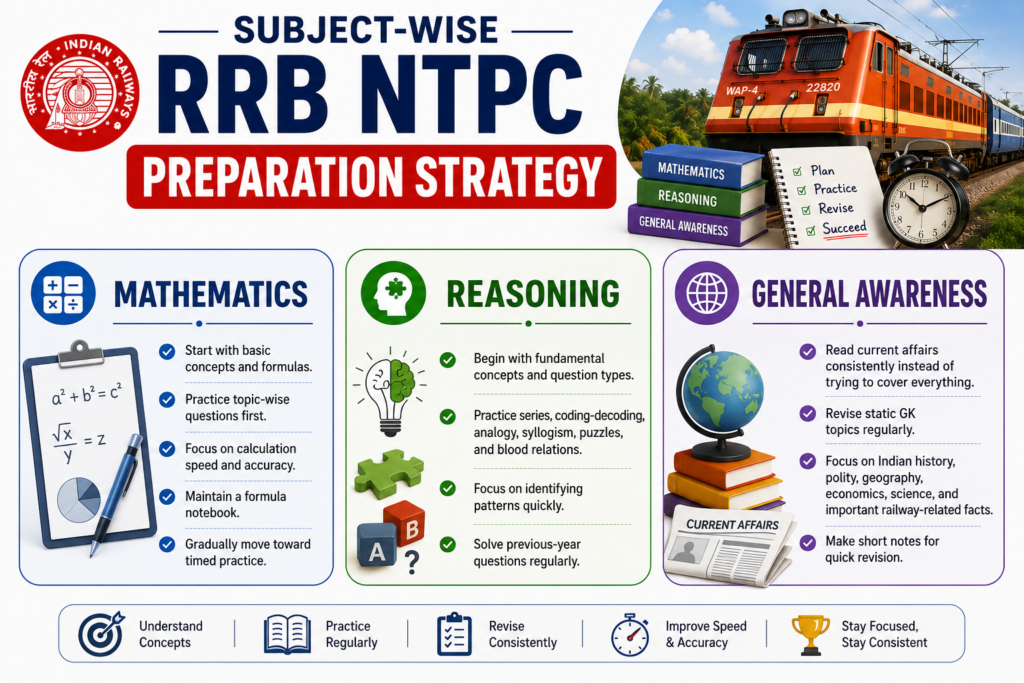
A subject-wise approach can make your RRB NTPC preparation more focused and effective. Since mathematics, reasoning, and general awareness require different methods of study, candidates should avoid using the same strategy for all three sections. Instead, identify the requirements of each subject and divide your study time accordingly.
Mathematics Preparation
Mathematics requires a strong understanding of concepts along with speed and accuracy. Start your RRB NTPC preparation with basic concepts and important formulas before moving to more challenging questions.
- Begin with fundamental topics such as percentages, averages, ratios, profit and loss, time and work, and time, speed, and distance.
- Practice topic-wise questions first to understand different question patterns.
- Maintain a formula notebook and revise it regularly.
- Work on mental calculations and shortcuts to improve calculation speed.
- Once your concepts are clear, gradually move towards mixed questions and timed practice.
- Analyze your mistakes to identify calculation errors and weak concepts.
Regular practice is essential because even familiar questions can consume significant time if calculations are slow. Include timed mathematics practice in your daily RRB NTPC preparation routine.
Reasoning Preparation
General intelligence and reasoning can become a scoring section with consistent practice. Start by understanding the basic concepts and common question patterns before attempting difficult questions.
Focus on topics such as:
- Series
- Coding-Decoding
- Analogy
- Classification
- Syllogism
- Puzzles
- Blood Relations
- Direction Sense
Try to identify patterns quickly rather than spending too much time on individual questions. Solve RRB NTPC previous-year questions regularly to understand the types of questions generally asked and improve your familiarity with the examination.
As your preparation progresses, include sectional tests and timed practice. This will help you improve both speed and accuracy while making your RRB NTPC preparation more exam-oriented.
General Awareness Preparation
General awareness covers a broad range of topics, so consistency is more important than last-minute preparation. Instead of trying to study everything at once, divide the syllabus into manageable areas and revise them regularly.
For effective RRB NTPC preparation, focus on:
- Current affairs
- Indian History
- Indian Polity
- Geography
- Economics
- General Science
- Government schemes
- Sports, awards, and important books
- Important national and international events
- Railway-related general knowledge
Read current affairs regularly and make short notes containing important facts, dates, appointments, awards, schemes, and events. Revise these notes weekly and monthly so that information remains fresh.
For static general awareness, use a limited number of reliable resources and revise them multiple times rather than collecting too many books or study materials. This makes your RRB NTPC preparation more efficient and leaves enough time for practice and mock tests.
4-Week RRB NTPC Preparation Strategy
A well-structured four-week plan can help candidates organize their RRB NTPC preparation without feeling overwhelmed. The goal should not be to study for extremely long hours but to use the available time efficiently. Divide each week into specific objectives, practice consistently, and track your progress through tests and revision.
Week 1: Build Your Foundation
The first week should focus on strengthening your basic concepts and understanding the syllabus.
- Complete the fundamental concepts of mathematics, reasoning, and general awareness.
- Identify your strong and weak topics through basic practice tests.
- Create a realistic daily study schedule.
- Start reading current affairs every day and make short notes.
- Revise important formulas and basic concepts before moving to advanced questions.
A strong foundation during Week 1 can make the rest of your RRB NTPC preparation more productive.
Week 2: Increase Practice
In the second week, move from learning concepts to applying them through regular question-solving.
- Cover the remaining important topics from the syllabus.
- Increase the number of questions solved each day.
- Begin taking sectional tests for mathematics, reasoning, and general awareness.
- Review mistakes after every test.
- Continue daily current affairs and revise the notes prepared during Week 1.
- Practice questions with a time limit to gradually improve your speed.
At this stage, focus on accuracy first and then work on increasing your solving speed.
Week 3: Practise Previous-Year Questions and Mocks
The third week should make your RRB NTPC preparation more exam-oriented. Start working extensively with previous-year question papers and full-length mock tests.
- Solve RRB NTPC previous-year questions regularly.
- Take full-length mock tests at regular intervals.
- Analyze your performance after every mock.
- Identify recurring mistakes and weak topics.
- Revisit difficult concepts and practice additional questions from those areas.
- Continue revising current affairs and static general awareness.
Do not focus only on your mock-test score. Analyze which questions you got wrong, which questions consumed too much time, and where you made avoidable mistakes.
Week 4: Revise and Strengthen
The final week should primarily be dedicated to revision and exam practice. Avoid trying to learn large amounts of completely new material.
- Revise important mathematics formulas and shortcuts.
- Review your short notes and frequently forgotten concepts.
- Revise current affairs and important general awareness topics.
- Take full-length mocks under exam-like conditions.
- Analyze mistakes and work on your weakest areas.
- Revisit important previous-year questions.
- Avoid collecting unnecessary new books, notes, or study resources.
During the final week of RRB NTPC preparation, revision should take priority over learning new topics. Keep your study material limited and focus on improving accuracy, confidence, and time management.
Following this four-week strategy consistently can help you cover the important syllabus, strengthen weak areas, and become more comfortable with the actual examination pattern. Adjust the daily study hours according to your current preparation level, but maintain regular practice throughout the four weeks.
Conclusion
Effective RRB NTPC preparation is not about studying for long hours without a clear direction. It requires a structured study plan, consistent practice, regular revision, and continuous performance analysis. Candidates should begin by understanding the exam pattern and syllabus, strengthen their fundamentals, and then gradually focus on previous-year questions and mock tests.
A subject-wise strategy can help you manage mathematics, general intelligence & reasoning, and general awareness more effectively. At the same time, regular revision and current affairs preparation are essential for retaining important information. Mock tests can further improve your speed, accuracy, and time-management skills while helping you identify areas that require additional practice.
With the right strategy and consistent effort, candidates can make their preparation more organized and productive. CareerGrowKaro aims to provide aspirants with practical career and exam-preparation resources to help them make informed decisions and prepare with greater confidence. Follow a realistic timetable, track your progress, learn from your mistakes, and stay consistent throughout your RRB NTPC Preparation journey. With focused preparation and a positive approach, you can move closer to achieving your goal of securing a position through RRB NTPC.
FAQs
1. How should I start my RRB NTPC Preparation?
Start by understanding the latest exam pattern and syllabus. Then assess your strengths and weaknesses, create a realistic study schedule, and begin with the basic concepts of mathematics, reasoning, and general awareness. Gradually include previous-year questions, sectional tests, and mock tests in your routine.
2. How many hours should I study for RRB NTPC?
The ideal study time depends on your current preparation level and daily schedule. Generally, 4–6 hours of focused study each day can be effective when combined with regular practice and revision. Quality and consistency are more important than simply increasing study hours.
3. Which subjects should I focus on for RRB NTPC?
The main sections are Mathematics, General Intelligence & Reasoning, and General Awareness. Give adequate attention to all three subjects while spending additional time on topics where your accuracy or understanding is weak.
4. Is solving previous-year papers important for RRB NTPC preparation?
Yes. Previous-year papers help you understand the types of questions asked, identify frequently tested topics, practice time management, and assess your preparation level. Analyze your mistakes after every paper instead of focusing only on your score.
5. How can I improve my RRB NTPC score?
Focus on conceptual clarity, regular question practice, revision, and mock tests. Work on your weak areas and maintain an error notebook to track recurring mistakes. Improving both speed and accuracy is essential because incorrect answers can result in negative marking.