
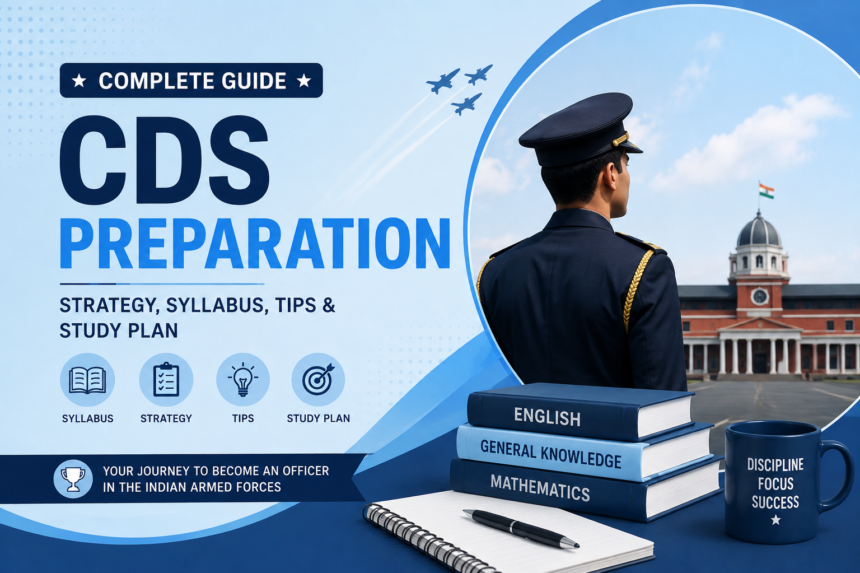
The Combined Defence Services (CDS) examination, conducted by the Union Public Service Commission (UPSC), is one of the most sought-after competitive examinations for graduates aspiring to join the Indian Armed Forces. Through the CDS examination, eligible candidates can pursue opportunities in prestigious institutions such as the Indian Military Academy (IMA), Indian Naval Academy (INA), Air Force Academy (AFA), and Officers’ Training Academy (OTA).
A well-planned CDS preparation strategy is essential because the examination tests candidates across multiple subjects, including English, general knowledge, and elementary mathematics. Simply studying for long hours without clear priorities can make preparation overwhelming and inefficient. Aspirants should instead focus on understanding the syllabus, practicing previous-year questions, revising regularly, and improving their speed and accuracy.
This CDS Preparation Guide covers the exam pattern, syllabus, subject-wise strategies, daily study plan, revision techniques, mock-test practice, and common mistakes to avoid. It is designed to help candidates build a practical preparation routine based on their strengths and weaknesses. CareerGrowKaro provides useful career and competitive-exam guidance to help aspirants make informed decisions throughout their preparation journey.
Whether you are beginning your preparation from scratch or looking to improve your existing strategy, consistent CDS preparation can help you move closer to your goal. Instead of focusing only on the number of hours studied, concentrate on the quality of learning, regular practice, and steady progress.
Understand the CDS Exam Pattern
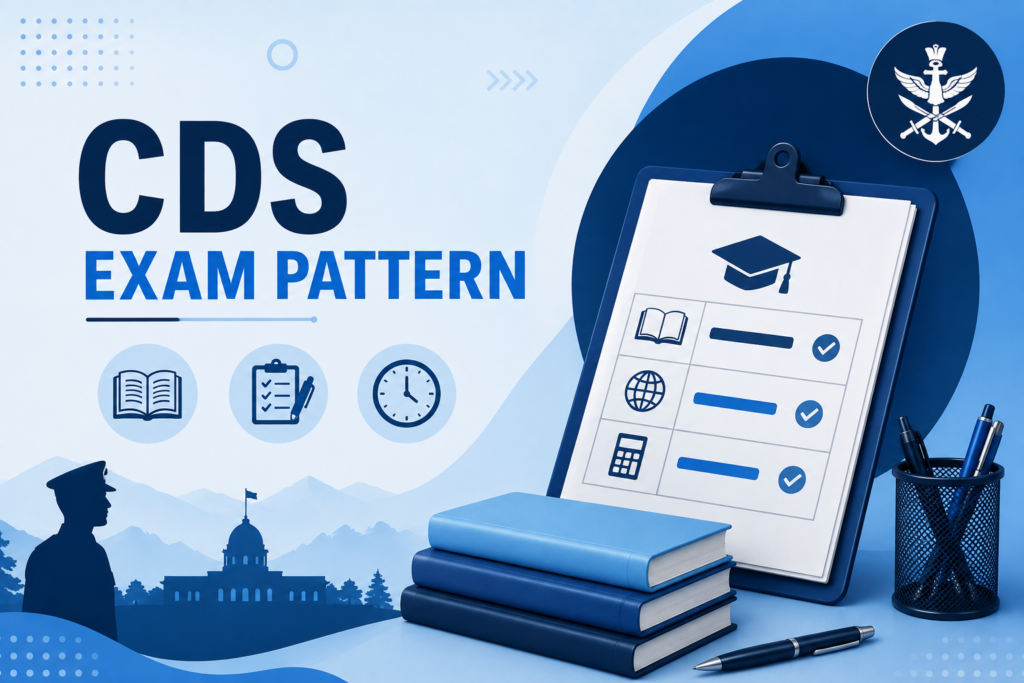
Before starting your CDS preparation, understand the exam pattern carefully. It helps you plan your study time, prioritize subjects, and practice according to the actual examination requirements.
CDS Exam Pattern for IMA, INA, and AFA
Candidates applying for the Indian Military Academy (IMA), Indian Naval Academy (INA), and Air Force Academy (AFA) have to appear for three papers:
- English: 100 marks | 2 hours
- General Knowledge: 100 marks | 2 hours
- Elementary Mathematics: 100 marks | 2 hours
- Total: 300 marks
CDS Exam Pattern for OTA
Candidates applying for the Officers’ Training Academy (OTA) appear for only two papers:
- English: 100 marks | 2 hours
- General Knowledge: 100 marks | 2 hours
- Total: 200 marks
Important Points to Remember
- The CDS examination has negative marking, so avoid random guessing.
- Accuracy and time management are important for scoring well.
- Candidates who qualify the written examination proceed to the SSB interview/personality test.
- The selection process also includes the required medical examination and other eligibility requirements.
- Your CDS preparation should therefore cover both conceptual learning and regular exam-oriented practice.
Understanding these details at the beginning makes your CDS preparation more organized. It also helps you create a realistic timetable, identify the subjects that need more attention, and approach mock tests more effectively.
Know the CDS Syllabus Thoroughly
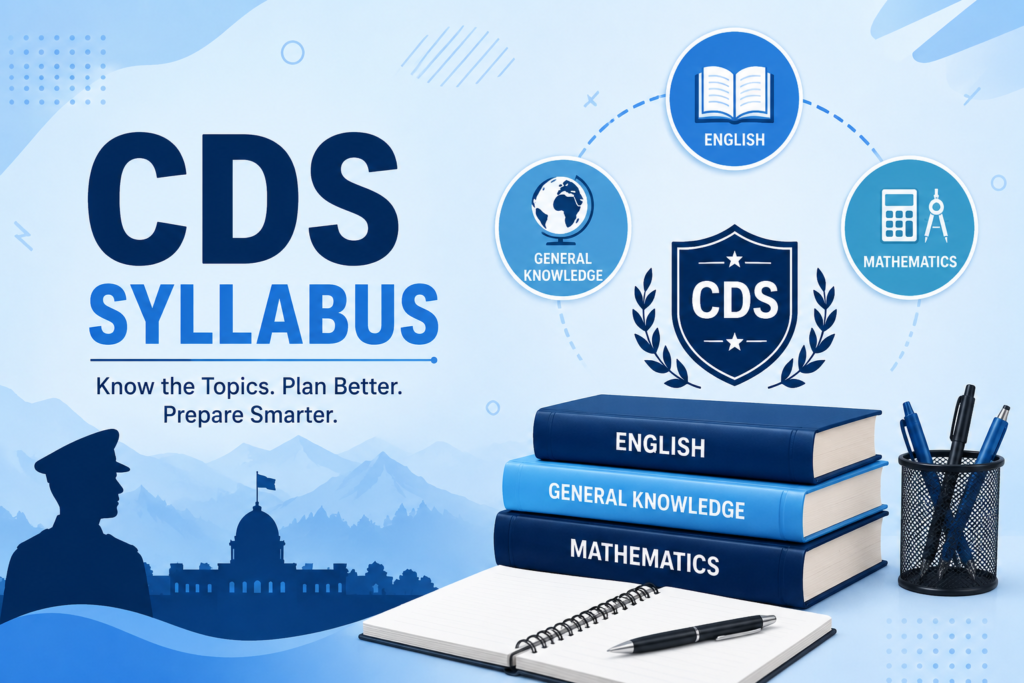
Understanding the syllabus is an important part of effective CDS preparation. It helps you identify high-priority topics, avoid spending excessive time on less relevant areas, and create a study plan according to your strengths and weaknesses. Before beginning CDS preparation, divide the syllabus into three categories: strong, moderate, and weak areas. This will help you focus more on topics that require improvement while regularly revising your stronger areas.
1. English
The English paper tests your grammar, vocabulary, comprehension, and overall language ability. Important topics include:
- Grammar and sentence structure
- Vocabulary
- Reading comprehension
- Sentence improvement
- Spotting errors
- Synonyms and antonyms
- Fill in the blanks
- Ordering of sentences
Regular reading and practice can help improve both accuracy and speed in this section.
2. General Knowledge
General Knowledge covers a broad range of static and current topics. Your CDS preparation should include:
- Current affairs
- Indian and world history
- Geography
- Indian polity
- Economics
- General science
- Defence-related awareness
- Important national and international events
Since GK has a wide syllabus, focus on consistent revision instead of trying to memorize everything at once.
3. Elementary Mathematics
Mathematics primarily tests basic concepts and problem-solving ability. Key areas include:
- Arithmetic
- Algebra
- Geometry
- Trigonometry
- Mensuration
- Statistics
- Number system
- Basic mathematical concepts
For effective CDS preparation, strengthen your fundamentals first and then move towards timed question practice. Once you have mapped the complete syllabus, allocate more study time to your weak areas while continuing regular revision of moderate and strong topics. This approach makes CDS preparation more structured and manageable.
Subject-Wise CDS Preparation Strategy
A subject-wise approach makes your CDS preparation more organized and helps you focus on the specific skills required for each paper. Instead of studying every subject in the same way, use different strategies for English, general knowledge, and mathematics.
1. English Preparation
English can become a scoring subject with regular practice and revision. Focus on:
- Build vocabulary: Read newspapers, books, or quality articles regularly and note down unfamiliar words.
- Revise grammar: Strengthen important rules related to tenses, articles, prepositions, subject-verb agreement, and sentence structure.
- Practice comprehension: Solve reading comprehension passages regularly to improve speed and accuracy.
- Work on error detection: Practice spotting grammatical and usage errors through topic-wise questions.
- Solve PYQs: Previous-year questions help you understand the type and difficulty of questions asked in the exam.
- Maintain a notebook: Keep separate sections for new vocabulary, grammar rules, and frequently repeated mistakes.
2. General Knowledge Preparation
GK covers a wide range of topics, so consistency is more important than last-minute cramming. Your CDS preparation should include:
- Cover static GK: Study history, geography, Indian polity, economics, general science, and other important static topics systematically.
- Follow current affairs: Read daily news and focus on important national, international, defense, sports, awards, and government-related developments.
- Focus on defense awareness: Keep track of major defense exercises, organizations, appointments, equipment, and developments.
- Revise regularly: Use weekly or monthly revision notes instead of leaving current affairs for the final weeks.
- Practice PYQs: Previous-year questions can help identify recurring themes and important areas.
3. Mathematics Preparation
Mathematics requires strong fundamentals, regular practice, and speed. Follow these steps:
- Strengthen basics: Clear your fundamental concepts before moving to difficult questions.
- Prioritize important topics: Give adequate attention to arithmetic, algebra, geometry, trigonometry, and mensuration.
- Improve calculation speed: Practice basic calculations regularly to save time during the examination.
- Use timed practice: Solve question sets within fixed time limits to develop exam-level speed.
- Analyze mistakes: After every practice session, identify incorrect answers and understand the concepts behind them.
- Revise formulas: Maintain a concise formula sheet for quick revision during the final stages of your CDS preparation.
A balanced subject-wise strategy ensures that you do not neglect any paper while gradually improving your speed, accuracy, and confidence.
Follow a Balanced Daily Study Routine
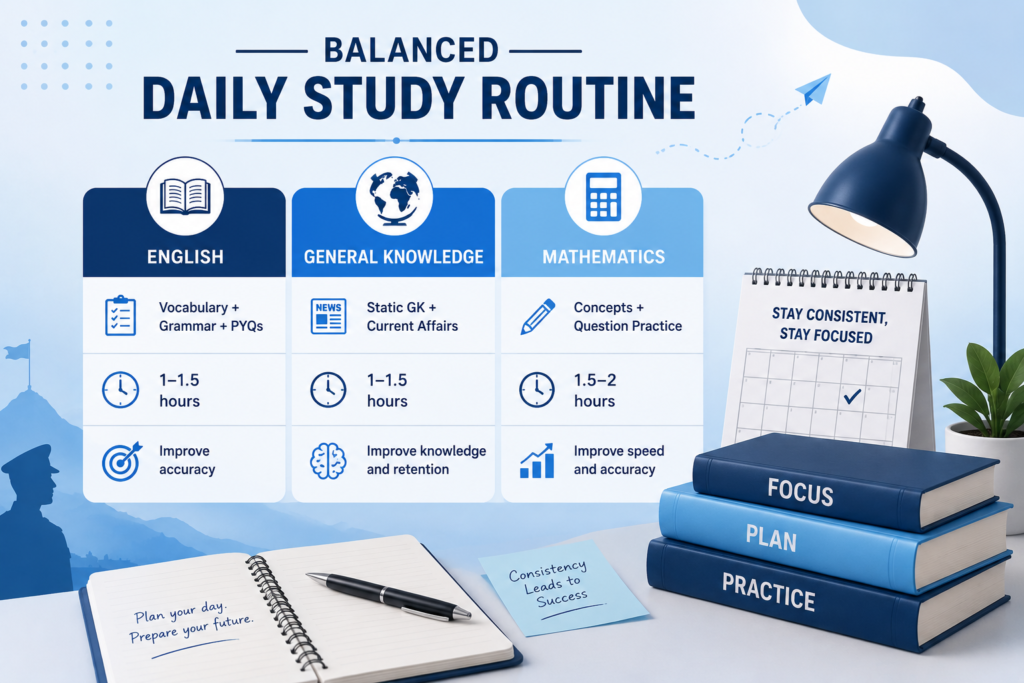
A consistent daily routine can make your CDS preparation more structured and prevent you from spending too much time on one subject. Instead of studying for long, irregular hours, divide your available study time across English, general knowledge, and mathematics. You can use the following routine as a starting point and adjust it according to your preparation level:
| Subject | Daily Activity | Recommended Time | Main Goal |
| English | Vocabulary + Grammar + PYQs | 1–1.5 hours | Improve accuracy |
| General Knowledge | Static GK + Current Affairs | 1–1.5 hours | Improve knowledge and retention |
| Mathematics | Concepts + Question Practice | 1.5–2 hours | Improve speed and accuracy |
This schedule does not need to be followed rigidly. If you are weak in mathematics, for example, you can dedicate additional time to it while maintaining regular practice in English and GK. The key is to remain consistent and review your progress every week. Along with these daily sessions, keep some time for revision, mock tests, and analyzing mistakes. A balanced routine will help you gradually improve your overall performance and make your CDS preparation more effective.
Common Mistakes to Avoid During CDS Preparation
Even with good study material and sufficient time, certain mistakes can slow down your CDS preparation. Being aware of these mistakes can help you use your preparation time more effectively and stay focused on your goal.
- Starting without understanding the syllabus: Know the complete syllabus and exam pattern before creating your study plan. This prevents you from spending time on irrelevant topics.
- Ignoring difficult subjects: Do not avoid mathematics or general knowledge simply because they seem challenging. Identify your weak areas and work on them consistently.
- Depending entirely on coaching: Coaching can provide guidance, but self-study and regular question practice are equally important.
- Skipping previous-year questions: PYQs help you understand recurring topics, question patterns, and the actual difficulty level of the examination.
- Taking mocks without analyzing them: Simply checking your score is not enough. Review every mistake and identify whether it occurred due to a conceptual gap, calculation error, or poor time management.
- Collecting too many resources: Using multiple books, apps, and study materials can create confusion. Stick to a limited number of reliable resources and revise them properly.
- Neglecting revision: Completing the syllabus once does not guarantee retention. Schedule regular revision of formulas, vocabulary, current affairs, and important concepts.
- Ignoring SSB preparation: Clearing the written examination is only one stage of the selection process. Gradually work on communication, confidence, awareness, leadership qualities, and overall personality alongside your written CDS preparation.
Avoiding these mistakes can make your preparation more focused and manageable. Instead of constantly changing your strategy or resources, follow a consistent routine, track your progress, and make improvements based on your performance.
Conclusion
Effective CDS preparation is not about studying for endless hours; it is about having a clear strategy, maintaining consistency, and making continuous improvements. Understanding the syllabus and exam pattern, following a subject-wise approach, practicing previous-year questions, and taking regular mock tests can help you prepare with greater confidence. Regular revision and proper analysis of mistakes are equally important for improving accuracy and retaining what you study.
Aspirants should also remember that the CDS selection process goes beyond the written examination. Preparing for the SSB stage alongside written exam preparation can help you develop the confidence, communication skills, awareness, and personality required for the next stage. Most importantly, avoid comparing your CDS preparation journey with others and focus on your own progress.
For more guidance on competitive examinations, career opportunities, preparation strategies, and useful study resources, aspirants can explore CareerGrowKaro. With the right plan, disciplined practice, and consistent effort, you can take a confident step towards achieving your goal of joining the Indian Armed Forces.
FAQs
1. How should I start my CDS preparation?
Start by understanding the CDS exam pattern and syllabus. Identify your strong and weak areas, choose reliable study resources, create a realistic timetable, and begin with the basics before moving to extensive practice.
2. How many hours should I study for CDS every day?
There is no fixed number of hours required for CDS preparation. Around 4–6 focused hours a day can be effective for many aspirants, depending on their preparation level and daily schedule. Consistency and quality of study matter more than the number of hours.
3. Are previous-year questions important for CDS preparation?
Yes. Previous-year questions help you understand the exam pattern, frequently tested topics, question difficulty, and time requirements. Include PYQs regularly in your CDS preparation and analyze your mistakes after solving them.
4. How can I improve my CDS General Knowledge score?
Cover static GK topics such as history, geography, polity, economics, and general science while following current affairs regularly. Revise your notes frequently and practice CDS PYQs to identify important and recurring topics.
5. When should I start taking CDS mock tests?
Start with sectional tests once you have covered the basics of a subject. Gradually introduce full-length mock tests as you progress through the syllabus. Always analyze your performance after each mock to identify areas that need improvement.