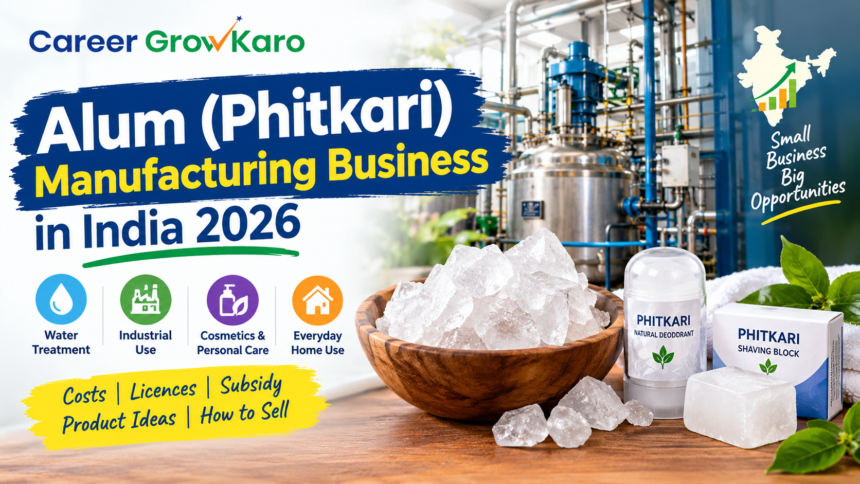
Alum (phitkari) manufacturing business in India is a steady, demand-backed business because alum is used in water treatment, paper, textiles, cosmetics and daily products like deodorant. A full manufacturing unit needs around ₹24 lakh, as per the KVIC project profile — but you can enter with far less by buying bulk alum and processing, branding and packaging it. Margins rise sharply as you move from selling raw alum (about ₹19–70/kg) to branded phitkari products (about ₹600/kg). Licences, BIS quality grades and PMEGP subsidy all apply.
- What Is Alum (Phitkari) and Why Does India Always Need It?
- How Big Is the Alum (phitkari) Manufacturing Business in India — and Is It Growing?
- Where Can You Actually Earn in the Alum Business? (The Value Chain)
- What Is Alum Used For? (Every Product You Can Sell)
- Two Ways to Enter — Full Manufacturing vs Processing & Branding
- How Much Does a Full Alum Manufacturing Unit Cost?
- What Raw Materials and Machinery Do You Need?
- How Is Alum Actually Made? (Step by Step)
- Which Licences and Quality Standards Do You Need?
- Which Government Schemes Can Fund This Business?
- How to Sell and Market Alum — a Plan for Every Stakeholder
- A Realistic Small-Unit Scenario (Illustrative)
- What Are the Real Risks?
- Frequently Asked Questions
- The Bottom Line
You have seen phitkari at home. That clear crystal your father rubbed on his face after shaving. The piece your mother dropped into a matka to clean the water. It looks ordinary. But behind that ordinary crystal is a chemical the whole country needs every single day.
At CareerGrowKaro, we look at businesses that are real, not hyped. Alum (phitkari) manufacturing is one of them. The mistake most people make is thinking “alum business” is one thing. It is not. It is a value chain — and you can join it at different points depending on your budget. This guide shows you exactly where the money is, with honest costs, licences, government schemes and a full plan for how to sell.
What Is Alum (Phitkari) and Why Does India Always Need It?
Alum is a group of chemical salts. The most common one — potash alum (potassium aluminium sulphate) — is what we call phitkari in Hindi. It is a white or clear crystal that dissolves in water and has a mild astringent taste.
It works because it pulls dirt and tiny particles in water together so they settle down and can be removed. This single property is why so many industries depend on it.
Where India uses alum
- Water treatment — the biggest user. Around 65% of all alum goes to water treatment plants, as per the KVIC alum project profile.
- Paper industry — as a sizing agent that improves paper strength and printability.
- Textiles — as a mordant that fixes dyes onto cotton and cloth.
- Cosmetics & personal care — deodorant crystals, aftershave blocks and skin astringents.
- Daily home use — water purification, pooja and vastu, and first aid (a styptic to stop small cuts bleeding).
Demand stays steady because India’s water problem is not going away. India generates roughly 72 billion litres of sewage every day and treats only about 28% of it, according to studies conducted by the Central Pollution Control Board (CPCB) under India’s Ministry of Jal Shakti. Government programmes like Namami Gange are funding many new sewage treatment plants — and every one of them needs a coagulant like alum.
How Big Is the Alum (phitkari) Manufacturing Business in India — and Is It Growing?
Alum sits inside the wider aluminium sulphate market. The numbers differ by research firm, but the direction is the same: slow, steady growth on the industrial side, and faster growth on the branded consumer side.
- The global aluminium sulphate market was valued at about USD 1.03 billion in 2024 and is projected to reach about USD 1.33 billion by 2032, at roughly 4% per year, according to Verified Market Research.
- Allied Market Research lists the global aluminum sulfate market around $1.1 billion–$1.2 billion for historical base years, scaling to $1.5 billion over the next decade. Industry market research metrics confirm the market trajectory hitting the $1.1B to $1.5B range over a 10-year forecast window.
- Multiple market intelligence reports (Business Research Insights) confirm that the Asia-Pacific region leads global consumption with a ~45–50% market share, driven heavily by municipal water treatment and industrialization projects in India and China.
- India is expected to be one of the fastest-growing markets for aluminium ammonium sulphate, at around 6.2% per year, according to Future Market Insights.
Honest caveat: Some reports warn that polyaluminium chloride (PAC) is slowly replacing alum in a few water plants. So the industrial alum market is stable, not explosive. The faster money is on the branded consumer side, phitkari powders, natural deodorants and skincare, which we cover below.
Where Can You Actually Earn in the Alum Business? (The Value Chain)
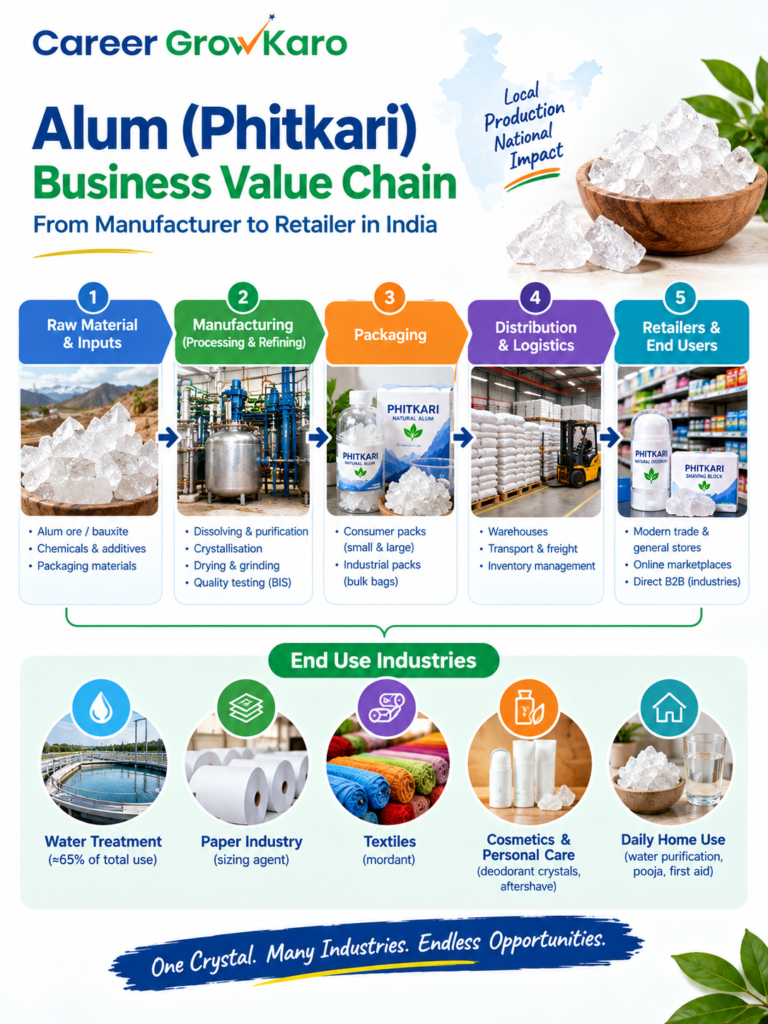
This is the part most guides skip. “Alum business” is a chain, and you can join at different points depending on how much money and skill you have.
| Your role | What you do | Rough entry cost | Best suited for |
| Manufacturer | Make alum from bauxite + acid | ₹24 lakh+ (KVIC) | Serious investor with space & compliance appetite |
| Processor / Brander | Buy bulk alum, crush, powder, brand, pack | A few lakh | First-time entrepreneur, D2C dreamer |
| Distributor / Retailer | Buy bulk or branded, sell to shops or industries | Mostly working capital | Trader with a local network |
| End seller / side-hustler | Sell phitkari, pooja packs, deodorant locally or online | Very low | Student or small shop owner |
The big insight: raw industrial alum sells for about ₹19–70 per kg on B2B platforms like IndiaMART. But branded phitkari powder sells for around ₹600 per kg, and alum crystal deodorant sticks sell at an even bigger premium. Same molecule. Very different money. The value you add grinding, purifying, branding, packaging and trust, is where your margin lives.
What Is Alum Used For? (Every Product You Can Sell)
Before you pick a product, know your options. Each one has a different buyer and a different price tier.
Industrial & B2B products
- Water-purification alum — bought by municipal water boards, RO plant operators and factories. Sold in 25–50 kg bags. Commodity pricing, high volume.
- Paper & textile grade alum — bought by paper mills and dyeing units. Bulk, repeat orders.
- Leather-tanning alum — bought by tanneries as part of the tanning process.
Consumer & personal-care products (higher margin)
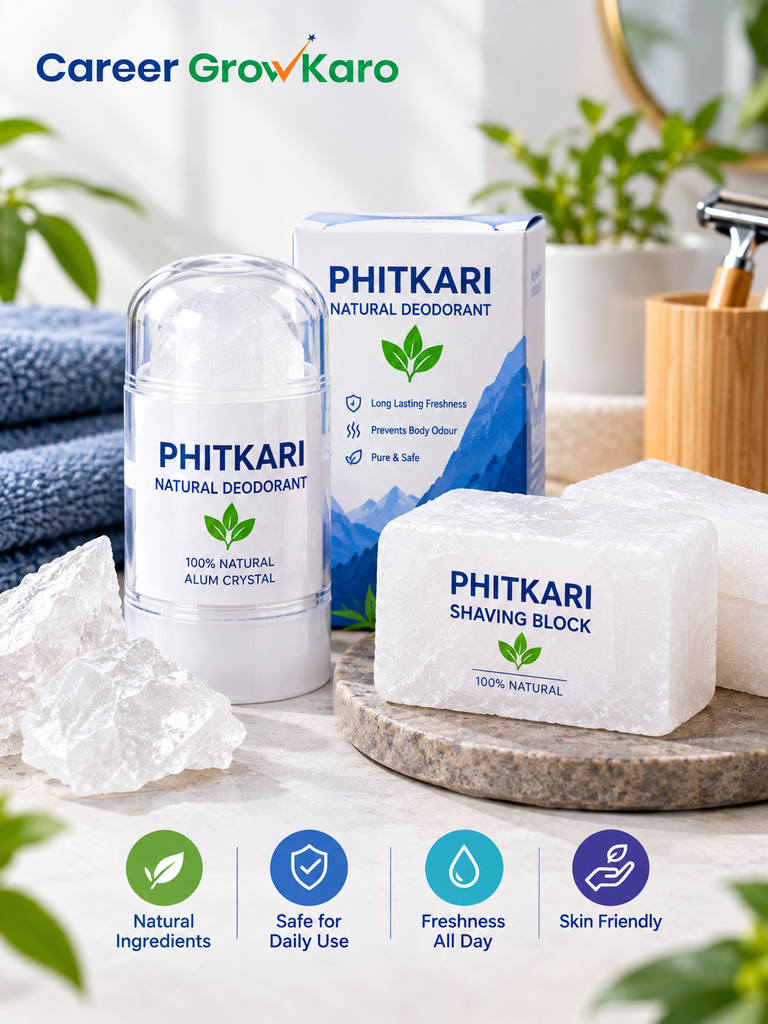
- Alum crystal deodorant stick — a fast-growing D2C category. Brands like Phitku, Exotic Veda and SVARA already sell alum crystal deodorants online.
- Shaving / aftershave alum block — bought by men’s grooming buyers, barbers and salons. Stops nicks and tightens skin.
- Phitkari face & skin powder — a traditional beauty product. Branded packs retail around ₹600/kg.
- Oral-care & gargle alum — used traditionally for sore throat and teeth.
- Pooja & vastu phitkari — small packs sold through pooja stores; steady festival demand.
- Food-grade / pickling alum — small use in pickles and baking. Needs food-grade compliance (FSSAI).
A word of honesty on “natural” deodorant Alum deodorants are marketed as “natural” and “aluminium-free alternatives”. But potash alum is itself an aluminium salt. If you sell these, label truthfully — CGK will never tell you to hide an ingredient to make a sale. Honest labelling builds a brand that lasts.
Two Ways to Enter — Full Manufacturing vs Processing & Branding
Your budget decides your entry route. Here is the honest comparison.
| Factor | Full Manufacturing | Processing & Branding |
| Investment | ₹24 lakh+ | A few lakh |
| Machinery | Reactor, crusher, boiler, filter press | Grinder, mixer, sieve, packing machine |
| Space | ~4,000 sq ft | A small room or shed |
| Licences | Heavy (PCB consent, Factory Licence) | Lighter (Udyam, GST, cosmetic/FSSAI if applicable) |
| Core skill | Chemical process control | Branding & marketing |
| Margin source | Volume | Brand value |
| Best for | Investor | First-time entrepreneur |
If you are starting your first business from a Tier 2 or Tier 3 town with limited capital, the processing-and-branding route is usually the smarter first step. You learn the market, build a brand, and can add manufacturing later.
How Much Does a Full Alum Manufacturing Unit Cost?
The KVIC (Khadi and Village Industries Commission) project profile for an alum unit gives the most reliable indicative numbers, because it is a government-published pre-feasibility report used for PMEGP funding.
KEY NUMBERS — Full Alum Manufacturing Unit
Total project cost: ₹24.06 lakh
- Plant & machinery: ₹17.50 lakh
- Own contribution (margin): ₹2.41 lakh
- Term loan + working-capital loan: ₹21.65 lakh
- Space required: ~4,000 sq ft (rented, ₹40,000–₹50,000/month)
- Power: 25 KW | Staff: 9 persons
- Break-even: ~28% capacity utilisation
These are indicative figures. Your actual cost will change with location, land rent, machinery brand and production capacity. Always build your own project report with live quotes before applying for a loan.
What Raw Materials and Machinery Do You Need?
Raw materials
- Bauxite (with about 60% alumina and less than 3% ferric oxide)
- Concentrated sulphuric acid (around 60% concentration)
- Potassium sulphate (99% pure)
- Distilled water
- Flaked glue (helps impurities settle)
- Black ash or barium sulphide (removes iron impurities)
Machinery
- Jaw crusher and pulverizer / hammer mill
- Reaction digester — a lead-lined mild-steel tank with a stirrer
- Evaporation and mixing tanks
- Boiler (for steam)
- Water-softening plant
- Acid pump
- Filter press and packaging machine
This process uses concentrated sulphuric acid at high temperature. Acid handling, worker safety gear and effluent treatment are not optional — they are required for Pollution Control Board consent and for keeping your workers safe.
How Is Alum Actually Made? (Step by Step)
Here is the simplified manufacturing process:
- Wash and concentrate the bauxite ore to remove dirt.
- Crush it in a jaw crusher, then pulverize it into a fine powder.
- React the powdered bauxite with 60% sulphuric acid in a lead-lined reactor at 105–110°C for 8–10 hours.
- Move the solution to a settling tank; add flaked glue and black ash to remove suspended particles and iron.
- Filter it to get a clear aluminium sulphate solution.
- Add potassium sulphate solution so crystals begin to form.
- Concentrate the solution (another 8–10 hours).
- Pour into moulds, cool, and let crystals form.
- Dry the crystals in a fluidised-bed dryer.
- Pack and store for dispatch.
The light route is much simpler: buy bulk alum lumps from an existing manufacturer, pulverize them, sieve to the right grade, mix in any fragrance (for deodorant), then mould, pack and brand. No acid, no reactor — you are adding value through processing and branding, not chemistry.
Which Licences and Quality Standards Do You Need?
Licences
- Udyam (MSME) registration
- GST registration
- Trade licence and Factory licence
- Pollution Control Board (PCB) consent — important, because acid and chemical waste are involved
- Fire-safety NOC
- Import/Export Code (only if you plan to export)
- Trademark registration (to protect your brand name)
BIS quality standards — the part competitors miss
- IS 299:2012 (Alumino-Ferric) — the standard for water-treatment grade alum. Reaffirmed in 2022. Municipal water tenders often demand conformity to this.
- IS 258:2000 (Potash Alum) — covers technical, pharmaceutical and reagent grades used in cosmetics, medicine and labs.
Which standard you follow depends on your buyer. A water board may need IS 299 conformity; a cosmetic or food buyer will look at IS 258 or the relevant cosmetic/food rules. If you make personal-care products (deodorant, face powder), cosmetic licensing (CDSCO / State Drug authority) and, for food-grade alum, FSSAI may apply.
Which Government Schemes Can Fund This Business?
PMEGP (Prime Minister’s Employment Generation Programme) is the main scheme. It gives a margin-money subsidy on your project cost:
| Category | Urban | Rural |
| General | 15% subsidy | 25% subsidy |
| Special (SC/ST/OBC/Women/PwD/Ex-servicemen/NER/Minority) | 25% subsidy | 35% subsidy |
- Own contribution: 10% for general category, 5% for special category.
- Maximum project cost for margin money: ₹50 lakh for manufacturing units.
- Administered by KVIC, KVIB and DIC under the Ministry of MSME.
The KVIC alum project profile is itself built around PMEGP funding — which tells you this business is scheme-eligible. For the lighter processing route, a MUDRA loan can fund working capital and small machinery.
How to Sell and Market Alum — a Plan for Every Stakeholder
A factory is not a business until you can sell what it makes. Here is a channel plan for each point in the value chain.
For manufacturers (B2B)
- List on IndiaMART, TradeIndia and Alibaba — this is where industrial buyers actually search.
- Apply for municipal and government water-board tenders through the GeM portal; BIS certification becomes a strong selling point here.
- Build direct supply relationships with paper mills, dyeing units and RO-plant operators.
- Appoint regional distributors to reach smaller buyers you can’t service directly.
For processors & D2C brand-builders
- Sell branded phitkari powder, deodorant sticks and shaving blocks on Amazon, Flipkart, Meesho and your own website.
- Position honestly around “natural”, “traditional” and “single-ingredient” — without hiding that it contains an aluminium salt.
- Use Instagram Reels and YouTube Shorts to show real use: shaving, cleaning water, skincare. Demonstration sells this product.
- Start with a third-party / private-label manufacturer (some already offer alum-deodorant private labelling) if you want to build a brand before owning a plant.
- Festival and gifting packs (Raksha Bandhan, grooming kits) lift both volume and margin.
For distributors & retailers
- Supply kirana stores, pooja shops, chemists and salons.
- Salons and barbershops are a steady, repeat channel for shaving alum blocks.
- Small, clearly-labelled retail packs (50g, 100g, 250g) move faster than loose alum.
- For rural markets, bundle a water-purification phitkari pack with a simple “how to use” leaflet.
The pricing ladder — why branding pays
| Product form | Typical buyer | Rough price tier [VERIFY] |
| Bulk industrial alum (25–50 kg bag) | Water boards, mills | ₹19–70 / kg |
| Branded phitkari powder (retail pack) | Home users | ~₹600 / kg |
| Alum deodorant / shaving block | Grooming consumers | Premium per 100g |
The jump from the first row to the last is the whole opportunity. Everyone in the chain can earn — but the branded end has the most room.
A Realistic Small-Unit Scenario (Illustrative)
Take a small processing-and-branding unit, not a chemical plant, just a setup that buys bulk alum and sells branded packs. These numbers are illustrative and must be checked with live quotes:
• Buy bulk industrial alum at ~₹40/kg
• Process into 250g branded phitkari packs
• Sell online at ~₹150 per 250g (≈ ₹600/kg)
• Gross difference before costs: ~₹560/kg
Out of that gap you must pay for grinding, packaging, branding, platform commissions (Amazon/Flipkart take a cut), shipping, GST and marketing, which eat a large share. So real take-home is much smaller than ₹560. The point is not “easy profit”; it is that the branded route has room for margin that raw selling does not. [Numbers are indicative. VERIFY all figures with real supplier quotes and platform fee structures.]
For a full manufacturing unit, the projects sales rising from about ₹81.85 lakh in year 1 (at 40% capacity) to about ₹153.96 lakh in year 5 (at 60% capacity), with net profit after tax growing from about ₹5.96 lakh to ₹17.92 lakh over five years.
What Are the Real Risks?
Every honest business guide must tell you what can go wrong. Here it is:
- Raw-material price swings — bauxite prices rose about 15% in 2024 (International Aluminium Institute, cited by Persistence Market Research), and sulphuric acid tracks oil prices.
- PAC substitution — polyaluminium chloride is slowly replacing alum in some water plants.
- Compliance cost — PCB consent, acid handling and effluent treatment cost money and cannot be skipped.
- Crowded commodity end — the ₹19/kg bulk market is competitive and low-margin. Winning here needs scale.
- Branding cost — the D2C route needs real spend on photography, ads and platform fees before it pays back.
- Working capital — industrial buyers often pay in 30–60 days, so you need cash to keep running.
Not sure which business fits your budget and city?
Explore CareerGrowKaro’s business guide.
Frequently Asked Questions
Is alum (phitkari) manufacturing business profitable in India?
Yes, it can be. Alum has steady demand from water treatment, paper, textile and personal-care buyers. Margins are thin at the raw industrial end (about ₹19–70/kg) but improve sharply on branded products. Profit depends on your entry point, quality and how well you sell.
How much money do I need to start an alum business?
A full manufacturing unit needs around ₹24 lakh, as per the KVIC project profile. But you can start much smaller — a processing-and-branding unit that buys bulk alum and sells branded packs can begin with a few lakh. PMEGP subsidy can reduce your own contribution.
Which licences do I need for an alum manufacturing unit?
Typically Udyam (MSME) registration, GST, trade licence, factory licence, Pollution Control Board consent and a fire NOC. For cosmetic or food-grade products, cosmetic or FSSAI licensing may also apply. Always confirm with your local DIC and Pollution Control Board.
Is alum deodorant safe and legal to sell?
Alum crystal deodorants are widely sold in India and are popular as “natural” options. But they do contain potassium alum, an aluminium salt, so label honestly. Selling cosmetic products needs proper cosmetic licensing — check current CDSCO / State Drug rules before you launch.
What is the BIS standard for alum?
IS 299 covers alumino-ferric used in water treatment, and IS 258 covers potash alum used in technical, pharmaceutical and reagent grades. Which one you follow depends on your buyer — water boards often ask for IS 299 conformity.
Can I get a government subsidy for an alum business?
Yes. PMEGP offers a 15–35% margin-money subsidy on project cost, depending on your category and location, for manufacturing projects up to ₹50 lakh. The KVIC alum project profile is itself designed for PMEGP funding.
The Bottom Line
Alum looks like a small crystal, but it sits inside a large, steady value chain — from municipal water plants to the deodorant in a young person’s grooming kit. You do not have to build a ₹24 lakh plant to join it. You can manufacture, process and brand, distribute, or simply sell — whichever fits your budget and skill.
Pick your entry point honestly, get your licences right, and let quality and trust do the selling. At CareerGrowKaro, we will keep breaking down real businesses like this one — Confusion Se Clarity Tak.