

Public Service Commission (PSC) exams offer aspirants an opportunity to secure various positions in state government services. With intense competition and a vast syllabus, effective planning is essential for focused and consistent PSC preparation.
Although the exam pattern and syllabus vary across states, the core preparation approach remains similar: understanding the syllabus, building strong fundamentals, staying updated with current affairs, practicing previous-year questions, and revising regularly.
In this guide, CareerGrowKaro covers everything you need for effective PSC preparation, including the exam pattern, syllabus, study plan, subject-wise tips, resources, mock-test strategy, and common mistakes to avoid.
What is the PSC Exam?
Public Service Commission (PSC) exams are competitive examinations conducted by State Public Service Commissions to recruit candidates for various government positions. PSC preparation helps aspirants develop the knowledge and skills required to perform well in these competitive exams.
Depending on the state, PSC exams may recruit candidates for posts such as
- Administrative and civil services
- Revenue and taxation services
- Police and other enforcement services
- Teaching and technical positions
- Other specialized government posts
The selection process generally includes:
- Preliminary Examination: Objective-type screening test.
- Main Examination: Detailed examination to assess subject knowledge and analytical ability.
- Interview/Personality Test: Conducted for applicable posts.
Since the syllabus and selection process vary across states, candidates should carefully check the latest official notification before beginning PSC preparation. It provides essential details about eligibility, vacancies, syllabus, exam pattern, and selection stages, helping you plan your PSC preparation effectively.
Know the PSC Syllabus
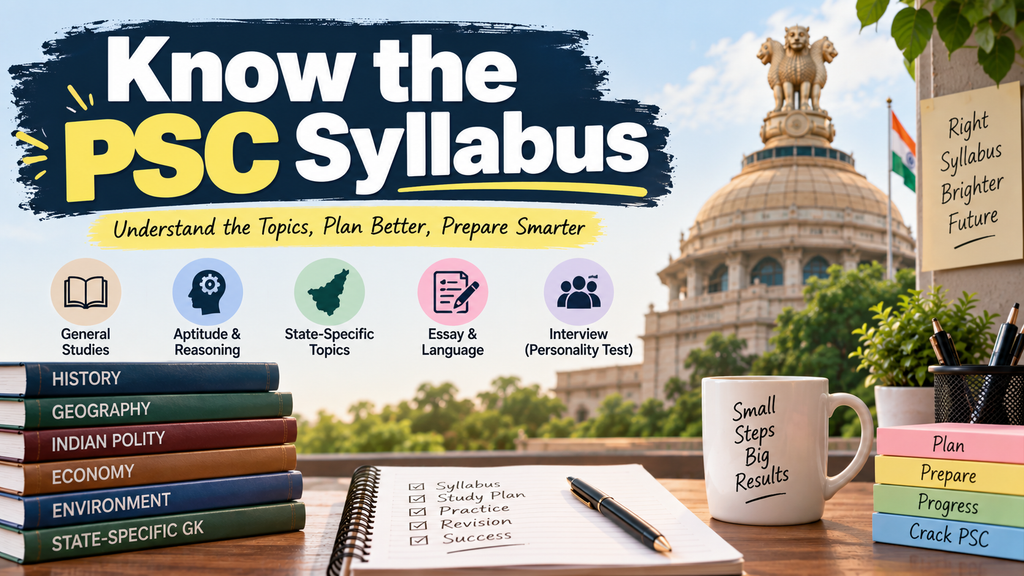
Understanding the syllabus is an important part of effective PCS preparation. While the exact syllabus varies by state and post, most PSC examinations cover the following subjects:
preparation.
1. General Studies
General Studies forms a major part of most PSC examinations and tests candidates on a wide range of national and state-level topics.
- Key Areas: History, geography, science, environment, governance, and general knowledge
- Focus: Conceptual understanding and factual knowledge
- Preparation Tip: Use standard textbooks and revise important facts regularly
2. Current Affairs
Current Affairs evaluates your awareness of important national, international, and state-specific developments.
- Key Areas: Government schemes, awards, appointments, sports, economy, and important events
- Focus: Recent national and state-level developments
- Preparation Tip: Follow reliable daily news sources and maintain concise revision notes.
3. Indian History and Geography
This section covers important events in Indian history and geographical features of India.
- History: Ancient, Medieval, and Modern India and the freedom movement
- Geography: Physical features, climate, rivers, resources, agriculture, and population
- Preparation Tip: Use timelines, maps, and short notes for quick revision
4. Indian Polity and Economy
Candidates are tested on their understanding of the Indian Constitution, governance, and basic economic concepts.
- Polity: Constitution, Fundamental Rights, Parliament, Judiciary, and Governance
- Economy: Banking, inflation, taxation, budget, and government policies
- Preparation Tip: Focus on concepts and connect them with current affairs
5. State-Specific General Knowledge
State-specific topics are particularly important because PSC examinations focus on the history, culture, and administration of the respective state.
- Key Areas: State history, geography, culture, economy, schemes, and important personalities
- Focus: State-specific current affairs and static GK
- Preparation Tip: Refer to official state government sources and state-specific study material
6. Aptitude and Reasoning
Aptitude and reasoning sections assess numerical ability, logical thinking, and problem-solving skills.
- Key Areas: Quantitative aptitude, logical reasoning, data interpretation, and basic mathematics
- Focus: Accuracy and speed
- Preparation Tip: Practice questions regularly and analyze your mistakes.
Tip: Download and study the latest official syllabus before beginning PSC preparation. Use it as a checklist to organize your study plan and ensure that no important topic is missed. A syllabus-focused approach can make your PSC preparation more structured and effective.
Best PSC Preparation Strategy
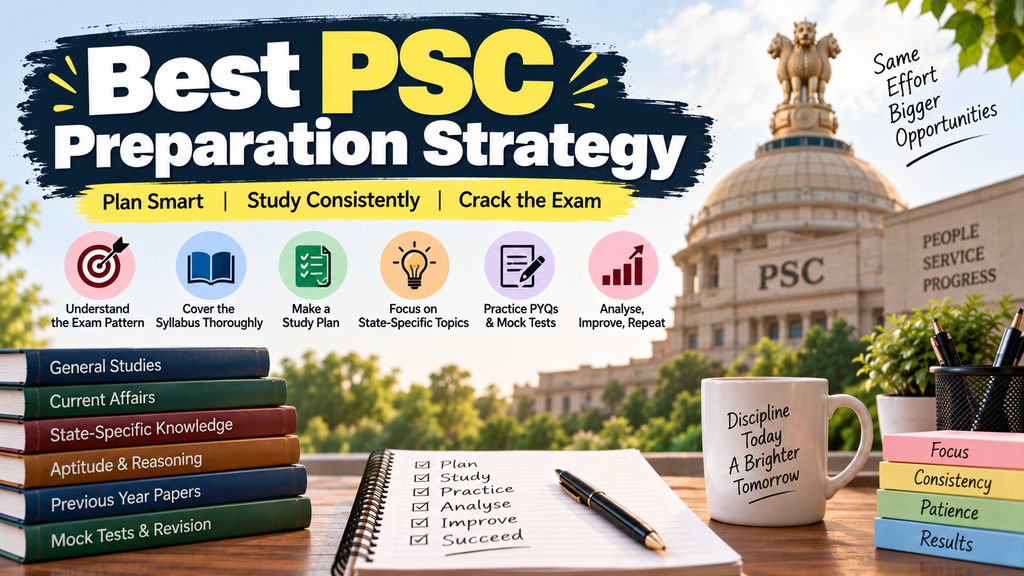
A well-structured strategy can make your PSC preparation more focused and productive. Instead of trying to cover everything at once, build strong fundamentals, stay updated, practice consistently, and revise regularly.
1. Build Strong Basics
A strong foundation helps you understand advanced topics more easily. Begin with basic concepts before moving to detailed study material.
- Start with fundamental concepts before advanced topics.
- Use standard school-level textbooks and reliable reference books.
- Focus on understanding concepts rather than memorising everything.
- Make short notes for important facts and concepts.
2. Make Current Affairs a Daily Habit
Current affairs play an important role in PSC preparation, particularly in general studies and state-specific sections. Make reading and revising current events a regular part of your routine.
- Read current affairs every day.
- Focus on national, international, economic, government, and state-related developments.
- Maintain concise notes for quick revision.
- Connect current events with static general studies topics.
- Revise monthly current affairs regularly.
3. Focus on State-Specific Knowledge
State-specific topics can give you an advantage in the examination. Give special attention to subjects related to the state for which you are appearing.
- Study state history and geography.
- Cover culture, festivals, literature, and important personalities.
- Learn about the state economy and government schemes.
- Understand the administrative structure and recent state developments.
- Follow important state-specific current affairs.
4. Practice Previous-Year Questions
Previous-year question papers help you understand the exam’s difficulty level, question patterns, and frequently tested topics. Include them regularly in your PSC preparation.
- Solve previous PSC question papers topic-wise.
- Identify recurring concepts and question patterns.
- Practice questions within a fixed time limit.
- Analyze incorrect answers and understand your mistakes.
- Use your performance to identify weak areas and improve them.
Consistent practice, regular revision, and analyzing your performance can make your PSC preparation more effective and exam-oriented.
Can You Prepare for PSC While Working or Studying?
Yes, you can prepare for the PSC exam while managing a job or studies. The key is to follow a realistic schedule, use your available time wisely, and stay consistent rather than focusing only on long study hours.
- Create a realistic schedule: Plan your study time around your classes or work commitments.
- Use weekdays wisely: Focus on specific topics during weekdays and reserve weekends for longer study sessions.
- Make use of short revision sessions: Revise current affairs, formulas, facts, and notes during breaks or commute time.
- Prioritise consistency: Regular, focused study is more effective than irregular long hours.
- Track weekly progress: Review completed topics, practice scores, and pending areas to keep your PSC preparation on track.
With proper time management and consistent effort, balancing PSC preparation with work or studies is achievable.
Sample Daily Study Routine
A balanced daily routine helps you cover the syllabus while leaving enough time for practice and revision. Here is a sample schedule for PSC preparation:
| Study Activity | Suggested Time |
| General Studies/Static Subjects | 2 hours |
| Current Affairs | 1 hour |
| State-Specific Topics | 1–2 hours |
| Aptitude & Reasoning | 1 hour |
| PYQs/Mock-Test Practice | 1 hour |
| Revision | 30–45 minutes |
You can adjust this routine based on your daily availability, preparation level, and exam timeline. The key is to maintain consistency and ensure regular practice and revision.
Common Mistakes to Avoid During PSC Preparation
Avoiding common mistakes is just as important as following the right PSC preparation strategy. Many aspirants lose valuable time by studying without a clear plan or focusing on the wrong resources. Keep these mistakes in mind during your PSC preparation:
- Starting without reading the syllabus: Always understand the official syllabus and exam pattern before beginning your PSC preparation.
- Ignoring state-specific topics: Give adequate attention to your state’s history, geography, culture, economy, and current affairs.
- Relying only on current affairs: Build strong static knowledge alongside current affairs for balanced PSC preparation.
- Using too many resources: Stick to a limited number of reliable books and online resources instead of constantly switching between them.
- Avoiding previous-year papers: Solve PYQs to understand question patterns, important topics, and difficulty levels.
- Not practicing enough questions: Include regular question-solving sessions to improve speed and accuracy.
- Neglecting revision: Schedule regular revisions to retain important concepts and facts.
A focused strategy, limited resources, regular practice, and consistent revision can help you make your PSC preparation more effective and productive.
Conclusion
Cracking a PSC exam requires consistent effort, smart planning, and regular practice. Effective PSC preparation should focus on understanding the syllabus, strengthening core concepts, covering state-specific topics, practicing previous-year papers, and revising regularly. Instead of relying on multiple resources, follow a structured study plan and track your progress consistently.
With the right strategy and determination, you can make your PSC preparation more focused and effective. CareerGrowKaro helps aspirants with useful exam guides, preparation strategies, study tips, and career resources to support them throughout their competitive exam journey.
FAQs
1. How should I start PSC preparation from scratch?
Start by understanding the latest official syllabus and exam pattern. Then choose reliable study materials, build your fundamentals, and gradually include current affairs, PYQs, mock tests, and revision in your routine.
2. How many hours should I study for the PSC exam?
There is no fixed number of hours required. Aim for 4–6 focused hours daily if possible, while prioritizing consistency, quality of study, and regular revision.
3. Can I prepare for PSC without coaching?
Yes. With the right books, official syllabus, previous-year papers, mock tests, and a structured study plan, you can prepare for the PSC exam through self-study.
4. How important are current affairs in PSC preparation?
Current affairs are an important part of PSC exams. Focus on national, international, economic, government, and state-specific developments and revise them regularly.
5. Are previous-year papers important for PSC exams?
Yes. Previous-year papers help you understand the question pattern, difficulty level, frequently tested topics, and time-management requirements.