Figuring out how to master data structures and algorithms is the ultimate priority for every ambitious engineering student today. Whether you are aiming for top multinational companies or high-growth startups, knowing how to master data structures and algorithms separates you from the competition. Thousands of students apply for software engineering roles, but only a few clear the technical screening rounds.
- Why Indian Engineering Students Struggle with DSA
- Step 1: Choose the Right Programming Language
- Step 2: Understand Time and Space Complexity
- Step 3: Start with Linear Data Structures
- Step 4: Conquer Non-Linear Data Structures
- Step 5: Master Algorithmic Paradigms
- The Best Way to Learn DSA for Placement
- Important DSA Topics for Product Based Companies
- How to Master Data Structures and Algorithms Using LeetCode
- Common Mistakes to Avoid During Your DSA Journey
- Frequently Asked Questions (FAQs)
- Launch Your Tech Career Trajectory Today
The secret to clearing these rounds is understanding how to master data structures and algorithms thoroughly. You do not need a genius-level IQ to get good at coding. By following a structured daily routine, learning how to master data structures and algorithms becomes a highly achievable goal. This CareerGrowKaro guide provides you with the ultimate roadmap.
We will break down exactly how to master data structures and algorithms from scratch. You will learn which programming language to pick, which topics to prioritize, and how to practice efficiently without burning out. Start your coding journey today and discover how to master data structures and algorithms right from your college hostel room.
Why Indian Engineering Students Struggle with DSA
Every semester, thousands of Indian engineering students ask how to master data structures and algorithms, yet many fail. College syllabi in most universities focus heavily on outdated theoretical definitions instead of practical problem-solving. This academic gap makes figuring out how to master data structures and algorithms extremely frustrating for freshers.
Students often buy expensive coding bootcamps hoping for a magic shortcut. However, learning how to master data structures and algorithms requires consistent, focused personal practice. When students jump directly to complex graph problems without understanding basic arrays, they lose their confidence quickly.
Understanding how to master data structures and algorithms means respecting the learning curve. You cannot rush the process by blindly memorizing code syntax. To truly learn how to master data structures and algorithms, you must understand the underlying logic behind every solution.
If you want to secure a top-tier software job, you must build a solid foundation first. Figuring out how to master data structures and algorithms bridges the gap between a struggling student and a highly paid professional. Commit to the process, and learning how to master data structures and algorithms will completely transform your technical career trajectory.
Step 1: Choose the Right Programming Language
The very first step in figuring out how to master data structures and algorithms is selecting the right tool. You must pick one primary programming language and stick with it entirely. Switching between languages constantly will destroy your progress when learning how to master data structures and algorithms.
Data Structures and Algorithms in C++
For competitive programming and technical interviews, studying data structures and algorithms in C++ is highly recommended. C++ offers the Standard Template Library (STL), which provides ready-to-use functions for vectors, stacks, and queues. Understanding how to master data structures and algorithms becomes much faster when you leverage C++ STL efficiently.
It executes code incredibly fast, which prevents “Time Limit Exceeded” errors on coding platforms. If you want to know how to master data structures and algorithms for product-based companies, C++ is an absolute industry favorite.
Java vs Python for DSA
Java is another massive corporate favorite, especially for enterprise-level software engineering roles. It offers robust memory management and a very strong collections framework. Learning how to master data structures and algorithms in Java prepares you perfectly for traditional campus placements.
Python is highly readable and excellent for machine learning, but it hides too much underlying logic. When figuring out how to master data structures and algorithms deeply, Python’s built-in shortcuts can sometimes make you lazy. Pick C++ or Java if you seriously want to learn how to master data structures and algorithms from the ground up.
Step 2: Understand Time and Space Complexity
You cannot learn how to master data structures and algorithms without deeply understanding Big O Notation. Time and space complexity metrics define the true efficiency of your code. Interviewers will always ask you to optimize your solution, which requires knowing how to master data structures and algorithms at a mathematical level.
Time complexity measures how your algorithm’s execution time grows as the input data increases. If you write nested loops, your time complexity becomes O(N squared), which is terrible for large datasets. Learning how to master data structures and algorithms means constantly striving for O(N) or O(log N) time complexities.
Space complexity measures how much extra RAM your code uses while executing. Creating unnecessary duplicate arrays destroys your space complexity score instantly. Understanding how to master data structures and algorithms requires you to solve problems using the least amount of memory possible. Always calculate these two metrics mentally before typing a single line of code.
Step 3: Start with Linear Data Structures
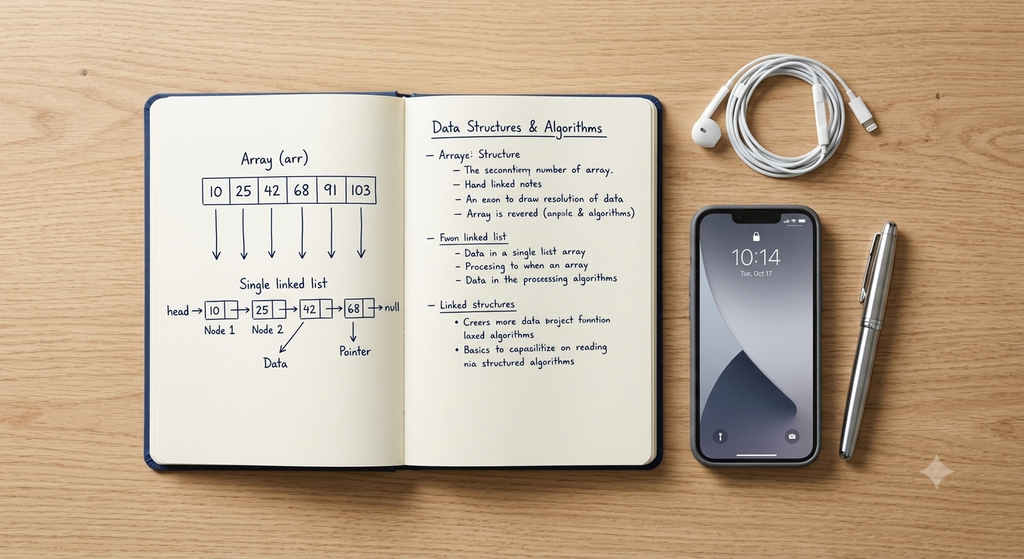
A proper DSA roadmap for beginners always starts with linear data structures. You must walk before you can run. Learning how to master data structures and algorithms begins with understanding how data is stored sequentially in computer memory.
Arrays and Vectors
Arrays are contiguous blocks of memory and form the absolute foundation of computer science. You must learn how to traverse, reverse, and rotate arrays efficiently using two-pointer techniques. When figuring out how to master data structures and algorithms, arrays are your very first major hurdle. In C++, mastering vectors (dynamic arrays) is critical for handling unpredictable data sizes effortlessly.
Strings and Character Manipulation
Strings are simply arrays of characters, but they come with unique edge cases. You must master string matching, substring extraction, and palindrome checking. Learning how to master data structures and algorithms requires you to handle string manipulation without relying completely on library functions. This builds your core logical thinking.
Linked Lists
Unlike arrays, linked lists store data in non-contiguous memory locations connected by pointers. Understanding pointers is the ultimate secret to learning how to master data structures and algorithms effectively. You must practice reversing a linked list, finding the middle node, and detecting loops using fast and slow pointers. Linked lists are extremely popular in top-tier technical interviews.
Stacks and Queues
Stacks follow the Last-In-First-Out (LIFO) principle, much like a stack of plates in a cafeteria. Queues follow the First-In-First-Out (FIFO) principle, like a ticket line at a movie theater. When learning how to master data structures and algorithms, you must implement these structures using raw arrays. Stacks are essential for solving parenthesis balancing problems and understanding deep system recursion.
Step 4: Conquer Non-Linear Data Structures
Once your linear foundation is solid, you must move to hierarchical data. This is where most students give up. However, learning how to master data structures and algorithms requires you to push through this exact barrier.
Trees and Binary Search Trees (BST)
Trees represent hierarchical data, much like a corporate organizational chart. You must learn how to master data structures and algorithms by writing recursive functions for tree traversals (Inorder, Preorder, Postorder). Binary Search Trees optimize search operations drastically, turning O(N) time into O(log N) time. Trees are frequently asked in almost every single product-based company interview.
Graphs and Matrix Traversal
Graphs represent networks, like Google Maps routing or Facebook friend connections. Learning how to master data structures and algorithms means understanding Breadth-First Search (BFS) and Depth-First Search (DFS). You must learn how to detect cycles in a graph and find the shortest paths using Dijkstra’s algorithm. Graph theory is considered advanced, but it is mandatory if you want to know how to master data structures and algorithms completely.
Hash Maps and Sets
Hash Maps store data in key-value pairs, offering lightning-fast O(1) data retrieval times. Whenever you face a frequency counting problem, Hash Maps are your best friend. Learning how to master data structures and algorithms requires knowing exactly when to trade memory space for execution speed.
Step 5: Master Algorithmic Paradigms
Data structures are the containers, but algorithms are the actual instructions. Knowing how to master data structures and algorithms means recognizing specific mathematical patterns instantly.
Dynamic Programming (DP)
Dynamic Programming strikes fear into the hearts of engineering students. It involves breaking a massive problem down into smaller overlapping subproblems and storing their results. Learning how to master data structures and algorithms requires you to practice memoization and tabulation techniques. Once you understand the underlying patterns, DP becomes incredibly predictable.
Greedy Algorithms
Greedy algorithms make the locally optimal choice at each step to find a global solution. They are used in scheduling problems and resource allocation. Learning how to master data structures and algorithms means knowing when a greedy approach will fail compared to Dynamic Programming.
Binary Search Applications
Binary search is not just for finding a number in a sorted array. It is a massive algorithmic concept. You can use it to find the square root of a number or allocate minimum pages to students. Understanding how to master data structures and algorithms requires looking beyond the basic definitions of these formulas.
The Best Way to Learn DSA for Placement

Following a random YouTube video every weekend is not a reliable strategy. The best way to learn DSA for placement is to adopt a strictly topic-wise approach. If you want to know how to master data structures and algorithms, you must build extreme daily consistency.
Start by dedicating two uninterrupted hours every single morning to problem-solving. Spend the first hour understanding the core theory and the second hour writing actual code. Learning how to master data structures and algorithms requires a minimum of four months of dedicated effort. Do not jump between topics randomly.
Finish all array problems before moving to strings, and finish all strings before touching linked lists. This sequential DSA roadmap for beginners builds logical momentum. If you get stuck on a bug, do not immediately check the solution. Learning how to master data structures and algorithms means forcing your brain to suffer through the debugging process manually.
Important DSA Topics for Product Based Companies
Product-based giants like Amazon, Microsoft, and Google have very specific interview patterns. If you want to crack these companies, you must prioritize important DSA topics for product based companies. Knowing how to master data structures and algorithms means focusing on high-return topics.
First, master the Sliding Window protocol and Two-Pointer techniques for arrays. These patterns appear in almost sixty percent of initial coding rounds. Next, ensure your Tree manipulation and Dynamic Programming skills are flawless. Learning how to master data structures and algorithms for elite companies requires deep expertise in these specific areas.
They rarely ask you to invert a binary tree; they ask you to find the maximum path sum within it. Furthermore, Graph algorithms like topological sorting are massive favorites for remote product startups. Knowing how to master data structures and algorithms gives you the power to negotiate incredible starting salaries at these elite firms.
How to Master Data Structures and Algorithms Using LeetCode

LeetCode is the ultimate battleground for software engineering aspirants. However, blindly solving five hundred random questions is a terrible strategy. Learning how to master data structures and algorithms on LeetCode requires tactical filtering.
Always sort problems by topic and start with “Easy” questions to build your syntax confidence. Once you can solve an easy problem in fifteen minutes, move exclusively to “Medium” difficulty questions. Medium questions form the absolute core of how to master data structures and algorithms for real interviews. They test your logic without introducing overly obscure mathematical tricks.
Participate in LeetCode weekly contests to simulate real interview pressure. When the timer is ticking, your brain operates completely differently. Learning how to master data structures and algorithms involves managing your anxiety while writing clean, bug-free code. Keep a digital notebook of your mistakes and review them every Sunday evening.
Common Mistakes to Avoid During Your DSA Journey
Many passionate students ruin their placement chances by falling into common behavioral traps. Avoiding these mistakes is just as important as learning how to master data structures and algorithms correctly.
Mistake 1: Memorizing Solutions
You cannot memorize your way through a technical interview. The interviewer will deliberately change the problem statement to test your adaptability. Learning how to master data structures and algorithms means understanding the “why” behind the code, not just the “how”. Dry run your code on a piece of paper to truly visualize the memory allocation.
Mistake 2: Ignoring Edge Cases
Writing code that passes the basic test case but fails on an empty array is unacceptable. You must actively look for null pointers, negative numbers, and massive integer overflows. Learning how to master data structures and algorithms requires extreme attention to detail and paranoid testing habits.
Mistake 3: Coding Without Planning
Never start typing the moment you read a problem statement. Spend the first ten minutes writing a rough algorithmic approach in plain English. Learning how to master data structures and algorithms means discussing the time complexity with the interviewer before writing actual syntax. Communication is just as crucial as coding.
Frequently Asked Questions (FAQs)
How long does it take to learn how to master data structures and algorithms?
If you practice consistently for two to three hours every single day, it takes roughly four to six months. You must follow a strict DSA roadmap for beginners to ensure you cover all major topics. Learning how to master data structures and algorithms is a marathon, not a weekend sprint.
Is mathematics important for learning how to master data structures and algorithms?
Basic discrete mathematics and high school algebra are very helpful, especially for time complexity analysis. However, you do not need a Ph.D. in mathematics to succeed. Learning how to master data structures and algorithms relies far more on logical deduction than heavy calculus.
Which language is better: C++ or Python?
For purely cracking technical interviews, practicing data structures and algorithms in C++ is widely considered the best approach. It forces you to manage memory manually and executes much faster than Python. However, if you are strictly targeting data science roles, Python is totally acceptable.
How many problems should I solve on LeetCode?
Quality matters far more than quantity when learning how to master data structures and algorithms. Solving 150 carefully selected, pattern-based “Medium” questions is much better than blindly solving 500 random ones. Focus on extracting the core logic from every single problem you encounter.
Can I learn how to master data structures and algorithms without a paid course?
Absolutely. There are thousands of brilliant free resources, documentation pages, and open-source repositories available online. Learning how to master data structures and algorithms only requires an internet connection, a code editor, and unbreakable personal discipline.
Launch Your Tech Career Trajectory Today
The modern corporate hiring environment heavily rewards candidates who take bold, creative initiative to solve complex technical bottlenecks. Thousands of intelligent college peers continue sending identical, boring applications without having real technical substance. Knowing how to master data structures and algorithms sets you apart instantly and aggressively from this massive, unseen crowd.
It shows extreme professional discipline and demonstrates absolute logical clarity to your future engineering manager. It actively proves that you are completely ready to thrive in modern digital, fast-paced technical workplaces. Understanding how to master data structures and algorithms is no longer optional for top-tier software and product roles in highly competitive tech industries. Knowing how to master data structures and algorithms gives you the ultimate, undeniable advantage over your college peers.
Do not wait for the perfect professional portfolio or a flawless academic transcript to get started with coding. Open your IDE immediately, select your primary programming language, and write out your first basic array traversal. The journey of learning how to master data structures and algorithms begins the exact moment you find the courage to compile your first program today.
Your first recorded logic does not need to achieve absolute algorithmic perfection. It simply needs to be genuine, clear, and relentlessly focused on the real technical value you want to build. Learning how to master data structures and algorithms is fundamentally about raw persistence and confident digital problem-solving. Practice daily on trusted platforms like LeetCode to build your algorithmic muscle memory. CareerGrowKaro is fully committed to supporting every step of your professional coding journey with actionable, tested guidance.
Before you hit send on your next technical application, make sure your standard written documents are just as optimized by reviewing the Biggest Resume Mistakes to Avoid. If you are balancing your heavy coding practice with ongoing rigorous semester exams, check out our Best Study Timetable for College Students to manage your time effectively. Open your code editor, tackle your next logic problem, and show the corporate tech world exactly what you are capable of achieving!