Will computer-based testing stop the NEET paper leak problem?
Partly, not fully. Moving NEET to a Computer-Based Test (CBT) from 2027 removes the weakest links: printing, transporting, and storing lakhs of physical papers across the country. That kills the most common way papers leak today. But CBT cannot stop every risk — insider access, impersonation, and cyber-attacks still need separate safeguards. So CBT is a big upgrade, not a magic fix. For the June 21, 2026 re-exam, the format stayed pen-and-paper.
- Will computer-based testing stop the NEET paper leak problem?
- Key Numbers (NEET Paper Leak, At a Glance)
- A Leaked Paper Doesn’t Just Cancel an Exam — It Breaks Trust
- What Actually Happened With NEET 2026?
- Why One Leaked Paper Can Hurt 22 Lakh Students
- The Government’s Answer: NEET Goes Computer-Based From 2027
- What CBT Will Fix — and What It Won’t
- CBT vs Adaptive Testing: The Difference No One Explains
- Could NEET Become a Fully Adaptive Exam One Day?
- What Should a NEET Aspirant Do Right Now?
- CareerGrowKaro’s Honest Take
- Frequently Asked Questions
- Final Thoughts
Key Numbers (NEET Paper Leak, At a Glance)
- 2.27 million candidates registered for NEET-UG 2026 — for roughly 1 lakh MBBS seats. (Sources: Wikipedia – 2026 NEET controversy; Wikipedia – Paper leak in India)
- The May 3, 2026 exam was cancelled on May 12, 2026 after a guess paper closely matched the real questions. Source: NTA, via Careers360)
- A re-exam (ReNEET 2026) was held on June 21, 2026, in pen-and-paper mode, with a 15-minute time extension. (Source: Careers360)
- From 2027, NEET-UG will be a Computer-Based Test, announced by Union Education Minister Dharmendra Pradhan. (Source: The Quint; Deccan Herald)
- 70+ paper-leak cases in 7 years have affected an estimated 1.5 crore students across India. (Source: NextIAS)
A Leaked Paper Doesn’t Just Cancel an Exam — It Breaks Trust

Picture a dropper in Kota or a final-year student in Patna. Two years of 5 AM wake-ups. Coaching fees their parents paid by cutting other costs. No festivals, no birthdays — just NCERT, mock tests, and one goal.
Then, hours before the exam, a screenshot starts moving on WhatsApp: “Paper leak ho gaya.”
Whether the message is true or fake, something snaps. Not just in the exam hall — in the student’s head. The biggest damage from a paper leak is not the cancelled exam. It is the lost trust. And trust is the hardest thing to rebuild.
This is why the NEET paper leak is not just a “news story.” For students from Tier 2 and Tier 3 cities — who have no backup plan, no second coaching budget — a cancelled exam can cost a full year. At CareerGrowKaro, we think students deserve more than outrage. They deserve to understand why this keeps happening, and whether the 2027 reform will actually help.
Let’s break it down simply.
What Actually Happened With NEET 2026?
Here is the short, honest timeline:
- 3 May 2026: NEET-UG 2026 is held for over 22 lakh aspirants.
- Early May: A “guess paper” circulating on Telegram is found to match a large number of real questions. The Rajasthan Special Operations Group (SOG) traces it.
- 12 May 2026: The National Testing Agency (NTA) cancels the exam.
- 15 May 2026: Education Minister Dharmendra Pradhan announces a re-exam and a major reform — NEET will move to computer-based testing from 2027.
- 21 June 2026: The re-exam (ReNEET 2026) is conducted in pen-and-paper mode, with tighter security.
The CBI took over the probe and made multiple arrests, including people linked to the exam process itself. The minister publicly admitted there had been a “breach in the command chain.”
One more thing worth saying plainly: ahead of the re-exam, the NTA had to warn students about Telegram channels with names like “Private Mafia” and “PAPER LEAKED NEET” that were selling fake papers for thousands to lakhs of rupees. (Source: PW) If you ever see such a channel — it is a scam. Report it, don’t pay.
One clear takeaway: Most “leaks” you see online are fake bait designed to scare you into paying. Real, verified leaks are rare — but when they happen, the whole system pays the price.
Why One Leaked Paper Can Hurt 22 Lakh Students
When a leak happens, everyone asks the same questions: Who leaked it? Which coaching centre? Who gets arrested? Will the exam be cancelled?
Fair questions. But they come after the damage. Almost nobody asks the bigger one:
Why is one leaked paper even capable of affecting 22 lakh students in the first place?
The answer is the exam’s design. Almost every traditional Indian competitive exam follows one model:
- One question paper.
- One answer key.
- Millions of students writing the same paper at the same time.
If someone gets early access to that single paper, the whole exam is at risk. That is not just a security problem — it’s an architecture problem.
Think of it like a bank. If everything sits behind one password, a thief only has to break one lock. Modern systems avoid this by spreading risk across many layers. The 2027 reform is India’s attempt to do exactly that for NEET.
The Government’s Answer: NEET Goes Computer-Based From 2027
This is the headline every aspirant should understand clearly.
From 2027, NEET-UG will be conducted as a Computer-Based Test (CBT) instead of the current OMR pen-and-paper format. The decision was announced by Union Education Minister Dharmendra Pradhan, who said the “root cause” of the problem was the OMR-based system itself. (Source: The Quint; Deccan Herald)
This wasn’t a sudden idea. After the 2024 NEET controversy, the government formed the Radhakrishnan Committee (led by former ISRO chairman K. Radhakrishnan) to fix how the NTA runs exams. That committee flagged the printed-paper system as a key weakness and pushed for a shift towards computer-based testing. (Source: The Quint)
What is a CBT? Simply put, you answer on a computer screen at an exam centre instead of filling an OMR sheet with a pen. The question paper is delivered digitally — usually encrypted — to the centre’s secure server, instead of being printed and trucked across the country.
Important: The 2027 switch changes only the mode of the exam. The syllabus, marking scheme, and subject weightage stay the same (Physics, Chemistry, Biology; 180 questions; 720 marks; +4 correct, –1 wrong).
What CBT Will Fix — and What It Won’t
Here is the honest part most articles skip. CBT is a real upgrade, but it is not a magic shield. Let’s be specific.
What CBT genuinely reduces:
- Printing leaks — no master paper sitting in a press.
- Transport leaks — no sealed packets travelling by road to thousands of centres.
- Storage leaks — no papers locked in centre cupboards the night before.
- Mass distribution — if papers go live digitally only at exam time, there’s no early physical copy to photograph and sell.
What CBT does not automatically fix:
- Insider access — someone inside the system with question-bank access is still a risk. (In the 2026 case, the CBI alleged people linked to the exam process were involved.)
- Impersonation — a paid stand-in writing the exam. This needs strong biometric checks, not just a computer.
- Cyber-attacks — digital systems can be hacked if not secured end-to-end.
- Centre-level cheating — weak invigilation or compromised staff.
So the right way to read the 2027 reform is this: CBT removes the biggest, most common doorway for leaks — the physical paper — but the building still needs other locks. Security, technology, and honest governance all still matter.
What this means for you: Don’t expect 2027 NEET to be “leak-proof.” Expect it to be harder to leak at scale. That alone is a meaningful improvement for a fair shot at a seat.
CBT vs Adaptive Testing: The Difference No One Explains
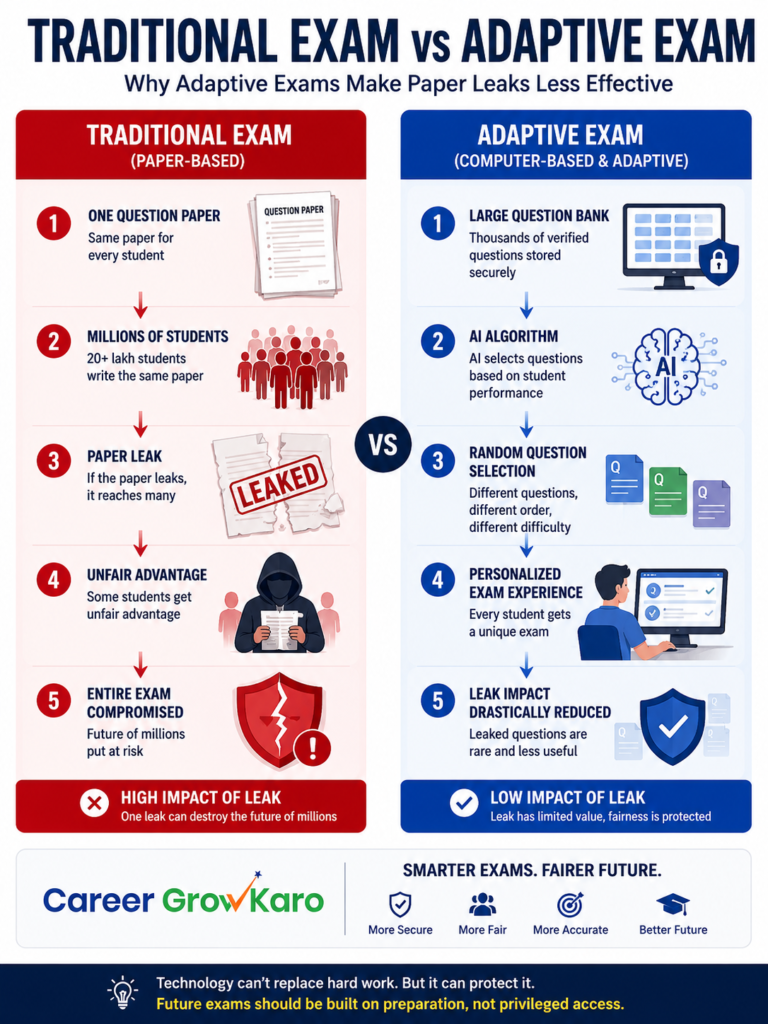
This is the part that confuses even toppers — and where most ranking articles get sloppy. CBT and adaptive testing are not the same thing.
| Feature | Traditional NEET (OMR) | CBT (NEET 2027 plan) | Adaptive Test (e.g. NMAT) |
|---|---|---|---|
| Answering mode | Pen on OMR sheet | Computer at a centre | Computer at a centre |
| Question paper | One common printed paper | Often the same set, delivered digitally | A unique path per student from a huge question bank |
| Do all students get the same questions? | Yes | Usually yes (per shift) | No — questions change based on your answers |
| Main leak risk it removes | — | Printing, transport, storage | The very idea of “one paper to leak” |
| Difficulty | Fixed for all | Fixed for all | Adjusts to each student’s level |
In one line:
- CBT = same exam, delivered by computer instead of paper. It protects the paper better.
- Adaptive testing = the computer builds a different paper for each student in real time, so there is no single “master paper” to leak at all.
In one line:
- CBT = same exam, delivered by computer instead of paper. It protects the paper better.
- Adaptive testing = the computer builds a different paper for each student in real time, so there is no single “master paper” to leak at all.
NEET 2027’s announced plan is CBT, not full adaptive testing. Adaptive is the next level — and worth understanding, because it changes the economics of a leak entirely.
How an adaptive exam works (the simple version)
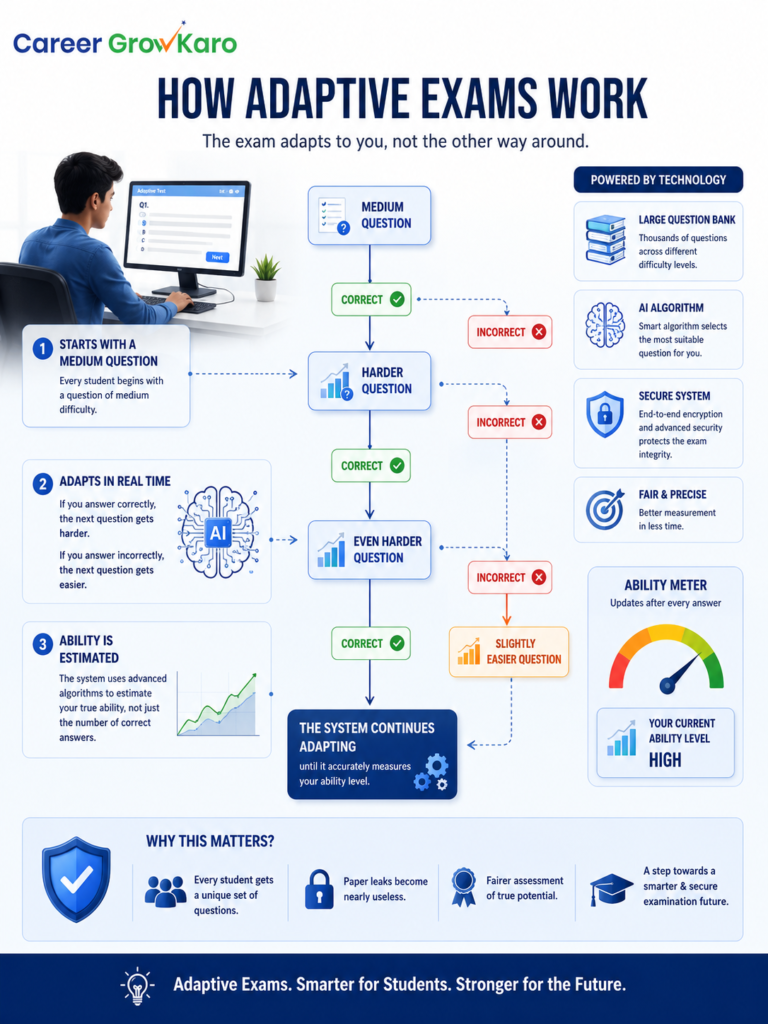
Think of Google Maps. If one road is blocked, it instantly reroutes you. An adaptive exam does the same with questions:
- Every student starts with a medium-difficulty question.
- Answer correctly → the next question gets slightly harder.
- Answer wrong → the next gets slightly easier.
- By the end, the system has measured your ability through a personalised path.
Two students sitting side by side never get the same paper. So even if someone steals 300 questions in advance, they can’t be sure which will appear, in what order, or for whom. Criminal networks sell certainty — adaptive testing replaces certainty with probability, and that destroys the resale value of a “leak.”
This is why exams like NMAT use computer-adaptive testing. (Note: CAT is computer-based, but its adaptive behaviour has changed over the years — always check the latest official pattern before you rely on it.)
Could NEET Become a Fully Adaptive Exam One Day?
Maybe — but not overnight, and not in 2027. Moving the world’s largest medical entrance exam to a fully adaptive format would need:
- A calibrated question bank of hundreds of thousands of validated questions.
- Psychometric analysis to keep difficulty fair across different question paths.
- Reliable computers and fast, secure networks at thousands of centres — including in small towns.
- Strong cybersecurity and standardised testing environments.
That is a multi-year project. The 2027 CBT shift is the realistic first step. India has modernised “impossible” systems before — payments moved to UPI, income tax went digital, passports went online. Exams may follow a similar curve: first CBT, then possibly hybrid or adaptive models. The lesson is the same one CareerGrowKaro keeps repeating: technology should reduce the chance of cheating, not just react after it happens.
What Should a NEET Aspirant Do Right Now?
Reform is the government’s job. Your job is your prep. Here’s the practical, no-panic plan:
- Trust only official sources. For anything about your exam, check neet.nta.nic.in — not WhatsApp forwards or Telegram channels.
- Never pay for a “leaked paper.” It is almost always a scam, and buying one is a punishable offence under the Public Examinations (Prevention of Unfair Means) Act, 2024 — which carries heavy fines. (Source: Education Today)
- Report fake leak claims. The NTA launched a portal to report fake paper-leak claims and scams ahead of the re-exam. Use it.
- If 2027 is your year, get CBT-ready early. Practise on a computer screen: on-screen calculators (if allowed), navigation between questions, and reading long passages on a monitor. Students who only practise on paper can lose time adjusting on exam day.
- Keep a backup plan. A leak or delay should never end your career. Know the other strong paths after 12th PCB (BSc Nursing, B Pharma, biotech, allied health, and more) so one bad day doesn’t decide everything.
CareerGrowKaro Magic Box
Stressed about NEET, re-exams, and the 2027 CBT change? You don’t need an expensive Delhi counsellor to make sense of it. CareerGrowKaro’s free Government Exam Guides explain NEET, NTA reforms, and your options after 12th — in simple language, built for Tier 2/3 students.
CareerGrowKaro’s Honest Take
Every leak triggers the same demands: more arrests, more cameras, stricter laws. All important — but they treat the symptom, not the cause.
The deeper fix is exam design. The strongest system is not the one with the most CCTV cameras. It is the one where stealing a single paper no longer compromises the future of 22 lakh students. The 2027 shift to CBT moves India in that direction. Full adaptive testing would go further.
Students deserve a system where success depends on preparation, not privileged access. That conversation is finally happening — and it should not stop until the design itself is fair. Confusion se clarity tak — that’s the whole point.
Explore CareerGrowKaro’s Government Exam Guides
Frequently Asked Questions
1. Was the NEET 2026 paper actually leaked?
The NTA cancelled the May 3, 2026 exam on May 12 after investigators found a guess paper closely matching the real questions, and the CBI made several arrests. A re-exam was held on June 21, 2026. Note that many other “leak” claims circulating online before the re-exam were officially declared fake.
2. Will computer-based NEET 2027 completely stop paper leaks?
No. CBT removes the biggest risks — printing, transport, and storage of physical papers — which makes large-scale leaks much harder. But it cannot alone stop insider access, impersonation, or cyber-attacks. Those need separate safeguards. CBT is a major upgrade, not a perfect fix.
3. Is NEET 2027 the same as an adaptive exam like NMAT?
No. NEET 2027 is a Computer-Based Test (CBT) — you answer on a computer, but students can still get the same set of questions. An adaptive exam like NMAT builds a different question path for each student in real time. Adaptive is a more advanced concept than the announced CBT plan.
4. Will the NEET syllabus or marking change in 2027?
No. The 2027 shift changes only the mode (computer instead of OMR sheet). The syllabus, 180-question pattern, 720 marks, and +4/–1 marking scheme stay the same.
5. What should I do if I see a “NEET paper leak” message online?
Do not forward it and never pay for it. Most are scams, and buying leaked material is a crime under the Public Examinations (Prevention of Unfair Means) Act, 2024. Verify everything only on the official NTA website and report fake claims through the NTA’s reporting portal.
6. Which Indian exams already use computer-based or adaptive testing?
Many entrance and recruitment exams are already computer-based (CBT). NMAT is a well-known computer-adaptive exam. Always check the latest official exam pattern before you apply, since formats are updated from time to time.
Key Takeaways
✔ A paper leak is not only a security failure — it is an exam-design failure.
✔ Traditional NEET relies on one common paper, so one leak can hurt millions.
✔ From 2027, NEET becomes a Computer-Based Test, removing printing/transport/storage risks.
✔ CBT is not the same as adaptive testing — and it cannot fix insider or impersonation risks alone.
✔ Your move now: trust only official sources, never pay for “leaks,” and stay exam-ready.
Final Thoughts
A fair examination system is built on trust.
Students invest years of their lives preparing for competitive exams.
They deserve confidence that their hard work—not a leaked paper—will decide the outcome.
Whether India ultimately adopts adaptive testing, hybrid testing, or another innovation, the objective should remain the same:
Reward merit. Protect integrity. Restore trust.
At CareerGrowKaro, we will continue to simplify complex education topics so every student can make informed career decisions with confidence.