Mamaearth Growth Story began in 2016 when Ghazal and Varun Alagh could not find safe skincare products for their baby and decided to make their own. The brand grew under parent company Honasa Consumer, raised funding from investors like Sequoia Capital and Fireside Ventures, and listed on the Indian stock market in November 2023 through a ₹1,701 crore IPO. After a rough patch in 2024, Honasa’s FY26 results show a real recovery, with profit rising to about ₹200 crore. This guide breaks down what actually happened, year by year, and what a student with zero funding can genuinely learn from it.
- What Is Mamaearth, and Who Owns It Now?
- How Did Mamaearth Actually Start? The Real Origin Story
- Mamaearth Growth Story — Year by Year
- The IPO — What Actually Happened in November 2023?
- What Went Wrong After the IPO? (Told Honestly)
- Is Mamaearth Profitable Now? The FY26 Comeback
- 6 Real Lessons for a Student or First-Time Founder With No Funding
- Mamaearth vs Other Indian D2C Brands — A Quick Comparison
- FAQs
- Your Next Step
- Related resources
You have probably used a Mamaearth shampoo, or seen co-founder Ghazal Alagh on Shark Tank India. But “a young couple built a ₹13,000 crore company” is not the real story — it is the headline.
At CareerGrowKaro, students building their own hustle ask us the same question about brands like this one: “Can I actually copy this?” Mostly, no — Mamaearth raised over $89 million from investors before it ever thought about an IPO. But parts of this story are copyable, and parts are honest warnings.
This case study gives you the full, updated-to-2026 version — the funding, the IPO, the mistakes, and the recovery — with the exact lessons a founder starting with zero capital can actually use.
What Is Mamaearth, and Who Owns It Now?

Mamaearth is a personal care brand — skincare, haircare, and baby care products. It is not a standalone company anymore. Since going public, it operates under a parent company called Honasa Consumer Limited, based in Gurugram.
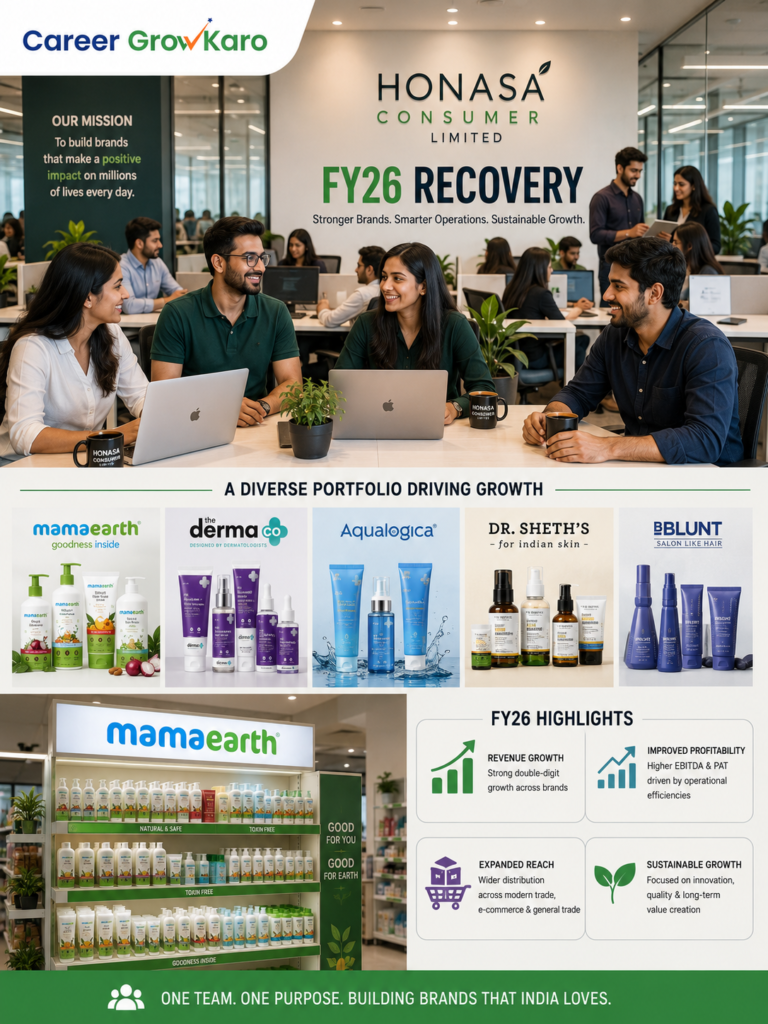
Honasa Consumer now owns a “house of brands,” not just Mamaearth. This matters for the story later — it is one reason the company survived its rough 2024.
Honasa Consumer’s Brand Portfolio
- Mamaearth — the original baby and personal care brand
- The Derma Co. — dermatology-inspired skincare
- Aqualogica — hydration-focused skincare
- Dr. Sheth’s — clinical skincare
- BBlunt — hair salons and hair care
- Momspresso — a content and influencer marketing platform
How Did Mamaearth Actually Start? The Real Origin Story
In 2016, Ghazal Alagh’s newborn son Agastya had a skin condition. When she and her husband Varun researched the baby care products available in India, they found most contained chemicals that were not suitable for sensitive skin.
Varun brought FMCG marketing experience. Ghazal had none — she learned the business side as she went. Neither of them came from a business family or a metro-city network. That part of the story is genuinely relatable for a Tier 2/3 reader.
Here is the part most articles skip: they did not start by building a website or a factory. They launched their first products on Amazon and waited to see if strangers would actually buy them before investing in anything bigger.
Explain → Example → Action
EXPLAIN: Before you spend money building your own website, app, or shop, test if people will actually pay for your product on a platform that already has buyers.
EXAMPLE: Mamaearth’s co-founder Ghazal Alagh has written that the brand deliberately kept its early go-to-market strategy simple — launching through Amazon first, and building its own website only after it saw real traction. (Source: Business Today, Jan 2024)
YOUR NEXT STEP: If you are starting a hustle today, sell your first 10 units on Instagram, WhatsApp Business, or Meesho before you spend a single rupee on a website. Let real orders — not your own excitement — tell you if the idea works.
Mamaearth Growth Story — Year by Year

Here is the full funding-to-IPO journey in one table, so you do not have to piece it together from ten different articles.
| Year | Milestone | Key Detail |
| 2016 | Founded in Gurugram | Seed funding from Fireside Ventures; first products launched on Amazon |
| 2018 | Series A | ₹27.5 crore (~$4 million) led by Stellaris Venture Partners |
| 2020 | Series B | ₹130 crore (~$18 million) led by Sequoia Capital India, with Fireside and Stellaris |
| 2021 | Series C | New investors Sofina and Evolvence India join the cap table |
| 2022 | Unicorn status | $52 million round led by Sequoia at a $1.2 billion valuation |
| 2023 | IPO | Listed on NSE/BSE in November 2023, raising ₹1,701 crore |
| 2024 | Post-IPO correction | Distributor disputes, inventory write-offs, stock fell to a 52-week low of ₹248.40 |
| 2026 | Recovery | FY26 profit rose to about ₹200 crore; stock recovered above ₹400 |
Funding figures compiled from Tracxn’s company profile and Inc42’s reporting on individual funding rounds. Total funding raised before the IPO is reported between $89 million and $111.6 million depending on the source and date of reporting.
The IPO — What Actually Happened in November 2023?
Honasa Consumer’s IPO ran from October 31 to November 2, 2023, priced between ₹308 and ₹324 per share.
- Total issue size: ₹1,701 crore
- Fresh issue (new money into the company): ₹365 crore
- Offer for sale (existing investors and founders selling shares): ₹1,336 crore
- Listed on the stock exchanges on November 7, 2023
The IPO was subscribed 7.61 times overall — but retail investors (ordinary individuals, not big institutions) subscribed only 1.35 times. (Source: Startup Story / Inc42 coverage)
That gap matters. It tells you institutions were confident, but everyday investors were far more cautious — largely because of a valuation debate that started months earlier.
Why the Valuation Was Controversial
When Mamaearth first announced IPO plans in early 2023, it sought a valuation of roughly $3 billion. In FY22, the company’s actual profit was about ₹19.86 crore — a huge gap between story and numbers that market watchers openly questioned before the listing.
What Went Wrong After the IPO? (Told Honestly)
This is the part most “inspiring founder story” articles quietly skip, and the part most “IPO disaster” articles never move past. A real business usually has both chapters — and CareerGrowKaro believes you learn more from the honest middle than from either extreme.
The Channel-Stuffing Problem
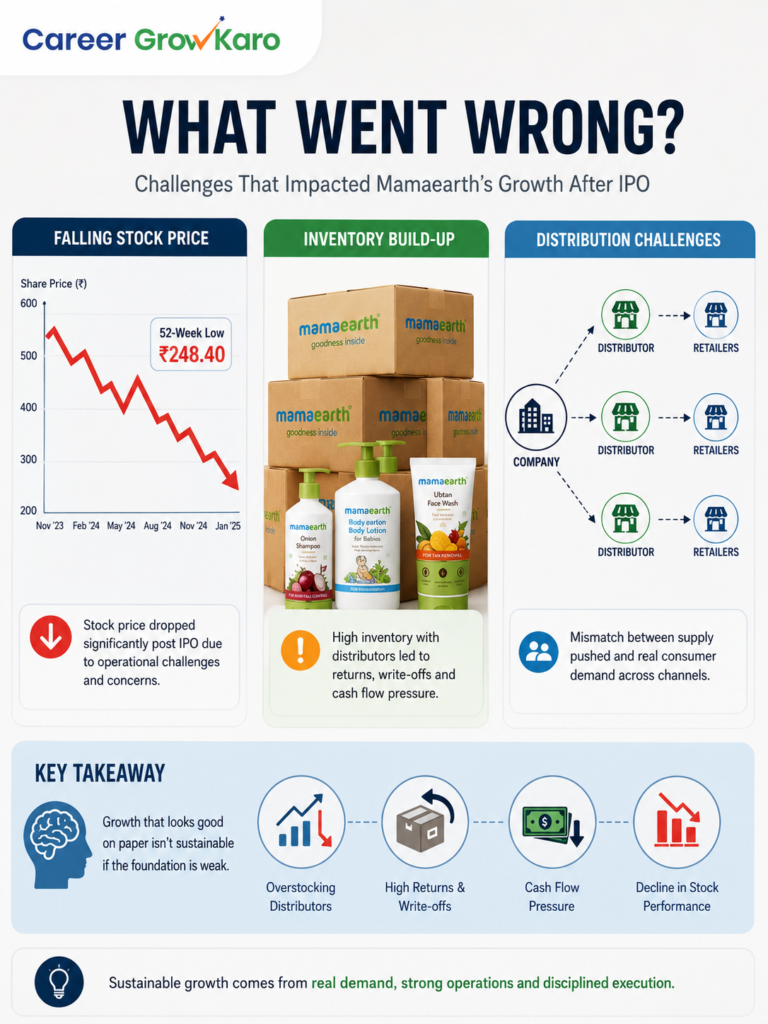
Reports based on Honasa’s own regulatory filings showed that inventory sitting with distributors jumped sharply in the run-up to the IPO — from about ₹41 crore in FY21 to nearly ₹114 crore in FY23, and further to ₹141 crore by mid-FY24.
Distributors, represented by the All India Consumer Products Distributors Federation (AICPDF), said the extra stock did not match real consumer demand and claimed distributors were left carrying a financial burden of around ₹300 crore in unsold inventory. (Source: The Core)
In plain terms: the company appears to have pushed more stock into the market than shops could actually sell, which made growth look stronger on paper right before investors were asked to buy in.
The Numbers That Followed
- Stock price fell to a 52-week low of ₹248.40 — well below the IPO price band
- Q2 FY25 net loss of about ₹19 crore, with revenue down 17% quarter-on-quarter
- High marketing spend — close to 40% of revenue at one point — while return on that ad spend lagged behind more established rivals
None of this means Mamaearth was a fraud or a failure. It means growth that is manufactured through the supply chain, instead of earned through real repeat customers, eventually shows up in the numbers. That lesson applies whether you are running a ₹2,000 crore company or a ₹2,000 side hustle.
Is Mamaearth Profitable Now? The FY26 Comeback
This is the update almost no other article online currently has: Honasa Consumer’s FY26 numbers (year ending March 2026) show a genuine turnaround, not just a bounce.
| Metric | FY25 | FY26 |
| Revenue | ~₹1,920 crore (FY24 figure for context) | ~₹2,475–2,479 crore |
| EBITDA | ₹69 crore | ₹231 crore (about 3x) |
| Profit after tax (PAT) | ₹73 crore | ₹200 crore (about 2.7x) |
| Gross margin (Q4) | 70.7% | 71.4% |
| Free cash flow | Lower | ₹134 crore for the year |
Figures compiled from IndMoney’s Q4 FY26 results coverage and stock data from Kotak Neo and Screener.in as of June 2026.
What Actually Drove the Recovery
- Diversifying beyond Mamaearth: The company’s younger brands (The Derma Co., Aqualogica, and others) grew more than 40% in FY26, reducing how dependent Honasa is on a single brand.
- Offline expansion done properly: Mamaearth now directly reaches around 1.2 lakh retail outlets through distributors and over 10,000 modern trade stores — this time with better inventory discipline.
- Better cash management: The company reported a negative working capital cycle of 14 days, meaning it is collecting cash from sales faster than it pays its own suppliers — a sign of a tighter, more efficient business.
- New bets: In June 2026, Honasa approved acquiring a 58% stake in Fluence Pharma for about ₹135 crore, forming a new health-focused subsidiary.
A word of caution: as of late June 2026, the stock trades at a price-to-earnings ratio of around 67–72, which is still priced for high future growth. This is a case study for learning, not investment advice — always do your own research before putting money into any stock.
6 Real Lessons for a Student or First-Time Founder With No Funding
Most of what made Mamaearth grow fast — $89 million in venture funding, national ad campaigns, a Shark Tank appearance — is not available to a student in Nagpur or Patna starting with ₹5,000. Here is what actually is.
1. Solve a problem you personally live, not one you read about
Ghazal Alagh did not study the baby care market and spot a “gap.” Her own son had a real skin problem, and existing products failed him. Your next step: list three problems you have faced yourself in the last month. Your best business idea is probably hiding in that list, not in a trending Instagram reel.
2. Test on a platform that already has buyers
Mamaearth sold on Amazon before building its own website. Your next step: use Instagram, WhatsApp Business, or Meesho to get your first 10–20 real paying customers before spending money on a website or app.
3. Growth on paper is not the same as healthy growth
Pushing extra stock to distributors made Mamaearth look bigger right before its IPO — until the stock got returned and the truth showed up in later results. Your next step: never inflate your numbers to impress an investor, a college competition judge, or your own Instagram followers. Track real repeat customers, not one-time hype.
4. Marketing spend has to earn loyalty, not just attention
Mamaearth’s high ad spend without matching returns was a red flag investors pointed out well before the IPO. Your next step: if you are spending on ads, track whether the same customer buys from you twice. One-time buyers funded by heavy discounts are not a business — they are a leak.
5. Do not depend on one product, one client, or one platform
Honasa’s FY26 recovery came partly because its newer brands grew faster than Mamaearth itself, so the whole company did not sink with one brand’s problems. Your next step: if you are freelancing, do not let one client be more than 30–40% of your income. If you sell products, do not depend on a single platform’s algorithm.
6. Honest correction beats hiding the problem
The FY26 turnaround happened after the company’s inventory and margin issues were reported publicly and addressed — not after they were hidden. Your next step: when your hustle hits a real problem — a bad batch, an unhappy client, slow sales — fix it and tell your customers honestly. Trust recovers faster than most founders expect.
Struggling to pick your own business idea? Use CareerGrowKaro’s Low-Investment Business Ideas guide to find a realistic hustle you can start with under ₹10,000 — no VC funding needed.
Mamaearth vs Other Indian D2C Brands — A Quick Comparison
Mamaearth is not the only path in Indian D2C beauty. Comparing it with peers shows there is more than one way to build a personal care brand in India.
| Brand | Founded | Funding Path | FY24 Revenue (approx.) | Status |
| Mamaearth (Honasa) | 2016 | $89-$111.6M+ in VC funding before IPO | ₹1,920 crore | Public (IPO Nov 2023) |
| WOW Skin Science | 2014 | ~$125M from ChrysCapital, GIC and others | ~₹247 crore (declining) | Private, still working toward consistent profit |
| SUGAR Cosmetics | 2015 | VC funded across multiple rounds | ₹222 crore (FY22 figure) | Private |
Comparison figures from Entrackr’s coverage of D2C beauty brand financials and Inc42’s reporting on WOW Skin Science’s funding history.
Notice something: bigger funding did not automatically mean a bigger or safer business. WOW Skin Science raised significant money too, and its revenue was shrinking in FY24 while Mamaearth’s was growing. Funding buys you a chance to grow fast — it does not guarantee you will grow well.
FAQs
Who founded Mamaearth, and when?
Ghazal Alagh and Varun Alagh founded Mamaearth in 2016 in Gurugram, after struggling to find safe skincare products for their newborn son. The company is now part of the publicly listed Honasa Consumer Limited.
Is Mamaearth still profitable in 2026?
Yes. Honasa Consumer’s FY26 results show profit after tax rose to about ₹200 crore, up from ₹73 crore in FY25, with EBITDA roughly tripling to ₹231 crore over the same period.
How much funding did Mamaearth raise before its IPO?
Honasa Consumer raised between $89 million and $112 million in venture funding before its IPO, depending on the source and methodology used.
Did Mamaearth’s IPO fail?
No, but it had a rocky first year. The IPO itself raised ₹1,701 crore and was oversubscribed 7.61 times. The stock later fell sharply on distributor and inventory concerns, hitting a 52-week low of ₹248.40, before recovering strongly through FY26.
What is Honasa Consumer Limited?
Honasa Consumer is the parent company that owns Mamaearth along with other personal care brands like The Derma Co., Aqualogica, Dr. Sheth’s, and BBlunt. It is the company that is actually listed on the NSE and BSE, not Mamaearth by itself.
Can I really start a business like Mamaearth without any funding?
Not the exact same way — Mamaearth’s scale came from large VC funding. But the starting principles are copyable: solve a problem you personally face, test it on an existing platform like Instagram or Meesho before spending money, and grow only as fast as your real numbers allow.
Your Next Step
Mamaearth’s story is not a script to copy line by line. It is proof that a real, personally-felt problem — handled honestly, even after mistakes — can still grow into something big in India’s market.
At CareerGrowKaro, we break down stories like this so you get the honest full picture, not just the highlight reel or the outrage headline. If you are ready to figure out your own business idea, explore more CareerGrowKaro guides on low-investment business ideas and side hustles built for Tier 2/3 India.
Related resources
How an Aligarh Shop Owner Tripled Sales using Instagram
Areca Leaf Plate Business in India 2026 – Proven Profitable Startup Blueprint
How to Start an Acrylic Paint Manufacturing Business in India: Complete 2026 Guide