If you’re an undergraduate, postgraduate, or PhD student looking to strengthen your academic profile, the CAG-ICSSR Research Article Competition 2026 could be one of the most rewarding opportunities this year. Beyond attractive cash prizes, the competition offers something far more valuable—an opportunity to conduct policy-oriented research using official government audit reports and showcase your analytical skills before leading academics and public policy experts.
- At a Glance: CAG-ICSSR Research Article Competition 2026
- What is the CAG-ICSSR Research Article Competition?
- Why Should Students Care?
- Understanding the Organisers
- Who Can Participate?
- Competition Timeline
- Prize Money and Recognition
- CareerGrowKaro Insight: Why This Competition Could Become a Major Academic Credential
- Understanding the Competition Themes: How to Choose a Winning Research Topic
- How to Read a CAG Audit Report Efficiently
- Where Can You Find Audit Reports?
- 20 Strong Research Topic Ideas
- CareerGrowKaro Expert Tip: Think Like a Policy Analyst
- How to Write a Winning Research Article for the CAG-ICSSR Competition
- What Makes a Research Article Stand Out?
- Official Submission Guidelines You Should Not Miss
- Can You Use AI Tools?
- Common Mistakes That Could Cost You Marks
- A 30-Day Preparation Plan
- Frequently Asked Questions (FAQs)
- CareerGrowKaro’s Final Take
- Related resources
Unlike conventional essay competitions that focus on opinions, this initiative challenges participants to analyse real governance issues using authentic public data published by the Office of the Comptroller and Auditor General (CAG) of India. It encourages evidence-based thinking, critical analysis, and practical policy recommendations—skills that are increasingly valued in higher education, civil services, research institutions, think tanks, and public administration.
The competition is being jointly organised by the Comptroller and Auditor General (CAG) of India and the Indian Council of Social Science Research (ICSSR), two of India’s most respected public institutions. According to the official announcement, the initiative aims to promote academically rigorous and policy-relevant research among students while encouraging greater engagement with public finance, governance, and accountability.
At a Glance: CAG-ICSSR Research Article Competition 2026
| Particular | Details |
|---|---|
| Competition Name | CAG-ICSSR Research Article Competition 2026 |
| Organisers | Comptroller and Auditor General of India (CAG) & Indian Council of Social Science Research (ICSSR) |
| Mode | Online |
| Participation | Individual |
| Eligible Students | Undergraduate, Postgraduate and Doctoral students |
| Registration Started | 1 June 2026 |
| State-Level Article Submission | 1 July – 31 August 2026 |
| National-Level Article Submission | 1 August – 30 September 2026 |
| Research Basis | Published CAG Audit Reports |
| Major Themes | Fiscal Governance, Social Sector Spending, MSMEs & Employment, Urban & Rural Local Bodies |
| Official Portal | ICSSR Competition Portal |
Dates and submission timelines are based on the official competition notification and may be updated by the organisers. Candidates should always verify the latest information before applying. They can also refer to the official guidelines: Click here
What is the CAG-ICSSR Research Article Competition?
At first glance, this may seem like another government-sponsored writing competition. In reality, it is much more than that.
The CAG-ICSSR Research Article Competition has been designed to bridge the gap between academic learning and public policy. Instead of asking participants to write generic essays, the competition requires students to examine official audit reports published by the CAG and develop well-researched articles that identify governance challenges, evaluate public programmes, and propose practical recommendations.
The initiative was launched to encourage young researchers to engage with authentic government data and contribute meaningfully to discussions around transparency, accountability, and efficient public spending.
Why is this different from a normal article-writing competition?
Most college competitions judge participants on creativity or language skills.
This competition evaluates much deeper capabilities, including:
- Research aptitude
- Data interpretation
- Evidence-based writing
- Public policy understanding
- Analytical thinking
- Academic referencing
- Originality of ideas
These are the same skills expected in postgraduate research, doctoral studies, policy consulting, and civil services.
Why Should Students Care?
Many students focus only on internships and certifications to build their CVs. While these are important, participating in a nationally recognised research competition can provide a distinct academic advantage.
For example, if you are planning to pursue:
- a Master’s degree,
- a PhD,
- public policy programmes,
- research fellowships,
- civil services,
- development sector careers,
- think tank roles,
having an original research publication or recognition in a national competition can significantly strengthen your profile.
More importantly, it demonstrates that you can analyse complex public issues using credible evidence rather than relying solely on opinion.
Understanding the Organisers
Comptroller and Auditor General (CAG) of India
The Comptroller and Auditor General of India is a constitutional authority established under Article 148 of the Constitution of India. Its primary responsibility is to audit the receipts and expenditure of the Union and State Governments, ensuring accountability and transparency in the use of public funds. CAG audit reports are presented before Parliament and State Legislatures and often influence policy reforms and administrative improvements.
For students, these audit reports represent a rich source of authentic data on governance, public finance, infrastructure, education, healthcare, local governance, taxation, and social welfare.
Indian Council of Social Science Research (ICSSR)
Established by the Government of India, ICSSR supports research across various social science disciplines through fellowships, grants, seminars, publications, and collaborative academic initiatives.
Through this partnership with CAG, ICSSR aims to encourage students to apply academic research methods to real-world governance issues, thereby promoting evidence-based policy discussions.
Who Can Participate?
One of the biggest strengths of this competition is its broad eligibility.
Students from recognised institutions across India can participate individually if they fall into one of the following categories:
- Undergraduate students
- Postgraduate students
- Doctoral (PhD) scholars
Unlike many research competitions that are restricted to economics or public administration students, this competition welcomes participants from a wide range of disciplines, provided they can produce an original, evidence-based research article aligned with the prescribed themes.
This means students from fields such as:
- Economics
- Political Science
- Public Administration
- Sociology
- Commerce
- Law
- Management
- Rural Development
- Social Work
- Engineering (with interdisciplinary research interests)
can all explore relevant research questions.
Competition Timeline
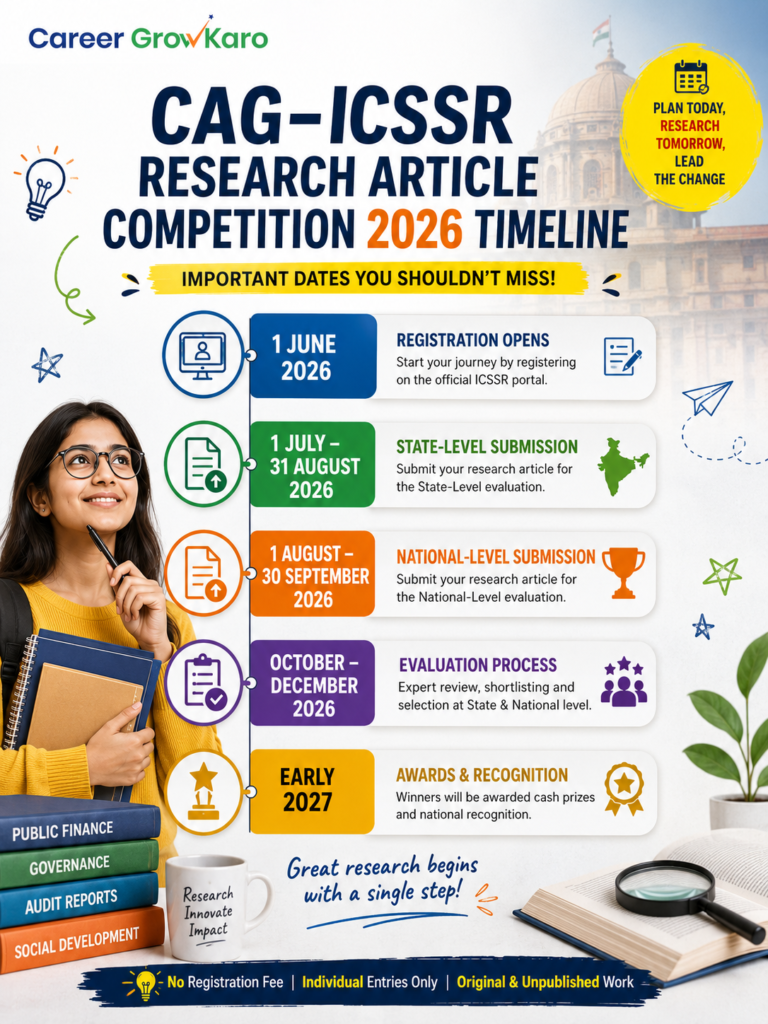
Planning ahead is crucial because a quality research article cannot be prepared in a few days.
Here’s the official schedule announced by the organisers:
| Activity | Timeline |
|---|---|
| Registration Opens | 1 June 2026 |
| State-Level Submission Window | 1 July – 31 August 2026 |
| National-Level Submission Window | 1 August – 30 September 2026 |
Students should avoid waiting until the final week. Reading audit reports, reviewing literature, collecting supporting evidence, and drafting a well-referenced article can easily take several weeks.
Prize Money and Recognition
While the official prize structure may vary across the state and national stages, the organisers have announced awards at multiple levels to recognise outstanding research contributions. Apart from cash prizes, successful participants receive national visibility and recognition from leading public institutions, adding significant value to their academic and professional profiles. Candidates should refer to the latest official guidelines for the detailed prize distribution applicable to their category.
CareerGrowKaro Insight: Why This Competition Could Become a Major Academic Credential
This competition reflects a larger shift in Indian higher education.
Universities, government bodies, and employers are increasingly looking beyond examination scores. They value candidates who can:
- analyse data,
- understand public policy,
- write evidence-based reports,
- propose practical solutions,
- and communicate complex ideas clearly.
Whether you’re preparing for UPSC, applying for a PhD, targeting a public policy programme, or simply aiming to build a stronger academic portfolio, participating in the CAG-ICSSR Research Article Competition offers an opportunity to demonstrate exactly these capabilities.
Unlike many short-term competitions, the research skills you develop here can continue to benefit you throughout your academic and professional journey.
Understanding the Competition Themes: How to Choose a Winning Research Topic
One of the biggest mistakes students make is selecting a topic simply because it sounds interesting. In reality, the quality of your research question often determines the quality of your final article.
The CAG-ICSSR Research Article Competition isn’t looking for opinion pieces or descriptive essays. The organisers expect participants to analyse published CAG audit reports, identify governance issues, evaluate policy implementation, and suggest practical recommendations based on evidence. Research articles must be original, unpublished, and should not disclose the participant’s identity. The official guidelines also state that the use of AI-generated or plagiarised content can lead to disqualification.
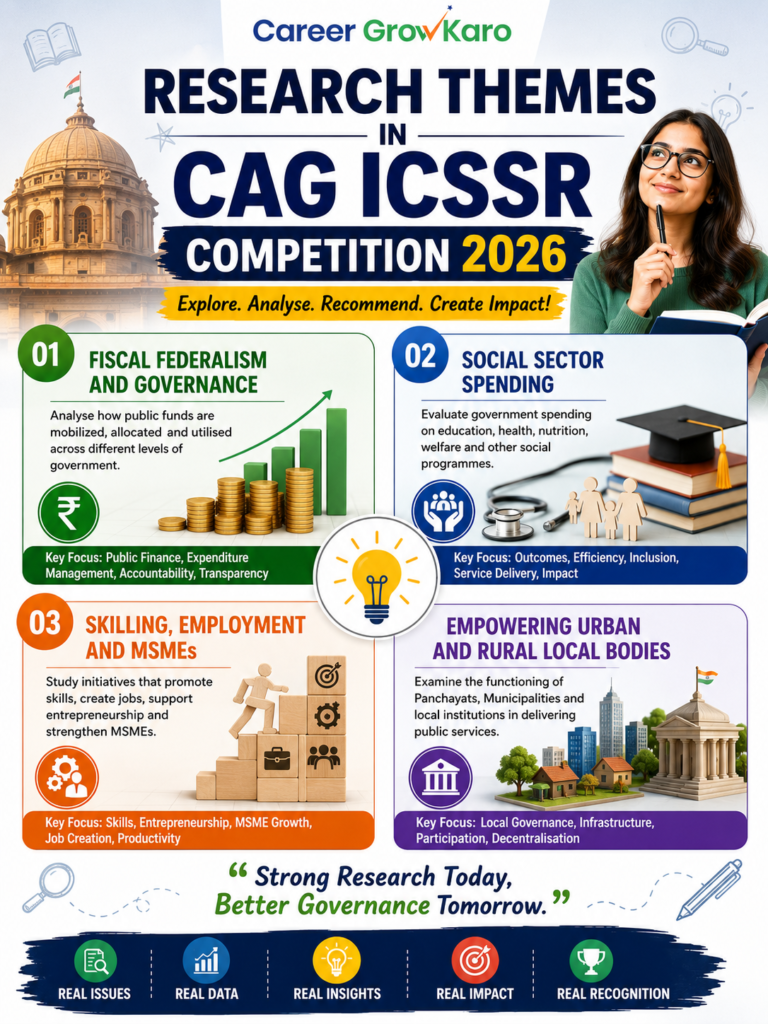
The competition has identified four broad themes, but these are intentionally wide enough to allow students from different academic backgrounds to contribute.
Theme 1: Fiscal Federalism and Governance
What does it mean?
Fiscal federalism refers to the financial relationship between the Union Government, State Governments, and local bodies. It examines how public money is collected, distributed, allocated, and utilised across different levels of government.
This theme goes far beyond budgets. It focuses on whether public funds are being spent efficiently, transparently, and for their intended purpose.
CAG audit reports often identify:
- Delays in project implementation
- Under-utilisation of allocated funds
- Cost overruns
- Weak financial controls
- Procurement irregularities
- Ineffective monitoring systems
These findings provide excellent starting points for evidence-based research.
Students best suited for this theme
- Economics
- Commerce
- Public Administration
- MBA
- Political Science
- Finance
- Chartered Accountancy
- Public Policy
Potential research questions
Instead of asking:
“How does the government spend money?”
Try questions such as:
- Why do centrally sponsored schemes experience delays despite adequate funding?
- How can digital financial monitoring improve utilisation of government grants?
- What do recent CAG audit observations reveal about public procurement practices?
- Can performance audits improve accountability in infrastructure projects?
These questions encourage analysis rather than description.
Theme 2: Social Sector Spending
Why is this theme important?
Governments spend thousands of crores every year on improving citizens’ quality of life through programmes in:
- Education
- Healthcare
- Nutrition
- Women and Child Development
- Drinking Water
- Rural Development
- Social Welfare
- Housing
The real question is not how much money was allocated—but whether these schemes achieved their intended outcomes.
This is exactly where CAG audit reports become valuable. They often examine whether schools, hospitals, welfare schemes, and social programmes delivered measurable benefits or suffered from implementation gaps.
Best suited for
- Sociology
- Social Work
- Public Health
- Education
- Development Studies
- Economics
- Rural Development
Sample research questions
- How effective is public spending on school infrastructure?
- What implementation gaps emerge in health-sector audit reports?
- How can outcome-based budgeting improve welfare programmes?
- What lessons do CAG findings offer for strengthening nutrition schemes?
Notice that each topic requires analysis supported by evidence rather than personal opinion.
Theme 3: Skilling, Employment and MSMEs
This is likely to be one of the most popular themes because it aligns closely with India’s employment and economic priorities.
Why does it matter?
India has one of the world’s youngest populations, but creating productive employment remains a major policy challenge.
Governments invest heavily in:
- Skill development programmes
- Entrepreneurship initiatives
- MSME promotion
- Startup support
- Vocational education
- Employment generation
The competition encourages students to evaluate whether these investments are translating into real economic outcomes using audit evidence.
Students who may find this theme attractive
- MBA
- Commerce
- Economics
- Management
- Engineering
- Entrepreneurship
- Labour Studies
Possible research ideas
- Are government skill-development programmes aligned with industry needs?
- What challenges affect MSME support schemes?
- How can audit findings improve employment-focused public expenditure?
- Can technology improve monitoring of skilling programmes?
Theme 4: Empowering Urban and Rural Local Bodies
This theme examines governance at the grassroots level.
Rather than focusing only on Parliament or State Governments, it explores the functioning of:
- Gram Panchayats
- Municipal Corporations
- Municipal Councils
- Zila Parishads
- Urban Local Bodies
These institutions are responsible for many day-to-day public services such as roads, sanitation, drinking water, waste management, and local infrastructure.
CAG performance audits often highlight issues such as weak planning, delayed execution, poor maintenance, and inadequate financial management within local bodies, making them a rich source for research.
Suitable for
- Political Science
- Rural Development
- Urban Planning
- Geography
- Civil Engineering
- Public Administration
Research ideas
- Improving accountability in Panchayati Raj Institutions
- Smart governance in urban local bodies
- Digital transformation in municipal administration
- Financial management challenges in rural governance
Which Theme Should You Choose?
Many students assume they should select the easiest theme. A better approach is to evaluate three factors together.
| Question | Why it matters |
|---|---|
| Do I genuinely understand the subject? | Familiarity helps you identify stronger research questions. |
| Is sufficient audit evidence available? | Rich source material makes analysis easier. |
| Can I offer a practical recommendation? | Judges are likely to value actionable insights. |
If the answer to all three is “Yes”, you have probably found a promising topic.
How to Read a CAG Audit Report Efficiently
A common concern among first-time participants is that CAG reports are lengthy and technical. The good news is that you do not need to read every page.
Here’s a practical workflow:
Step 1: Read the Executive Summary
This provides a quick overview of the audit findings and highlights the most significant observations.
Step 2: Identify recurring issues
Look for patterns such as:
- Delayed implementation
- Cost escalation
- Idle assets
- Weak monitoring
- Poor record keeping
- Inefficient utilisation of funds
These recurring observations often point towards meaningful research questions.
Step 3: Understand the evidence
Pay attention to:
- Financial figures
- Audit observations
- Departmental responses
- Recommendations
Avoid relying on isolated statistics. Instead, connect the evidence to broader governance or policy issues.
Step 4: Review the recommendations
Many reports already recommend corrective measures. Your role is to evaluate them, build upon them, or suggest additional policy improvements supported by your analysis.
Where Can You Find Audit Reports?
One of the biggest advantages of this competition is that the organisers have already curated relevant audit reports.
Participants can access:
- National-level audit reports
- State-specific audit reports
- Theme-wise report collections
through the official CAG competition pages, making it easier to locate material aligned with the four approved themes.
20 Strong Research Topic Ideas
Instead of choosing generic subjects, consider framing your article around a focused research question.
Fiscal Federalism & Governance
- Improving transparency in public procurement through audit reforms.
- Analysing delays in infrastructure expenditure.
- Fiscal accountability in centrally sponsored schemes.
- Digital governance and financial oversight.
- Performance auditing as a tool for better governance.
Social Sector Spending
- Measuring outcomes of public health expenditure.
- School infrastructure and audit-based policy improvements.
- Strengthening nutrition programmes through better financial monitoring.
- Public spending efficiency in rural development.
- Lessons from CAG audits on social welfare implementation.
Skilling, Employment & MSMEs
- Evaluating skill-development programmes using audit evidence.
- MSME financing and public accountability.
- Employment generation through government-funded initiatives.
- Digital monitoring of skilling programmes.
- Public investment and entrepreneurship ecosystems.
Urban & Rural Local Bodies
- Strengthening Panchayati Raj institutions through financial accountability.
- Municipal governance and infrastructure management.
- Waste management: Lessons from urban audit reports.
- Improving financial planning in local governments.
- Technology-enabled transparency in local governance.
These are starting points. The strongest submissions will narrow the scope further—for example, by focusing on a specific state, programme, or audit report.
CareerGrowKaro Expert Tip: Think Like a Policy Analyst
Many students approach competitions with the mindset of writing an essay. That is not what this competition seeks.
A high-quality research article should answer four simple questions:
- What problem did the audit identify?
- Why did the problem occur?
- What evidence supports this conclusion?
- What practical policy recommendations can address it?
If your article clearly answers these questions with credible evidence and logical analysis, you’ll be much closer to producing a submission that stands out.
How to Write a Winning Research Article for the CAG-ICSSR Competition
Reaching the final stage of this competition requires much more than selecting a good topic. The evaluation process focuses on the quality of research, originality, analytical depth, and the practical value of your recommendations—not just your writing style.
According to the official guidelines, every submission undergoes a blind review by domain experts. Reviewers assess entries on parameters such as policy relevance, originality, methodological rigour, quality of analysis, interpretation of findings, and proper citations. They do not know the identity of the author during evaluation, making the quality of the manuscript the deciding factor.
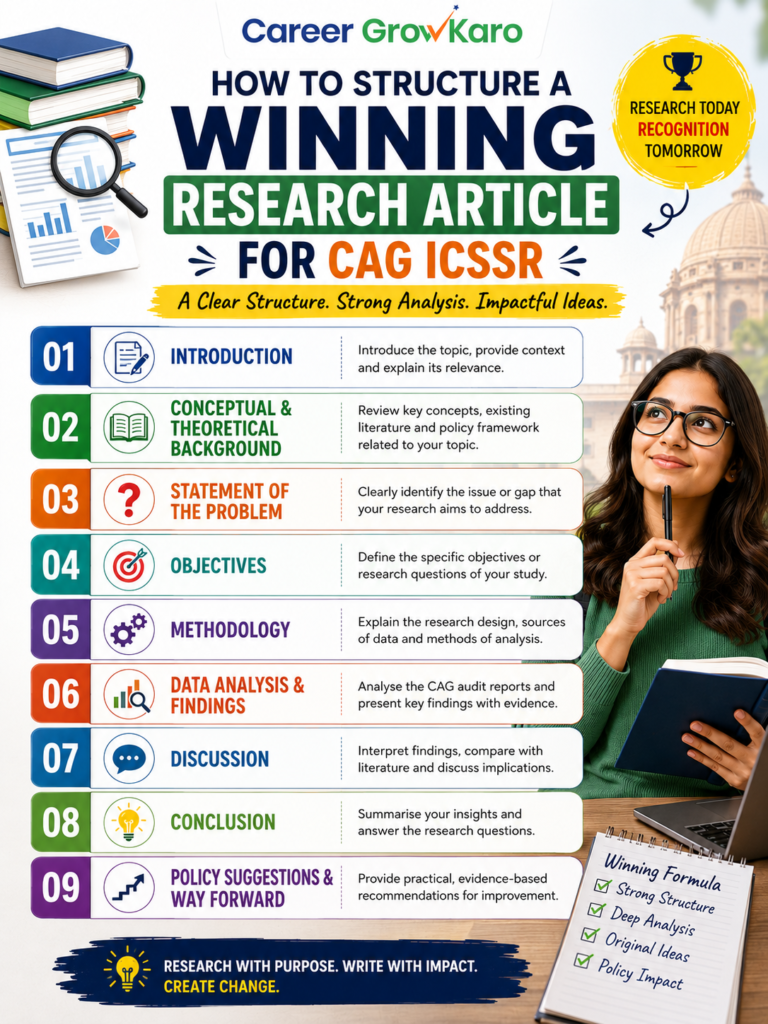
Recommended Structure of Your Research Article
The organisers have prescribed a broad academic structure for submissions. Instead of treating it as a checklist, think of it as a logical flow of ideas.
| Section | Purpose |
|---|---|
| Introduction | Introduce the topic, explain why it matters and provide context. |
| Conceptual & Theoretical Background | Explain the concepts, literature and policy framework. |
| Statement of the Problem | Clearly identify the governance or policy issue you intend to analyse. |
| Objectives | Define what your research aims to examine. |
| Methodology | Explain how you analysed audit reports and supporting data. |
| Data Analysis & Findings | Present evidence from CAG reports and interpret the findings. |
| Discussion | Compare your findings with existing literature or policy objectives. |
| Conclusion | Summarise the key insights. |
| Policy Suggestions & Way Forward | Recommend realistic, evidence-based improvements. |
This structure aligns with the official competition guidelines for both UG/PG and doctoral submissions.
What Makes a Research Article Stand Out?
Many participants will use the same audit reports. What differentiates the winning entries is how they interpret the evidence.
Here are a few ways to add value:
1. Don’t repeat the audit report
The audit report already states what happened.
Instead of copying observations, explain:
- Why did the issue arise?
- What were the administrative or financial implications?
- Could the problem have been prevented?
- What policy reforms would address it?
This transforms a descriptive paper into an analytical one.
2. Support every major argument
Whenever you make a claim, support it using:
- CAG audit observations
- Government reports
- Official statistics
- Peer-reviewed research
- Parliamentary committee reports (where relevant)
Avoid relying heavily on newspaper reports unless they provide verified context.
3. Focus on solutions
Judges are likely to appreciate articles that move beyond criticism.
For every problem you identify, ask:
“What practical, implementable recommendation can improve this system?”
Official Submission Guidelines You Should Not Miss
The competition has laid down several technical requirements. Missing them could affect the eligibility of your submission.
Formatting
- PDF format only
- Times New Roman
- 12-point font
- Double spacing
- Standard margins
- MLA 9th Edition referencing style
Word Limit
- UG & PG: 4,000–5,000 words
- Doctoral scholars: 5,000–6,000 words
Identity
Do not include:
- your name,
- institution,
- department,
- acknowledgements,
- or any identifying information
inside the manuscript. The review is conducted anonymously.
Can You Use AI Tools?
This is one area where students need to be particularly careful.
The official competition instructions clearly state that AI-generated or plagiarised content is liable to disqualification. Research articles must be original and unpublished.
From an academic perspective, AI can be useful for:
- brainstorming ideas,
- improving grammar,
- organising notes,
but it should never replace original thinking, analysis, or writing.
Your interpretation of the audit findings is what the evaluators want to assess.
Common Mistakes That Could Cost You Marks
Even a well-researched article can lose marks because of avoidable errors.
Avoid these mistakes:
❌ Choosing a topic that is too broad
❌ Merely summarising the audit report
❌ Using unsupported opinions
❌ Weak or missing citations
❌ Plagiarism
❌ AI-generated content
❌ Poor formatting
❌ Revealing your identity
❌ Missing the submission deadline
A 30-Day Preparation Plan
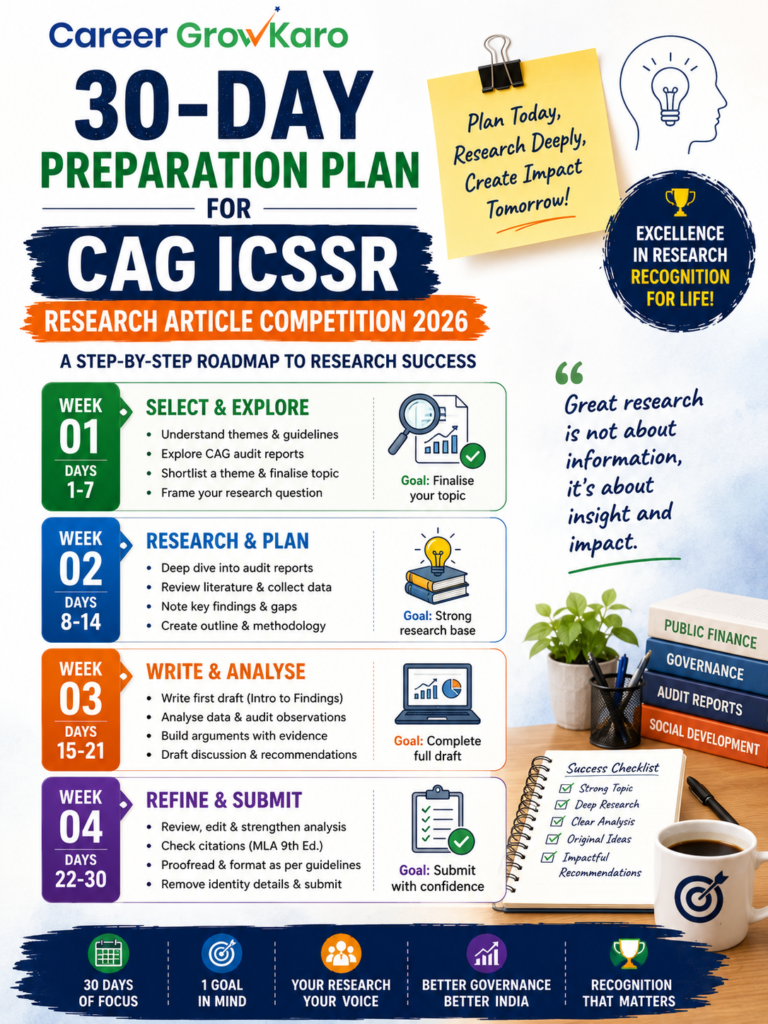
If you haven’t started yet, here’s a practical roadmap.
| Week | Focus Area |
|---|---|
| Week 1 | Select your theme, read 2–3 relevant CAG audit reports, finalise the research question. |
| Week 2 | Review literature, collect supporting government data, prepare the outline and methodology. |
| Week 3 | Draft the article, analyse findings, write conclusions and policy recommendations. |
| Week 4 | Edit, proofread, verify citations, check formatting, remove identifying details and submit before the deadline. |
Starting early gives you enough time to refine your arguments rather than rushing through the writing process.
Frequently Asked Questions (FAQs)
Is there an application fee?
No. As per the official information shared by participating CAG offices, there is no entry fee for the competition.
Can engineering or management students participate?
Yes, provided they are full-time UG, PG or doctoral students enrolled in recognised institutions and their research aligns with one of the approved themes.
Can two students submit a joint paper?
No. Only individual entries are permitted, and each participant can submit one research article.
Can I submit the same paper to another competition?
The article must be original and unpublished. Review the official terms carefully before submitting the same work elsewhere.
Which language can I use?
State-level submissions are accepted in English and the scheduled Indian languages specified by the organisers, while the National Level accepts entries in English and Hindi.
CareerGrowKaro’s Final Take
The CAG-ICSSR Research Article Competition is not just another academic contest—it is an opportunity to engage with real public policy challenges using authentic government data.
Whether your ambition is to pursue higher studies, prepare for the UPSC Civil Services Examination, work in public policy, join a think tank, or simply strengthen your academic profile, the skills developed through this competition—critical thinking, evidence-based analysis, research writing, and policy evaluation—will continue to benefit you long after the competition ends.
Rather than chasing a “winning topic,” focus on asking a meaningful research question, interpreting audit evidence objectively, and offering practical recommendations that can improve governance. Those qualities are far more likely to impress the evaluation committee than a lengthy but descriptive article.
Related resources
PM Internship Scheme 2026: Stipend, Eligibility, Apply
KPMG India Internship 2026: Best Step-by-Step Guide for Freshers
What is FAANG? Proven 2026 Roadmap to FAANG Jobs, Internships & Success